The CPI data will be released tonight; could the data itself be inaccurate? What will the market do?
2025-12-18 17:17:52
Thursday, December 18th. Entering the year-end trading session, the US dollar index is caught in a tug-of-war between two main themes: "data credibility" and "central bank policy pace." On one hand, the market awaits the latest inflation clues to calibrate its understanding of the Federal Reserve's path; on the other hand, policy decisions from the European Central Bank and the Bank of England will also create disturbances in interest rate differential expectations and risk appetite.

The US dollar index is currently trading around 98.40 during the European session, having fallen from above 100 to below 99. The market is more concerned about which type of information the dollar's pricing will rely on if there are gaps or noise in the key data, and how the volatility will be transmitted to major currencies.
Today's focus is on the November Consumer Price Index (CPI) to be released by the U.S. Bureau of Labor Statistics at 9:30 PM. Unlike regular releases, this inflation report is affected by data collection limitations during the government shutdown: October data is incomplete, and November may lack complete month-on-month details, even focusing more on "price levels." This structure, "only results, insufficient details," will make the market rely more on year-on-year indicators for interpretation, but will also weaken the grasp of inflation momentum. The market generally expects November's overall inflation to be around 3.1% year-on-year, and core inflation (excluding food and energy) to be around 3.0% year-on-year; some believe overall inflation may be slightly higher, reaching 3.2%, mainly driven by energy prices, while core inflation will remain roughly flat. If the year-on-year reading is significantly higher than expected, it may reinforce the interpretation of "the Fed remaining on hold for longer," providing immediate support for the dollar; conversely, if the reading is significantly weaker, it may fuel discussions of "earlier rate cuts," putting downward pressure on the dollar. However, it should be emphasized that in the absence of a complete monthly breakdown and insufficient sample coverage, even if the market is sensitive to the numbers, it is more likely to exhibit a "first shock, then reassessment" pattern, and its sustainability often depends on whether a more consistent chain of evidence can be obtained subsequently.
In terms of inflation structure, two forces at the end of the year deserve to be understood within the same framework: firstly, the upward pressure on core commodity prices due to cost factors such as tariffs; and secondly, the downward pressure on prices of some categories due to seasonal promotional discounts. With both factors combined, even if the year-on-year figures appear to rebound, it doesn't necessarily mean that inflation is accelerating again; conversely, a year-on-year decline doesn't necessarily indicate weakening demand, but rather that statistical presentation is more easily "masked" by short-term factors. On the employment side, recent official employment reports show that non-farm payrolls decreased by 105,000 in October and increased by 64,000 in November, with the unemployment rate rising from 4.4% in September to 4.6%. The volatility and structural noise in the employment data itself have reduced market confidence in "single-month changes," further amplifying the weight of inflation data in pricing. Regarding interest rate expectations, derivative pricing indicates an implied probability of a 25 basis point rate cut at the January meeting approaching 20%, while the market is pricing in the next more explicit easing action more towards the middle of next year or later. This curve pattern, characterized by "more sensitivity at the far end and more caution at the near end," suggests that the trading logic for the US dollar is more about waiting for more reliable trend confirmation rather than being completely rewritten by a single incomplete data set.
During the European session, the decisions of the Bank of England and the European Central Bank are another channel influencing the US dollar. If the Bank of England cuts interest rates while the ECB keeps rates unchanged, interest rate differential expectations within Europe will diverge: the pound may be more influenced by the repricing of its own policy orientation and economic outlook, while the euro will rely more on the support for short- to medium-term interest rates from a "wait-and-see" approach. In other words, today's structure is more like "multiple events in parallel," and the direction of the US dollar often comes from the combined forces rather than a single point.
The US dollar index is currently trading around 98.40, and on the daily chart, it is clearly below 99. The area around 99 is more of a memorable watershed for the market: when prices are above this level, pullbacks are more easily seen as consolidation; however, after breaking below it, the 99 area often becomes a potential resistance zone, and if a rebound is blocked here, the market is more likely to interpret it as a trend continuation rather than a simple correction. Graphically, the previous high was around 100.3900, followed by a relatively continuous decline, reaching a low of around 97.8679.
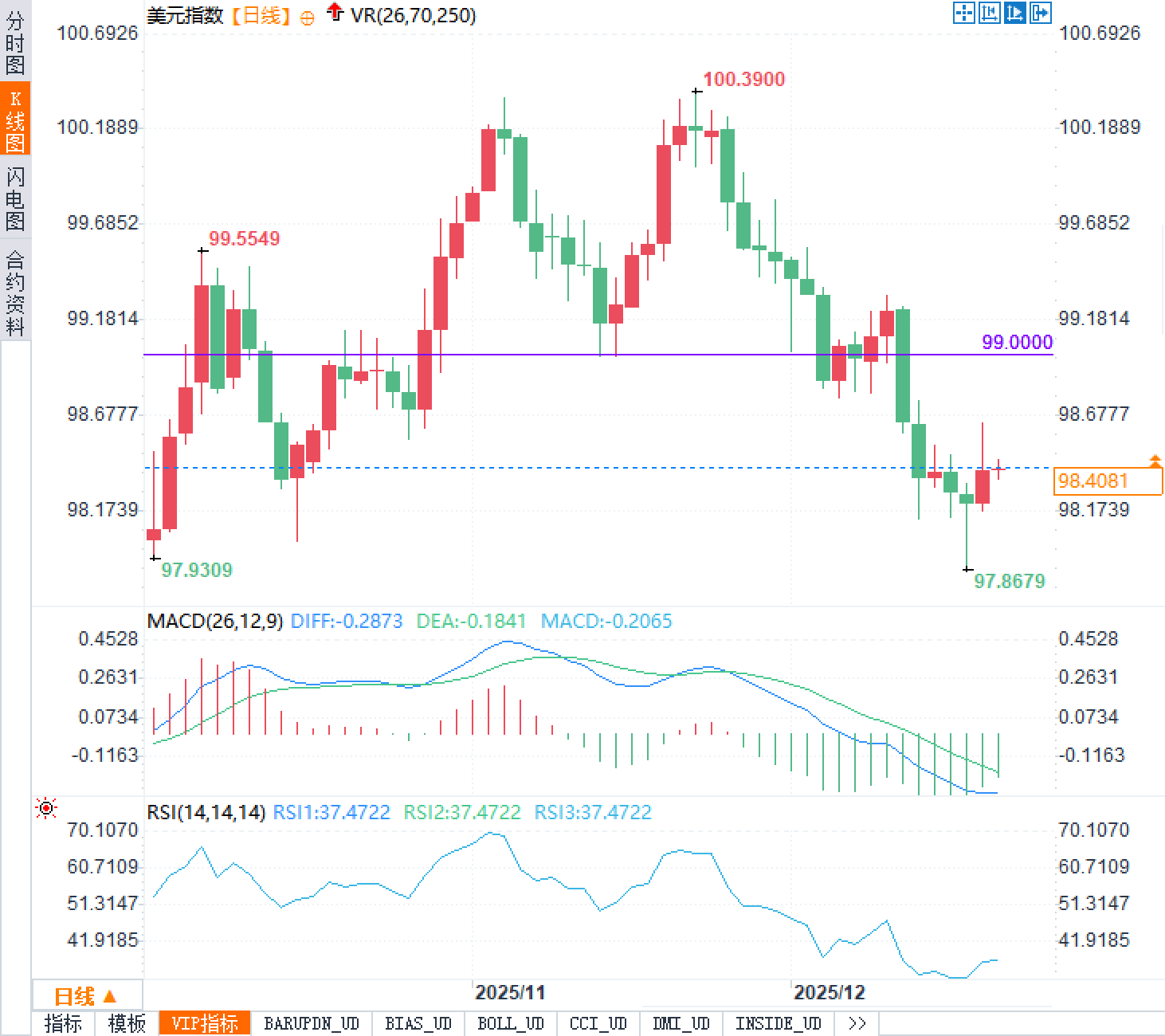
In terms of momentum indicators, the MACD is below the zero line and the histogram is negative, reflecting that the medium-term downward momentum remains. The Relative Strength Index (RSI) is around 37.4722, in the weak range but without extreme imbalance. This usually means that although selling pressure is dominant, technical corrective fluctuations may still occur due to event-driven factors. Overall, the US dollar index is currently more like a "rebalancing within a downtrend": bearish momentum dominates the pace, but key events may amplify short-term two-way fluctuations, especially against the backdrop of questionable data quality. Traders are more likely to choose quick profit-taking and re-entry rather than firmly betting on one side.
Traders will continue to focus on two types of information to see if they can improve the signal-to-noise ratio: first, more complete details on inflation and consumption to verify whether year-end price changes are more driven by energy and seasonal factors or by a broader rise in core components; second, statements from Federal Reserve officials on how to handle the "data gap," particularly regarding the persistence of inflation, the degree of easing in employment, and the policy response function. If data continuity recovers and core inflation remains resilient, the market's pricing in "interest rates remaining high for longer" may be more stable, and downward pressure on the dollar index may ease. If subsequent evidence shows that price pressures continue to ease and growth momentum slows more clearly, the dollar index may continue to operate within a weak framework. In either scenario, today's key data with "incomplete information" is more like a stress test: testing the market's dependence on the dollar narrative and the tolerance of risk assets and major currency pairs for changes in interest rate paths.
In summary, the US dollar index around 98.40 represents a typical pattern after the macroeconomic narrative has entered a reassessment phase: the trend remains, but so do the disagreements. Inflation data remains the dominant variable, but data quality issues make it more difficult for the market to reach a consensus on medium-term pricing; the UK and EU policy decisions provide clues about interest rate differentials, but may not be enough to drive the dollar out of a clear unilateral trend.
The US dollar index is currently trading around 98.40 during the European session, having fallen from above 100 to below 99. The market is more concerned about which type of information the dollar's pricing will rely on if there are gaps or noise in the key data, and how the volatility will be transmitted to major currencies.
Today's focus is on the November Consumer Price Index (CPI) to be released by the U.S. Bureau of Labor Statistics at 9:30 PM. Unlike regular releases, this inflation report is affected by data collection limitations during the government shutdown: October data is incomplete, and November may lack complete month-on-month details, even focusing more on "price levels." This structure, "only results, insufficient details," will make the market rely more on year-on-year indicators for interpretation, but will also weaken the grasp of inflation momentum. The market generally expects November's overall inflation to be around 3.1% year-on-year, and core inflation (excluding food and energy) to be around 3.0% year-on-year; some believe overall inflation may be slightly higher, reaching 3.2%, mainly driven by energy prices, while core inflation will remain roughly flat. If the year-on-year reading is significantly higher than expected, it may reinforce the interpretation of "the Fed remaining on hold for longer," providing immediate support for the dollar; conversely, if the reading is significantly weaker, it may fuel discussions of "earlier rate cuts," putting downward pressure on the dollar. However, it should be emphasized that in the absence of a complete monthly breakdown and insufficient sample coverage, even if the market is sensitive to the numbers, it is more likely to exhibit a "first shock, then reassessment" pattern, and its sustainability often depends on whether a more consistent chain of evidence can be obtained subsequently.
In terms of inflation structure, two forces at the end of the year deserve to be understood within the same framework: firstly, the upward pressure on core commodity prices due to cost factors such as tariffs; and secondly, the downward pressure on prices of some categories due to seasonal promotional discounts. With both factors combined, even if the year-on-year figures appear to rebound, it doesn't necessarily mean that inflation is accelerating again; conversely, a year-on-year decline doesn't necessarily indicate weakening demand, but rather that statistical presentation is more easily "masked" by short-term factors. On the employment side, recent official employment reports show that non-farm payrolls decreased by 105,000 in October and increased by 64,000 in November, with the unemployment rate rising from 4.4% in September to 4.6%. The volatility and structural noise in the employment data itself have reduced market confidence in "single-month changes," further amplifying the weight of inflation data in pricing. Regarding interest rate expectations, derivative pricing indicates an implied probability of a 25 basis point rate cut at the January meeting approaching 20%, while the market is pricing in the next more explicit easing action more towards the middle of next year or later. This curve pattern, characterized by "more sensitivity at the far end and more caution at the near end," suggests that the trading logic for the US dollar is more about waiting for more reliable trend confirmation rather than being completely rewritten by a single incomplete data set.
During the European session, the decisions of the Bank of England and the European Central Bank are another channel influencing the US dollar. If the Bank of England cuts interest rates while the ECB keeps rates unchanged, interest rate differential expectations within Europe will diverge: the pound may be more influenced by the repricing of its own policy orientation and economic outlook, while the euro will rely more on the support for short- to medium-term interest rates from a "wait-and-see" approach. In other words, today's structure is more like "multiple events in parallel," and the direction of the US dollar often comes from the combined forces rather than a single point.
Market performance
The US dollar index is currently trading around 98.40, and on the daily chart, it is clearly below 99. The area around 99 is more of a memorable watershed for the market: when prices are above this level, pullbacks are more easily seen as consolidation; however, after breaking below it, the 99 area often becomes a potential resistance zone, and if a rebound is blocked here, the market is more likely to interpret it as a trend continuation rather than a simple correction. Graphically, the previous high was around 100.3900, followed by a relatively continuous decline, reaching a low of around 97.8679.
In terms of momentum indicators, the MACD is below the zero line and the histogram is negative, reflecting that the medium-term downward momentum remains. The Relative Strength Index (RSI) is around 37.4722, in the weak range but without extreme imbalance. This usually means that although selling pressure is dominant, technical corrective fluctuations may still occur due to event-driven factors. Overall, the US dollar index is currently more like a "rebalancing within a downtrend": bearish momentum dominates the pace, but key events may amplify short-term two-way fluctuations, especially against the backdrop of questionable data quality. Traders are more likely to choose quick profit-taking and re-entry rather than firmly betting on one side.
Market Outlook
Traders will continue to focus on two types of information to see if they can improve the signal-to-noise ratio: first, more complete details on inflation and consumption to verify whether year-end price changes are more driven by energy and seasonal factors or by a broader rise in core components; second, statements from Federal Reserve officials on how to handle the "data gap," particularly regarding the persistence of inflation, the degree of easing in employment, and the policy response function. If data continuity recovers and core inflation remains resilient, the market's pricing in "interest rates remaining high for longer" may be more stable, and downward pressure on the dollar index may ease. If subsequent evidence shows that price pressures continue to ease and growth momentum slows more clearly, the dollar index may continue to operate within a weak framework. In either scenario, today's key data with "incomplete information" is more like a stress test: testing the market's dependence on the dollar narrative and the tolerance of risk assets and major currency pairs for changes in interest rate paths.
In summary, the US dollar index around 98.40 represents a typical pattern after the macroeconomic narrative has entered a reassessment phase: the trend remains, but so do the disagreements. Inflation data remains the dominant variable, but data quality issues make it more difficult for the market to reach a consensus on medium-term pricing; the UK and EU policy decisions provide clues about interest rate differentials, but may not be enough to drive the dollar out of a clear unilateral trend.
- Risk Warning and Disclaimer
- The market involves risk, and trading may not be suitable for all investors. This article is for reference only and does not constitute personal investment advice, nor does it take into account certain users’ specific investment objectives, financial situation, or other needs. Any investment decisions made based on this information are at your own risk.