Who will determine the fate of the US dollar? Four key storms reveal the mysteries.
2025-12-18 17:00:38
The implementation of the Big Beauty Act (OBBB), the continued uncertainty of tariff policies, the weak labor market, and the vacillation of the Federal Reserve's interest rate path together constitute the underlying logic of the dollar index fluctuations.
Amid the dual impacts of evolving global economic landscape and policy adjustments, understanding how these factors influence the US dollar index is crucial for market participants to seize exchange rate opportunities.
This article will delve into four core issues to analyze the driving mechanisms and future trends of the US dollar index fluctuations.
Historically, government shutdowns have had a relatively limited impact on the macroeconomy. In the past, shutdowns have lasted an average of 20 to 25 days, with a weekly GDP drag of about 0.1%. In the early stages of a shutdown, market risk aversion usually drives the US dollar index to strengthen temporarily.
It is worth noting that although Congress passed a temporary solution to avert the most recent shutdown crisis, the government reopening agreement will expire at the end of January. If no consensus is reached on the budget, the United States will face the risk of another shutdown.
The federal government’s huge budget deficit and increasing reliance on tariff revenue have made fiscal fundamentals a focus of market concern.
While short-term shutdowns only cause inconvenience in terms of liquidity and do not yet constitute systemic risk, the expectation of repeated shutdowns will weaken the attractiveness of the US dollar as a safe-haven asset, becoming a potential factor suppressing its long-term trend.
The tax policy debate triggered by the "Big Beauty Act" is influencing the US dollar index through both economic expectations and fiscal fundamentals.
The short-term stimulus measures in the bill aim to quickly inject liquidity and stimulate consumption and investment demand. If they can effectively boost economic growth, they may enhance the attractiveness of the dollar. However, the bill also leads to an increase in federal debt and fiscal deficit levels, which has become a key factor in suppressing the dollar. In the first half of 2025, the dollar index fell by 10.8%, marking its worst performance since 1973. The expectation of the bill's passage was one of the important driving forces behind this.
Looking at the policy details, the 100% accelerated depreciation policy releases a large amount of cash flow to enterprises. If the funds are guided to invest in capacity expansion, it will support the US dollar in the long run through improved economic efficiency. Although tax incentives for consumers can increase disposable income, rising medical costs may offset the stimulus effect, making it difficult to form a sustainable economic growth momentum and limiting its boosting effect on the US dollar.
The balancing act faced by policymakers is directly reflected in the dollar's trajectory: insufficient coordination between short-term stimulus and long-term reforms will cause the dollar index to fluctuate within a range.
The current state of the labor market profoundly influences the US dollar index through expectations of Federal Reserve policy.
Adjustments to immigration policies and increased enforcement have led to some groups leaving the labor market. Coupled with the uncertainty caused by the tariff announcement in April, companies have generally entered a wait-and-see period in their hiring decisions, directly dragging down employment data.
Weak hiring data has dampened expectations of a Federal Reserve rate hike, becoming a major reason for the recent pressure on the dollar index. The dollar index is highly correlated with the spread of US Treasury yields, and expectations of rate cuts triggered by weak employment will narrow the spread between US Treasury yields and other countries' bonds, suppressing the demand for the dollar.
Interest rate policy is the most direct driver of the US dollar index, and its transmission logic is rooted in the structural changes of the yield curve.
In a normal market environment, the yield curve slopes upward. The Federal Reserve controls the short end by setting the overnight rate, and the current federal funds rate is maintained in the range of 3.50% to 3.75%, which directly affects short-term financing costs. The yields of 10-year and 30-year US Treasury bonds are priced by the market, reflecting inflation and economic outlook expectations.
The Federal Reserve has a long-standing habit of relying on data and using it to calculate the neutral interest rate. Currently, the federal funds rate is already very close to the calculated neutral interest rate, which means that further rate cuts represent an increase in long-term inflation risk and could easily raise long-term interest rates. This would ultimately put pressure on the dollar and put pressure on long-term stocks such as technology stocks, while gold may benefit from the decline in real interest rates due to inflation.
The US dollar index is closely linked to the US Treasury yield spread, and expectations of a short-term interest rate cut have become the core force suppressing the dollar.
In the short term, the risk of government shutdown and expectations of interest rate cuts fueled by weak employment data will continue to put pressure on the US dollar; while in the medium to long term, the fiscal path and debt expansion represented by the Great Beauty Act constitute a more fundamental constraint.
Meanwhile, as the Federal Reserve's interest rate cut approaches the neutral rate, the US dollar may rebound as a result.
Traders need to pay attention to the pace of the Federal Reserve's interest rate decisions under "data dependence" and examine the substantive balance between US fiscal discipline and trade policy.
From a technical perspective, the US dollar index rebounded from the 5-day moving average to the 50% retracement level of the trading range. The support level is the 5-day moving average and the bottom of the trading range at 98.10. The resistance levels are 98.63 and 98.91.
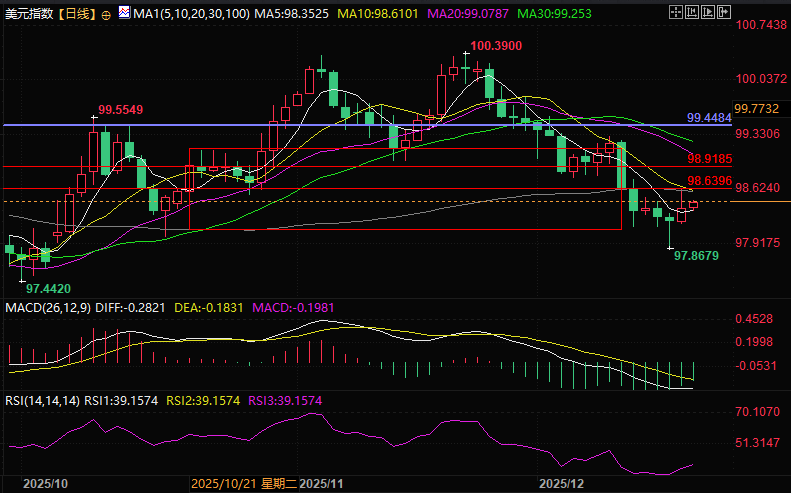
(US Dollar Index Daily Chart, Source: FX678)
At 16:58 Beijing time, the US dollar index is currently at 98.47.
Amid the dual impacts of evolving global economic landscape and policy adjustments, understanding how these factors influence the US dollar index is crucial for market participants to seize exchange rate opportunities.
This article will delve into four core issues to analyze the driving mechanisms and future trends of the US dollar index fluctuations.
The government shutdown may have a sequel, suppressing the US economy.
Historically, government shutdowns have had a relatively limited impact on the macroeconomy. In the past, shutdowns have lasted an average of 20 to 25 days, with a weekly GDP drag of about 0.1%. In the early stages of a shutdown, market risk aversion usually drives the US dollar index to strengthen temporarily.
It is worth noting that although Congress passed a temporary solution to avert the most recent shutdown crisis, the government reopening agreement will expire at the end of January. If no consensus is reached on the budget, the United States will face the risk of another shutdown.
The federal government’s huge budget deficit and increasing reliance on tariff revenue have made fiscal fundamentals a focus of market concern.
While short-term shutdowns only cause inconvenience in terms of liquidity and do not yet constitute systemic risk, the expectation of repeated shutdowns will weaken the attractiveness of the US dollar as a safe-haven asset, becoming a potential factor suppressing its long-term trend.
Tax Policy: The Dollar's Long-Short Game Between Short-Term Stimulus and Long-Term Debt
The tax policy debate triggered by the "Big Beauty Act" is influencing the US dollar index through both economic expectations and fiscal fundamentals.
The short-term stimulus measures in the bill aim to quickly inject liquidity and stimulate consumption and investment demand. If they can effectively boost economic growth, they may enhance the attractiveness of the dollar. However, the bill also leads to an increase in federal debt and fiscal deficit levels, which has become a key factor in suppressing the dollar. In the first half of 2025, the dollar index fell by 10.8%, marking its worst performance since 1973. The expectation of the bill's passage was one of the important driving forces behind this.
Looking at the policy details, the 100% accelerated depreciation policy releases a large amount of cash flow to enterprises. If the funds are guided to invest in capacity expansion, it will support the US dollar in the long run through improved economic efficiency. Although tax incentives for consumers can increase disposable income, rising medical costs may offset the stimulus effect, making it difficult to form a sustainable economic growth momentum and limiting its boosting effect on the US dollar.
The balancing act faced by policymakers is directly reflected in the dollar's trajectory: insufficient coordination between short-term stimulus and long-term reforms will cause the dollar index to fluctuate within a range.
Labor Market: Structural Divergence and its Impact on the US Dollar Index
The current state of the labor market profoundly influences the US dollar index through expectations of Federal Reserve policy.
Adjustments to immigration policies and increased enforcement have led to some groups leaving the labor market. Coupled with the uncertainty caused by the tariff announcement in April, companies have generally entered a wait-and-see period in their hiring decisions, directly dragging down employment data.
Weak hiring data has dampened expectations of a Federal Reserve rate hike, becoming a major reason for the recent pressure on the dollar index. The dollar index is highly correlated with the spread of US Treasury yields, and expectations of rate cuts triggered by weak employment will narrow the spread between US Treasury yields and other countries' bonds, suppressing the demand for the dollar.
Interest Rate Policy: Interest Rate Spread Game Dominates the Core Trend of the US Dollar Index
Interest rate policy is the most direct driver of the US dollar index, and its transmission logic is rooted in the structural changes of the yield curve.
In a normal market environment, the yield curve slopes upward. The Federal Reserve controls the short end by setting the overnight rate, and the current federal funds rate is maintained in the range of 3.50% to 3.75%, which directly affects short-term financing costs. The yields of 10-year and 30-year US Treasury bonds are priced by the market, reflecting inflation and economic outlook expectations.
The Federal Reserve has a long-standing habit of relying on data and using it to calculate the neutral interest rate. Currently, the federal funds rate is already very close to the calculated neutral interest rate, which means that further rate cuts represent an increase in long-term inflation risk and could easily raise long-term interest rates. This would ultimately put pressure on the dollar and put pressure on long-term stocks such as technology stocks, while gold may benefit from the decline in real interest rates due to inflation.
The US dollar index is closely linked to the US Treasury yield spread, and expectations of a short-term interest rate cut have become the core force suppressing the dollar.
Summary and Technical Analysis:
In the short term, the risk of government shutdown and expectations of interest rate cuts fueled by weak employment data will continue to put pressure on the US dollar; while in the medium to long term, the fiscal path and debt expansion represented by the Great Beauty Act constitute a more fundamental constraint.
Meanwhile, as the Federal Reserve's interest rate cut approaches the neutral rate, the US dollar may rebound as a result.
Traders need to pay attention to the pace of the Federal Reserve's interest rate decisions under "data dependence" and examine the substantive balance between US fiscal discipline and trade policy.
From a technical perspective, the US dollar index rebounded from the 5-day moving average to the 50% retracement level of the trading range. The support level is the 5-day moving average and the bottom of the trading range at 98.10. The resistance levels are 98.63 and 98.91.
(US Dollar Index Daily Chart, Source: FX678)
At 16:58 Beijing time, the US dollar index is currently at 98.47.
- Risk Warning and Disclaimer
- The market involves risk, and trading may not be suitable for all investors. This article is for reference only and does not constitute personal investment advice, nor does it take into account certain users’ specific investment objectives, financial situation, or other needs. Any investment decisions made based on this information are at your own risk.