The US dollar index fluctuated at low levels, awaiting guidance from US employment and ISM data.
2026-01-07 14:14:04
The US dollar index has maintained a generally weak trend recently, and after a brief rebound, it has fallen into a sideways consolidation again, indicating that the market is cautious ahead of the release of key economic data.
Traders are currently opting to reduce their positions and await new fundamental signals to confirm whether the Federal Reserve will initiate a clearer easing path this year.
From a macro perspective, the US December ADP employment change data and ISM services purchasing managers' index (PMI), to be released on Wednesday, are considered important leading indicators, while Friday's non-farm payroll report may become the core trigger for short-term market volatility.

The market generally expects that the number of new jobs in December will slow to 55,000, lower than the previous value of 64,000. If the data continues to signal a cooling of employment, it may reinforce the market's judgment that economic momentum is slowing down.
Despite the continued complexity of the international situation, the US actions on Venezuela and multilateral tensions have not significantly boosted risk aversion. The US dollar's appeal as a traditional safe-haven asset remains limited, reflecting the market's current focus on the US domestic economic fundamentals and monetary policy outlook.
In addition, internal disagreements within the Federal Reserve regarding the interest rate path, as well as uncertainty surrounding the selection of the next Federal Reserve Chairman, have also weakened the directional momentum of the US dollar to some extent.
From a policy perspective, the CME Group's FedWatch tool shows that the probability of the Federal Reserve keeping interest rates unchanged at its January 27-28 meeting remains high, and the market has not yet fully bet on a rapid rate cut in the short term.
This state of "high probability of remaining inactive and low certainty of subsequent path" makes the US dollar index more susceptible to the impact of a single economic data point, rather than forming a trend.
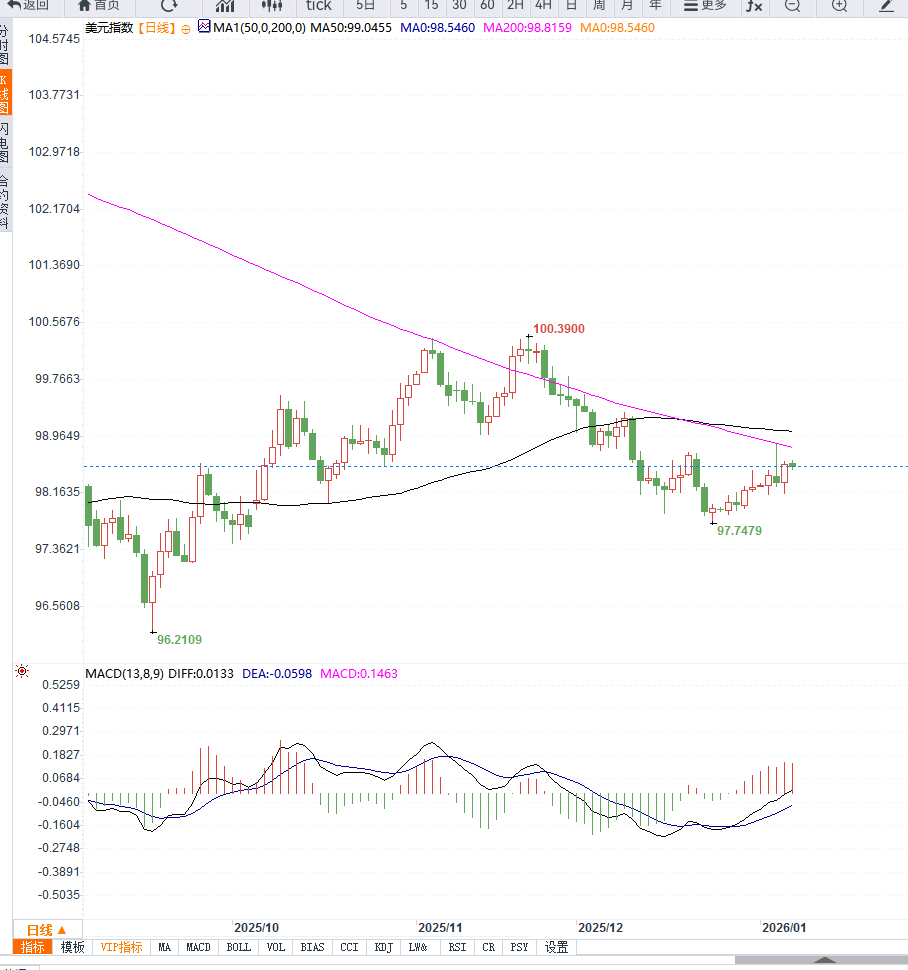
Looking at the daily chart of the US Dollar Index (DXY), it is currently trading below several short- and medium-term moving averages, indicating a bearish overall structure. On the daily chart, the index failed to recover effectively after breaking below the 100 level, and the rebound highs have been gradually shifting downwards, suggesting significant selling pressure above.
On the 14th, the Relative Strength Index (RSI) hovered in the neutral to weak zone, and no obvious oversold signal has appeared yet, indicating that although the downward momentum has slowed down, the conditions for a reversal are not yet mature.
Meanwhile, the MACD indicator remains below the zero line, with the fast and slow lines maintaining a weak structure, suggesting that the US dollar index will likely continue to fluctuate with a slight downward bias in the short term. A break below the 98.00 support level could open up further downside potential; conversely, if economic data unexpectedly improves, the index needs to regain a foothold above 99.00 to improve its overall technical pattern.
In summary, ahead of the release of key economic data, the US dollar index lacks clear drivers and is more likely to maintain range-bound trading in the short term. The performance of employment and services data will directly influence market perceptions of the Federal Reserve's policy pace and become a key variable determining the dollar's next move.
Editor's Note:
The core issue for the US dollar index at present is not geopolitical risk, but whether there are signs of a substantial slowdown in the US economy. Before the policy outlook becomes clearer, the dollar is more likely to digest uncertainty through fluctuations.
If subsequent data continues to weaken, the medium-term downward pressure on the US dollar may gradually emerge; conversely, if the resilience of employment and the service sector remains, the potential for a phased rebound in the US dollar should not be ignored, but its extent may be limited by the technical resistance zone formed by the previous breakdown.
Traders are currently opting to reduce their positions and await new fundamental signals to confirm whether the Federal Reserve will initiate a clearer easing path this year.
From a macro perspective, the US December ADP employment change data and ISM services purchasing managers' index (PMI), to be released on Wednesday, are considered important leading indicators, while Friday's non-farm payroll report may become the core trigger for short-term market volatility.
The market generally expects that the number of new jobs in December will slow to 55,000, lower than the previous value of 64,000. If the data continues to signal a cooling of employment, it may reinforce the market's judgment that economic momentum is slowing down.
Despite the continued complexity of the international situation, the US actions on Venezuela and multilateral tensions have not significantly boosted risk aversion. The US dollar's appeal as a traditional safe-haven asset remains limited, reflecting the market's current focus on the US domestic economic fundamentals and monetary policy outlook.
In addition, internal disagreements within the Federal Reserve regarding the interest rate path, as well as uncertainty surrounding the selection of the next Federal Reserve Chairman, have also weakened the directional momentum of the US dollar to some extent.
From a policy perspective, the CME Group's FedWatch tool shows that the probability of the Federal Reserve keeping interest rates unchanged at its January 27-28 meeting remains high, and the market has not yet fully bet on a rapid rate cut in the short term.
This state of "high probability of remaining inactive and low certainty of subsequent path" makes the US dollar index more susceptible to the impact of a single economic data point, rather than forming a trend.
Looking at the daily chart of the US Dollar Index (DXY), it is currently trading below several short- and medium-term moving averages, indicating a bearish overall structure. On the daily chart, the index failed to recover effectively after breaking below the 100 level, and the rebound highs have been gradually shifting downwards, suggesting significant selling pressure above.
On the 14th, the Relative Strength Index (RSI) hovered in the neutral to weak zone, and no obvious oversold signal has appeared yet, indicating that although the downward momentum has slowed down, the conditions for a reversal are not yet mature.
Meanwhile, the MACD indicator remains below the zero line, with the fast and slow lines maintaining a weak structure, suggesting that the US dollar index will likely continue to fluctuate with a slight downward bias in the short term. A break below the 98.00 support level could open up further downside potential; conversely, if economic data unexpectedly improves, the index needs to regain a foothold above 99.00 to improve its overall technical pattern.
In summary, ahead of the release of key economic data, the US dollar index lacks clear drivers and is more likely to maintain range-bound trading in the short term. The performance of employment and services data will directly influence market perceptions of the Federal Reserve's policy pace and become a key variable determining the dollar's next move.
Editor's Note:
The core issue for the US dollar index at present is not geopolitical risk, but whether there are signs of a substantial slowdown in the US economy. Before the policy outlook becomes clearer, the dollar is more likely to digest uncertainty through fluctuations.
If subsequent data continues to weaken, the medium-term downward pressure on the US dollar may gradually emerge; conversely, if the resilience of employment and the service sector remains, the potential for a phased rebound in the US dollar should not be ignored, but its extent may be limited by the technical resistance zone formed by the previous breakdown.
- Risk Warning and Disclaimer
- The market involves risk, and trading may not be suitable for all investors. This article is for reference only and does not constitute personal investment advice, nor does it take into account certain users’ specific investment objectives, financial situation, or other needs. Any investment decisions made based on this information are at your own risk.