Japan's data storm follows closely on non-farm payroll night! Behind the false prosperity of USD/JPY, negative factors are brewing.
2026-01-09 11:09:26
Data released on Friday (January 9) showed that Japanese household spending surged in November 2025, sparking speculation that the Bank of Japan might raise interest rates and drawing close attention to the USD/JPY exchange rate.
Household spending data contrasted sharply with November wage growth data, the latter suggesting a potential year-end slowdown in consumption, putting downward pressure on the yen. During Friday's Asian session, the USD/JPY pair fluctuated upwards, extending gains from the previous three trading days, with a daily increase of approximately 0.22%, currently trading around 157.20.
The sharp rise in household spending had a limited impact on the 10-year Japanese government bond yield, highlighting the importance of weak wage data. Nevertheless, given the prospect of future rate cuts by the Federal Reserve and eventual rate hikes by the Bank of Japan, the outlook for the USD/JPY pair remains bearish.

Japanese household spending rose 6.2% month-on-month in November, rebounding from a 3.5% decline in October. Year-on-year, household spending increased by 2.9%, compared to a 2.9% decrease in October.
November's spending data will provide stronger evidence for hawks at the Bank of Japan to push for a higher neutral interest rate and interest rate hikes. Strong consumer spending will drive demand-driven inflation, supporting a tighter monetary policy stance. Furthermore, private consumption accounts for approximately 55% of Japan's GDP growth.
Given the Bank of Japan's focus on economic momentum and prices, the November household spending data supports a more hawkish policy stance. This week, Bank of Japan Governor Kazuo Ueda stated that if price and economic trends align with the Bank of Japan's expectations, further interest rate hikes will be implemented.
In contrast, November's wage growth data suggests that caution is needed regarding monetary policy tightening in the first quarter of 2026. Average cash earnings rose 0.5% year-over-year in November, a significant drop from October's 2.5% increase, while overtime pay rose 1.2% year-over-year (October: 2.1%).
Typically, slower wage growth, coupled with a weaker yen, weakens household purchasing power, thereby dampening consumption. A decline in consumer spending will alleviate demand-driven inflation and signal weakening economic momentum, which would support the Bank of Japan adopting a less aggressive path of interest rate hikes.
Despite mixed November data, economists expect wages to rebound in December, which would support a bearish outlook for the dollar against the yen.
The East Asian Economic Review analyzed recent Japanese economic data, including November's wage growth figures, noting that:
"The Bank of Japan's quarterly regional report indicates that the economic situation remains stable, and given the rebound since March, the slight decline in consumer confidence in December is not worrying. November's wage growth was mixed, but it is expected to rebound in December due to increased bonuses."
At 21:30 Beijing time on Friday, the highly anticipated US non-farm payrolls report will influence market expectations for a Federal Reserve rate cut in March 2026. Economists predict that non-farm payrolls will increase by 60,000 in December, following an increase of 64,000 in November; meanwhile, they expect the unemployment rate to fall to 4.5% in December from 4.6%. Furthermore, economists expect the year-on-year increase in average hourly earnings in December to rise to 3.6% from 3.5% in November.
Weaker-than-expected labor market data will intensify market bets on a Federal Reserve rate cut in March. A more dovish interest rate path from the Fed will dampen demand for the dollar, leading to a weaker dollar-yen exchange rate.
According to the CME FedWatch tool, the probability of a Federal Reserve rate cut in March has fallen to about 40% from 41.6% on January 8. Stronger-than-expected U.S. services PMI data weakened market expectations for a March rate cut. The Institute for Supply Management (ISM) services PMI rose to 54.4 in December from 52.6 in November, indicating a robust U.S. economy.
The US non-farm payrolls report later today will be key to the short-term movement of USD/JPY. If market expectations for a Fed rate cut in March weaken, it could reverse the current bearish short-term outlook and push USD/JPY higher.
However, expectations of a Bank of Japan interest rate hike and the potential for a new Federal Reserve chairman to favor rate cuts remain key factors influencing the exchange rate. These fundamental factors support a bearish medium-term outlook for USD/JPY.
For the USD/JPY exchange rate, traders should assess the technical aspects and pay close attention to the fundamentals.
Looking at the daily chart, USD/JPY is above its 50-day and 200-day exponential moving averages (EMA, 155.22, 151.56), indicating a bullish bias. While the technicals remain bullish, changes in bearish fundamental factors have offset the technical impact.
On the downside, if the exchange rate breaks below the 50-day moving average (155.22) and the 155 support level, the decline will accelerate, with the 200-day moving average becoming the next support level. If it breaks below the 200-day moving average, the psychological level of 150 will be the next key support level.
Crucially, a sustained break below the 50-day and 200-day EMAs would reinforce the bearish price outlook in the medium term.
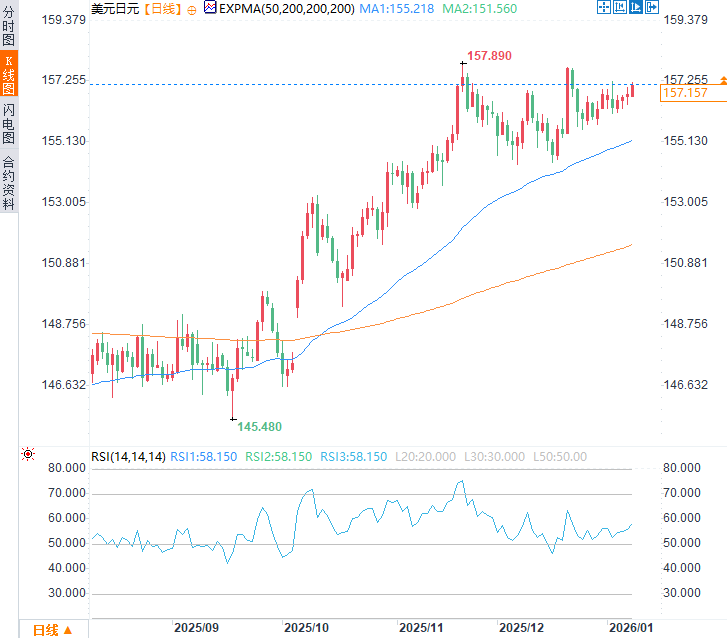
(USD/JPY daily chart, source: FX678)
At 11:09 Beijing time, the US dollar was trading at 157.17/18 against the Japanese yen.
Household spending data contrasted sharply with November wage growth data, the latter suggesting a potential year-end slowdown in consumption, putting downward pressure on the yen. During Friday's Asian session, the USD/JPY pair fluctuated upwards, extending gains from the previous three trading days, with a daily increase of approximately 0.22%, currently trading around 157.20.
The sharp rise in household spending had a limited impact on the 10-year Japanese government bond yield, highlighting the importance of weak wage data. Nevertheless, given the prospect of future rate cuts by the Federal Reserve and eventual rate hikes by the Bank of Japan, the outlook for the USD/JPY pair remains bearish.
Household spending and the impact of inflation
Japanese household spending rose 6.2% month-on-month in November, rebounding from a 3.5% decline in October. Year-on-year, household spending increased by 2.9%, compared to a 2.9% decrease in October.
November's spending data will provide stronger evidence for hawks at the Bank of Japan to push for a higher neutral interest rate and interest rate hikes. Strong consumer spending will drive demand-driven inflation, supporting a tighter monetary policy stance. Furthermore, private consumption accounts for approximately 55% of Japan's GDP growth.
Given the Bank of Japan's focus on economic momentum and prices, the November household spending data supports a more hawkish policy stance. This week, Bank of Japan Governor Kazuo Ueda stated that if price and economic trends align with the Bank of Japan's expectations, further interest rate hikes will be implemented.
Wage growth raises concerns
In contrast, November's wage growth data suggests that caution is needed regarding monetary policy tightening in the first quarter of 2026. Average cash earnings rose 0.5% year-over-year in November, a significant drop from October's 2.5% increase, while overtime pay rose 1.2% year-over-year (October: 2.1%).
Typically, slower wage growth, coupled with a weaker yen, weakens household purchasing power, thereby dampening consumption. A decline in consumer spending will alleviate demand-driven inflation and signal weakening economic momentum, which would support the Bank of Japan adopting a less aggressive path of interest rate hikes.
Despite mixed November data, economists expect wages to rebound in December, which would support a bearish outlook for the dollar against the yen.
The East Asian Economic Review analyzed recent Japanese economic data, including November's wage growth figures, noting that:
"The Bank of Japan's quarterly regional report indicates that the economic situation remains stable, and given the rebound since March, the slight decline in consumer confidence in December is not worrying. November's wage growth was mixed, but it is expected to rebound in December due to increased bonuses."
US Jobs Report: A Key Catalyst in the Near Term
At 21:30 Beijing time on Friday, the highly anticipated US non-farm payrolls report will influence market expectations for a Federal Reserve rate cut in March 2026. Economists predict that non-farm payrolls will increase by 60,000 in December, following an increase of 64,000 in November; meanwhile, they expect the unemployment rate to fall to 4.5% in December from 4.6%. Furthermore, economists expect the year-on-year increase in average hourly earnings in December to rise to 3.6% from 3.5% in November.
Weaker-than-expected labor market data will intensify market bets on a Federal Reserve rate cut in March. A more dovish interest rate path from the Fed will dampen demand for the dollar, leading to a weaker dollar-yen exchange rate.
According to the CME FedWatch tool, the probability of a Federal Reserve rate cut in March has fallen to about 40% from 41.6% on January 8. Stronger-than-expected U.S. services PMI data weakened market expectations for a March rate cut. The Institute for Supply Management (ISM) services PMI rose to 54.4 in December from 52.6 in November, indicating a robust U.S. economy.
The US non-farm payrolls report later today will be key to the short-term movement of USD/JPY. If market expectations for a Fed rate cut in March weaken, it could reverse the current bearish short-term outlook and push USD/JPY higher.
However, expectations of a Bank of Japan interest rate hike and the potential for a new Federal Reserve chairman to favor rate cuts remain key factors influencing the exchange rate. These fundamental factors support a bearish medium-term outlook for USD/JPY.
Technology Outlook: Key Levels to Watch
For the USD/JPY exchange rate, traders should assess the technical aspects and pay close attention to the fundamentals.
Looking at the daily chart, USD/JPY is above its 50-day and 200-day exponential moving averages (EMA, 155.22, 151.56), indicating a bullish bias. While the technicals remain bullish, changes in bearish fundamental factors have offset the technical impact.
On the downside, if the exchange rate breaks below the 50-day moving average (155.22) and the 155 support level, the decline will accelerate, with the 200-day moving average becoming the next support level. If it breaks below the 200-day moving average, the psychological level of 150 will be the next key support level.
Crucially, a sustained break below the 50-day and 200-day EMAs would reinforce the bearish price outlook in the medium term.
(USD/JPY daily chart, source: FX678)
At 11:09 Beijing time, the US dollar was trading at 157.17/18 against the Japanese yen.
- Risk Warning and Disclaimer
- The market involves risk, and trading may not be suitable for all investors. This article is for reference only and does not constitute personal investment advice, nor does it take into account certain users’ specific investment objectives, financial situation, or other needs. Any investment decisions made based on this information are at your own risk.