Trump forcibly releases 50 million barrels of Venezuelan crude oil? Oil market may face a supply tsunami.
2026-01-07 15:07:34
On Wednesday (January 7), during the Asian and European sessions, US crude oil prices fluctuated downwards, continuing the previous trading day's decline, with a daily drop of approximately 1.63%, currently trading around $56.20 per barrel. This followed US President Trump's announcement that Venezuela would transfer 30 million to 50 million barrels of crude oil to the United States. As traders readjusted their supply forecasts based on new geopolitical developments, oil prices came under downward pressure.

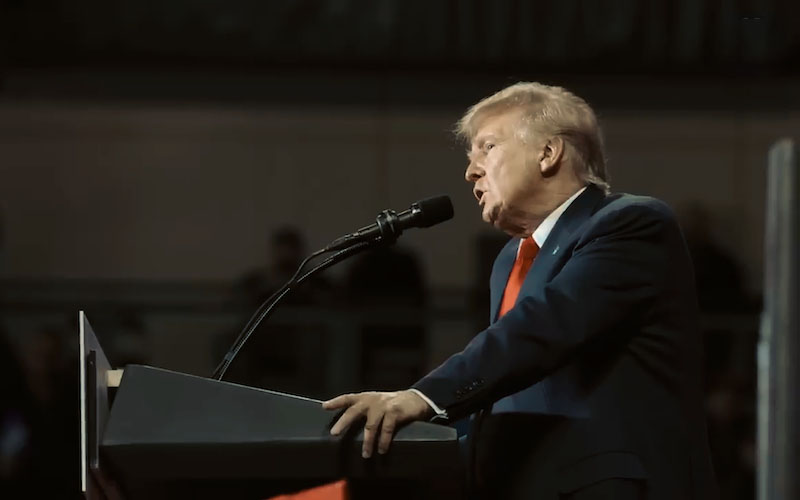
In his social media statement, Trump emphasized that the crude oil would be sold at market prices, and the proceeds would be overseen by him and used to serve the people of Venezuela and the United States. This statement suggests a long-term increase in available supply, directly impacting market sentiment and exacerbating expectations of a supply glut in early 2026.
The market reaction reflects investor concerns that the US approach prioritizes increasing oil supply rather than limiting it. As Tina Teng of Moomoo ANZ points out, this exacerbates the current global supply glut.
The agreement with Caracas could potentially divert cargoes from existing shipments. While Chevron is the only company authorized to transport Venezuelan oil under current sanctions and retains operational control, the volume of crude oil involved is enormous. Chevron currently transports 100,000 to 150,000 barrels of crude oil per day, and the agreement, potentially worth $1.9 billion, would mean a significant injection of new supply into the global market.
Some market analysts believe that despite geopolitical headlines dominating early 2026, the underlying spot market has consistently shown signs of weakness. The continued decline in Middle Eastern crude oil grades indicates insufficient buyer interest and may suggest regional oversupply, further weakening the global crude oil pricing structure.
Contrary to concerns about oversupply, data from the American Petroleum Institute (API) showed a 2.77 million barrel decrease in U.S. crude oil inventories last week, providing a short-term balancing factor for the market (despite reports of an increase in refined product inventories). While API data suggests tighter domestic supply in the U.S., the market expects official data to show a slight increase in crude oil inventories for the week ending January 2. If this forecast is confirmed, the discrepancy could indicate volatility in the report and uncertainty regarding the near-term direction of inventories.
Morgan Stanley predicts a potential oversupply of up to 3 million barrels per day in the oil market in the first half of 2026, further intensifying bearish sentiment. This forecast is based on the assessment of stagnant demand growth in 2025 and rising production from both OPEC and non-OPEC oil-producing countries. The Venezuela deal, reached at a time of rising global production, has exacerbated market concerns that supply will continue to exceed demand (for at least the next two quarters).
The US-Venezuela oil deal introduced new supply-side variables as markets grappled with stagnant demand and high inventory levels. While geopolitical dynamics are attracting significant attention, fundamental factors are currently driving prices – namely weak demand growth and rising non-OPEC production. Unless there is a substantial shift in consumption trends or a production correction, the crude oil market is likely to remain vulnerable to further downward pressure in the short term .
The daily chart shows that US crude oil prices have been running steadily in a downward channel for a long time, indicating that the bearish trend may dominate in the long term.
Meanwhile, the 14-day Relative Strength Index (RSI) was significantly below the midline, and the MACD oscillator was in negative territory, further intensifying the downward pressure.
On the upside, the upper rail of the upward channel (59.25) is expected to form a significant resistance level. If the upper rail of the upward channel is effectively broken, it may reverse the short-term bearish trend.
On the downside, $55.00 will form the first support level. If oil prices close below this level, it could accelerate the decline towards the $50.00 support level.
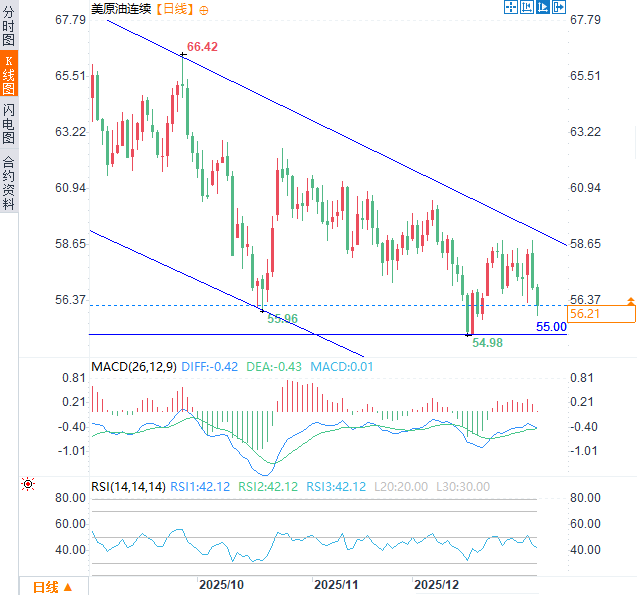
(US crude oil daily chart, source: FX678)
At 15:02 Beijing time, US crude oil futures were trading at $56.19 per barrel.
In his social media statement, Trump emphasized that the crude oil would be sold at market prices, and the proceeds would be overseen by him and used to serve the people of Venezuela and the United States. This statement suggests a long-term increase in available supply, directly impacting market sentiment and exacerbating expectations of a supply glut in early 2026.
Market expectations shift towards supply expansion
The market reaction reflects investor concerns that the US approach prioritizes increasing oil supply rather than limiting it. As Tina Teng of Moomoo ANZ points out, this exacerbates the current global supply glut.
The agreement with Caracas could potentially divert cargoes from existing shipments. While Chevron is the only company authorized to transport Venezuelan oil under current sanctions and retains operational control, the volume of crude oil involved is enormous. Chevron currently transports 100,000 to 150,000 barrels of crude oil per day, and the agreement, potentially worth $1.9 billion, would mean a significant injection of new supply into the global market.
Some market analysts believe that despite geopolitical headlines dominating early 2026, the underlying spot market has consistently shown signs of weakness. The continued decline in Middle Eastern crude oil grades indicates insufficient buyer interest and may suggest regional oversupply, further weakening the global crude oil pricing structure.
Inventory data may trigger conflicting market sentiment.
Contrary to concerns about oversupply, data from the American Petroleum Institute (API) showed a 2.77 million barrel decrease in U.S. crude oil inventories last week, providing a short-term balancing factor for the market (despite reports of an increase in refined product inventories). While API data suggests tighter domestic supply in the U.S., the market expects official data to show a slight increase in crude oil inventories for the week ending January 2. If this forecast is confirmed, the discrepancy could indicate volatility in the report and uncertainty regarding the near-term direction of inventories.
Morgan Stanley predicts a potential oversupply of up to 3 million barrels per day in the oil market in the first half of 2026, further intensifying bearish sentiment. This forecast is based on the assessment of stagnant demand growth in 2025 and rising production from both OPEC and non-OPEC oil-producing countries. The Venezuela deal, reached at a time of rising global production, has exacerbated market concerns that supply will continue to exceed demand (for at least the next two quarters).
The US-Venezuela oil deal introduced new supply-side variables as markets grappled with stagnant demand and high inventory levels. While geopolitical dynamics are attracting significant attention, fundamental factors are currently driving prices – namely weak demand growth and rising non-OPEC production. Unless there is a substantial shift in consumption trends or a production correction, the crude oil market is likely to remain vulnerable to further downward pressure in the short term .
Technical Analysis
The daily chart shows that US crude oil prices have been running steadily in a downward channel for a long time, indicating that the bearish trend may dominate in the long term.
Meanwhile, the 14-day Relative Strength Index (RSI) was significantly below the midline, and the MACD oscillator was in negative territory, further intensifying the downward pressure.
On the upside, the upper rail of the upward channel (59.25) is expected to form a significant resistance level. If the upper rail of the upward channel is effectively broken, it may reverse the short-term bearish trend.
On the downside, $55.00 will form the first support level. If oil prices close below this level, it could accelerate the decline towards the $50.00 support level.
(US crude oil daily chart, source: FX678)
At 15:02 Beijing time, US crude oil futures were trading at $56.19 per barrel.
- Risk Warning and Disclaimer
- The market involves risk, and trading may not be suitable for all investors. This article is for reference only and does not constitute personal investment advice, nor does it take into account certain users’ specific investment objectives, financial situation, or other needs. Any investment decisions made based on this information are at your own risk.