The changing role of gold in 2026
2026-01-07 15:24:53
Since the beginning of 2026, gold prices have hovered near historical highs, even approaching the $4,500 mark at one point. Strangely, this surge has not been accompanied by significant inflation—consumer prices have remained generally stable, and unexpected inflation data has become much less frequent. Following the logic of the past decade or so, once inflation cools and real interest rates remain high, gold should lose its appeal and gradually decline. However, the reality is quite the opposite; gold has not only failed to "retreat," but has also demonstrated remarkable resilience after breaking through key support levels, repeatedly consolidating above them.

This apparent "divergence" is not a market failure, but rather a signal that gold's function is undergoing a fundamental shift. It is no longer merely a tool to hedge against the shrinking purchasing power of currencies, but is increasingly being used by traders as a structural "anchor" to hedge against deeper macroeconomic vulnerabilities. Analysts believe that the current market's pricing focus has shifted from "whether inflation will rebound" to "whether policy can still control the situation."
What truly drives gold prices is no longer tomorrow's CPI figures, but rather concerns about future fiscal sustainability, the credibility of monetary policy, and the stability of the entire financial system. Developed countries still face high levels of government debt and limited room for new fiscal spending, while central banks are caught in a dilemma: further tightening could trigger financial turmoil, while premature easing would undermine policy credibility. Against this backdrop, the "room for error" in policy has significantly narrowed, and the market is beginning to worry about "what if something goes wrong?" Gold is precisely the asset priced in for this "possibility of error."
If gold was a weapon against the printing press in the last cycle, then in 2026 it's more like an insurance policy for the balance sheet. It protects against not just immediate price fluctuations, but also against potential credit dilution and policy missteps. Even if inflation expectations remain stable, gold will have reason to be supported as long as the capacity of the public sector and the financial system is questioned.
A significant change is the weakening correlation between gold and real interest rates. Previously, rising real interest rates meant a higher opportunity cost of holding gold, typically putting downward pressure on gold prices. However, in the current environment, even without a significant decline in interest rates, gold has demonstrated remarkable resilience. This suggests that funds are no longer valuing gold solely based on monetary variables, but rather viewing it as a neutral reserve asset for coping with institutional uncertainty and long-term policy constraints.
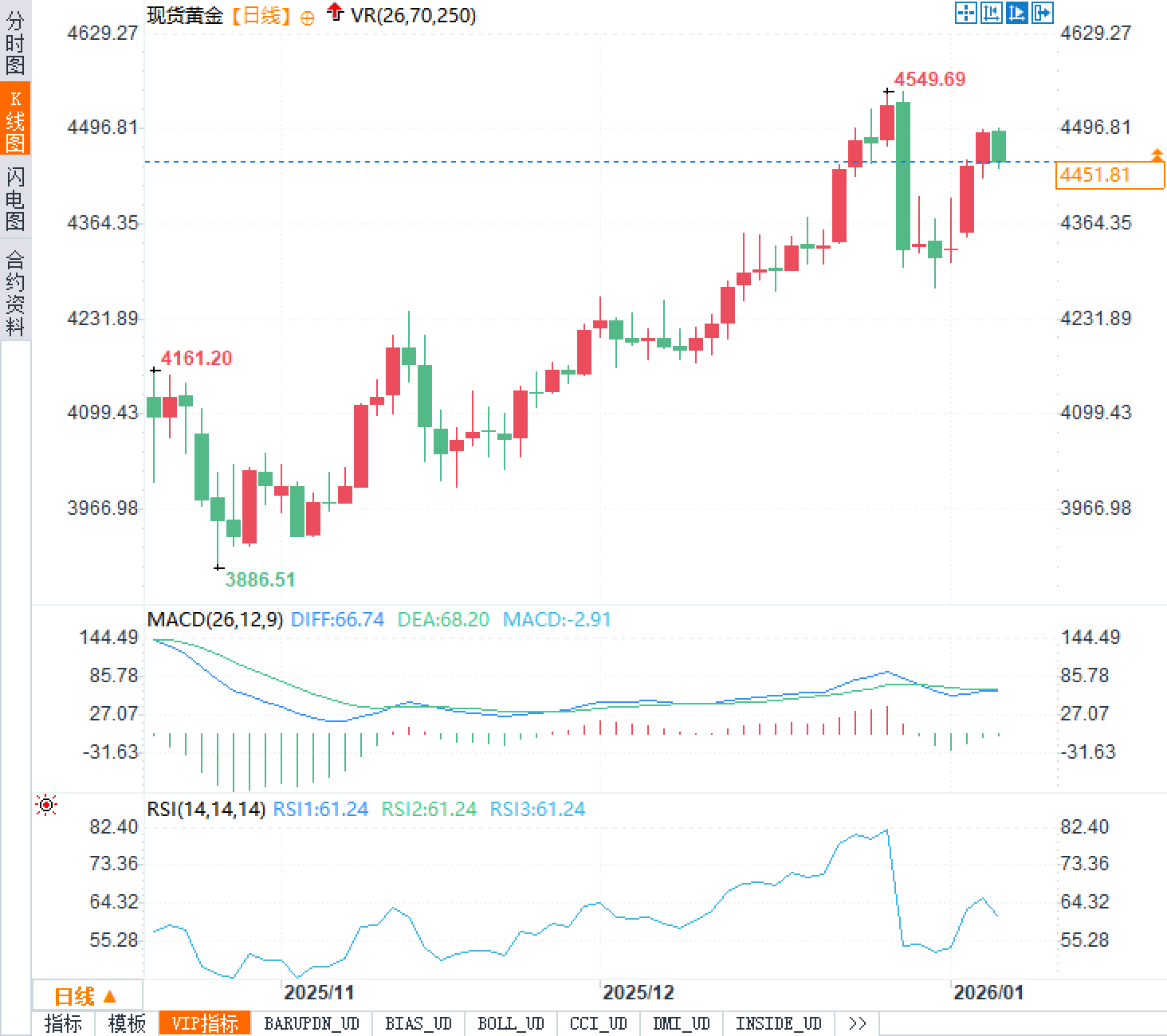
Market behavior confirms this. During this round of gold price increases, there were no typical signs of speculative frenzy. Instead, after reaching a new high above $4,500, prices entered an orderly correction phase. The pullback was mild, and momentum indicators gradually cooled down without disrupting the trend. More importantly, each dip was met with buying support, indicating that institutional funds were using the pullbacks for allocation, rather than retail investors chasing highs and lows. This rhythm of "rising, consolidating, and then correcting" reflects a growing acceptance of a higher price level in the market.
Gold is transforming from a trading asset into a strategic asset allocation asset. It is no longer a safe haven only thought of during crises, but a "ballast" incorporated into long-term portfolios during calm times. Behind this transformation lies an upgraded understanding of profound changes in the global macroeconomic structure.
The surge in gold prices is driven not only by short-term sentiment or trading logic, but also by a structural force at the top – global central banks are re-evaluating their foreign exchange reserve structures. Data shows that gold's share of global official reserves has been steadily increasing in recent years, even surpassing the proportion of US Treasury bonds for the first time in some statistical dimensions. This is not a coincidence, but a systemic restructuring of reserve management.
Faced with an increasingly fragmented international order, frequent geopolitical frictions, and a restructuring of energy and trade patterns, central banks around the world are beginning to reduce their reliance on single currencies and assets. For decades, the "dollar + US Treasury" combination was considered a naturally safe-haven asset portfolio, but this assumption is now being reassessed. Some capital has begun to express its cautious attitude towards "dollar dominance" through its actions—the dollar index has seen a near double-digit decline over the past year, which is not merely a cyclical adjustment but may also reflect a deeper shift in confidence.
Against this backdrop, gold's advantages become apparent: it belongs to no single country, its value is not affected by changes in any nation's policies, and it is not directly impacted by sovereign credit risk. Therefore, even without major geopolitical conflicts, as long as uncertainty persists at a low frequency, it can support demand for gold as an asset allocation. This type of demand is often highly persistent—it doesn't withdraw due to price corrections but may instead lead to increased holdings at lower prices, creating a "buy the dip" pattern.
Meanwhile, the performance of other metals also provides corroborating evidence for gold. Silver is being revalued due to a combination of tight supply and industrial demand; copper prices are at historical highs, reflecting confidence in long-term growth across the physical commodity supply chain; aluminum and nickel are also slowly rising. The entire commodity spectrum exhibits a coordinated structural revaluation, with gold serving as a core anchor. Unlike copper, which represents "belief in the future," gold represents "vigilance in the present."
Looking ahead, gold doesn't need extreme easing or runaway inflation to drive further gains. As long as the uncertainty surrounding real returns persists, the opportunity cost logic of holding gold will continue to weaken. Even if the Federal Reserve cuts interest rates in the future, the market's real concern isn't the amount cut, but rather whether the policy path is clear and the forward guidance is credible. Once policy statements become vague and conditional, funds tend to position themselves in gold as a "waiting" place, rather than waiting for a crisis to erupt before "escaping."
Under this logic, $4,800 is more like the next natural step up, and $5,000 is no longer an emotional pronouncement, but a price level gradually acquiring the characteristics of a "structural target." Of course, this does not mean that gold prices will skyrocket. A path more in line with the laws of financial markets is to gradually raise the central level: after rising, consolidation occurs, pullbacks are absorbed, positions are rebuilt in the fluctuations, and eventually a new equilibrium is formed.
Ultimately, gold's strength in 2026 is not due to panic, but to sobriety. It's not a prediction of economic collapse, but a reminder that constraints are accumulating, resilience is disappearing, and the system's "margin of safety" is thinner than it appears. When policy space is limited, fiscal burdens are heavy, and institutional credibility is tested, gold is no longer just an option, but a necessary asset allocation.
This apparent "divergence" is not a market failure, but rather a signal that gold's function is undergoing a fundamental shift. It is no longer merely a tool to hedge against the shrinking purchasing power of currencies, but is increasingly being used by traders as a structural "anchor" to hedge against deeper macroeconomic vulnerabilities. Analysts believe that the current market's pricing focus has shifted from "whether inflation will rebound" to "whether policy can still control the situation."
What truly drives gold prices is no longer tomorrow's CPI figures, but rather concerns about future fiscal sustainability, the credibility of monetary policy, and the stability of the entire financial system. Developed countries still face high levels of government debt and limited room for new fiscal spending, while central banks are caught in a dilemma: further tightening could trigger financial turmoil, while premature easing would undermine policy credibility. Against this backdrop, the "room for error" in policy has significantly narrowed, and the market is beginning to worry about "what if something goes wrong?" Gold is precisely the asset priced in for this "possibility of error."
Gold's New Role: An Insurance Policy on the Balance Sheet
If gold was a weapon against the printing press in the last cycle, then in 2026 it's more like an insurance policy for the balance sheet. It protects against not just immediate price fluctuations, but also against potential credit dilution and policy missteps. Even if inflation expectations remain stable, gold will have reason to be supported as long as the capacity of the public sector and the financial system is questioned.
A significant change is the weakening correlation between gold and real interest rates. Previously, rising real interest rates meant a higher opportunity cost of holding gold, typically putting downward pressure on gold prices. However, in the current environment, even without a significant decline in interest rates, gold has demonstrated remarkable resilience. This suggests that funds are no longer valuing gold solely based on monetary variables, but rather viewing it as a neutral reserve asset for coping with institutional uncertainty and long-term policy constraints.
Market behavior confirms this. During this round of gold price increases, there were no typical signs of speculative frenzy. Instead, after reaching a new high above $4,500, prices entered an orderly correction phase. The pullback was mild, and momentum indicators gradually cooled down without disrupting the trend. More importantly, each dip was met with buying support, indicating that institutional funds were using the pullbacks for allocation, rather than retail investors chasing highs and lows. This rhythm of "rising, consolidating, and then correcting" reflects a growing acceptance of a higher price level in the market.
Gold is transforming from a trading asset into a strategic asset allocation asset. It is no longer a safe haven only thought of during crises, but a "ballast" incorporated into long-term portfolios during calm times. Behind this transformation lies an upgraded understanding of profound changes in the global macroeconomic structure.
Central bank portfolio reshuffling and dollar easing: a silent reserve revolution
The surge in gold prices is driven not only by short-term sentiment or trading logic, but also by a structural force at the top – global central banks are re-evaluating their foreign exchange reserve structures. Data shows that gold's share of global official reserves has been steadily increasing in recent years, even surpassing the proportion of US Treasury bonds for the first time in some statistical dimensions. This is not a coincidence, but a systemic restructuring of reserve management.
Faced with an increasingly fragmented international order, frequent geopolitical frictions, and a restructuring of energy and trade patterns, central banks around the world are beginning to reduce their reliance on single currencies and assets. For decades, the "dollar + US Treasury" combination was considered a naturally safe-haven asset portfolio, but this assumption is now being reassessed. Some capital has begun to express its cautious attitude towards "dollar dominance" through its actions—the dollar index has seen a near double-digit decline over the past year, which is not merely a cyclical adjustment but may also reflect a deeper shift in confidence.
Against this backdrop, gold's advantages become apparent: it belongs to no single country, its value is not affected by changes in any nation's policies, and it is not directly impacted by sovereign credit risk. Therefore, even without major geopolitical conflicts, as long as uncertainty persists at a low frequency, it can support demand for gold as an asset allocation. This type of demand is often highly persistent—it doesn't withdraw due to price corrections but may instead lead to increased holdings at lower prices, creating a "buy the dip" pattern.
Meanwhile, the performance of other metals also provides corroborating evidence for gold. Silver is being revalued due to a combination of tight supply and industrial demand; copper prices are at historical highs, reflecting confidence in long-term growth across the physical commodity supply chain; aluminum and nickel are also slowly rising. The entire commodity spectrum exhibits a coordinated structural revaluation, with gold serving as a core anchor. Unlike copper, which represents "belief in the future," gold represents "vigilance in the present."
4800 is not the end, and 5000 is no longer just a slogan.
Looking ahead, gold doesn't need extreme easing or runaway inflation to drive further gains. As long as the uncertainty surrounding real returns persists, the opportunity cost logic of holding gold will continue to weaken. Even if the Federal Reserve cuts interest rates in the future, the market's real concern isn't the amount cut, but rather whether the policy path is clear and the forward guidance is credible. Once policy statements become vague and conditional, funds tend to position themselves in gold as a "waiting" place, rather than waiting for a crisis to erupt before "escaping."
Under this logic, $4,800 is more like the next natural step up, and $5,000 is no longer an emotional pronouncement, but a price level gradually acquiring the characteristics of a "structural target." Of course, this does not mean that gold prices will skyrocket. A path more in line with the laws of financial markets is to gradually raise the central level: after rising, consolidation occurs, pullbacks are absorbed, positions are rebuilt in the fluctuations, and eventually a new equilibrium is formed.
Ultimately, gold's strength in 2026 is not due to panic, but to sobriety. It's not a prediction of economic collapse, but a reminder that constraints are accumulating, resilience is disappearing, and the system's "margin of safety" is thinner than it appears. When policy space is limited, fiscal burdens are heavy, and institutional credibility is tested, gold is no longer just an option, but a necessary asset allocation.
- Risk Warning and Disclaimer
- The market involves risk, and trading may not be suitable for all investors. This article is for reference only and does not constitute personal investment advice, nor does it take into account certain users’ specific investment objectives, financial situation, or other needs. Any investment decisions made based on this information are at your own risk.