Traders are keeping a close eye on Greenland: Could the path to $4,530 for gold be already set if the situation escalates?
2026-01-07 18:05:06
On Wednesday (January 7), spot gold remained range-bound around $4,460 per ounce, experiencing a slight pullback during the day. Although technical indicators suggest weakening short-term momentum, gold prices remained firmly above key moving averages. The current market calm is being disrupted by the escalating geopolitical tensions across the Atlantic. The White House recently reiterated its intention to gain control of Greenland, even not ruling out military options, a move that has triggered deep concern within the transatlantic alliance and fueled a surge of risk aversion in financial markets.

The core driving force behind recent developments stems from the public nature of the US administration's systematic pressure on Greenland. On Tuesday, the White House officially declared that acquiring Greenland is a national security priority for deterring adversaries in the Arctic region, and explicitly stated that "the use of US military force is always one of the president's available options." Although Secretary of State Marco Rubio attempted to downplay the possibility of immediate military intervention in a closed-door briefing to congressional leaders, emphasizing that the goal was to achieve a deal through purchase, the continued refusal of senior officials, including Trump himself, to rule out the use of force has significantly increased the tail risks of this event .
The European response quickly shifted from cautious to a public, united boycott. Danish Prime Minister Mette Frederiksen stated bluntly that if the United States attacked a NATO member state to seize Greenland, it would lead to the end of NATO and even the existing international order. Subsequently, the leaders of France, Germany, the United Kingdom, Italy, Poland, and Spain issued a rare joint statement, firmly supporting Denmark, emphasizing that Greenland's fate could only be decided by its people and Denmark, and calling on the United States to address Arctic security issues based on cooperation rather than coercion. While French Foreign Minister Jean-Noël Barro quoted Rubio as ruling out the possibility of an "invasion," he also confirmed that France was working with its partners to develop contingency plans.
This series of developments reveals three key fundamental changes:
1. The collapse of trust within the alliance: The United States' open threat to the territorial integrity of a loyal NATO ally has shaken the Western alliance system built on the foundations of sovereign equality and collective security since World War II. When assessing geopolitical risks, the market must take into account the possibility of "major internal divisions within NATO" and even "functional failure of the alliance."
2. Soaring Policy Uncertainty: There appear to be conflicting signals within the White House – diplomatic channels are attempting to reassure, while the inner circle continues to release hawkish rhetoric. This uncertainty itself dampens risk appetite. Analysts from prominent institutions point out that recent US actions in Venezuela may reinforce the administration's tendency to take more aggressive measures on issues such as Greenland.
3. Shift in the logic of safe-haven assets: Traditional risk aversion is often triggered by regional conflicts or economic crises. The current situation, however, exhibits characteristics of "order risk." This instability in the macro-political structure provides a deeper and more lasting support for ultimate safe-haven assets such as gold .
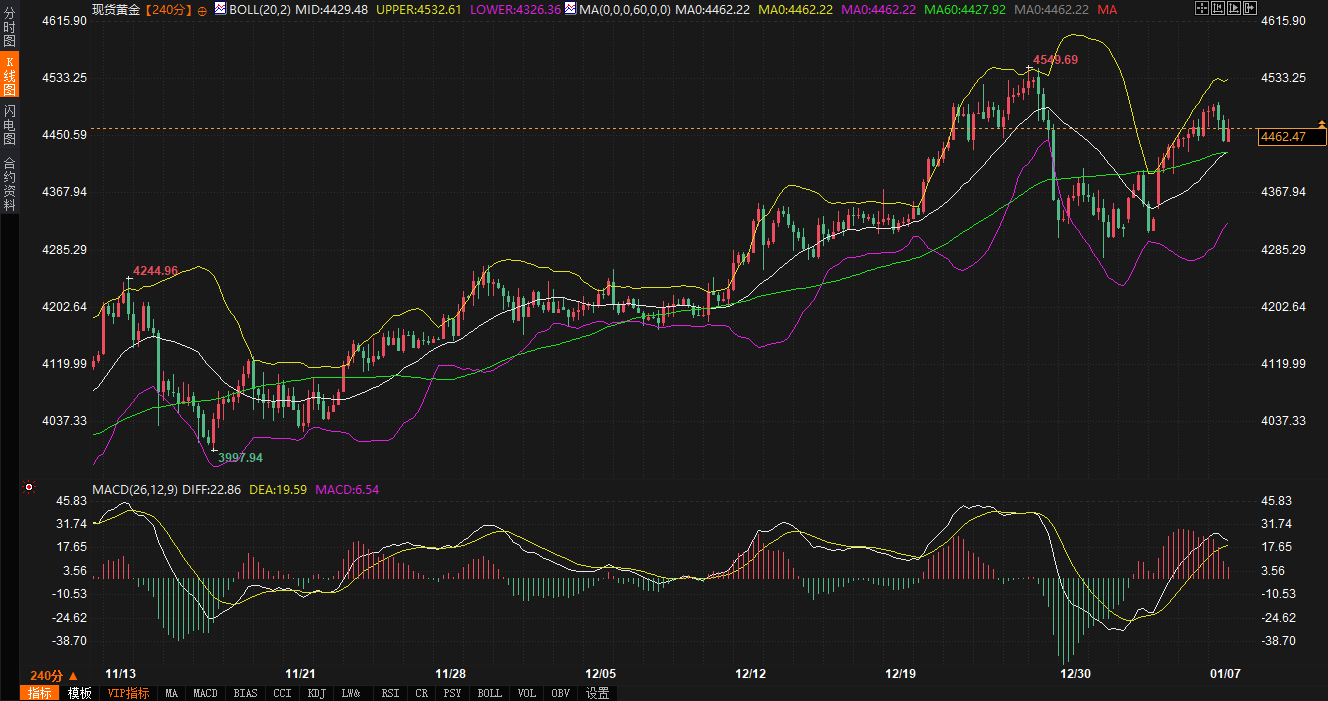
Technical indicators suggest that gold is currently in a short-term consolidation phase after its previous rise. On the 4-hour chart, although the price has slightly retreated, it remains firmly above the Bollinger Band middle line (approximately $4429/oz), maintaining an overall upward trend. While the MACD indicator shows the DIFF and DEA lines converging in the positive zone, suggesting a possible pause in short-term upward momentum, a bearish crossover has not yet formed, and the histogram remains positive. Key support is concentrated around the Bollinger Band middle line and the previous area of high trading volume. If geopolitical tensions escalate, gold prices could find buying support and test the upper Bollinger Band resistance (approximately $4532/oz).
In terms of market sentiment, professional discussions indicate that traders are repricing from two dimensions:
Direct demand for safe haven: If the situation escalates further, it will directly drive funds into gold, the US dollar and US Treasury bonds.
Indirect confidence shock: The internal crisis within NATO will weaken the credibility of the "safe harbor" system on which dollar assets rely. From a longer-term perspective, this may prompt global reserve managers to rebalance their assets, and some long-term funds may gradually increase their gold allocation to hedge against risks in the alliance system.
The Greenland crisis is expected to continue to unfold in the short term, becoming a key variable disrupting financial markets, in addition to monetary policy and economic growth data. Its future trajectory and market impact can be observed at the following key points:
1. Clarity of US Policy: The market needs to see a clear, unified roadmap from the US administration that does not include military threats. If the US continues to maintain a vague and hardline stance of "all options on the table," risk aversion will be difficult to subside. Members of both parties in Congress have jointly emphasized the need to respect Danish sovereignty; domestic political constraints are a factor that needs to be observed.
2. European Solidarity and Countermeasures: The joint statement from six European countries is only the first step. The next step requires monitoring whether specific political or economic countermeasures will be formulated within the EU or NATO framework. Any measures to strengthen Europe's independent defense capabilities could be interpreted by the market as a long-term weakening of the existing US-led security system, which would be beneficial for gold.
3. Linkage with other geopolitical hotspots: The authorities' actions in Venezuela may encourage them to adopt similar hardline measures in other regions. New signs of intervention in Latin America or other regions will amplify and reinforce market perceptions of "order risk."
The Greenland dispute has evolved from a political spectacle into a real geopolitical event that could shake the foundations of the post-World War II Western political and military alliance. Its impact on financial markets lies not in the short-term fluctuations of individual assets, but in raising the premium for global political risk and potentially triggering a rethinking of the deep-seated structure of the international reserve system. For the gold market, this provides a potential supporting logic based on "distrust" and "order reconstruction," transcending inflation and interest rate cycles. Traders should closely monitor progress through diplomatic channels, the outcome of NATO consultations, and changes in risk sentiment indicators to grasp market dynamics. Until the situation becomes clearer, market volatility is likely to remain high, and capital flows between safe-haven and risk assets will become more sensitive.
Fundamental Analysis: From Diplomatic Games to Alliance Crisis
The core driving force behind recent developments stems from the public nature of the US administration's systematic pressure on Greenland. On Tuesday, the White House officially declared that acquiring Greenland is a national security priority for deterring adversaries in the Arctic region, and explicitly stated that "the use of US military force is always one of the president's available options." Although Secretary of State Marco Rubio attempted to downplay the possibility of immediate military intervention in a closed-door briefing to congressional leaders, emphasizing that the goal was to achieve a deal through purchase, the continued refusal of senior officials, including Trump himself, to rule out the use of force has significantly increased the tail risks of this event .
The European response quickly shifted from cautious to a public, united boycott. Danish Prime Minister Mette Frederiksen stated bluntly that if the United States attacked a NATO member state to seize Greenland, it would lead to the end of NATO and even the existing international order. Subsequently, the leaders of France, Germany, the United Kingdom, Italy, Poland, and Spain issued a rare joint statement, firmly supporting Denmark, emphasizing that Greenland's fate could only be decided by its people and Denmark, and calling on the United States to address Arctic security issues based on cooperation rather than coercion. While French Foreign Minister Jean-Noël Barro quoted Rubio as ruling out the possibility of an "invasion," he also confirmed that France was working with its partners to develop contingency plans.
This series of developments reveals three key fundamental changes:
1. The collapse of trust within the alliance: The United States' open threat to the territorial integrity of a loyal NATO ally has shaken the Western alliance system built on the foundations of sovereign equality and collective security since World War II. When assessing geopolitical risks, the market must take into account the possibility of "major internal divisions within NATO" and even "functional failure of the alliance."
2. Soaring Policy Uncertainty: There appear to be conflicting signals within the White House – diplomatic channels are attempting to reassure, while the inner circle continues to release hawkish rhetoric. This uncertainty itself dampens risk appetite. Analysts from prominent institutions point out that recent US actions in Venezuela may reinforce the administration's tendency to take more aggressive measures on issues such as Greenland.
3. Shift in the logic of safe-haven assets: Traditional risk aversion is often triggered by regional conflicts or economic crises. The current situation, however, exhibits characteristics of "order risk." This instability in the macro-political structure provides a deeper and more lasting support for ultimate safe-haven assets such as gold .
Technical Analysis and Market Sentiment
Technical indicators suggest that gold is currently in a short-term consolidation phase after its previous rise. On the 4-hour chart, although the price has slightly retreated, it remains firmly above the Bollinger Band middle line (approximately $4429/oz), maintaining an overall upward trend. While the MACD indicator shows the DIFF and DEA lines converging in the positive zone, suggesting a possible pause in short-term upward momentum, a bearish crossover has not yet formed, and the histogram remains positive. Key support is concentrated around the Bollinger Band middle line and the previous area of high trading volume. If geopolitical tensions escalate, gold prices could find buying support and test the upper Bollinger Band resistance (approximately $4532/oz).
In terms of market sentiment, professional discussions indicate that traders are repricing from two dimensions:
Direct demand for safe haven: If the situation escalates further, it will directly drive funds into gold, the US dollar and US Treasury bonds.
Indirect confidence shock: The internal crisis within NATO will weaken the credibility of the "safe harbor" system on which dollar assets rely. From a longer-term perspective, this may prompt global reserve managers to rebalance their assets, and some long-term funds may gradually increase their gold allocation to hedge against risks in the alliance system.
Future Trend Outlook
The Greenland crisis is expected to continue to unfold in the short term, becoming a key variable disrupting financial markets, in addition to monetary policy and economic growth data. Its future trajectory and market impact can be observed at the following key points:
1. Clarity of US Policy: The market needs to see a clear, unified roadmap from the US administration that does not include military threats. If the US continues to maintain a vague and hardline stance of "all options on the table," risk aversion will be difficult to subside. Members of both parties in Congress have jointly emphasized the need to respect Danish sovereignty; domestic political constraints are a factor that needs to be observed.
2. European Solidarity and Countermeasures: The joint statement from six European countries is only the first step. The next step requires monitoring whether specific political or economic countermeasures will be formulated within the EU or NATO framework. Any measures to strengthen Europe's independent defense capabilities could be interpreted by the market as a long-term weakening of the existing US-led security system, which would be beneficial for gold.
3. Linkage with other geopolitical hotspots: The authorities' actions in Venezuela may encourage them to adopt similar hardline measures in other regions. New signs of intervention in Latin America or other regions will amplify and reinforce market perceptions of "order risk."
The Greenland dispute has evolved from a political spectacle into a real geopolitical event that could shake the foundations of the post-World War II Western political and military alliance. Its impact on financial markets lies not in the short-term fluctuations of individual assets, but in raising the premium for global political risk and potentially triggering a rethinking of the deep-seated structure of the international reserve system. For the gold market, this provides a potential supporting logic based on "distrust" and "order reconstruction," transcending inflation and interest rate cycles. Traders should closely monitor progress through diplomatic channels, the outcome of NATO consultations, and changes in risk sentiment indicators to grasp market dynamics. Until the situation becomes clearer, market volatility is likely to remain high, and capital flows between safe-haven and risk assets will become more sensitive.
- Risk Warning and Disclaimer
- The market involves risk, and trading may not be suitable for all investors. This article is for reference only and does not constitute personal investment advice, nor does it take into account certain users’ specific investment objectives, financial situation, or other needs. Any investment decisions made based on this information are at your own risk.