Crude oil trading alert: Geopolitical uncertainty supports another rebound in oil prices, which are expected to remain range-bound in the short term.
2026-01-09 09:49:13
After two consecutive days of decline, the international crude oil market rebounded significantly on Thursday. Brent crude oil prices rose by as much as 5% during the session, hitting a two-week high, indicating that market sentiment quickly shifted from cautious to bullish. During Friday's Asian session, WTI crude oil prices retreated slightly, approaching a dense resistance zone, and traded around $58 per barrel in the short term.
From a short-term fundamental perspective, negative factors have not completely subsided. The US plans to sell up to 50 million barrels of Venezuelan crude oil to domestic refiners, while the latest data shows that US gasoline and distillate fuel inventories have both increased, theoretically putting downward pressure on oil prices.
However, the current market pricing logic focuses more on short- to medium-term supply disruption risks than on changes in inventory data alone. The situation in Venezuela remains one of the key variables that investors are assessing.

U.S. Energy Secretary Chris Wright said he expects Chevron to rapidly expand its operations in Venezuela, and ConocoPhillips and ExxonMobil are also seeking to play a constructive role.
However, energy consultancy Ritterbusch and Associates points out that it may still take several years for large quantities of Venezuelan crude oil to actually enter the U.S. Gulf Coast market, and it is unlikely to have a substantial impact on the global crude oil supply and demand pattern in the short term.
Meanwhile, potential supply risks continue to accumulate in other major oil-producing countries. An oil tanker bound for Russia was attacked in the Black Sea; in Iraq, the nationalization of the West Qurna 2 oil field is underway due to US sanctions against Russia's Lukoil.
Funding and positioning structures also amplified price volatility. On the one hand, the annual commodity index rebalancing is approaching, which is expected to prompt some funds to flow back into the crude oil market in the coming trading days;
On the other hand, the options market shows a significantly stronger preference for Brent crude call options relative to put options, reflecting increased traders' demand for hedging against upside risk. Positioning data also reinforces the fragility of any oil price rebound.
In assessing the U.S. actions toward Venezuela's oil industry, Amrita Sen, co-founder and head of research at Energy Aspects, said: "The real change right now is more about trade flows than production itself. You may see more oil flowing to the U.S., but Venezuela's overall production may not necessarily see a significant increase."
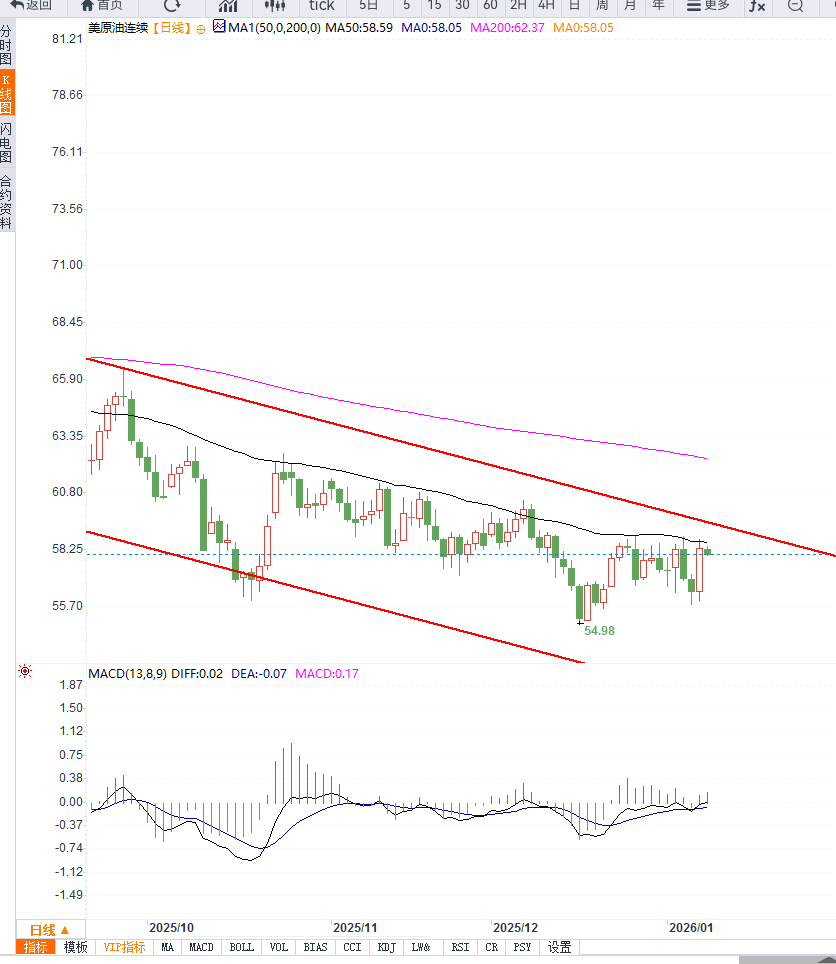
From the daily chart, WTI crude oil found effective support near $57 after a continuous pullback, and the price has returned above the lower edge of the previous trading range, indicating that buying pressure has begun to emerge.
In terms of candlestick pattern, Thursday closed with a large bullish candlestick, essentially covering the previous trading day's losses, forming a rebound and recovery structure, indicating a significant weakening of short-term bearish momentum. Technically, the daily RSI has rebounded from near oversold territory to below the neutral zone, with momentum stabilizing after a period of weakness.
The MACD histogram continues to shorten, and there are potential signs of a golden cross at a low level. Overall, as long as oil prices hold the key support range of $56.5-$57, there is still technical potential for an upward test of the $60 level in the short term, but the $61-$62 area will still constitute a resistance zone.
Editor's Note:
In summary, the current rebound in oil prices is not driven by a single event, but is the result of the combined effects of geopolitical risk repricing, expectations of capital inflows, and imbalances in portfolio structure.
Despite continued macroeconomic expectations of ample supply in the medium term, any unexpected events from major oil-producing countries could rapidly alter market sentiment in the short term. With a high concentration of short positions, oil price volatility is significantly amplified, and short-term price movements are more driven by news and sentiment; the risk of both rapid rallies and sharp pullbacks should be closely monitored.
From a short-term fundamental perspective, negative factors have not completely subsided. The US plans to sell up to 50 million barrels of Venezuelan crude oil to domestic refiners, while the latest data shows that US gasoline and distillate fuel inventories have both increased, theoretically putting downward pressure on oil prices.
However, the current market pricing logic focuses more on short- to medium-term supply disruption risks than on changes in inventory data alone. The situation in Venezuela remains one of the key variables that investors are assessing.
U.S. Energy Secretary Chris Wright said he expects Chevron to rapidly expand its operations in Venezuela, and ConocoPhillips and ExxonMobil are also seeking to play a constructive role.
However, energy consultancy Ritterbusch and Associates points out that it may still take several years for large quantities of Venezuelan crude oil to actually enter the U.S. Gulf Coast market, and it is unlikely to have a substantial impact on the global crude oil supply and demand pattern in the short term.
Meanwhile, potential supply risks continue to accumulate in other major oil-producing countries. An oil tanker bound for Russia was attacked in the Black Sea; in Iraq, the nationalization of the West Qurna 2 oil field is underway due to US sanctions against Russia's Lukoil.
Funding and positioning structures also amplified price volatility. On the one hand, the annual commodity index rebalancing is approaching, which is expected to prompt some funds to flow back into the crude oil market in the coming trading days;
On the other hand, the options market shows a significantly stronger preference for Brent crude call options relative to put options, reflecting increased traders' demand for hedging against upside risk. Positioning data also reinforces the fragility of any oil price rebound.
In assessing the U.S. actions toward Venezuela's oil industry, Amrita Sen, co-founder and head of research at Energy Aspects, said: "The real change right now is more about trade flows than production itself. You may see more oil flowing to the U.S., but Venezuela's overall production may not necessarily see a significant increase."
From the daily chart, WTI crude oil found effective support near $57 after a continuous pullback, and the price has returned above the lower edge of the previous trading range, indicating that buying pressure has begun to emerge.
In terms of candlestick pattern, Thursday closed with a large bullish candlestick, essentially covering the previous trading day's losses, forming a rebound and recovery structure, indicating a significant weakening of short-term bearish momentum. Technically, the daily RSI has rebounded from near oversold territory to below the neutral zone, with momentum stabilizing after a period of weakness.
The MACD histogram continues to shorten, and there are potential signs of a golden cross at a low level. Overall, as long as oil prices hold the key support range of $56.5-$57, there is still technical potential for an upward test of the $60 level in the short term, but the $61-$62 area will still constitute a resistance zone.
Editor's Note:
In summary, the current rebound in oil prices is not driven by a single event, but is the result of the combined effects of geopolitical risk repricing, expectations of capital inflows, and imbalances in portfolio structure.
Despite continued macroeconomic expectations of ample supply in the medium term, any unexpected events from major oil-producing countries could rapidly alter market sentiment in the short term. With a high concentration of short positions, oil price volatility is significantly amplified, and short-term price movements are more driven by news and sentiment; the risk of both rapid rallies and sharp pullbacks should be closely monitored.
- Risk Warning and Disclaimer
- The market involves risk, and trading may not be suitable for all investors. This article is for reference only and does not constitute personal investment advice, nor does it take into account certain users’ specific investment objectives, financial situation, or other needs. Any investment decisions made based on this information are at your own risk.