Euro/Dollar Exchange Rate Analysis: Geopolitics Dominates Short-Term Trend, Institutional Outlook Divergence and Key Variables
2026-01-09 18:39:01
The euro continues its weak trend against the US dollar in the short term, currently fluctuating between 1.16 and 1.17. In recent trading days, it has hovered around 1.1650-1.1690, a slight pullback from the highs at the end of last year, but it has not yet broken through key support levels. It is worth noting that the core driver of current market volatility is not simply economic data or tariff events, but rather the escalating geopolitical risks. This factor has become the dominant force triggering risk aversion in the market. Mainstream institutions generally believe that geopolitical uncertainty is the core logic dragging down the euro and strengthening the safe-haven appeal of the US dollar, especially since the Eurozone, as the region with the heaviest geopolitical burden, lacks independent upward momentum due to the combined effects of multiple external shocks.
I. Latest views from core institutions: Geopolitical risks will be a key constraint on the euro's trajectory in 2026.
Recently, several authoritative institutions have released a series of outlook reports focusing on the impact of geopolitics on the euro, with views showing a divergence between cautious short-term and optimistic long-term perspectives.
MUFG Research (This Week's FX Outlook Report): The report clearly points out that geopolitical uncertainties such as the ongoing conflict in Ukraine and the escalating situation in Venezuela will continue to drag down global growth, but the Eurozone is expected to benefit from lower energy prices and fiscal support policies. The report provides a specific forecast that EUR/USD is expected to recover to 1.24 by the end of 2026.
Nordea Corporate (latest report, January 6): Focusing on the US intervention in Venezuela, this event further escalates global geopolitical risks. Coupled with short-term liquidity pressures from the Dutch pension fund transition, this will put downward pressure on the euro. However, from a long-term perspective, the Eurozone's economic growth potential is superior to some developed economies, potentially supporting a euro rebound.
Allianz GI (January 8 commentary): Offers a differentiated view, arguing that while rising geopolitical risks may trigger a shift in market risk appetite, the Eurozone central bank is nearing its neutral interest rate range. This policy stance will effectively enhance the Eurozone economy's resilience and mitigate the drag on the euro from geopolitical shocks.
Lite Finance (January 5th In-Depth Analysis): Lists the Fed's tightening policy and geopolitical risks as the two key factors for the euro's weakness, judging that EUR/USD will maintain a neutral position in the short term, but the recent weak economic indicators in the Eurozone may further exacerbate the downward pressure on the euro.
Deloitte Insights (Global Outlook Report, January 7): Added supporting factors to the Eurozone's economic fundamentals, believing that the Eurozone will achieve moderate expansion in 2026, mainly benefiting from a stable labor market and the implementation of the EU investment plan. However, trade tensions and geopolitical uncertainties remain the core risks constraining growth, thus affecting the euro's performance.
Rabobank & Eurasia Group: Both institutions have listed geopolitical risks as a defining risk for 2026, emphasizing that the potential escalation of hybrid warfare between Russia and NATO will directly increase European security spending and fiscal budget pressures, reinforcing the market perception of Europe as having the "highest geopolitical burden" in the long term and continuously suppressing the euro's valuation.
FXEmpire (Latest Forecast Report): Maintains its core judgment that geopolitical volatility is beneficial to the US dollar, believing that geopolitical events such as the Ukraine conflict and Sino-US tensions will continue to drive up the demand for the US dollar as a safe haven. However, it also points out that the Eurozone has strong political stability and will not significantly hinder long-term capital inflows, thus preserving support for the long-term trend of the euro.
II. Specific Transmission Paths of Key Geopolitical Risks to the Euro
The situation in Ukraine: a long-term drag, lacking a strong catalyst.
The conflict in Ukraine continues to escalate, with no clear signs of progress towards peace. Sucden Financial, in its outlook report this month, emphasizes that even if a ceasefire or freeze occurs, it will only remove tail risks to the euro and cannot become a core catalyst for a strong euro rally. From a transmission perspective, the prolonged Ukraine crisis will continue to deplete Eurozone fiscal resources (such as aid to Ukraine and energy substitution investments), while exacerbating uncertainty among businesses and households, suppressing investment and consumption momentum, and ultimately dragging down the euro through weak economic growth. Furthermore, a potential escalation of conflict between Russia and NATO could trigger a European security crisis, further strengthening market sentiment for safe-haven assets and prompting a sell-off.
Russian sanctions and energy uncertainty: a double whammy of inflation and growth
The ongoing rumors of sanctions against Russia, coupled with the potential disruption of energy transport routes (such as alternative routes to Nord Stream), have become a significant threat to the Eurozone economy. Recent reports indicate that although Eurozone inflation has fallen back to the 2% target level, the lagged effects of geopolitical pressures may gradually emerge: businesses are postponing investment plans due to energy supply uncertainty, and households are increasing precautionary savings to cope with potential energy price increases. Both factors contribute to slower GDP growth, weakening the euro's economic fundamentals. Meanwhile, volatile energy prices could disrupt the European Central Bank's policy pace, further increasing the volatility of the euro exchange rate.
The Venezuelan crisis: a double whammy of energy and regional instability.
Recent large-scale US intervention in Venezuela (including the arrest of the president) has triggered concerns about global energy supplies and instability in Latin America. Analysts point out that as a major energy exporter, Venezuela's instability directly increases international oil price volatility, while exacerbating global risk aversion and prompting a shift of funds towards safe-haven dollar assets, putting direct pressure on the euro. The Eurasia Group and Stimson Center have listed the Venezuelan situation as one of the top risks for 2026, believing that the US's strong intervention in the Western Hemisphere will further amplify global geopolitical uncertainty and negatively impact the Eurozone's external environment.
The Greenland issue: A crisis of trust among allies exacerbates political concerns.
The ongoing rhetoric from the United States regarding intervention or "acquisition" of Greenland has triggered widespread unease among Eurozone allies. Reports indicate that this issue has directly exacerbated political and security concerns within the Eurozone, causing the euro to weaken against safe-haven currencies such as the US dollar and the Japanese yen. European Central Bank Vice President Guindos recently stated publicly that such geopolitical uncertainties will dampen corporate investment, increase household savings rates, and lead to insufficient economic growth momentum in the Eurozone, further weakening the euro's attractiveness.
III. The combined effects of the European Central Bank's policies and the safe-haven advantage of the US dollar
The European Central Bank's policy stance has further limited the euro's upside potential. The latest ECB forecasts indicate that interest rates will remain around 2% for an extended period, with limited room for rate cuts. This policy position, coupled with the dollar's continued relative interest rate advantage, further weakens the euro's carry trade appeal.
Meanwhile, geopolitical risks continue to reinforce the dollar's status as a "safe haven." Despite strong US economic data (such as the recent resilience of the labor market), the market's short-term dominant logic remains focused on geopolitical risks. Rabobank and FX Empire both point out that persistent geopolitical volatility naturally benefits the dollar, and in the short term, safe-haven buying of the dollar will outweigh the impact of economic data on the exchange rate. NAGA and LiteFinance add that unforeseen geopolitical events could keep EUR/USD volatility at an annualized high of 8-10%, with the exchange rate likely to fluctuate within a wide range of 1.10-1.40 in the short term. A Reuters report on January 3rd indicates that the dollar's strong start to 2026 pushed EUR/USD down to 1.1716, and subsequent key economic data will become a supplementary variable guiding Federal Reserve policy and thus influencing the exchange rate trend of the Eurozone.
IV. Key Short-Term Variables and Long-Term Outlook
Short-term key variables: geopolitical escalation and US judicial rulings
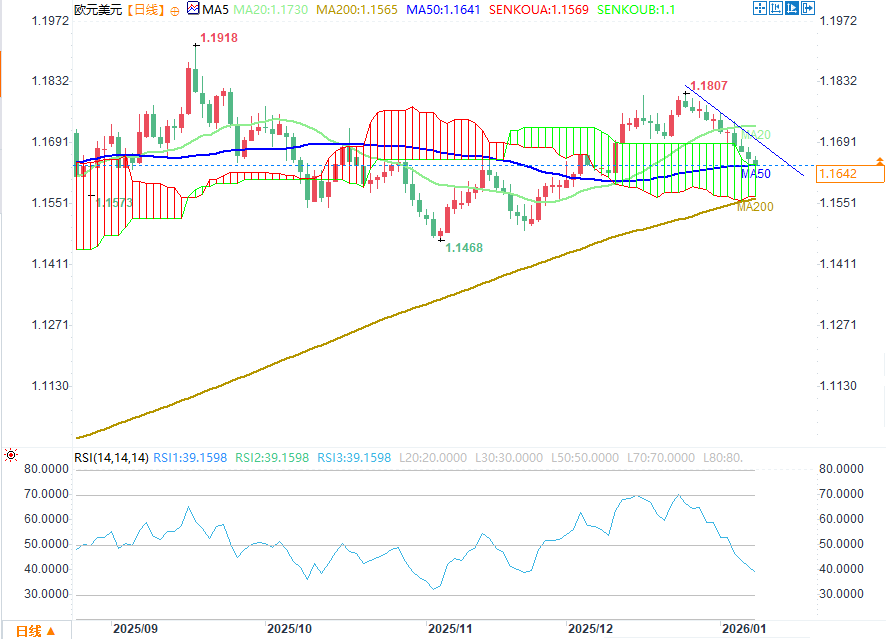
(EUR/USD daily chart source: FX678)
In the short term, the core variables for the euro/dollar exchange rate are concentrated in two main areas: first, whether geopolitical events will escalate further. If there are further sanctions against Russia, energy supply disruptions, or a deterioration in the Latin American situation, safe-haven buying of the dollar will increase further, and EUR/USD may break below the key support level of 1.16; second, the US Supreme Court's ruling on Trump's tariff policies (the result is expected on January 9th). The market currently bets a 70-80% probability that the ruling is illegal. A FOREX website outlook report on January 6th pointed out that if the ruling is illegal, it may trigger a brief dollar rebound (due to market expectations of a more hawkish Fed policy), but the market focus will quickly shift to the risk of long-term US debt, giving the euro a relative advantage; if the ruling is upheld, the dollar's strength will continue, and the euro will remain under pressure. In addition, the US employment data to be released next week will also be an important factor affecting short-term market sentiment.
Long-term outlook: Fundamental support coexists with geopolitical black swan events.
From a long-term perspective, mainstream institutions are optimistic about the EUR/USD exchange rate. ING, Rabobank, Goldman Sachs, JPMorgan, Deutsche Bank, and BNP Paribas, among others, have a consensus forecast range of 1.18-1.25 for the EUR/USD exchange rate by the end of 2026, with Goldman Sachs, Deutsche Bank, and BNP Paribas all giving a target price of 1.25. The core supporting logic includes: first, the gradual recovery of the Eurozone economy, with the implementation of German fiscal stimulus policies and declining energy prices continuing to release growth momentum; second, the Federal Reserve's policy is moving towards a neutral interest rate (3.00%-3.25%), which will gradually weaken the relative interest rate advantage of the US dollar.
However, it should be noted that the long-term outlook is predicated on the absence of a significant escalation of geopolitical risks. ING specifically emphasizes that geopolitics remains the "biggest black swan" event for the euro's long-term trajectory, and all fundamental-based forecasts will need to be reassessed should unexpected geopolitical crises occur in Ukraine, the Middle East, or Latin America.
V. Conclusion
In summary, the core driving force behind the current short-term EUR/USD exchange rate movement is geopolitical turmoil. The escalation and easing of risk events directly determine the strength of the safe-haven demand for the US dollar, thus dominating exchange rate fluctuations. Investors should not be overly concerned with single economic data points and should maintain strategic flexibility: closely monitor the US Supreme Court's tariff ruling on January 9th, various geopolitical developments (especially those related to energy supply, sanctions against Russia, and the situation in Latin America), and next week's US employment data. Given the current high degree of market volatility, it is recommended to reserve sufficient buffer space in portfolio allocation and avoid concentrating positions in a single direction.
I. Latest views from core institutions: Geopolitical risks will be a key constraint on the euro's trajectory in 2026.
Recently, several authoritative institutions have released a series of outlook reports focusing on the impact of geopolitics on the euro, with views showing a divergence between cautious short-term and optimistic long-term perspectives.
MUFG Research (This Week's FX Outlook Report): The report clearly points out that geopolitical uncertainties such as the ongoing conflict in Ukraine and the escalating situation in Venezuela will continue to drag down global growth, but the Eurozone is expected to benefit from lower energy prices and fiscal support policies. The report provides a specific forecast that EUR/USD is expected to recover to 1.24 by the end of 2026.
Nordea Corporate (latest report, January 6): Focusing on the US intervention in Venezuela, this event further escalates global geopolitical risks. Coupled with short-term liquidity pressures from the Dutch pension fund transition, this will put downward pressure on the euro. However, from a long-term perspective, the Eurozone's economic growth potential is superior to some developed economies, potentially supporting a euro rebound.
Allianz GI (January 8 commentary): Offers a differentiated view, arguing that while rising geopolitical risks may trigger a shift in market risk appetite, the Eurozone central bank is nearing its neutral interest rate range. This policy stance will effectively enhance the Eurozone economy's resilience and mitigate the drag on the euro from geopolitical shocks.
Lite Finance (January 5th In-Depth Analysis): Lists the Fed's tightening policy and geopolitical risks as the two key factors for the euro's weakness, judging that EUR/USD will maintain a neutral position in the short term, but the recent weak economic indicators in the Eurozone may further exacerbate the downward pressure on the euro.
Deloitte Insights (Global Outlook Report, January 7): Added supporting factors to the Eurozone's economic fundamentals, believing that the Eurozone will achieve moderate expansion in 2026, mainly benefiting from a stable labor market and the implementation of the EU investment plan. However, trade tensions and geopolitical uncertainties remain the core risks constraining growth, thus affecting the euro's performance.
Rabobank & Eurasia Group: Both institutions have listed geopolitical risks as a defining risk for 2026, emphasizing that the potential escalation of hybrid warfare between Russia and NATO will directly increase European security spending and fiscal budget pressures, reinforcing the market perception of Europe as having the "highest geopolitical burden" in the long term and continuously suppressing the euro's valuation.
FXEmpire (Latest Forecast Report): Maintains its core judgment that geopolitical volatility is beneficial to the US dollar, believing that geopolitical events such as the Ukraine conflict and Sino-US tensions will continue to drive up the demand for the US dollar as a safe haven. However, it also points out that the Eurozone has strong political stability and will not significantly hinder long-term capital inflows, thus preserving support for the long-term trend of the euro.
II. Specific Transmission Paths of Key Geopolitical Risks to the Euro
The situation in Ukraine: a long-term drag, lacking a strong catalyst.
The conflict in Ukraine continues to escalate, with no clear signs of progress towards peace. Sucden Financial, in its outlook report this month, emphasizes that even if a ceasefire or freeze occurs, it will only remove tail risks to the euro and cannot become a core catalyst for a strong euro rally. From a transmission perspective, the prolonged Ukraine crisis will continue to deplete Eurozone fiscal resources (such as aid to Ukraine and energy substitution investments), while exacerbating uncertainty among businesses and households, suppressing investment and consumption momentum, and ultimately dragging down the euro through weak economic growth. Furthermore, a potential escalation of conflict between Russia and NATO could trigger a European security crisis, further strengthening market sentiment for safe-haven assets and prompting a sell-off.
Russian sanctions and energy uncertainty: a double whammy of inflation and growth
The ongoing rumors of sanctions against Russia, coupled with the potential disruption of energy transport routes (such as alternative routes to Nord Stream), have become a significant threat to the Eurozone economy. Recent reports indicate that although Eurozone inflation has fallen back to the 2% target level, the lagged effects of geopolitical pressures may gradually emerge: businesses are postponing investment plans due to energy supply uncertainty, and households are increasing precautionary savings to cope with potential energy price increases. Both factors contribute to slower GDP growth, weakening the euro's economic fundamentals. Meanwhile, volatile energy prices could disrupt the European Central Bank's policy pace, further increasing the volatility of the euro exchange rate.
The Venezuelan crisis: a double whammy of energy and regional instability.
Recent large-scale US intervention in Venezuela (including the arrest of the president) has triggered concerns about global energy supplies and instability in Latin America. Analysts point out that as a major energy exporter, Venezuela's instability directly increases international oil price volatility, while exacerbating global risk aversion and prompting a shift of funds towards safe-haven dollar assets, putting direct pressure on the euro. The Eurasia Group and Stimson Center have listed the Venezuelan situation as one of the top risks for 2026, believing that the US's strong intervention in the Western Hemisphere will further amplify global geopolitical uncertainty and negatively impact the Eurozone's external environment.
The Greenland issue: A crisis of trust among allies exacerbates political concerns.
The ongoing rhetoric from the United States regarding intervention or "acquisition" of Greenland has triggered widespread unease among Eurozone allies. Reports indicate that this issue has directly exacerbated political and security concerns within the Eurozone, causing the euro to weaken against safe-haven currencies such as the US dollar and the Japanese yen. European Central Bank Vice President Guindos recently stated publicly that such geopolitical uncertainties will dampen corporate investment, increase household savings rates, and lead to insufficient economic growth momentum in the Eurozone, further weakening the euro's attractiveness.
III. The combined effects of the European Central Bank's policies and the safe-haven advantage of the US dollar
The European Central Bank's policy stance has further limited the euro's upside potential. The latest ECB forecasts indicate that interest rates will remain around 2% for an extended period, with limited room for rate cuts. This policy position, coupled with the dollar's continued relative interest rate advantage, further weakens the euro's carry trade appeal.
Meanwhile, geopolitical risks continue to reinforce the dollar's status as a "safe haven." Despite strong US economic data (such as the recent resilience of the labor market), the market's short-term dominant logic remains focused on geopolitical risks. Rabobank and FX Empire both point out that persistent geopolitical volatility naturally benefits the dollar, and in the short term, safe-haven buying of the dollar will outweigh the impact of economic data on the exchange rate. NAGA and LiteFinance add that unforeseen geopolitical events could keep EUR/USD volatility at an annualized high of 8-10%, with the exchange rate likely to fluctuate within a wide range of 1.10-1.40 in the short term. A Reuters report on January 3rd indicates that the dollar's strong start to 2026 pushed EUR/USD down to 1.1716, and subsequent key economic data will become a supplementary variable guiding Federal Reserve policy and thus influencing the exchange rate trend of the Eurozone.
IV. Key Short-Term Variables and Long-Term Outlook
Short-term key variables: geopolitical escalation and US judicial rulings
(EUR/USD daily chart source: FX678)
In the short term, the core variables for the euro/dollar exchange rate are concentrated in two main areas: first, whether geopolitical events will escalate further. If there are further sanctions against Russia, energy supply disruptions, or a deterioration in the Latin American situation, safe-haven buying of the dollar will increase further, and EUR/USD may break below the key support level of 1.16; second, the US Supreme Court's ruling on Trump's tariff policies (the result is expected on January 9th). The market currently bets a 70-80% probability that the ruling is illegal. A FOREX website outlook report on January 6th pointed out that if the ruling is illegal, it may trigger a brief dollar rebound (due to market expectations of a more hawkish Fed policy), but the market focus will quickly shift to the risk of long-term US debt, giving the euro a relative advantage; if the ruling is upheld, the dollar's strength will continue, and the euro will remain under pressure. In addition, the US employment data to be released next week will also be an important factor affecting short-term market sentiment.
Long-term outlook: Fundamental support coexists with geopolitical black swan events.
From a long-term perspective, mainstream institutions are optimistic about the EUR/USD exchange rate. ING, Rabobank, Goldman Sachs, JPMorgan, Deutsche Bank, and BNP Paribas, among others, have a consensus forecast range of 1.18-1.25 for the EUR/USD exchange rate by the end of 2026, with Goldman Sachs, Deutsche Bank, and BNP Paribas all giving a target price of 1.25. The core supporting logic includes: first, the gradual recovery of the Eurozone economy, with the implementation of German fiscal stimulus policies and declining energy prices continuing to release growth momentum; second, the Federal Reserve's policy is moving towards a neutral interest rate (3.00%-3.25%), which will gradually weaken the relative interest rate advantage of the US dollar.
However, it should be noted that the long-term outlook is predicated on the absence of a significant escalation of geopolitical risks. ING specifically emphasizes that geopolitics remains the "biggest black swan" event for the euro's long-term trajectory, and all fundamental-based forecasts will need to be reassessed should unexpected geopolitical crises occur in Ukraine, the Middle East, or Latin America.
V. Conclusion
In summary, the core driving force behind the current short-term EUR/USD exchange rate movement is geopolitical turmoil. The escalation and easing of risk events directly determine the strength of the safe-haven demand for the US dollar, thus dominating exchange rate fluctuations. Investors should not be overly concerned with single economic data points and should maintain strategic flexibility: closely monitor the US Supreme Court's tariff ruling on January 9th, various geopolitical developments (especially those related to energy supply, sanctions against Russia, and the situation in Latin America), and next week's US employment data. Given the current high degree of market volatility, it is recommended to reserve sufficient buffer space in portfolio allocation and avoid concentrating positions in a single direction.
- Risk Warning and Disclaimer
- The market involves risk, and trading may not be suitable for all investors. This article is for reference only and does not constitute personal investment advice, nor does it take into account certain users’ specific investment objectives, financial situation, or other needs. Any investment decisions made based on this information are at your own risk.