The yen hit a one-year low: is it nearing collapse?
2026-01-12 20:28:58
On Monday (January 12), the USD/JPY pair continued its upward trend immediately after the foreign exchange market opened, briefly surging to around 158.20, its highest level in about a year. While this surge appeared aggressive, a closer look revealed a lack of significant new positive support. After reaching its high, prices quickly cooled, falling back to around 157.900 in pre-market trading and consolidating. This indicates that the current market movement is not driven by strong buying pressure, but rather resembles a continuation of the previous trend and a high-level turnover – meaning some funds are taking profits, while other traders are still observing whether it's worth chasing the price higher.

The core logic supporting the dollar's strength remains the interest rate differential and the difference in monetary policy expectations. While the Federal Reserve has recently signaled caution in its policy, interest rates remain at a high level, while the Bank of Japan, although having begun its rate hike cycle, is proceeding slowly and with considerable uncertainty. This difference in pace—one fast, one slow—has given the dollar an overall advantage. However, as it approaches the key psychological level of 158, market enthusiasm for further gains has noticeably weakened. This is partly due to heightened risk aversion, with some funds turning to the yen for refuge; and partly due to increased concerns about the Federal Reserve's ability to make truly independent decisions, thus limiting the dollar's further upward momentum.
From the perspective of the yen itself, the biggest problem lies in its unclear direction. Although Bank of Japan Governor Kazuo Ueda has repeatedly stated that if the economy and inflation meet expectations, interest rate hikes will continue, he has also emphasized that policy adjustments will remain "flexible." This ambiguous statement has left the market confused—people are no longer debating "whether interest rates will be raised," but rather repeatedly speculating "when they will be raised." As a result, trading activity is more driven by news, making it difficult to form a sustained yen rebound.
Adding to the woes is the political uncertainty within Japan. Reports indicate that Prime Minister Sanae Takaichi is considering holding an early parliamentary election in the first half of February, with possible window dates including February 8th or 15th. Such political rumors often trigger market concerns about fiscal expansion and policy continuity, leading short-term funds to reduce their long yen positions and await clarity. Furthermore, the start of the week coincides with a Japanese public holiday, reducing market liquidity; even minor news can cause significant price volatility, making a "surge without volume, rapid pullback" pattern unsurprising.
Meanwhile, geopolitical tensions should have benefited the yen, a traditional safe-haven currency. However, in reality, this support has only acted as a decelerator, rather than an engine driving a trend reversal. Recent escalation in Venezuela, strong rhetoric against Iran, and renewed tensions in the Russia-Ukraine conflict have indeed suppressed global risk appetite, leading to some capital inflows into the yen. However, as long as interest rate differentials among major economies persist, it will be difficult for the yen to achieve a fundamental reversal based on a single event. Structural pressures remain heavy.
Conversely, the US dollar is not without its own challenges. The latest employment data shows that only 50,000 jobs were added in December, lower than the market expectation of 60,000 and also lower than the previous figure of 56,000 (revised from 64,000). This figure indicates that the momentum of the US economy is slowing marginally. However, at the same time, the unemployment rate unexpectedly fell to 4.4%, indicating that the labor market has not yet fully deteriorated. This contradictory data of "weakness with stability" has left the market uncertain about the Federal Reserve's next move.
Analysts have noted that the market is repricing its expectations for the interest rate path before and after the January 28th policy meeting. Of particular note is Federal Reserve Chairman Powell's rare statement—he explicitly emphasized that central bank interest rate decisions should be based on the best judgment of the public interest, not on catering to political pressure. This seemingly ordinary statement sends a strong signal: even if future data supports a rate cut, policy communication may lead to periodic fluctuations. This also explains why, despite weak employment data, the dollar did not weaken significantly, but instead encountered profit-taking at high levels. Traders are beginning to realize that the risks of one-sided bets are rising.
The market's focus has now shifted to the upcoming US inflation data. The Consumer Price Index (CPI) and Producer Price Index (PPI) will be released on Tuesday and Wednesday, respectively, and these two indicators will be crucial in determining the short-term trend. If inflation strengthens again, the market will reinforce expectations of "high interest rates lasting longer," and the USD/JPY pair may retest the 158.20 area. Conversely, if inflation falls significantly, coupled with a slowdown in employment, expectations of a policy shift will rise, putting pressure on the dollar and potentially causing the exchange rate to give back its recent gains.
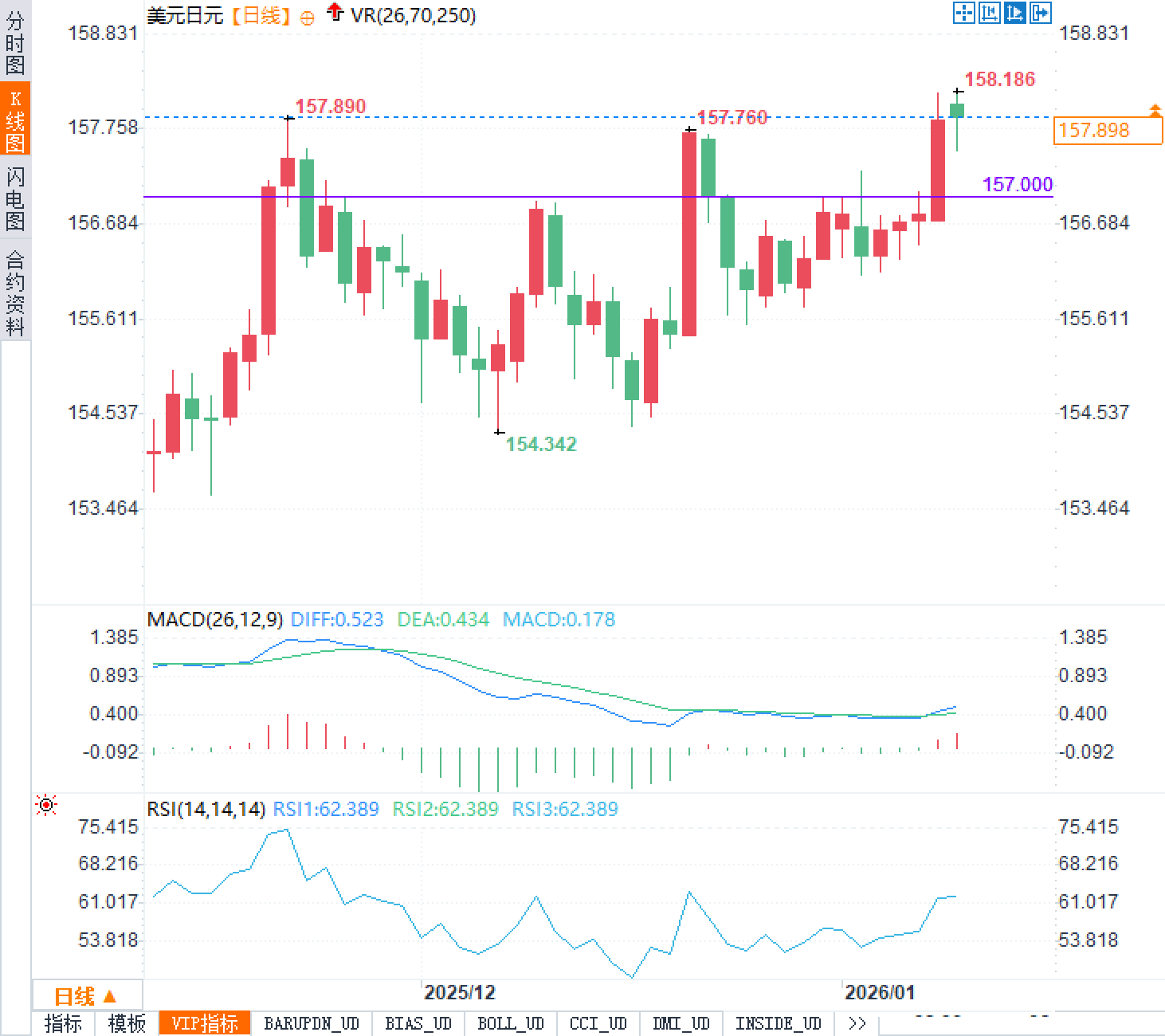
From a technical chart perspective, the USD/JPY daily chart structure remains bullish. The price has repeatedly tested the previous high area, with the most recent high marked at 158.186, indicating that this level has become a clear psychological and technical resistance zone. Support is concentrated around 157.000, a crucial watershed. If the price retraces but does not break below this level, the bullish trend remains intact; however, a decisive break below this level followed by further declines warrants caution, as the pullback could extend to 156.50 or even lower.
Other technical indicators also confirm the current complex situation. In the MACD, the DIFF is 0.523, the DEA is 0.434, and the MACD histogram is 0.178, indicating that the bullish momentum is still there, but it is in a "high-level stagnation" state. The RSI (14) is about 62.389, which is above the strong and weak dividing line, but has not entered the overbought zone, reflecting that although the market is relatively strong, the willingness to chase higher prices is insufficient.
In summary, the USD/JPY pair is currently in a "catalyst-awaiting" phase. An upward breakout requires stronger drivers, such as a rebound in inflation or expectations of the Bank of Japan further delaying interest rate hikes; a downward correction depends on a combination of weakening US data and improved yen fundamentals. In the absence of a clear direction, 157.000 and 158.20 will be important anchor points for short-term trading.
The core logic supporting the dollar's strength remains the interest rate differential and the difference in monetary policy expectations. While the Federal Reserve has recently signaled caution in its policy, interest rates remain at a high level, while the Bank of Japan, although having begun its rate hike cycle, is proceeding slowly and with considerable uncertainty. This difference in pace—one fast, one slow—has given the dollar an overall advantage. However, as it approaches the key psychological level of 158, market enthusiasm for further gains has noticeably weakened. This is partly due to heightened risk aversion, with some funds turning to the yen for refuge; and partly due to increased concerns about the Federal Reserve's ability to make truly independent decisions, thus limiting the dollar's further upward momentum.
The Yen's Dilemma: Policy Ambiguity + Political Instability Make it Difficult for Bulls to Make a Move
From the perspective of the yen itself, the biggest problem lies in its unclear direction. Although Bank of Japan Governor Kazuo Ueda has repeatedly stated that if the economy and inflation meet expectations, interest rate hikes will continue, he has also emphasized that policy adjustments will remain "flexible." This ambiguous statement has left the market confused—people are no longer debating "whether interest rates will be raised," but rather repeatedly speculating "when they will be raised." As a result, trading activity is more driven by news, making it difficult to form a sustained yen rebound.
Adding to the woes is the political uncertainty within Japan. Reports indicate that Prime Minister Sanae Takaichi is considering holding an early parliamentary election in the first half of February, with possible window dates including February 8th or 15th. Such political rumors often trigger market concerns about fiscal expansion and policy continuity, leading short-term funds to reduce their long yen positions and await clarity. Furthermore, the start of the week coincides with a Japanese public holiday, reducing market liquidity; even minor news can cause significant price volatility, making a "surge without volume, rapid pullback" pattern unsurprising.
Meanwhile, geopolitical tensions should have benefited the yen, a traditional safe-haven currency. However, in reality, this support has only acted as a decelerator, rather than an engine driving a trend reversal. Recent escalation in Venezuela, strong rhetoric against Iran, and renewed tensions in the Russia-Ukraine conflict have indeed suppressed global risk appetite, leading to some capital inflows into the yen. However, as long as interest rate differentials among major economies persist, it will be difficult for the yen to achieve a fundamental reversal based on a single event. Structural pressures remain heavy.
The US dollar is caught in a dilemma, and the data game has entered a heated phase.
Conversely, the US dollar is not without its own challenges. The latest employment data shows that only 50,000 jobs were added in December, lower than the market expectation of 60,000 and also lower than the previous figure of 56,000 (revised from 64,000). This figure indicates that the momentum of the US economy is slowing marginally. However, at the same time, the unemployment rate unexpectedly fell to 4.4%, indicating that the labor market has not yet fully deteriorated. This contradictory data of "weakness with stability" has left the market uncertain about the Federal Reserve's next move.
Analysts have noted that the market is repricing its expectations for the interest rate path before and after the January 28th policy meeting. Of particular note is Federal Reserve Chairman Powell's rare statement—he explicitly emphasized that central bank interest rate decisions should be based on the best judgment of the public interest, not on catering to political pressure. This seemingly ordinary statement sends a strong signal: even if future data supports a rate cut, policy communication may lead to periodic fluctuations. This also explains why, despite weak employment data, the dollar did not weaken significantly, but instead encountered profit-taking at high levels. Traders are beginning to realize that the risks of one-sided bets are rising.
The market's focus has now shifted to the upcoming US inflation data. The Consumer Price Index (CPI) and Producer Price Index (PPI) will be released on Tuesday and Wednesday, respectively, and these two indicators will be crucial in determining the short-term trend. If inflation strengthens again, the market will reinforce expectations of "high interest rates lasting longer," and the USD/JPY pair may retest the 158.20 area. Conversely, if inflation falls significantly, coupled with a slowdown in employment, expectations of a policy shift will rise, putting pressure on the dollar and potentially causing the exchange rate to give back its recent gains.
Technical indicators are releasing key signals, suggesting the consolidation pattern may continue.
From a technical chart perspective, the USD/JPY daily chart structure remains bullish. The price has repeatedly tested the previous high area, with the most recent high marked at 158.186, indicating that this level has become a clear psychological and technical resistance zone. Support is concentrated around 157.000, a crucial watershed. If the price retraces but does not break below this level, the bullish trend remains intact; however, a decisive break below this level followed by further declines warrants caution, as the pullback could extend to 156.50 or even lower.
Other technical indicators also confirm the current complex situation. In the MACD, the DIFF is 0.523, the DEA is 0.434, and the MACD histogram is 0.178, indicating that the bullish momentum is still there, but it is in a "high-level stagnation" state. The RSI (14) is about 62.389, which is above the strong and weak dividing line, but has not entered the overbought zone, reflecting that although the market is relatively strong, the willingness to chase higher prices is insufficient.
In summary, the USD/JPY pair is currently in a "catalyst-awaiting" phase. An upward breakout requires stronger drivers, such as a rebound in inflation or expectations of the Bank of Japan further delaying interest rate hikes; a downward correction depends on a combination of weakening US data and improved yen fundamentals. In the absence of a clear direction, 157.000 and 158.20 will be important anchor points for short-term trading.
- Risk Warning and Disclaimer
- The market involves risk, and trading may not be suitable for all investors. This article is for reference only and does not constitute personal investment advice, nor does it take into account certain users’ specific investment objectives, financial situation, or other needs. Any investment decisions made based on this information are at your own risk.