Trump imposes 25% tariffs on countries trading with Iran, pushing oil prices to a one-month high.
2026-01-13 09:07:35
U.S. President Donald Trump announced a comprehensive new policy on Monday afternoon (January 12) that would immediately impose a 25% tariff on any country doing business with Iran. This move comes as Washington closely monitors Tehran's response to large-scale anti-government protests.
Trump outlined the new economic sanctions in a post on the social media platform Truth Social.
He wrote: "Effective immediately, any country that does business with the Islamic Republic of Iran will be subject to a 25% tariff on all its business dealings with the United States of America." He emphasized the decisiveness of this move and added: "This order is final and irrevocable."
This statement marks a significant escalation of economic pressure, directly linking international trade relations to U.S. foreign policy toward Iran.
Further details of the tariff announcement have not yet been made available.
The new tariff is described as a response to the Iranian government's handling of recent nationwide protests, in which hundreds of protesters have reportedly been killed during more than two weeks of demonstrations sparked by economic hardship and other grievances.
Earlier this month, Trump stated that the United States would "come to the rescue" if Iran "violently kills peaceful protesters."
The tariff policy was announced shortly after comments made by White House Press Secretary Carolyn Levitt. In a press interview, Levitt stated that while diplomacy remains the administration's "preferred option" in dealing with Iran, the use of force remains one of the president's available options.
These tariffs—including the controversial “reciprocal” tariffs imposed in early April and other smuggling-related tariffs—are implemented under the International Emergency Economic Powers Act (IEEPA).
It remains unclear whether Trump's latest announcement of tariffs on Iran is also based on this law.
Trump's announcement of a 25% tariff on countries trading with Iran will directly threaten Iranian crude oil exports and could trigger a global supply shortage. Short-term oil prices may rise due to panic buying and geopolitical risk premiums.
Major Asian importers are facing pressure to find alternative oil sources, while the limited production capacity of US shale oil makes it difficult to quickly fill the gap. This has exacerbated supply risks and price volatility in the global crude oil market.
On Tuesday in Asian trading, US crude oil prices fluctuated upwards, rising about 0.4% on the day, and once touched a near one-month high of $59.95 per barrel. Oil prices had previously risen for three consecutive trading days, with a cumulative increase of about 6%.
5.
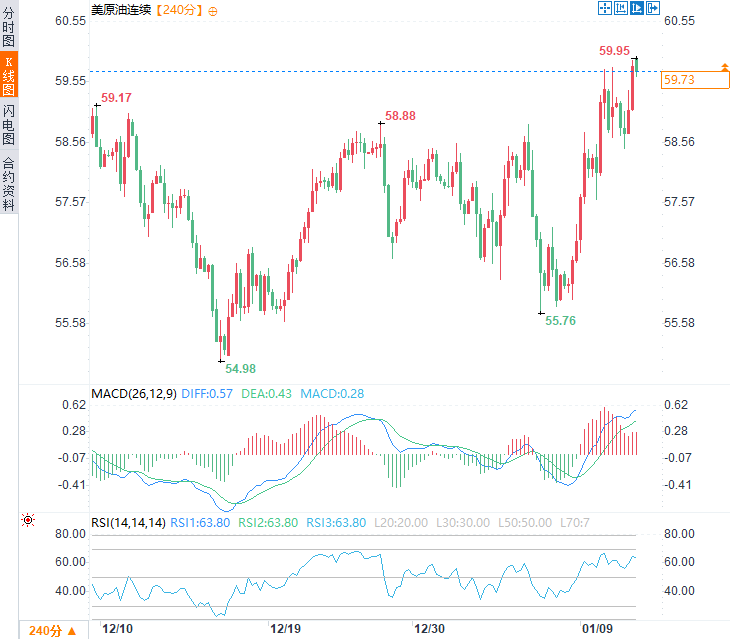
(US crude oil 4-hour chart, source: FX678)
At 9:07 AM Beijing time, US crude oil futures were trading at $59.83 per barrel.
Instant Economy Ultimatum
Trump outlined the new economic sanctions in a post on the social media platform Truth Social.
He wrote: "Effective immediately, any country that does business with the Islamic Republic of Iran will be subject to a 25% tariff on all its business dealings with the United States of America." He emphasized the decisiveness of this move and added: "This order is final and irrevocable."
This statement marks a significant escalation of economic pressure, directly linking international trade relations to U.S. foreign policy toward Iran.
Further details of the tariff announcement have not yet been made available.
The policy followed closely on the heels of the crackdown on the protests.
The new tariff is described as a response to the Iranian government's handling of recent nationwide protests, in which hundreds of protesters have reportedly been killed during more than two weeks of demonstrations sparked by economic hardship and other grievances.
Earlier this month, Trump stated that the United States would "come to the rescue" if Iran "violently kills peaceful protesters."
The White House retains all options.
The tariff policy was announced shortly after comments made by White House Press Secretary Carolyn Levitt. In a press interview, Levitt stated that while diplomacy remains the administration's "preferred option" in dealing with Iran, the use of force remains one of the president's available options.
These tariffs—including the controversial “reciprocal” tariffs imposed in early April and other smuggling-related tariffs—are implemented under the International Emergency Economic Powers Act (IEEPA).
It remains unclear whether Trump's latest announcement of tariffs on Iran is also based on this law.
Impact on the crude oil market
Trump's announcement of a 25% tariff on countries trading with Iran will directly threaten Iranian crude oil exports and could trigger a global supply shortage. Short-term oil prices may rise due to panic buying and geopolitical risk premiums.
Major Asian importers are facing pressure to find alternative oil sources, while the limited production capacity of US shale oil makes it difficult to quickly fill the gap. This has exacerbated supply risks and price volatility in the global crude oil market.
On Tuesday in Asian trading, US crude oil prices fluctuated upwards, rising about 0.4% on the day, and once touched a near one-month high of $59.95 per barrel. Oil prices had previously risen for three consecutive trading days, with a cumulative increase of about 6%.
5.
(US crude oil 4-hour chart, source: FX678)
At 9:07 AM Beijing time, US crude oil futures were trading at $59.83 per barrel.
- Risk Warning and Disclaimer
- The market involves risk, and trading may not be suitable for all investors. This article is for reference only and does not constitute personal investment advice, nor does it take into account certain users’ specific investment objectives, financial situation, or other needs. Any investment decisions made based on this information are at your own risk.