The yen remained under pressure, with the dollar hitting a new high against the yen in July.
2026-01-13 14:25:47
The US dollar continued its upward trend against the Japanese yen during Tuesday's Asian trading session, reaching around 159.00, its highest level since July 2024. News that Japanese Prime Minister Sanae Takaichi might call a snap election in early February fueled market expectations for further expansionary fiscal policies.
In addition, uncertainty surrounding the timing of the Bank of Japan's next interest rate hike, coupled with supply chain risks and rising global risk appetite, are all putting continued pressure on the yen.
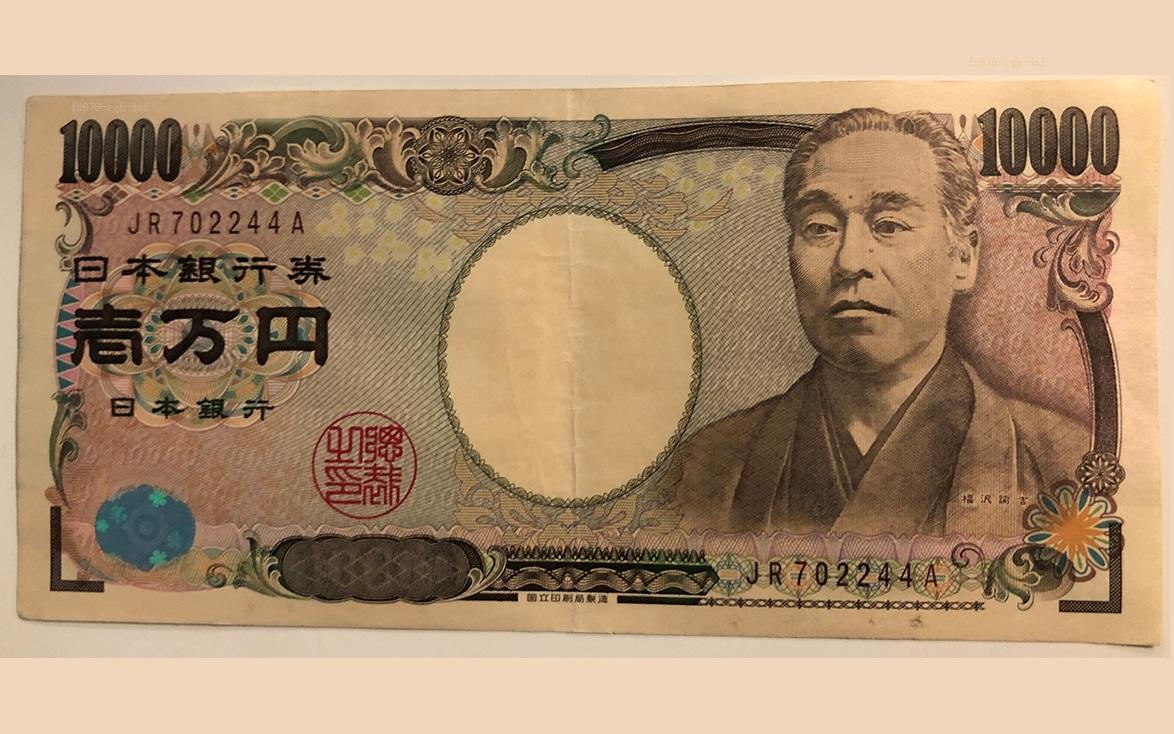 Although the recent rapid depreciation of the yen may trigger verbal intervention from the Japanese authorities, making yen short sellers cautious about chasing the rally, the dollar's buying interest is limited due to the issue of the Federal Reserve's independence, and it is unlikely to be under full pressure in the short term.
Investors are also awaiting US December consumer inflation data for the latest signals on the Federal Reserve's future interest rate path, which will have a key impact on the near-term movement of the USD/JPY exchange rate. Japan's Finance Minister stated that he has expressed concern to the US Treasury Secretary regarding the unilateral depreciation of the yen and emphasized that there is limited room for further depreciation.
Market expectations that the Federal Reserve may cut interest rates twice in 2026 are significantly diverging from the Bank of Japan's continued policy normalization, which to some extent limits the further upside potential of the USD/JPY exchange rate.
The Bank of Japan governor stated that as long as the economy and prices move in line with expectations, interest rate hikes will continue, and the possibility of policy tightening remains.
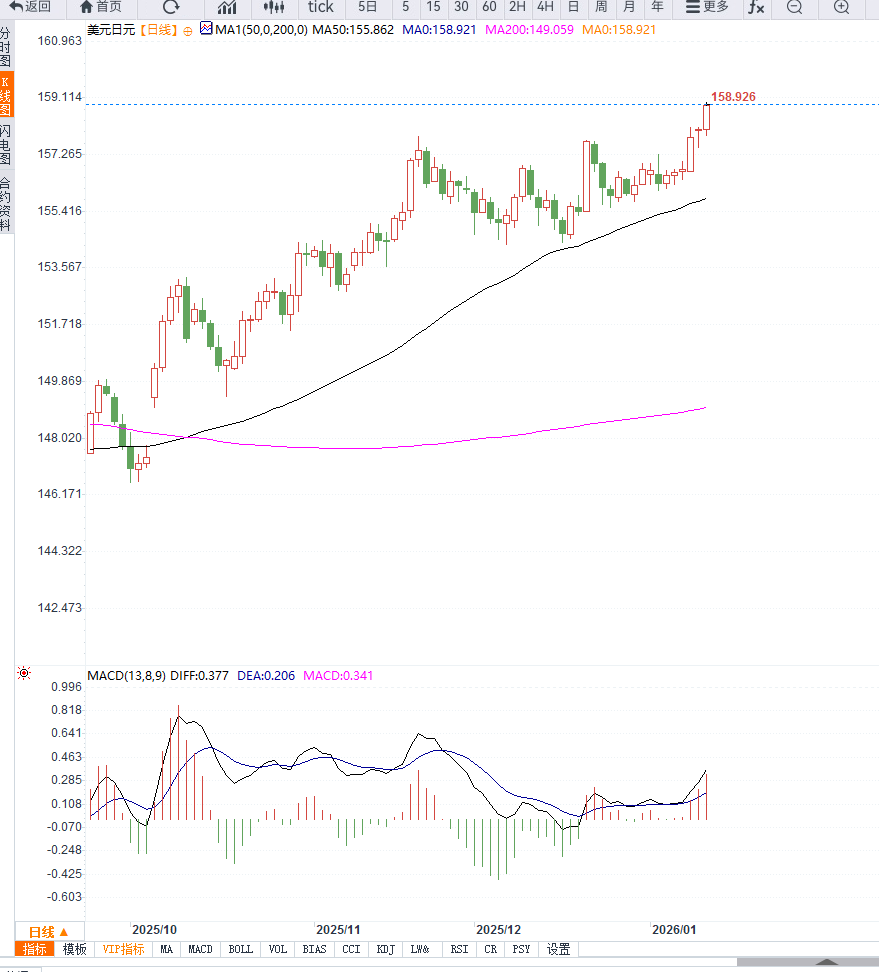
From the daily chart, the USD/JPY pair maintains a clear bullish pattern. The price action has seen consecutive medium-to-long bullish candles, indicating a steady upward momentum. The 50-day simple moving average (SMA) continues to rise, and the price is holding above it. The SMA, located around 156.00, provides dynamic support for the recent upward movement.
The MACD indicator formed a golden cross near the zero line, and the histogram turned positive, indicating improved momentum. The RSI is 67.47, which is strong but has not entered the overbought zone, leaving room for the exchange rate to rise.
As long as the price stays above the rising SMA on the daily chart, the pullback will be controlled, and there is a possibility of further upward movement to 158.00 or even 159.50; if the closing price falls below the moving average, the bullish momentum may weaken and the price may enter a consolidation phase.
On the 4-hour chart, the exchange rate is showing a short-term upward trend. The price remains above the short-term and medium-term moving averages, which are in a bullish alignment, providing relatively solid support. The MACD continues its golden cross above the zero line, with the histogram remaining positive and momentum maintaining an upward trend.
The KDJ indicator is running at a high level but has not completely diverged, indicating further upward momentum in the short term. The 4-hour chart suggests that the exchange rate may continue to fluctuate upwards within the 158.50–159.50 range, awaiting new policy or data signals to trigger a directional breakout.
Editor's Note:
The short-term strength of the USD/JPY pair is mainly driven by declining demand for the yen as a safe haven and expectations surrounding Japanese politics, with technical indicators showing a solid bullish trend. Although Japanese authorities may intervene verbally to curb the yen's depreciation, the market still favors a stronger dollar in the short term.
Key factors to watch include upcoming US inflation data and Japanese policy developments, which will determine whether the USD/JPY pair can continue its upward breakout or enter a range-bound trading pattern.
In addition, uncertainty surrounding the timing of the Bank of Japan's next interest rate hike, coupled with supply chain risks and rising global risk appetite, are all putting continued pressure on the yen.
Although the recent rapid depreciation of the yen may trigger verbal intervention from the Japanese authorities, making yen short sellers cautious about chasing the rally, the dollar's buying interest is limited due to the issue of the Federal Reserve's independence, and it is unlikely to be under full pressure in the short term.Investors are also awaiting US December consumer inflation data for the latest signals on the Federal Reserve's future interest rate path, which will have a key impact on the near-term movement of the USD/JPY exchange rate. Japan's Finance Minister stated that he has expressed concern to the US Treasury Secretary regarding the unilateral depreciation of the yen and emphasized that there is limited room for further depreciation.
Market expectations that the Federal Reserve may cut interest rates twice in 2026 are significantly diverging from the Bank of Japan's continued policy normalization, which to some extent limits the further upside potential of the USD/JPY exchange rate.
The Bank of Japan governor stated that as long as the economy and prices move in line with expectations, interest rate hikes will continue, and the possibility of policy tightening remains.
From the daily chart, the USD/JPY pair maintains a clear bullish pattern. The price action has seen consecutive medium-to-long bullish candles, indicating a steady upward momentum. The 50-day simple moving average (SMA) continues to rise, and the price is holding above it. The SMA, located around 156.00, provides dynamic support for the recent upward movement.
The MACD indicator formed a golden cross near the zero line, and the histogram turned positive, indicating improved momentum. The RSI is 67.47, which is strong but has not entered the overbought zone, leaving room for the exchange rate to rise.
As long as the price stays above the rising SMA on the daily chart, the pullback will be controlled, and there is a possibility of further upward movement to 158.00 or even 159.50; if the closing price falls below the moving average, the bullish momentum may weaken and the price may enter a consolidation phase.
On the 4-hour chart, the exchange rate is showing a short-term upward trend. The price remains above the short-term and medium-term moving averages, which are in a bullish alignment, providing relatively solid support. The MACD continues its golden cross above the zero line, with the histogram remaining positive and momentum maintaining an upward trend.
The KDJ indicator is running at a high level but has not completely diverged, indicating further upward momentum in the short term. The 4-hour chart suggests that the exchange rate may continue to fluctuate upwards within the 158.50–159.50 range, awaiting new policy or data signals to trigger a directional breakout.
Editor's Note:
The short-term strength of the USD/JPY pair is mainly driven by declining demand for the yen as a safe haven and expectations surrounding Japanese politics, with technical indicators showing a solid bullish trend. Although Japanese authorities may intervene verbally to curb the yen's depreciation, the market still favors a stronger dollar in the short term.
Key factors to watch include upcoming US inflation data and Japanese policy developments, which will determine whether the USD/JPY pair can continue its upward breakout or enter a range-bound trading pattern.
- Risk Warning and Disclaimer
- The market involves risk, and trading may not be suitable for all investors. This article is for reference only and does not constitute personal investment advice, nor does it take into account certain users’ specific investment objectives, financial situation, or other needs. Any investment decisions made based on this information are at your own risk.