Is the dollar's hegemony crumbling? Trump's tariffs and pressure on the Federal Reserve may be digging the dollar's grave!
2026-01-13 15:12:14
Although US President Trump has blamed the de-dollarization trend on foreign investors and BRICS countries, closer examination suggests that his own policies and rhetoric were the main catalysts accelerating this shift.
Although the dollar's role as the world's reserve currency had been gradually diminishing for decades long before President Trump's term, his administration's actions have significantly boosted this trend. On Tuesday (January 13), the dollar index fluctuated around 98.98 during the European session.
Trump's strategy of using "reciprocal tariffs" aimed to reduce the U.S. trade deficit. However, a direct consequence of this policy is that if countries cannot sell goods to the U.S., they cannot earn the dollars needed for international trade and investment .
This approach, coupled with insistence on bilateral negotiations, has unsettled global partners, including long-time U.S. allies. As countries reassess their economic dependence on the United States, they are actively seeking alternatives to the dollar, inadvertently accelerating the de-dollarization process. These defensive countermeasures are a direct response to the pressure tactics employed by Washington.
To combat inflation stemming from the pandemic and the Russia-Ukraine conflict, the Federal Reserve has maintained relatively high interest rates since 2022. As the Fed raises rates, the yield on US government debt also climbs.
However, President Trump is now pressuring the Federal Reserve to cut interest rates significantly. His goal is to reduce the debt servicing costs of the massive debt borne by the federal government and private enterprises. In 2024, interest payments alone will account for approximately 3% of the U.S. federal government's GDP. Given that the national debt already exceeds 120% of GDP, these costs can only be kept under control if interest rates remain low.
His public attacks on Federal Reserve Chairman Jerome Powell unsettled investors, undermining confidence in the Fed's independence and raising serious questions about future monetary policy.
Investors are increasingly concerned that Trump's influence on the Federal Reserve could force interest rates to be lowered prematurely, a move they believe would trigger a new round of inflation and cause the dollar to depreciate against other major currencies. If the Fed is forced to buy U.S. Treasury bonds in a new round of quantitative easing, the real return on dollar-denominated investments could turn negative.
While the worst inflation fears have yet to materialize, the impact of tariffs on prices is undeniable. Many U.S. companies stockpiled imported goods before the tariffs took effect on April 2, 2025. As these inventories gradually dwindle, price increases are inevitable.
This environment has prompted many investors and monetary authorities worldwide to sell off their dollar-denominated assets in search of alternatives. Such selling directly puts downward pressure on the dollar's value, creating a feedback loop that further accelerates de-dollarization.
Washington is increasingly worried that foreign investors will continue to sell off U.S. Treasury bonds. In 2015, foreigners held one-third of the debt; now that proportion has fallen to less than one-quarter.
Proposals such as the "Mar-a-Lago Agreement," which require foreign governments to hold U.S. Treasury bonds for 100 years with a guarantee of losses, will only exacerbate discontent.
For the highly financialized U.S. economy, efforts to lower Treasury yields are both difficult and risky. Previous bond market turmoil triggered a stock market sell-off, leading to declines in stock prices and tax revenue. Furthermore, trillions of dollars in corporate bonds will mature over the next two years, and rising interest rates will significantly increase borrowing costs for U.S. companies, many of which had hoped to refinance at lower rates.
However, any attempt to artificially suppress interest rates amid persistent inflation will signal to investors that negative real yields will persist for a long time, further reducing the attractiveness of dollar assets.
President Trump's policies, particularly his use of tariffs and sanctions as a threat, have triggered a global reaction and are steadily eroding the dollar's dominance. This process is accelerating, compounded by declining public confidence in U.S. institutions.
A clear sign of this shift will appear in mid-2025 when a massive sell-off of U.S. assets causes the dollar to suffer its biggest drop since the 1973 oil crisis, depreciating by more than 10% against other major currencies.
Historically, during periods of financial stress, dollar liquidity has been seen as the ultimate safe haven. However, the sell-off in 2025 suggests that this confidence is waning. While Trump has been adept at handling short-term market volatility, his unpredictable style has left everyone wondering when the dollar's "music" will finally stop.
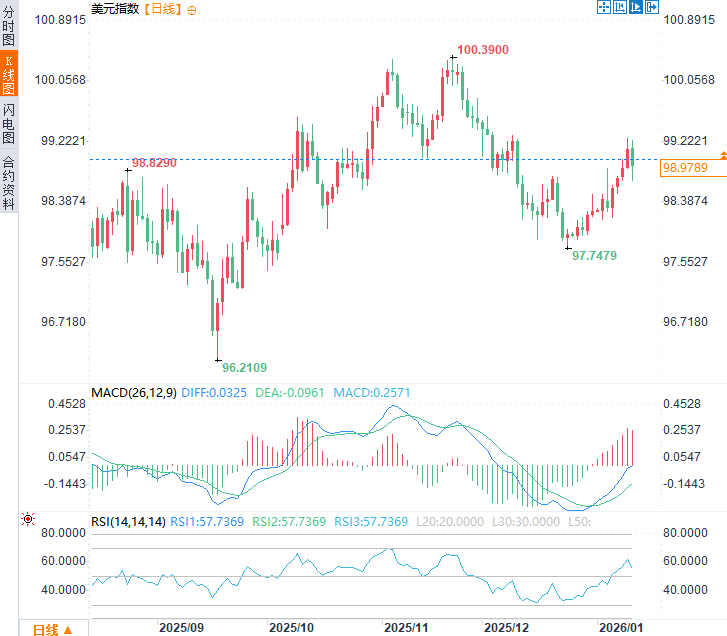
(US Dollar Index Daily Chart, Source: FX678)
Conclusion : Trump's policies, through multiple channels including trade measures, Federal Reserve intervention, and debt management, have systematically weakened the global status of the US dollar. While de-dollarization is not an overnight process, its progress has accelerated significantly due to the combined effects of policy catalysts and market feedback, and the dollar system is facing its most severe structural challenges in decades.
At 15:11 Beijing time, the US dollar index is currently at 99.00.
Although the dollar's role as the world's reserve currency had been gradually diminishing for decades long before President Trump's term, his administration's actions have significantly boosted this trend. On Tuesday (January 13), the dollar index fluctuated around 98.98 during the European session.
How tariffs are pushing countries away from the dollar
Trump's strategy of using "reciprocal tariffs" aimed to reduce the U.S. trade deficit. However, a direct consequence of this policy is that if countries cannot sell goods to the U.S., they cannot earn the dollars needed for international trade and investment .
This approach, coupled with insistence on bilateral negotiations, has unsettled global partners, including long-time U.S. allies. As countries reassess their economic dependence on the United States, they are actively seeking alternatives to the dollar, inadvertently accelerating the de-dollarization process. These defensive countermeasures are a direct response to the pressure tactics employed by Washington.
Trump vs. the Federal Reserve: The Interest Rate Battle
To combat inflation stemming from the pandemic and the Russia-Ukraine conflict, the Federal Reserve has maintained relatively high interest rates since 2022. As the Fed raises rates, the yield on US government debt also climbs.
However, President Trump is now pressuring the Federal Reserve to cut interest rates significantly. His goal is to reduce the debt servicing costs of the massive debt borne by the federal government and private enterprises. In 2024, interest payments alone will account for approximately 3% of the U.S. federal government's GDP. Given that the national debt already exceeds 120% of GDP, these costs can only be kept under control if interest rates remain low.
His public attacks on Federal Reserve Chairman Jerome Powell unsettled investors, undermining confidence in the Fed's independence and raising serious questions about future monetary policy.
Inflation concerns fuel panic among dollar investors
Investors are increasingly concerned that Trump's influence on the Federal Reserve could force interest rates to be lowered prematurely, a move they believe would trigger a new round of inflation and cause the dollar to depreciate against other major currencies. If the Fed is forced to buy U.S. Treasury bonds in a new round of quantitative easing, the real return on dollar-denominated investments could turn negative.
While the worst inflation fears have yet to materialize, the impact of tariffs on prices is undeniable. Many U.S. companies stockpiled imported goods before the tariffs took effect on April 2, 2025. As these inventories gradually dwindle, price increases are inevitable.
This environment has prompted many investors and monetary authorities worldwide to sell off their dollar-denominated assets in search of alternatives. Such selling directly puts downward pressure on the dollar's value, creating a feedback loop that further accelerates de-dollarization.
Foreign demand for U.S. Treasury bonds is weakening.
Washington is increasingly worried that foreign investors will continue to sell off U.S. Treasury bonds. In 2015, foreigners held one-third of the debt; now that proportion has fallen to less than one-quarter.
Proposals such as the "Mar-a-Lago Agreement," which require foreign governments to hold U.S. Treasury bonds for 100 years with a guarantee of losses, will only exacerbate discontent.
For the highly financialized U.S. economy, efforts to lower Treasury yields are both difficult and risky. Previous bond market turmoil triggered a stock market sell-off, leading to declines in stock prices and tax revenue. Furthermore, trillions of dollars in corporate bonds will mature over the next two years, and rising interest rates will significantly increase borrowing costs for U.S. companies, many of which had hoped to refinance at lower rates.
However, any attempt to artificially suppress interest rates amid persistent inflation will signal to investors that negative real yields will persist for a long time, further reducing the attractiveness of dollar assets.
Has de-dollarization reached a tipping point?
President Trump's policies, particularly his use of tariffs and sanctions as a threat, have triggered a global reaction and are steadily eroding the dollar's dominance. This process is accelerating, compounded by declining public confidence in U.S. institutions.
A clear sign of this shift will appear in mid-2025 when a massive sell-off of U.S. assets causes the dollar to suffer its biggest drop since the 1973 oil crisis, depreciating by more than 10% against other major currencies.
Historically, during periods of financial stress, dollar liquidity has been seen as the ultimate safe haven. However, the sell-off in 2025 suggests that this confidence is waning. While Trump has been adept at handling short-term market volatility, his unpredictable style has left everyone wondering when the dollar's "music" will finally stop.
(US Dollar Index Daily Chart, Source: FX678)
Conclusion : Trump's policies, through multiple channels including trade measures, Federal Reserve intervention, and debt management, have systematically weakened the global status of the US dollar. While de-dollarization is not an overnight process, its progress has accelerated significantly due to the combined effects of policy catalysts and market feedback, and the dollar system is facing its most severe structural challenges in decades.
At 15:11 Beijing time, the US dollar index is currently at 99.00.
- Risk Warning and Disclaimer
- The market involves risk, and trading may not be suitable for all investors. This article is for reference only and does not constitute personal investment advice, nor does it take into account certain users’ specific investment objectives, financial situation, or other needs. Any investment decisions made based on this information are at your own risk.