US inflation data was moderate, but employment remained strong, causing the dollar index to fluctuate at high levels, hovering around the 99 mark.
2026-01-14 16:23:22
The US dollar index (DXY) edged lower in Asian trading on Wednesday, hovering around 99.10. After a modest gain in the previous session, the market entered a wait-and-see mode as investors awaited the release of US retail sales and producer price index (PPI) data during the North American session to further assess the latest developments in inflation and economic momentum.
The latest U.S. Consumer Price Index (CPI) figures were largely in line with market expectations. Data shows that the CPI rose 0.3% month-on-month in December 2025, consistent with expectations; the year-on-year increase remained at 2.7%. The core CPI, excluding food and energy prices, rose 0.2% month-on-month, lower than market expectations, while the core year-on-year growth rate remained at 2.6%, a four-year low.
Inflation data suggests that price pressures in the United States are slowly easing, providing some evidence for the downward trend in inflation. However, the cooling of inflation has not significantly weakened the dollar.
The previously released strong non-farm payroll report, declining unemployment rate, and a solid four-week moving average of ADP employment data indicate that the US labor market remains resilient. This has led the market to widely believe that the Federal Reserve is highly likely to keep policy rates unchanged at its meeting this month, and even if there is room for future rate cuts, the pace will likely be cautious.
On the other hand, the upside potential of the US dollar is constrained by concerns about the independence of the Federal Reserve. The threat of charges by US federal prosecutors against Federal Reserve Chairman Jerome Powell for his previous remarks to Congress regarding the headquarters renovation project has raised market doubts about the central bank's policy independence.
The Trump administration continues to pressure the Federal Reserve to cut interest rates, while Powell has called the allegations “an excuse for pressuring the government”, adding uncertainty to the dollar’s trajectory.
Furthermore, continued geopolitical tensions have also led to cautious market sentiment. US President Trump's public call for continued protests in Iran, coupled with his statement that "aid is on its way," has further exacerbated regional tensions. Until these risk events become clearer, the US dollar is likely to maintain a volatile trading pattern in the short term.
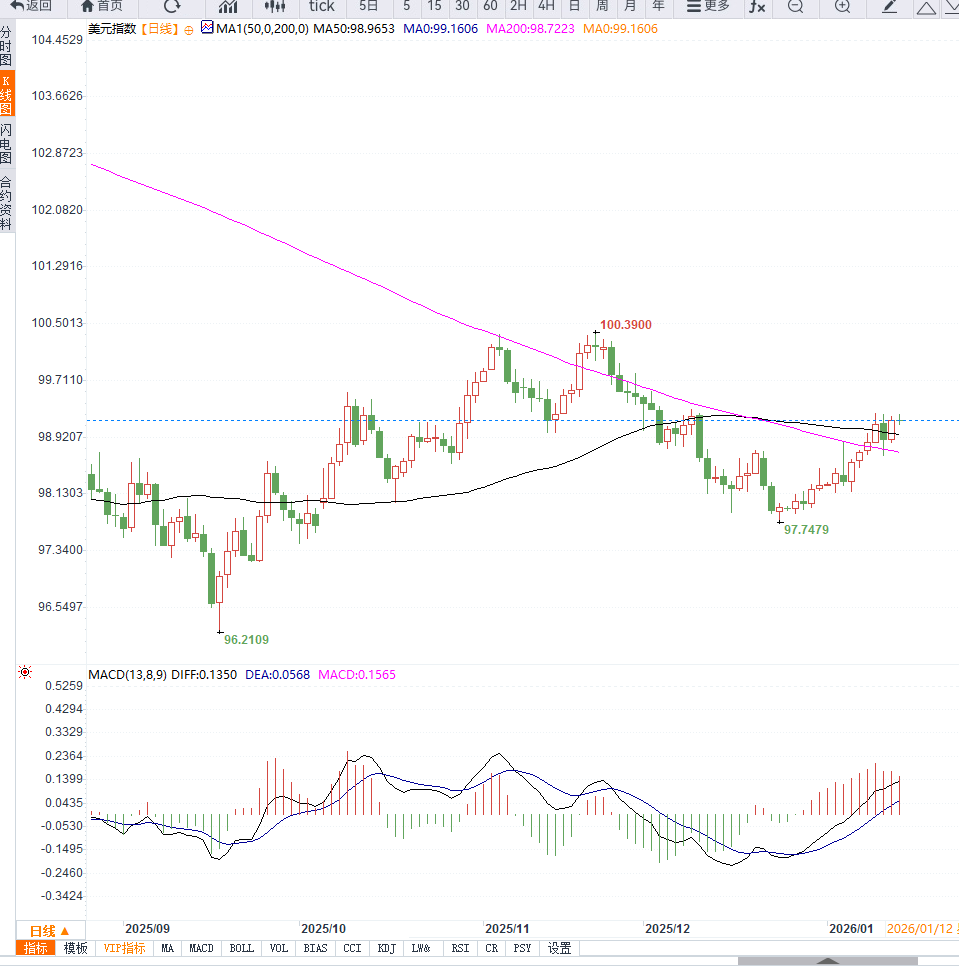
From a daily chart perspective, the US dollar index maintains an overall oscillating but slightly bullish pattern, although upward momentum has slowed. The price action around the 99 level indicates increasing divergence between bulls and bears, and the short-term direction remains unclear.
Prices are still trading above the 50-day and 100-day moving averages, indicating that the medium-term trend has not weakened. However, the short-term moving averages are flattening, suggesting that momentum is beginning to slow. The daily KDJ indicator has turned downwards from a high level, and the K and D lines show signs of forming a death cross, reflecting short-term technical downward pressure.
Although the MACD indicator remains above the zero line, the red momentum bars continue to shrink, indicating that the bullish momentum is weakening. In the absence of new positive catalysts, the US dollar index is likely to consolidate at high levels in the short term, with support levels to watch in the 98.60-98.80 range. A break below this level could lead to a wider pullback.
The resistance level is concentrated around 99.50, and it will be difficult to resume the upward trend before a breakthrough is achieved.
Editor's Note:
Overall, the US dollar index is currently in a tug-of-war between bullish and bearish forces. On the one hand, while inflation has moderated, employment remains strong, giving the Federal Reserve little incentive to quickly shift to an easing stance in the short term, thus supporting the dollar.
On the other hand, the controversy surrounding the Federal Reserve's independence and geopolitical uncertainties have dampened market bullish sentiment. Until key economic data and policy signals become clearer, the dollar index is more likely to fluctuate around the 99 level, awaiting new directional catalysts.
The latest U.S. Consumer Price Index (CPI) figures were largely in line with market expectations. Data shows that the CPI rose 0.3% month-on-month in December 2025, consistent with expectations; the year-on-year increase remained at 2.7%. The core CPI, excluding food and energy prices, rose 0.2% month-on-month, lower than market expectations, while the core year-on-year growth rate remained at 2.6%, a four-year low.
Inflation data suggests that price pressures in the United States are slowly easing, providing some evidence for the downward trend in inflation. However, the cooling of inflation has not significantly weakened the dollar.
The previously released strong non-farm payroll report, declining unemployment rate, and a solid four-week moving average of ADP employment data indicate that the US labor market remains resilient. This has led the market to widely believe that the Federal Reserve is highly likely to keep policy rates unchanged at its meeting this month, and even if there is room for future rate cuts, the pace will likely be cautious.
On the other hand, the upside potential of the US dollar is constrained by concerns about the independence of the Federal Reserve. The threat of charges by US federal prosecutors against Federal Reserve Chairman Jerome Powell for his previous remarks to Congress regarding the headquarters renovation project has raised market doubts about the central bank's policy independence.
The Trump administration continues to pressure the Federal Reserve to cut interest rates, while Powell has called the allegations “an excuse for pressuring the government”, adding uncertainty to the dollar’s trajectory.
Furthermore, continued geopolitical tensions have also led to cautious market sentiment. US President Trump's public call for continued protests in Iran, coupled with his statement that "aid is on its way," has further exacerbated regional tensions. Until these risk events become clearer, the US dollar is likely to maintain a volatile trading pattern in the short term.
From a daily chart perspective, the US dollar index maintains an overall oscillating but slightly bullish pattern, although upward momentum has slowed. The price action around the 99 level indicates increasing divergence between bulls and bears, and the short-term direction remains unclear.
Prices are still trading above the 50-day and 100-day moving averages, indicating that the medium-term trend has not weakened. However, the short-term moving averages are flattening, suggesting that momentum is beginning to slow. The daily KDJ indicator has turned downwards from a high level, and the K and D lines show signs of forming a death cross, reflecting short-term technical downward pressure.
Although the MACD indicator remains above the zero line, the red momentum bars continue to shrink, indicating that the bullish momentum is weakening. In the absence of new positive catalysts, the US dollar index is likely to consolidate at high levels in the short term, with support levels to watch in the 98.60-98.80 range. A break below this level could lead to a wider pullback.
The resistance level is concentrated around 99.50, and it will be difficult to resume the upward trend before a breakthrough is achieved.
Editor's Note:
Overall, the US dollar index is currently in a tug-of-war between bullish and bearish forces. On the one hand, while inflation has moderated, employment remains strong, giving the Federal Reserve little incentive to quickly shift to an easing stance in the short term, thus supporting the dollar.
On the other hand, the controversy surrounding the Federal Reserve's independence and geopolitical uncertainties have dampened market bullish sentiment. Until key economic data and policy signals become clearer, the dollar index is more likely to fluctuate around the 99 level, awaiting new directional catalysts.
- Risk Warning and Disclaimer
- The market involves risk, and trading may not be suitable for all investors. This article is for reference only and does not constitute personal investment advice, nor does it take into account certain users’ specific investment objectives, financial situation, or other needs. Any investment decisions made based on this information are at your own risk.