Crude oil prices surged! $70 is just around the corner, but are some people panicking?
2026-01-14 19:35:22
On Wednesday (January 14), Brent crude oil was quoted at around $66.30 per barrel during the European session, continuing its upward trend. The price had previously touched $66.43 per barrel; US crude oil also reached $61.83 per barrel during the same period. This marks the fifth consecutive trading day of increases in oil prices. The core driving force behind this is not a sudden change in actual supply and demand, but rather the continued rise in the "risk premium" brought about by geopolitical tensions in the Middle East.

The recent situation in Iran has become a market focus, with escalating rhetoric raising widespread concerns about potential supply disruptions. While there have been no verifiable production declines or transportation disruptions, financial markets tend to price in advance—especially when uncertainty rises. Once the market perceives a slight increase in the probability of conflict, traders quickly add an "insurance premium" to near-month contracts. This behavior is particularly pronounced against a backdrop of short positions or low inventories, directly driving both spot and futures prices higher.
More notably, US President Trump has recently taken a hard line and threatened to impose a 25% tariff on countries that trade energy with Iran. If this policy materializes, it will severely restrict the trade options of third-party countries, forcing buyers to hedge against risks in advance, thereby altering global oil flow patterns. Even without immediate production cuts, the mere expectation of this policy is enough to support oil prices. Some institutions estimate that if Iran experiences severe disruption, it could affect global supply by up to approximately 3.5 million barrels per day, of which nearly 2 million barrels per day are directly related to international market liquidity. While these figures represent "tail risks," in a sentiment-driven market, the market reaction is often faster and more dramatic than the data itself.
While oil prices are soaring due to geopolitical concerns, another force is quietly exerting pressure – signals from the actual supply and demand in the United States are indicating a marginal easing. According to the latest data released by the American Petroleum Institute (API), in the week ending January 9, U.S. crude oil inventories unexpectedly increased by 5.23 million barrels, gasoline inventories surged by 8.23 million barrels, and distillate fuel inventories also rose by 4.34 million barrels. The simultaneous accumulation of these three key indicators reflects that current demand is not keeping pace with supply, and may even indicate a period of weakness.
Rising inventories suggest that refinery capacity is not fully utilizing some of the crude oil, or that domestic production and imports have exceeded expectations, potentially indicating weakening end-user demand. Regardless of the specific reasons, this type of data weakens market perceptions of a "near-term shortage." After all, the logic of financial markets ultimately returns to fundamentals: risk premiums can push prices up in the short term, but if there is no real supply gap, the upward trend is unsustainable and easily evolves into a "surge followed by a pullback" or high-level consolidation.
Traders are paying closer attention to the verification of subsequent official inventory reports, especially whether changes in commercial crude oil inventories are concentrated at specific delivery points (such as Cushing), and whether the accumulation of refined product inventories reflects signals of weakening real demand, such as reduced driving mileage and declining industrial oil consumption. If the trend of inventory accumulation is confirmed to continue, the price increase originally driven by sentiment may face corrective pressure.
Besides the immediate constraints posed by US inventories, another factor that cannot be ignored is the quiet resumption of Venezuelan crude oil exports. Monday's news indicated that two very large crude carriers (VLCCs) had left the country's waters, each carrying approximately 1.8 million barrels of crude oil, totaling over 3.6 million barrels. This is considered an early sign of the first substantial resumption of export flows since Venezuela and Washington reached a supply agreement of approximately 50 million barrels. Although this shipment will not immediately appear in this week's inventories, it clearly exerts downward pressure on global supply expectations in the coming weeks.
Analysts point out that the return of Venezuelan supply is fraught with policy and implementation uncertainties. Therefore, the market will not factor it all into prices at once, but rather adopt a "gradual confirmation, gradual pricing" approach. This means that it will not reverse the overall upward trend in the short term, but will act as an "invisible ceiling," limiting the upward potential and timeframe for oil prices. Especially given the current high geopolitical premium and the lack of tightening in actual supply and demand, any news of new supply is likely to be amplified and interpreted.
Furthermore, the oil-producing alliance itself still possesses a certain degree of regulatory capacity. Even if there are localized supply disruptions in the Middle East, other major oil-producing countries have the potential to partially fill the gap by increasing production. This means that the market is not simply betting on a "supply disruption," but rather weighing the "increased probability of risk" against the "existence of alternative production capacity." For this reason, while some institutions have raised their Brent crude oil target for the next three months to $70 per barrel, they also emphasize that this is only a short-term scenario, contingent on the continued escalation of geopolitical risks without effective hedging.
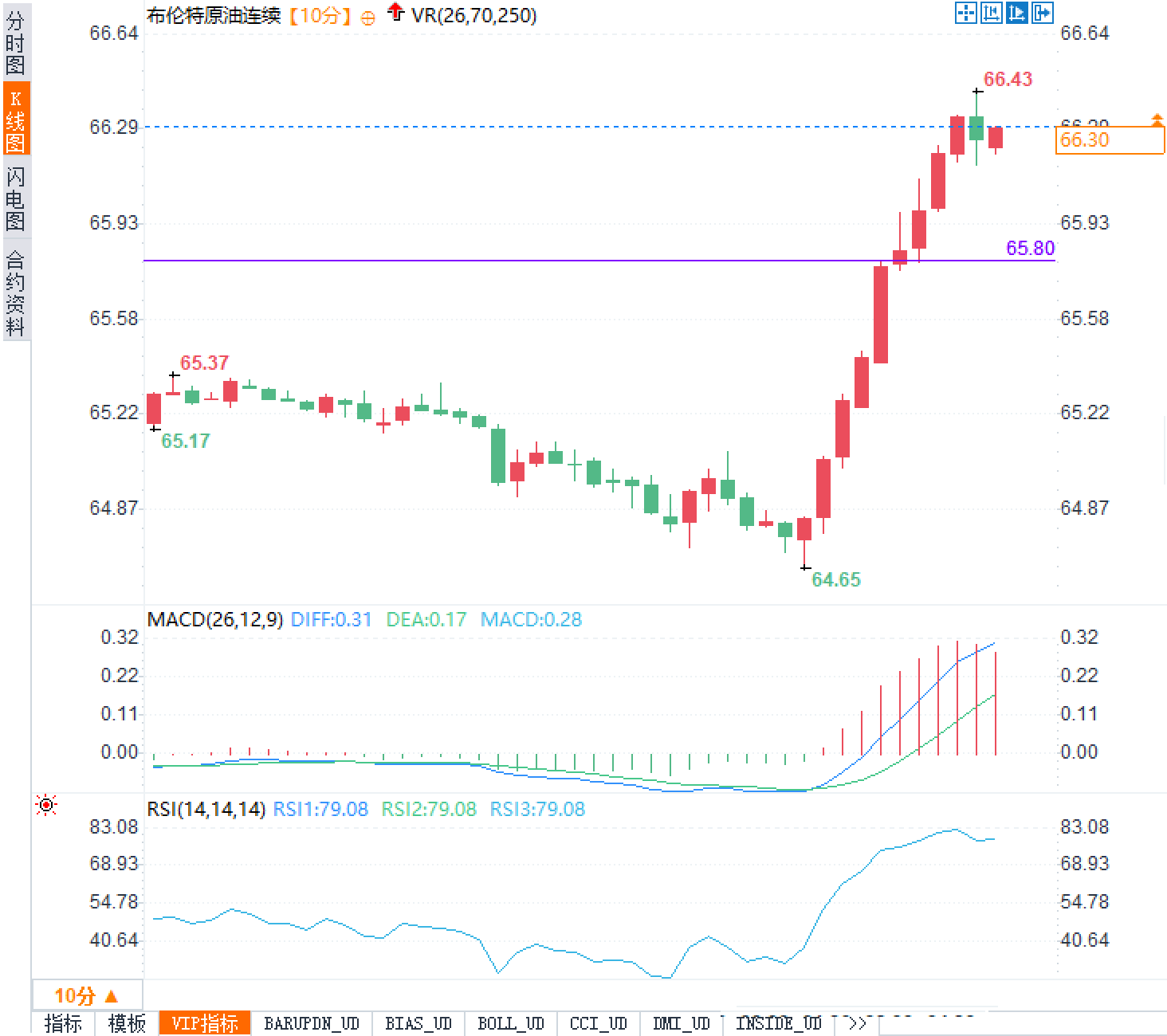
From a technical perspective, Brent crude oil has entered a consolidation phase above $66 per barrel after a rapid rise. The technical chart shows that the key short-term resistance level is at $66.43 per barrel; a successful break above this level could potentially lead to a challenge of the $70 mark. On the downside, support is expected around $65.80 per barrel. The MACD indicator is still expanding above the zero line, indicating that bullish momentum remains, but the RSI has risen to approximately 79.08, clearly entering overbought territory, suggesting that those chasing the rally face a higher risk of a pullback.
The typical trading pattern is as follows: Without new geopolitical escalation events, prices may consolidate at high levels, digesting previous gains. Only if the situation worsens further, causing disruptions to actual production and transportation, will there be a basis for reaching higher targets. Conversely, if US inventories continue to accumulate while Venezuelan exports show stable growth, oil prices are more likely to gradually decline without fundamental support, returning to a trading range anchored by supply and demand.
In summary, the current rise in oil prices is essentially a "risk premium trade," rather than being supported by a solid supply-demand gap. The key to future price movements lies in the evolution of three main factors: first, whether the situation with Iran will escalate from verbal threats to actual supply chain disruptions; second, whether the accumulation of US inventories is a short-term fluctuation or a long-term signal of weakening demand; and third, whether Venezuela can continue to export new crude oil. If the first factor strengthens significantly, and the latter two fail to effectively offset each other, the $70/barrel target will be repeatedly tested; conversely, if real data remains accommodative, this sentiment-driven rally will eventually cool down.
The recent situation in Iran has become a market focus, with escalating rhetoric raising widespread concerns about potential supply disruptions. While there have been no verifiable production declines or transportation disruptions, financial markets tend to price in advance—especially when uncertainty rises. Once the market perceives a slight increase in the probability of conflict, traders quickly add an "insurance premium" to near-month contracts. This behavior is particularly pronounced against a backdrop of short positions or low inventories, directly driving both spot and futures prices higher.
More notably, US President Trump has recently taken a hard line and threatened to impose a 25% tariff on countries that trade energy with Iran. If this policy materializes, it will severely restrict the trade options of third-party countries, forcing buyers to hedge against risks in advance, thereby altering global oil flow patterns. Even without immediate production cuts, the mere expectation of this policy is enough to support oil prices. Some institutions estimate that if Iran experiences severe disruption, it could affect global supply by up to approximately 3.5 million barrels per day, of which nearly 2 million barrels per day are directly related to international market liquidity. While these figures represent "tail risks," in a sentiment-driven market, the market reaction is often faster and more dramatic than the data itself.
Real data pours cold water on the rally: a surge in US inventories limits upside potential.
While oil prices are soaring due to geopolitical concerns, another force is quietly exerting pressure – signals from the actual supply and demand in the United States are indicating a marginal easing. According to the latest data released by the American Petroleum Institute (API), in the week ending January 9, U.S. crude oil inventories unexpectedly increased by 5.23 million barrels, gasoline inventories surged by 8.23 million barrels, and distillate fuel inventories also rose by 4.34 million barrels. The simultaneous accumulation of these three key indicators reflects that current demand is not keeping pace with supply, and may even indicate a period of weakness.
Rising inventories suggest that refinery capacity is not fully utilizing some of the crude oil, or that domestic production and imports have exceeded expectations, potentially indicating weakening end-user demand. Regardless of the specific reasons, this type of data weakens market perceptions of a "near-term shortage." After all, the logic of financial markets ultimately returns to fundamentals: risk premiums can push prices up in the short term, but if there is no real supply gap, the upward trend is unsustainable and easily evolves into a "surge followed by a pullback" or high-level consolidation.
Traders are paying closer attention to the verification of subsequent official inventory reports, especially whether changes in commercial crude oil inventories are concentrated at specific delivery points (such as Cushing), and whether the accumulation of refined product inventories reflects signals of weakening real demand, such as reduced driving mileage and declining industrial oil consumption. If the trend of inventory accumulation is confirmed to continue, the price increase originally driven by sentiment may face corrective pressure.
Venezuela quietly resumes production, subtly putting the brakes on oil prices.
Besides the immediate constraints posed by US inventories, another factor that cannot be ignored is the quiet resumption of Venezuelan crude oil exports. Monday's news indicated that two very large crude carriers (VLCCs) had left the country's waters, each carrying approximately 1.8 million barrels of crude oil, totaling over 3.6 million barrels. This is considered an early sign of the first substantial resumption of export flows since Venezuela and Washington reached a supply agreement of approximately 50 million barrels. Although this shipment will not immediately appear in this week's inventories, it clearly exerts downward pressure on global supply expectations in the coming weeks.
Analysts point out that the return of Venezuelan supply is fraught with policy and implementation uncertainties. Therefore, the market will not factor it all into prices at once, but rather adopt a "gradual confirmation, gradual pricing" approach. This means that it will not reverse the overall upward trend in the short term, but will act as an "invisible ceiling," limiting the upward potential and timeframe for oil prices. Especially given the current high geopolitical premium and the lack of tightening in actual supply and demand, any news of new supply is likely to be amplified and interpreted.
Furthermore, the oil-producing alliance itself still possesses a certain degree of regulatory capacity. Even if there are localized supply disruptions in the Middle East, other major oil-producing countries have the potential to partially fill the gap by increasing production. This means that the market is not simply betting on a "supply disruption," but rather weighing the "increased probability of risk" against the "existence of alternative production capacity." For this reason, while some institutions have raised their Brent crude oil target for the next three months to $70 per barrel, they also emphasize that this is only a short-term scenario, contingent on the continued escalation of geopolitical risks without effective hedging.
The technical outlook has entered a sensitive zone; whether the trend can continue depends on the "gap being filled".
From a technical perspective, Brent crude oil has entered a consolidation phase above $66 per barrel after a rapid rise. The technical chart shows that the key short-term resistance level is at $66.43 per barrel; a successful break above this level could potentially lead to a challenge of the $70 mark. On the downside, support is expected around $65.80 per barrel. The MACD indicator is still expanding above the zero line, indicating that bullish momentum remains, but the RSI has risen to approximately 79.08, clearly entering overbought territory, suggesting that those chasing the rally face a higher risk of a pullback.
The typical trading pattern is as follows: Without new geopolitical escalation events, prices may consolidate at high levels, digesting previous gains. Only if the situation worsens further, causing disruptions to actual production and transportation, will there be a basis for reaching higher targets. Conversely, if US inventories continue to accumulate while Venezuelan exports show stable growth, oil prices are more likely to gradually decline without fundamental support, returning to a trading range anchored by supply and demand.
In summary, the current rise in oil prices is essentially a "risk premium trade," rather than being supported by a solid supply-demand gap. The key to future price movements lies in the evolution of three main factors: first, whether the situation with Iran will escalate from verbal threats to actual supply chain disruptions; second, whether the accumulation of US inventories is a short-term fluctuation or a long-term signal of weakening demand; and third, whether Venezuela can continue to export new crude oil. If the first factor strengthens significantly, and the latter two fail to effectively offset each other, the $70/barrel target will be repeatedly tested; conversely, if real data remains accommodative, this sentiment-driven rally will eventually cool down.
- Risk Warning and Disclaimer
- The market involves risk, and trading may not be suitable for all investors. This article is for reference only and does not constitute personal investment advice, nor does it take into account certain users’ specific investment objectives, financial situation, or other needs. Any investment decisions made based on this information are at your own risk.