January 16th Financial Breakfast: Strong US jobs data dragged down gold prices from record highs, while easing geopolitical tensions caused oil prices to fall by over 3%.
2026-01-16 07:27:46
On Friday (January 16, Beijing time) in early Asian trading, spot gold was trading around $4,613.90 per ounce. Gold prices retreated from record highs on Thursday, influenced by strong US jobs data and easing geopolitical tensions. US crude oil was trading around $59.08 per barrel. Oil prices fell sharply by more than 3% on Thursday, ending a five-day winning streak, pressured by conciliatory comments from US President Trump regarding the situation in Iran, coupled with data showing a significant increase in US crude oil inventories.

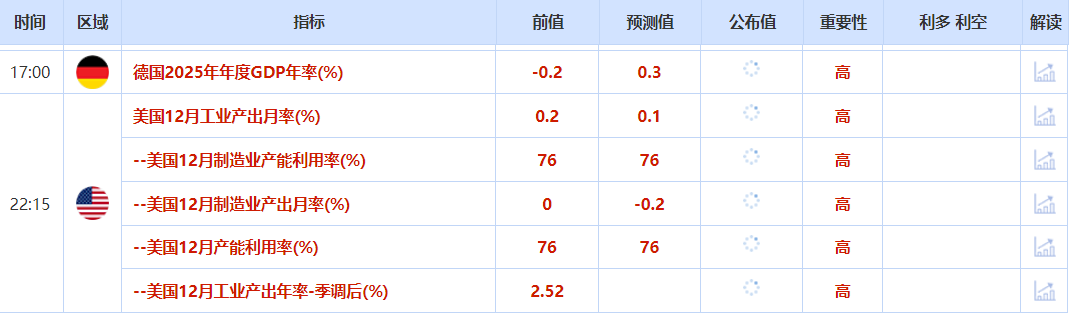
U.S. stocks closed mostly higher on Thursday after two consecutive days of declines, boosted by strong bank earnings and an optimistic outlook for the chip industry. The Dow Jones Industrial Average rose 0.60%, the S&P 500 gained 0.26%, and the Nasdaq Composite climbed 0.25%.
The banking sector performed particularly well. Goldman Sachs and Morgan Stanley reported better-than-expected quarterly results due to active trading, sending their shares soaring 4.6% and 5.8% respectively, becoming one of the main drivers of the market rally. BlackRock, the world's largest asset manager, also saw its shares rise 5.9% after its assets under management reached a new high of $14.04 trillion.
Meanwhile, technology stocks, particularly chip stocks, rose, with companies like Nvidia and Broadcom seeing gains, resulting in a broad-based market rally. The S&P 500 Industrial Index hit a new closing record high. Market funds continued to rotate from highly valued technology stocks to relatively undervalued traditional sectors. Furthermore, small-cap stocks continued their strong performance, with the Russell 2000 index reaching a new closing high, and the equal-weighted S&P 500 index significantly outperforming the market capitalization-weighted S&P 500 index since the end of last year.
Trading volume was active throughout the day, with a total of 19.12 billion shares traded across U.S. exchanges, higher than recent averages.
Gold prices retreated from record highs on Thursday, buoyed by strong U.S. jobs data and easing geopolitical tensions. Spot gold fell 0.1% to settle at $4,614.93 an ounce, while U.S. gold futures settled down 0.3% at $4,623.70. The decline was driven primarily by two factors: a surprise drop in U.S. initial jobless claims last week boosted the dollar index to a multi-week high, making dollar-denominated gold more expensive for holders of other currencies.
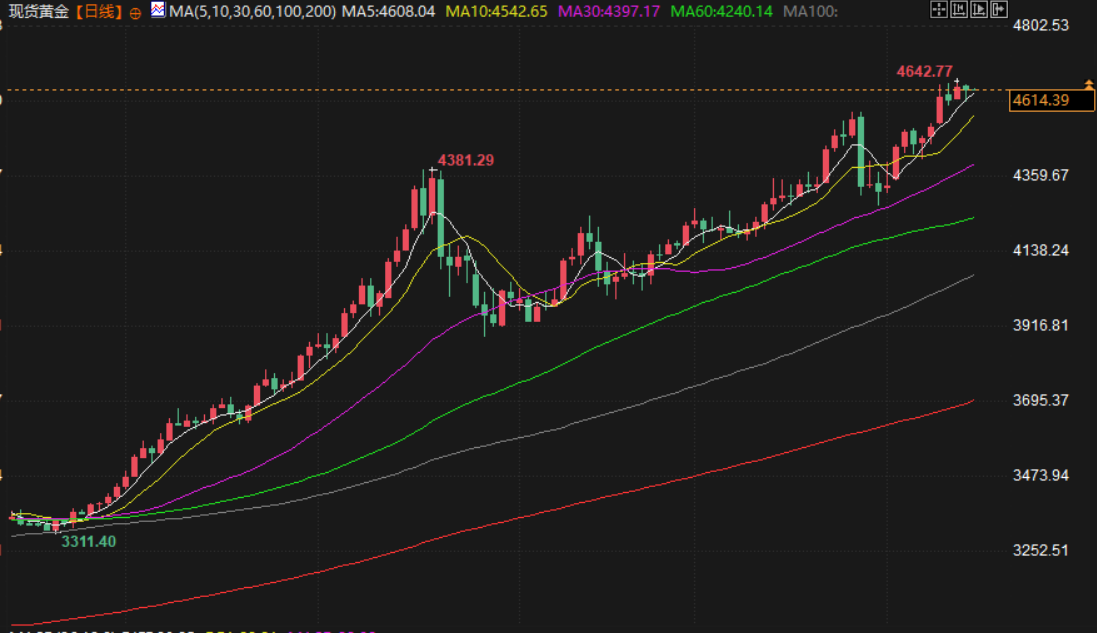
Demand for safe haven cools: US President Trump said that Iran’s crackdown on protests appears to be easing, suggesting it may be taking a wait-and-see approach, which has diminished gold’s safe-haven appeal.
Meanwhile, Trump stated that there are currently no plans to fire Federal Reserve Chairman Powell, but did not rule out the possibility in the future. The market widely expects the Fed to keep interest rates unchanged at its January meeting, but there are still expectations of at least two rate cuts this year, which provides long-term support for gold prices.
Other precious metals showed mixed results: spot silver retreated slightly after hitting a record high of $93.57; platinum fell, while palladium remained largely unchanged.
Oil prices fell sharply by more than 3% on Thursday, ending a five-day winning streak, pressured by conciliatory comments from U.S. President Trump regarding the situation in Iran, coupled with data showing a significant increase in U.S. crude oil inventories.
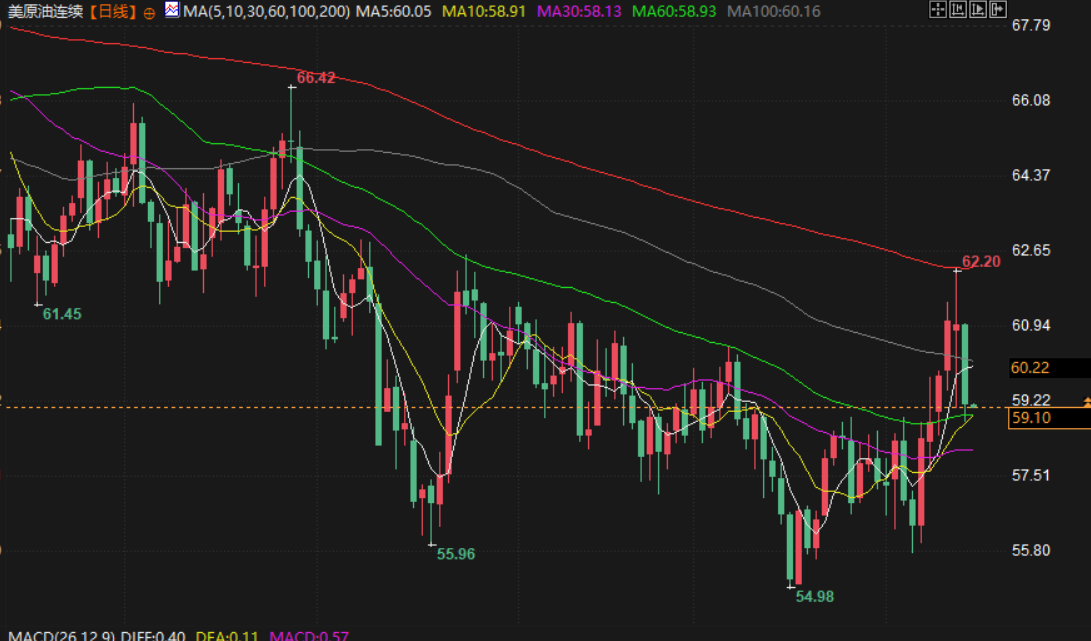
Brent crude fell $4.15 to settle at $63.76 a barrel, while WTI crude fell 4.56% to settle at $59.19 a barrel. The main reason for the market decline was the rapid fading of geopolitical risk premiums.
Trump stated that he had been informed that Iran's crackdown on protests was subsiding and that there were currently no plans for mass executions, suggesting a wait-and-see approach. Analysts pointed out that this statement significantly reduced market concerns about an escalation of the US-Iran conflict and disruptions to Iranian oil supplies in the short term.
In addition, fundamental data also put pressure on oil prices. The U.S. Energy Information Administration (EIA) reported on Wednesday that U.S. crude oil and gasoline inventories both saw unexpected and significant increases last week, further confirming the situation of ample market supply and potentially weaker-than-expected demand.
The dollar index rose to a six-week high on Thursday, supported by strong jobs data, while the yen continued to be pressured by market expectations of potential fiscal expansion policies in Japan.
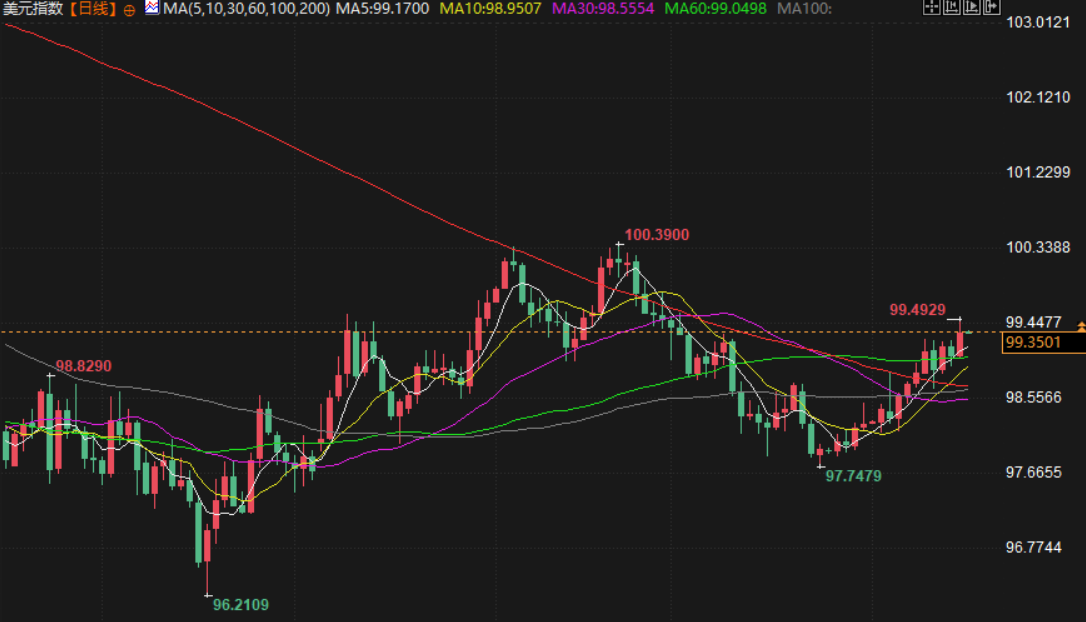
Data showed that initial jobless claims in the U.S. unexpectedly fell last week, dropping to 198,000 after seasonal adjustment, far below market expectations. This further strengthened market expectations that the Federal Reserve will maintain high interest rates in the coming months. The interest rate futures market has already pushed back its expectation of the Fed's first rate cut to June. Driven by this, the dollar index rose 0.24% to close at 99.31, having touched its highest point since December 2nd of last year during the session. The euro fell 0.25% against the dollar to $1.1613.
On the other hand, the yen continued to weaken. Markets are concerned that Prime Minister Sanae Takaichi will be given greater authority to implement more expansionary fiscal policies following the snap election.
TD Securities analysts pointed out that if their party wins a majority of seats, it could be a catalyst for the dollar to break through 162 against the yen. The yen fell slightly by 0.02% against the dollar, closing at 158.48, but remained above its recent 18-month low as traders were wary of possible intervention by Japanese authorities.
In addition, US President Trump stated that there are currently no plans to fire Federal Reserve Chairman Powell and believes that the situation in Iran has eased somewhat.
US media reports that Trump has postponed his decision to use force against Iran.
According to a report by Axios on January 15th, US President Trump is "temporarily suspending his decision on whether to launch a military strike against Iran." The White House is reportedly engaged in intensive internal discussions and consultations with allies to "assess the timing of the strike and whether it could truly destabilize the Iranian regime." Sources in the US, Israel, and Arab countries stated that "military options remain on the table, but uncertainty has clearly increased." (CCTV International News)
Russia claims that all foreign troops within Ukraine are considered legitimate targets.
On January 15 local time, Russian Foreign Ministry spokeswoman Maria Zakharova stated at a briefing that any foreign military forces stationed in Ukraine are considered legitimate targets of the Russian Armed Forces. She emphasized that the statements by relevant countries regarding the formation of such forces are aimed at undermining the process of resolving the Ukrainian conflict. Zakharova also stated that the West does not want to see an end to the Russia-Ukraine conflict and peace. Europe continues to provide military and financial support to Kyiv. (CCTV)
The U.S. Treasury Department announced new sanctions against Iran.
On January 15 local time, the U.S. Treasury Department announced sanctions against several Iranian individuals and entities, as well as several foreign companies with ties to Iran. Iranian Supreme National Security Council Secretary Larijani was added to the sanctions list. In addition, the U.S. Treasury Department designated 18 individuals and entities, stating they were involved in the export of Iranian oil and petrochemical products. (CCTV News)
Zakharova: Russia is committed to long-term cooperation with Iran in multiple sectors, including energy.
On January 15 local time, Russian Foreign Ministry spokeswoman Maria Zakharova, responding to a question about Trump's statement that any country doing business with Iran would face a 25% tariff, stated that Russia does not recognize unilateral sanctions against sovereign states and considers such sanctions to violate international law. Zakharova emphasized that Russia will continue to uphold this position. She stated that trade and economic cooperation are beneficial and should not be influenced by external sanctions. Russia is committed to long-term cooperation with Iran in multiple sectors, including energy, and intends to continue developing trade relations with all interested countries. She stressed that Russia's primary basis for international cooperation is its own national interests, not threats or intimidation from third-party countries. (CCTV News)
The United States announced the seizure of another oil tanker in the Caribbean Sea.
On January 15 local time, the U.S. Southern Command stated that Marines and sailors from the Joint Task Force "Southern Spear," with support from the Department of Homeland Security, seized the oil tanker "Veronica" from the aircraft carrier USS Gerald R. Ford. The U.S. Southern Command claimed that the "Veronica" disregarded President Trump's ban on sanctioned vessels in the Caribbean. On the same day, two U.S. officials revealed that the U.S. seized an oil tanker linked to Venezuela ahead of Trump's meeting with Venezuelan opposition leader Machado. (CCTV News)
Chinese researchers have made new breakthroughs in the field of cell and gene therapy.
Recently, a Chinese research team successfully treated patients with autoimmune hemolytic anemia (AIHA) who had failed multiple lines of drug therapy using self-developed autologous CD19 CAR T cells, providing a new salvage treatment option for patients who have failed conventional drug therapy. On January 15th, this research result, obtained by the team of Shi Jun and Xiong Haiqing from the Institute of Hematology, Chinese Academy of Medical Sciences (Chinese Academy of Medical Sciences Institute of Hematology), was published online in the *New England Journal of Medicine*, marking a new breakthrough in innovative cell and gene therapy in my country's regenerative medicine field. (CCTV)
Trump suspends tariffs on key minerals; silver resumes its decline.
Silver prices fell as much as 7.3% on Thursday before recovering most of their losses during the trading session, only to widen the decline again, currently down over 5%. President Trump did not impose tariffs on imports of key minerals, including silver and platinum, stating that the issue would be resolved through bilateral negotiations and proposing the idea of setting a price floor. Market concerns about tariffs led to the stockpiling of some metals, including silver, in US warehouses. Currently, warehouses associated with futures trading on the New York Mercantile Exchange hold approximately 434 million ounces of silver, an increase of about 100 million ounces since the trade disruptions caused by tariffs intensified about a year ago. While these inventories may help alleviate other tensions, StoneX Group analyst Rhona O'Connell noted that silver outflows from the US may face some resistance as it remains on Trump's list of key minerals. OCBC strategist Christopher Wong stated that the medium-term outlook for silver remains firmly positive, supported by spillover effects from supply shortages, industrial consumption, and gold demand. However, the recent pace of price volatility necessitates a cautious approach in the short term.
Expanding coverage! Two departments issue document to allow more employees to enjoy enterprise annuities.
The Ministry of Human Resources and Social Security and the Ministry of Finance jointly issued an opinion on further improving enterprise annuity work, enhancing the inclusiveness, flexibility, and convenience of the enterprise annuity system, and continuously promoting the expansion of coverage so that more employees can enjoy enterprise annuities. According to the opinion, various enterprises, social organizations, foundations, private non-enterprise units, and other eligible employers and their employees can establish enterprise annuities as stipulated. Regarding contribution rates, employers and their employees can flexibly choose contribution rates or amounts within the contribution limits. Those with limited financial capacity can start with lower contribution rates or amounts and gradually increase them. Regarding establishment methods, employers can establish a single enterprise annuity plan or choose to participate in a collective enterprise annuity plan initiated by a corporate trustee institution. The opinion also promotes exploring simplified procedures based on collective plans to facilitate the establishment of enterprise annuities for small and micro enterprises. (Xinhua News Agency)
The People's Bank of China has decided to lower the interest rates on relending and rediscounting.
To better leverage the incentive role of structural monetary policy tools and guide financial institutions to increase support for major strategies, key areas, and weak links, the People's Bank of China has decided to lower the rediscount and relending rates by 0.25 percentage points, effective January 19, 2026. After the reduction, the interest rates for 3-month, 6-month, and 1-year relending programs for agriculture and small businesses will be 0.95%, 1.15%, and 1.25%, respectively; the rediscount rate will be 1.5%; the pledged supplementary lending rate will be 1.75%; and the interest rate for special structural monetary policy tools will be 1.25%. (People's Bank of China)
The Shanghai Futures Exchange adjusts margin requirements, price limits, and trading limits for tin futures.
According to the Shanghai Futures Exchange (SHFE) announcement, effective from the closing settlement on January 15, 2026 (Thursday), the trading margin ratio and price limits will be adjusted as follows: the price limit for tin futures contracts will be adjusted to 11%, the margin ratio for hedging positions will be adjusted to 12%, and the margin ratio for general positions will be adjusted to 13%. Starting from trading on January 16, 2026 (i.e., the night session of January 15), the maximum number of intraday open positions for non-futures company members, overseas special non-brokerage participants, and clients in all tin futures contracts will be 800 lots.
The Vice Governor of the People's Bank of China stated that there is still room for further reserve requirement ratio and interest rate cuts this year.
Zou Lan, spokesperson and vice governor of the People's Bank of China, stated at a press conference held by the State Council Information Office on January 15 that there is still room for further reductions in the reserve requirement ratio and interest rates this year. Regarding the statutory reserve requirement ratio, the current average ratio for financial institutions is 6.3%, leaving room for further cuts. As for policy interest rates, external constraints include a relatively stable RMB exchange rate and a declining US dollar, meaning the exchange rate does not pose a strong constraint. Internal constraints include signs of stabilization in banks' net interest margins since 2025, and a significant amount of 3-year and 5-year long-term deposits maturing in 2026. The current reduction in interest rates for various structural monetary policy tools will help lower banks' interest costs, stabilize net interest margins, and create room for further interest rate cuts. (Xinhua News Agency)
Key Focus Today
stock market
U.S. stocks closed mostly higher on Thursday after two consecutive days of declines, boosted by strong bank earnings and an optimistic outlook for the chip industry. The Dow Jones Industrial Average rose 0.60%, the S&P 500 gained 0.26%, and the Nasdaq Composite climbed 0.25%.
The banking sector performed particularly well. Goldman Sachs and Morgan Stanley reported better-than-expected quarterly results due to active trading, sending their shares soaring 4.6% and 5.8% respectively, becoming one of the main drivers of the market rally. BlackRock, the world's largest asset manager, also saw its shares rise 5.9% after its assets under management reached a new high of $14.04 trillion.
Meanwhile, technology stocks, particularly chip stocks, rose, with companies like Nvidia and Broadcom seeing gains, resulting in a broad-based market rally. The S&P 500 Industrial Index hit a new closing record high. Market funds continued to rotate from highly valued technology stocks to relatively undervalued traditional sectors. Furthermore, small-cap stocks continued their strong performance, with the Russell 2000 index reaching a new closing high, and the equal-weighted S&P 500 index significantly outperforming the market capitalization-weighted S&P 500 index since the end of last year.
Trading volume was active throughout the day, with a total of 19.12 billion shares traded across U.S. exchanges, higher than recent averages.
Gold Market
Gold prices retreated from record highs on Thursday, buoyed by strong U.S. jobs data and easing geopolitical tensions. Spot gold fell 0.1% to settle at $4,614.93 an ounce, while U.S. gold futures settled down 0.3% at $4,623.70. The decline was driven primarily by two factors: a surprise drop in U.S. initial jobless claims last week boosted the dollar index to a multi-week high, making dollar-denominated gold more expensive for holders of other currencies.
Demand for safe haven cools: US President Trump said that Iran’s crackdown on protests appears to be easing, suggesting it may be taking a wait-and-see approach, which has diminished gold’s safe-haven appeal.
Meanwhile, Trump stated that there are currently no plans to fire Federal Reserve Chairman Powell, but did not rule out the possibility in the future. The market widely expects the Fed to keep interest rates unchanged at its January meeting, but there are still expectations of at least two rate cuts this year, which provides long-term support for gold prices.
Other precious metals showed mixed results: spot silver retreated slightly after hitting a record high of $93.57; platinum fell, while palladium remained largely unchanged.
oil market
Oil prices fell sharply by more than 3% on Thursday, ending a five-day winning streak, pressured by conciliatory comments from U.S. President Trump regarding the situation in Iran, coupled with data showing a significant increase in U.S. crude oil inventories.
Brent crude fell $4.15 to settle at $63.76 a barrel, while WTI crude fell 4.56% to settle at $59.19 a barrel. The main reason for the market decline was the rapid fading of geopolitical risk premiums.
Trump stated that he had been informed that Iran's crackdown on protests was subsiding and that there were currently no plans for mass executions, suggesting a wait-and-see approach. Analysts pointed out that this statement significantly reduced market concerns about an escalation of the US-Iran conflict and disruptions to Iranian oil supplies in the short term.
In addition, fundamental data also put pressure on oil prices. The U.S. Energy Information Administration (EIA) reported on Wednesday that U.S. crude oil and gasoline inventories both saw unexpected and significant increases last week, further confirming the situation of ample market supply and potentially weaker-than-expected demand.
Foreign exchange market
The dollar index rose to a six-week high on Thursday, supported by strong jobs data, while the yen continued to be pressured by market expectations of potential fiscal expansion policies in Japan.
Data showed that initial jobless claims in the U.S. unexpectedly fell last week, dropping to 198,000 after seasonal adjustment, far below market expectations. This further strengthened market expectations that the Federal Reserve will maintain high interest rates in the coming months. The interest rate futures market has already pushed back its expectation of the Fed's first rate cut to June. Driven by this, the dollar index rose 0.24% to close at 99.31, having touched its highest point since December 2nd of last year during the session. The euro fell 0.25% against the dollar to $1.1613.
On the other hand, the yen continued to weaken. Markets are concerned that Prime Minister Sanae Takaichi will be given greater authority to implement more expansionary fiscal policies following the snap election.
TD Securities analysts pointed out that if their party wins a majority of seats, it could be a catalyst for the dollar to break through 162 against the yen. The yen fell slightly by 0.02% against the dollar, closing at 158.48, but remained above its recent 18-month low as traders were wary of possible intervention by Japanese authorities.
In addition, US President Trump stated that there are currently no plans to fire Federal Reserve Chairman Powell and believes that the situation in Iran has eased somewhat.
International News
US media reports that Trump has postponed his decision to use force against Iran.
According to a report by Axios on January 15th, US President Trump is "temporarily suspending his decision on whether to launch a military strike against Iran." The White House is reportedly engaged in intensive internal discussions and consultations with allies to "assess the timing of the strike and whether it could truly destabilize the Iranian regime." Sources in the US, Israel, and Arab countries stated that "military options remain on the table, but uncertainty has clearly increased." (CCTV International News)
Russia claims that all foreign troops within Ukraine are considered legitimate targets.
On January 15 local time, Russian Foreign Ministry spokeswoman Maria Zakharova stated at a briefing that any foreign military forces stationed in Ukraine are considered legitimate targets of the Russian Armed Forces. She emphasized that the statements by relevant countries regarding the formation of such forces are aimed at undermining the process of resolving the Ukrainian conflict. Zakharova also stated that the West does not want to see an end to the Russia-Ukraine conflict and peace. Europe continues to provide military and financial support to Kyiv. (CCTV)
The U.S. Treasury Department announced new sanctions against Iran.
On January 15 local time, the U.S. Treasury Department announced sanctions against several Iranian individuals and entities, as well as several foreign companies with ties to Iran. Iranian Supreme National Security Council Secretary Larijani was added to the sanctions list. In addition, the U.S. Treasury Department designated 18 individuals and entities, stating they were involved in the export of Iranian oil and petrochemical products. (CCTV News)
Zakharova: Russia is committed to long-term cooperation with Iran in multiple sectors, including energy.
On January 15 local time, Russian Foreign Ministry spokeswoman Maria Zakharova, responding to a question about Trump's statement that any country doing business with Iran would face a 25% tariff, stated that Russia does not recognize unilateral sanctions against sovereign states and considers such sanctions to violate international law. Zakharova emphasized that Russia will continue to uphold this position. She stated that trade and economic cooperation are beneficial and should not be influenced by external sanctions. Russia is committed to long-term cooperation with Iran in multiple sectors, including energy, and intends to continue developing trade relations with all interested countries. She stressed that Russia's primary basis for international cooperation is its own national interests, not threats or intimidation from third-party countries. (CCTV News)
The United States announced the seizure of another oil tanker in the Caribbean Sea.
On January 15 local time, the U.S. Southern Command stated that Marines and sailors from the Joint Task Force "Southern Spear," with support from the Department of Homeland Security, seized the oil tanker "Veronica" from the aircraft carrier USS Gerald R. Ford. The U.S. Southern Command claimed that the "Veronica" disregarded President Trump's ban on sanctioned vessels in the Caribbean. On the same day, two U.S. officials revealed that the U.S. seized an oil tanker linked to Venezuela ahead of Trump's meeting with Venezuelan opposition leader Machado. (CCTV News)
Chinese researchers have made new breakthroughs in the field of cell and gene therapy.
Recently, a Chinese research team successfully treated patients with autoimmune hemolytic anemia (AIHA) who had failed multiple lines of drug therapy using self-developed autologous CD19 CAR T cells, providing a new salvage treatment option for patients who have failed conventional drug therapy. On January 15th, this research result, obtained by the team of Shi Jun and Xiong Haiqing from the Institute of Hematology, Chinese Academy of Medical Sciences (Chinese Academy of Medical Sciences Institute of Hematology), was published online in the *New England Journal of Medicine*, marking a new breakthrough in innovative cell and gene therapy in my country's regenerative medicine field. (CCTV)
Trump suspends tariffs on key minerals; silver resumes its decline.
Silver prices fell as much as 7.3% on Thursday before recovering most of their losses during the trading session, only to widen the decline again, currently down over 5%. President Trump did not impose tariffs on imports of key minerals, including silver and platinum, stating that the issue would be resolved through bilateral negotiations and proposing the idea of setting a price floor. Market concerns about tariffs led to the stockpiling of some metals, including silver, in US warehouses. Currently, warehouses associated with futures trading on the New York Mercantile Exchange hold approximately 434 million ounces of silver, an increase of about 100 million ounces since the trade disruptions caused by tariffs intensified about a year ago. While these inventories may help alleviate other tensions, StoneX Group analyst Rhona O'Connell noted that silver outflows from the US may face some resistance as it remains on Trump's list of key minerals. OCBC strategist Christopher Wong stated that the medium-term outlook for silver remains firmly positive, supported by spillover effects from supply shortages, industrial consumption, and gold demand. However, the recent pace of price volatility necessitates a cautious approach in the short term.
Domestic News
Expanding coverage! Two departments issue document to allow more employees to enjoy enterprise annuities.
The Ministry of Human Resources and Social Security and the Ministry of Finance jointly issued an opinion on further improving enterprise annuity work, enhancing the inclusiveness, flexibility, and convenience of the enterprise annuity system, and continuously promoting the expansion of coverage so that more employees can enjoy enterprise annuities. According to the opinion, various enterprises, social organizations, foundations, private non-enterprise units, and other eligible employers and their employees can establish enterprise annuities as stipulated. Regarding contribution rates, employers and their employees can flexibly choose contribution rates or amounts within the contribution limits. Those with limited financial capacity can start with lower contribution rates or amounts and gradually increase them. Regarding establishment methods, employers can establish a single enterprise annuity plan or choose to participate in a collective enterprise annuity plan initiated by a corporate trustee institution. The opinion also promotes exploring simplified procedures based on collective plans to facilitate the establishment of enterprise annuities for small and micro enterprises. (Xinhua News Agency)
The People's Bank of China has decided to lower the interest rates on relending and rediscounting.
To better leverage the incentive role of structural monetary policy tools and guide financial institutions to increase support for major strategies, key areas, and weak links, the People's Bank of China has decided to lower the rediscount and relending rates by 0.25 percentage points, effective January 19, 2026. After the reduction, the interest rates for 3-month, 6-month, and 1-year relending programs for agriculture and small businesses will be 0.95%, 1.15%, and 1.25%, respectively; the rediscount rate will be 1.5%; the pledged supplementary lending rate will be 1.75%; and the interest rate for special structural monetary policy tools will be 1.25%. (People's Bank of China)
The Shanghai Futures Exchange adjusts margin requirements, price limits, and trading limits for tin futures.
According to the Shanghai Futures Exchange (SHFE) announcement, effective from the closing settlement on January 15, 2026 (Thursday), the trading margin ratio and price limits will be adjusted as follows: the price limit for tin futures contracts will be adjusted to 11%, the margin ratio for hedging positions will be adjusted to 12%, and the margin ratio for general positions will be adjusted to 13%. Starting from trading on January 16, 2026 (i.e., the night session of January 15), the maximum number of intraday open positions for non-futures company members, overseas special non-brokerage participants, and clients in all tin futures contracts will be 800 lots.
The Vice Governor of the People's Bank of China stated that there is still room for further reserve requirement ratio and interest rate cuts this year.
Zou Lan, spokesperson and vice governor of the People's Bank of China, stated at a press conference held by the State Council Information Office on January 15 that there is still room for further reductions in the reserve requirement ratio and interest rates this year. Regarding the statutory reserve requirement ratio, the current average ratio for financial institutions is 6.3%, leaving room for further cuts. As for policy interest rates, external constraints include a relatively stable RMB exchange rate and a declining US dollar, meaning the exchange rate does not pose a strong constraint. Internal constraints include signs of stabilization in banks' net interest margins since 2025, and a significant amount of 3-year and 5-year long-term deposits maturing in 2026. The current reduction in interest rates for various structural monetary policy tools will help lower banks' interest costs, stabilize net interest margins, and create room for further interest rate cuts. (Xinhua News Agency)
- Risk Warning and Disclaimer
- The market involves risk, and trading may not be suitable for all investors. This article is for reference only and does not constitute personal investment advice, nor does it take into account certain users’ specific investment objectives, financial situation, or other needs. Any investment decisions made based on this information are at your own risk.