Crude oil trading alert: Geopolitical premiums have declined, and oil prices have returned to range-bound trading.
2026-01-16 09:14:10
WTI crude oil prices rebounded slightly in Asian trading on Friday, trading around $59.20 per barrel. Yesterday's sharp decline was attributed to signs of easing geopolitical tensions, which had been a major market focus, prompting investors to quickly unwind long positions. Data showed that New York WTI crude oil prices fell 4.3% to $59.36 per barrel yesterday, while London Brent crude oil fell 4.2% to $63.77 per barrel.
Market participants generally believe that the core reason for the price correction is the decreased likelihood of US military action against Iran, which has weakened the main driver of the recent rise in oil prices.
 "The U.S. appears to have temporarily shelved further action, easing immediate concerns about supply disruptions, but geopolitical risks have not truly disappeared," said Daniel Takieddine, an analyst at Sky Links Capital Group.
As tensions eased, markets refocused on fundamentals. Newly released U.S. energy data showed a significant increase in commercial crude oil inventories, further fueling concerns about a global supply glut.
The previous rise in oil prices was largely based on expectations that it could impact Iranian crude oil exports and the security of key shipping routes, but this logic has now loosened.
Soojin Kim, an analyst at MUFG, pointed out: "Despite the decline in oil prices, the regional situation remains tense, with Iran's brief closure of some airspace and related military deployment adjustments indicating that the risks have not been completely eliminated."
Meanwhile, cautious sentiment regarding demand prospects also weighed on price performance. The slowing pace of the global economic recovery meant that trade concerns continued to impact energy consumption expectations. Investors worried that even if geopolitical premiums rebounded, without substantial improvement on the demand side, oil price increases would lack sustained momentum.
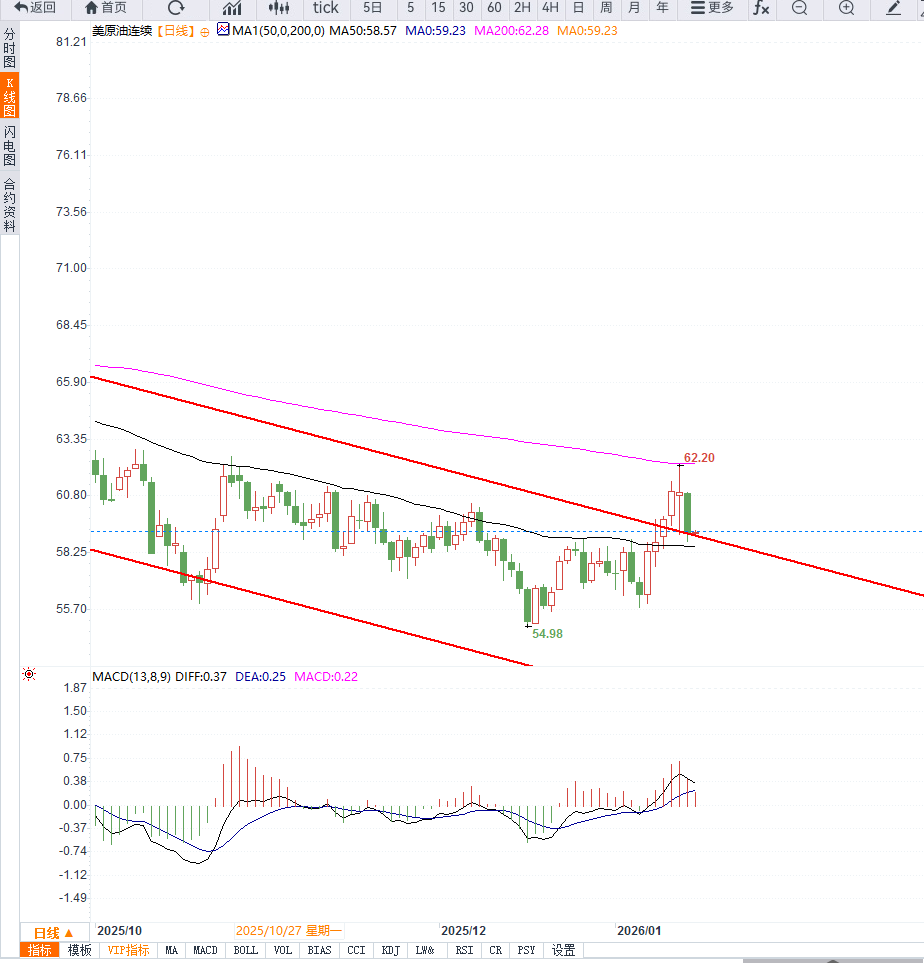
From a daily chart perspective, WTI encountered significant resistance around $62 after its previous surge, subsequently breaking below the $60 mark with a medium-sized bearish candle, indicating a shift from a strong to a weak technical pattern. The current price has fallen below the 20-day moving average, and the 5-day and 10-day moving averages are showing signs of a death cross, suggesting that short-term bearish momentum is in control.
The MACD indicator's fast and slow lines turned downwards above the zero axis, and the red bars shortened significantly, indicating a shift from bullish to bearish momentum; RSI (14): fell back from the overbought zone to around 48, indicating a rapid cooling of market sentiment; The price quickly retreated from near the upper rail to below the middle rail, and the opening showed a tendency to converge again.
Key support levels are concentrated in the $58.80-$59.00 area, where the previous consolidation range and the 60-day moving average intersect. A decisive break below this level could target $56.50. Resistance levels are at $60.00 and $62.00. Overall, the daily chart has shifted to a slightly bearish consolidation pattern, and any short-term rebounds are more likely to be seen as corrective movements.
Editor's Note:
Looking at this round of market movements, the rapid decline in oil prices was not due to a sudden deterioration in demand, but rather a temporary squeeze out of geopolitical premiums. The market's over-reliance on unexpected events for pricing has significantly amplified volatility. Technical indicators show a weakening of the bullish structure, while inventory pressures are further weakening fundamental support.
In the near future, crude oil prices may return to a more rational range: if US inventories continue to accumulate and global trade concerns suppress industrial activity, oil prices may remain weak; however, if the situation in the Middle East escalates again, a price rebound could be equally rapid. The risk of a double-dip recession due to a confluence of sentiment and technical factors should be closely monitored.
Market participants generally believe that the core reason for the price correction is the decreased likelihood of US military action against Iran, which has weakened the main driver of the recent rise in oil prices.
"The U.S. appears to have temporarily shelved further action, easing immediate concerns about supply disruptions, but geopolitical risks have not truly disappeared," said Daniel Takieddine, an analyst at Sky Links Capital Group.As tensions eased, markets refocused on fundamentals. Newly released U.S. energy data showed a significant increase in commercial crude oil inventories, further fueling concerns about a global supply glut.
The previous rise in oil prices was largely based on expectations that it could impact Iranian crude oil exports and the security of key shipping routes, but this logic has now loosened.
Soojin Kim, an analyst at MUFG, pointed out: "Despite the decline in oil prices, the regional situation remains tense, with Iran's brief closure of some airspace and related military deployment adjustments indicating that the risks have not been completely eliminated."
Meanwhile, cautious sentiment regarding demand prospects also weighed on price performance. The slowing pace of the global economic recovery meant that trade concerns continued to impact energy consumption expectations. Investors worried that even if geopolitical premiums rebounded, without substantial improvement on the demand side, oil price increases would lack sustained momentum.
From a daily chart perspective, WTI encountered significant resistance around $62 after its previous surge, subsequently breaking below the $60 mark with a medium-sized bearish candle, indicating a shift from a strong to a weak technical pattern. The current price has fallen below the 20-day moving average, and the 5-day and 10-day moving averages are showing signs of a death cross, suggesting that short-term bearish momentum is in control.
The MACD indicator's fast and slow lines turned downwards above the zero axis, and the red bars shortened significantly, indicating a shift from bullish to bearish momentum; RSI (14): fell back from the overbought zone to around 48, indicating a rapid cooling of market sentiment; The price quickly retreated from near the upper rail to below the middle rail, and the opening showed a tendency to converge again.
Key support levels are concentrated in the $58.80-$59.00 area, where the previous consolidation range and the 60-day moving average intersect. A decisive break below this level could target $56.50. Resistance levels are at $60.00 and $62.00. Overall, the daily chart has shifted to a slightly bearish consolidation pattern, and any short-term rebounds are more likely to be seen as corrective movements.
Editor's Note:
Looking at this round of market movements, the rapid decline in oil prices was not due to a sudden deterioration in demand, but rather a temporary squeeze out of geopolitical premiums. The market's over-reliance on unexpected events for pricing has significantly amplified volatility. Technical indicators show a weakening of the bullish structure, while inventory pressures are further weakening fundamental support.
In the near future, crude oil prices may return to a more rational range: if US inventories continue to accumulate and global trade concerns suppress industrial activity, oil prices may remain weak; however, if the situation in the Middle East escalates again, a price rebound could be equally rapid. The risk of a double-dip recession due to a confluence of sentiment and technical factors should be closely monitored.
- Risk Warning and Disclaimer
- The market involves risk, and trading may not be suitable for all investors. This article is for reference only and does not constitute personal investment advice, nor does it take into account certain users’ specific investment objectives, financial situation, or other needs. Any investment decisions made based on this information are at your own risk.