A rebound in the US dollar, coupled with a recovery in UK GDP, kept the pound sterling trading within a range against the dollar.
2026-01-16 13:45:08
The pound rebounded modestly against the dollar in Asian trading on Friday after a slight pullback in the previous session, trading around 1.3380. However, the dollar's strength, driven by US jobs data, limited the pair's upside potential.
The market generally believes that the likelihood of the Federal Reserve keeping interest rates unchanged in the coming months is increasing, becoming an important factor supporting the US dollar.
Data released by the U.S. Department of Labor shows that initial jobless claims fell to 198,000 in the week ending January 10, lower than the market expectation of 215,000 and a further decline from the revised figure of 207,000 in the previous week.
Data indicates that corporate layoffs remain limited, and the labor market remains resilient in a high-interest-rate environment. Pricing in the interest rate futures market shows that investors have postponed their expectations for the next Federal Reserve rate cut to June, reflecting rising concerns about sticky inflation and robust employment.
The US dollar thus received additional support, limiting the rebound of non-US currencies. On the other hand, UK economic data provided some support for the pound sterling.
Data released by the UK Office for National Statistics shows that the UK economy has returned to a growth trajectory, with GDP growing by 0.3% month-on-month in December, significantly better than the market expectation of 0.1% and reversing the contraction of the previous two months.
The Bank of England stated at its December meeting that monetary policy would follow a gradual easing path, and the latest data may reduce the need for it to accelerate interest rate cuts.
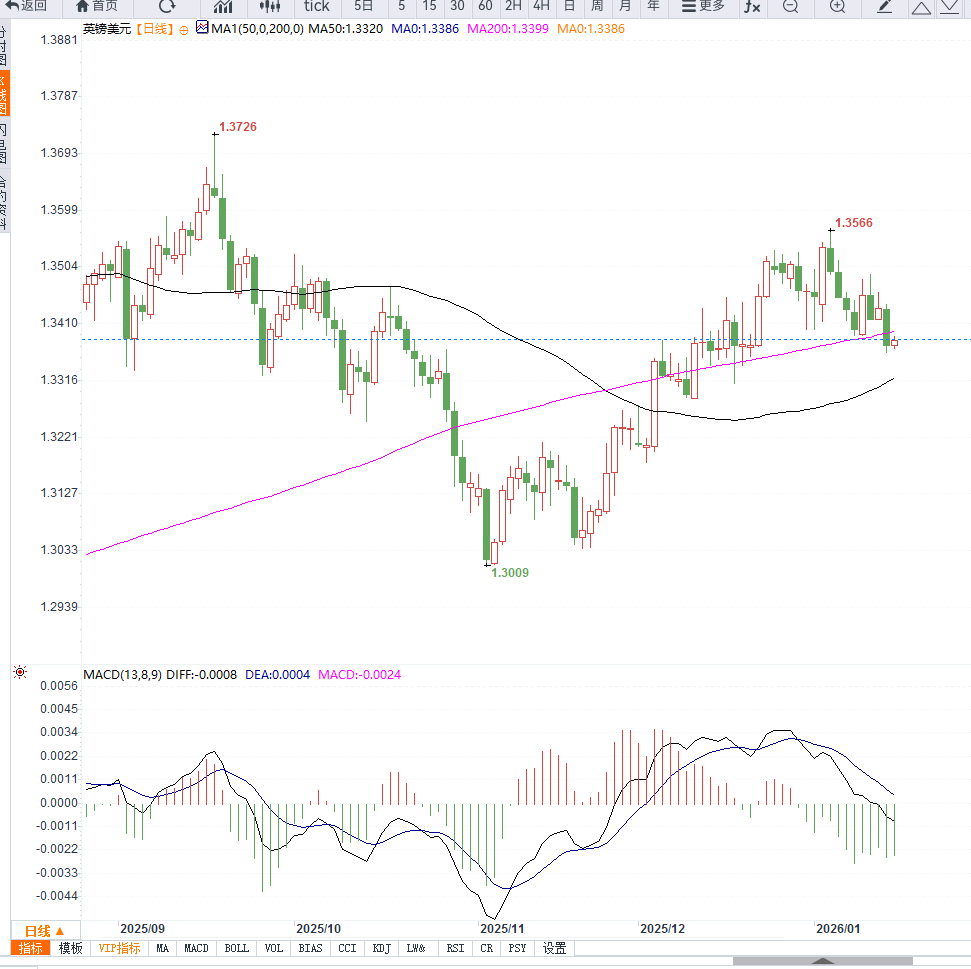
From the daily chart, the British pound against the US dollar has gradually entered a consolidation phase after previously rising above 1.3500, and recently retreated to around 1.3380, indicating that the bullish momentum has slowed down.
The exchange rate is currently fluctuating around the 20-day moving average, while the 5-day and 10-day moving averages are trending flat. The overall structure is biased towards consolidation in a high-level range rather than a downward trend.
In terms of momentum indicators, the MACD shows signs of consolidation above the zero line, with the red bars continuing to contract, indicating that the upward momentum is weakening but has not yet completely turned bearish; the RSI has fallen back to the neutral zone around 50, indicating that market sentiment is becoming more cautious.
The Bollinger Bands are narrowing, suggesting a decrease in short-term volatility and an awaiting directional move. Technically, 1.3350 forms the first key support level; a break below this level could lead to further testing of 1.3280 or even 1.3200.
Resistance is concentrated at 1.3450 and 1.3500. Only by regaining a foothold in this area can the bullish structure be restored. Overall, the market is expected to remain in a weak, oscillating pattern, with short-term price action likely characterized by repeated fluctuations.
Editor's Note:
The British pound is currently caught in a tug-of-war between a strong dollar and a stabilizing UK economy. Resilient US employment data has significantly increased expectations that the Federal Reserve will maintain high interest rates, and the dollar will retain a relative advantage in the short term.
However, the unexpected rebound in UK GDP weakened market bets on a significant easing by the Bank of England, limiting the downside potential of the pound. Technically, the exchange rate has entered a converging range, lacking a clear unilateral driver. It is expected that the exchange rate will likely fluctuate within the 1.3300-1.3500 range until a new catalyst emerges.
The market generally believes that the likelihood of the Federal Reserve keeping interest rates unchanged in the coming months is increasing, becoming an important factor supporting the US dollar.
Data released by the U.S. Department of Labor shows that initial jobless claims fell to 198,000 in the week ending January 10, lower than the market expectation of 215,000 and a further decline from the revised figure of 207,000 in the previous week.
Data indicates that corporate layoffs remain limited, and the labor market remains resilient in a high-interest-rate environment. Pricing in the interest rate futures market shows that investors have postponed their expectations for the next Federal Reserve rate cut to June, reflecting rising concerns about sticky inflation and robust employment.
The US dollar thus received additional support, limiting the rebound of non-US currencies. On the other hand, UK economic data provided some support for the pound sterling.
Data released by the UK Office for National Statistics shows that the UK economy has returned to a growth trajectory, with GDP growing by 0.3% month-on-month in December, significantly better than the market expectation of 0.1% and reversing the contraction of the previous two months.
The Bank of England stated at its December meeting that monetary policy would follow a gradual easing path, and the latest data may reduce the need for it to accelerate interest rate cuts.
From the daily chart, the British pound against the US dollar has gradually entered a consolidation phase after previously rising above 1.3500, and recently retreated to around 1.3380, indicating that the bullish momentum has slowed down.
The exchange rate is currently fluctuating around the 20-day moving average, while the 5-day and 10-day moving averages are trending flat. The overall structure is biased towards consolidation in a high-level range rather than a downward trend.
In terms of momentum indicators, the MACD shows signs of consolidation above the zero line, with the red bars continuing to contract, indicating that the upward momentum is weakening but has not yet completely turned bearish; the RSI has fallen back to the neutral zone around 50, indicating that market sentiment is becoming more cautious.
The Bollinger Bands are narrowing, suggesting a decrease in short-term volatility and an awaiting directional move. Technically, 1.3350 forms the first key support level; a break below this level could lead to further testing of 1.3280 or even 1.3200.
Resistance is concentrated at 1.3450 and 1.3500. Only by regaining a foothold in this area can the bullish structure be restored. Overall, the market is expected to remain in a weak, oscillating pattern, with short-term price action likely characterized by repeated fluctuations.
Editor's Note:
The British pound is currently caught in a tug-of-war between a strong dollar and a stabilizing UK economy. Resilient US employment data has significantly increased expectations that the Federal Reserve will maintain high interest rates, and the dollar will retain a relative advantage in the short term.
However, the unexpected rebound in UK GDP weakened market bets on a significant easing by the Bank of England, limiting the downside potential of the pound. Technically, the exchange rate has entered a converging range, lacking a clear unilateral driver. It is expected that the exchange rate will likely fluctuate within the 1.3300-1.3500 range until a new catalyst emerges.
- Risk Warning and Disclaimer
- The market involves risk, and trading may not be suitable for all investors. This article is for reference only and does not constitute personal investment advice, nor does it take into account certain users’ specific investment objectives, financial situation, or other needs. Any investment decisions made based on this information are at your own risk.