The yen strengthened slightly, putting pressure on the dollar/yen pair to remain range-bound at high levels.
2026-01-16 14:49:47
The dollar fell slightly by about 0.18% against the yen in early European trading on Friday, trading around 158.35. Strong statements from Japanese authorities regarding unilateral exchange rate fluctuations boosted yen sentiment and were the main factor driving the currency's decline.
Market concerns that Japan might resume direct market intervention if the yen continues to depreciate rapidly have prompted some speculative long positions to take profits. Japanese Finance Minister Satsuki Katayama stated that the government is closely monitoring foreign exchange market movements and that all options are on the table, including direct foreign exchange intervention measures, to address excessive and one-sided yen volatility.

This statement is seen as one of the clearest policy warnings recently, reinforcing market expectations that the authorities will defend the exchange rate floor. Meanwhile, US Treasury Secretary Bessant, after meeting with the Japanese Finance Minister, pointed out that Japan needs to remain prudent in its monetary policy formulation and communication, which the market interpreted as US concern over the excessive weakness of the yen.
Amidst a confluence of conflicting opinions, the yen received short-term sentiment support and performed relatively strongly among major currencies. However, from a broader perspective, the foundation for the yen's rebound remains fragile.
Investors generally expect Japan to stimulate economic growth this year through more accommodative fiscal policies, while the Bank of Japan remains cautious in its pace of monetary policy normalization, which limits the yen's potential for further appreciation.
In contrast, the US economy remains resilient, and the Federal Reserve is highly likely to keep interest rates unchanged at its meeting this month, giving the dollar a fundamental advantage overall. With the holiday approaching, the dollar index has slightly declined, but generally remains in a high-level consolidation pattern.
Market focus will continue to be on the policy differences between the US and Japan and the subsequent statements from Japanese authorities. Several potential risks are escalating, and the volatility of the USD/JPY exchange rate may increase significantly.
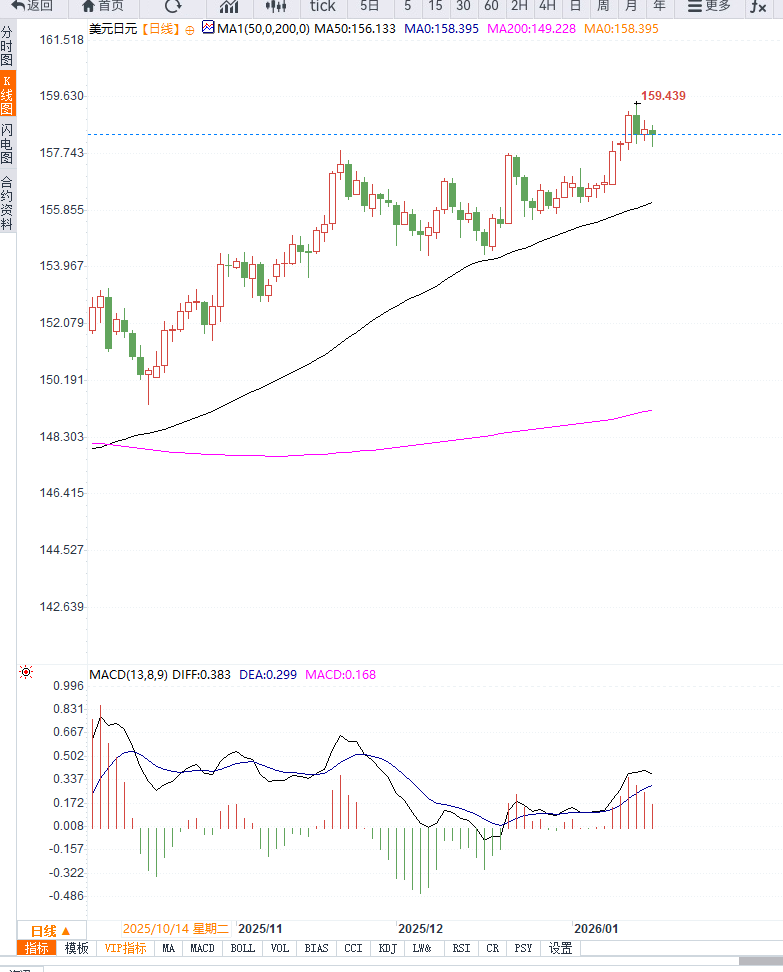
From a daily chart perspective, the USD/JPY pair underwent a technical correction after touching above 158. Currently, the price is retracing to confirm the breakout from the 154.40-157.90 range, but the overall upward trend remains intact. The exchange rate is still firmly trading above the 20-day exponential moving average at 157.30, which continues its gentle upward trend, indicating that medium-term buying power remains dominant.
The Relative Strength Index (RSI) has fallen back to around 62, cooling from the previous overbought zone, but it remains in bullish territory, meaning that upward momentum has not yet completely exhausted. As long as the daily closing price continues to hold above 157.30, the market structure remains biased towards buying on dips, and there is still a possibility of retesting the 159.00 or even 160.00 levels in the future.
If the price unexpectedly falls below the 20-day moving average, it could trigger a deeper pullback, potentially targeting 156.00 and the upper edge of the previous consolidation range. At that point, the short-term bullish trend would be shaken.
Editor's Note:
The current decline in the USD/JPY exchange rate reflects more of a sentiment correction driven by policy expectations than a trend reversal. While verbal intervention by Japanese authorities can curb unilateral fluctuations in the short term, without concrete action, market focus will return to the USD/JPY interest rate differential and economic fundamentals.
Technically, as long as the key level of 157.30 holds, the bullish structure will remain dominant. However, be wary of short-term disturbances caused by sudden interventionist statements.
Market concerns that Japan might resume direct market intervention if the yen continues to depreciate rapidly have prompted some speculative long positions to take profits. Japanese Finance Minister Satsuki Katayama stated that the government is closely monitoring foreign exchange market movements and that all options are on the table, including direct foreign exchange intervention measures, to address excessive and one-sided yen volatility.
This statement is seen as one of the clearest policy warnings recently, reinforcing market expectations that the authorities will defend the exchange rate floor. Meanwhile, US Treasury Secretary Bessant, after meeting with the Japanese Finance Minister, pointed out that Japan needs to remain prudent in its monetary policy formulation and communication, which the market interpreted as US concern over the excessive weakness of the yen.
Amidst a confluence of conflicting opinions, the yen received short-term sentiment support and performed relatively strongly among major currencies. However, from a broader perspective, the foundation for the yen's rebound remains fragile.
Investors generally expect Japan to stimulate economic growth this year through more accommodative fiscal policies, while the Bank of Japan remains cautious in its pace of monetary policy normalization, which limits the yen's potential for further appreciation.
In contrast, the US economy remains resilient, and the Federal Reserve is highly likely to keep interest rates unchanged at its meeting this month, giving the dollar a fundamental advantage overall. With the holiday approaching, the dollar index has slightly declined, but generally remains in a high-level consolidation pattern.
Market focus will continue to be on the policy differences between the US and Japan and the subsequent statements from Japanese authorities. Several potential risks are escalating, and the volatility of the USD/JPY exchange rate may increase significantly.
From a daily chart perspective, the USD/JPY pair underwent a technical correction after touching above 158. Currently, the price is retracing to confirm the breakout from the 154.40-157.90 range, but the overall upward trend remains intact. The exchange rate is still firmly trading above the 20-day exponential moving average at 157.30, which continues its gentle upward trend, indicating that medium-term buying power remains dominant.
The Relative Strength Index (RSI) has fallen back to around 62, cooling from the previous overbought zone, but it remains in bullish territory, meaning that upward momentum has not yet completely exhausted. As long as the daily closing price continues to hold above 157.30, the market structure remains biased towards buying on dips, and there is still a possibility of retesting the 159.00 or even 160.00 levels in the future.
If the price unexpectedly falls below the 20-day moving average, it could trigger a deeper pullback, potentially targeting 156.00 and the upper edge of the previous consolidation range. At that point, the short-term bullish trend would be shaken.
Editor's Note:
The current decline in the USD/JPY exchange rate reflects more of a sentiment correction driven by policy expectations than a trend reversal. While verbal intervention by Japanese authorities can curb unilateral fluctuations in the short term, without concrete action, market focus will return to the USD/JPY interest rate differential and economic fundamentals.
Technically, as long as the key level of 157.30 holds, the bullish structure will remain dominant. However, be wary of short-term disturbances caused by sudden interventionist statements.
- Risk Warning and Disclaimer
- The market involves risk, and trading may not be suitable for all investors. This article is for reference only and does not constitute personal investment advice, nor does it take into account certain users’ specific investment objectives, financial situation, or other needs. Any investment decisions made based on this information are at your own risk.