Trump brandishes tariffs, US-EU trade war on the verge of erupting! Gold prices continue to rise, touching the $4700 mark.
2026-01-20 13:34:38
The economic relationship between the United States and Europe has long been considered the closest and most stable transatlantic partnership in the world. However, this relationship is facing an unprecedented crisis as US President Trump attempts to annex Greenland and imposes high tariffs on several European countries. A full-blown trade war could severely impact the US, from its manufacturing powerhouse to its technological hub. In the short term, slower economic growth and rising inflationary pressures are inevitable; in the long term, the deterioration of US-EU relations could reshape the global trade landscape, with US companies losing significant market share. Market risk aversion continues to rise, and spot gold extended its gains on Tuesday (January 20), climbing as much as 0.65% to a record high of $4701.32 per ounce.

The economic ties between the United States and the European Union go far beyond simple trade, forming a deeply intertwined and interdependent relationship. The EU is the United States' largest trading partner and also its largest source of foreign direct investment.
As of 2024, total direct investment from Europe in the United States reached $3.6 trillion, while American companies also reaped huge returns in Europe, particularly in the software, financial products, and energy sectors. In terms of services trade, US service exports to the EU reached $294.7 billion in 2024, with digital services, cloud computing, and financial services dominating.
The Western European market accounts for a significant portion of the revenue of many top U.S. technology companies, such as Microsoft, Amazon, Google, and IBM. This deep integration means that trade barriers imposed by either side could trigger a chain reaction, directly impacting the profits and global competitiveness of companies in both countries.
Trump is using the strength of the U.S. economy as a diplomatic lever, attempting to force allies to comply through tariff threats. He publicly stated that a 10% tariff would be imposed on Denmark, Norway, Sweden, France, Germany, the United Kingdom, the Netherlands, and Finland starting February 1, and that if no agreement was reached on the sale of Greenland by June 1, the tariff would rise to 25%.
These measures target high-end goods such as French perfumes, cheeses, and wines, as well as German cars, aiming to exert pressure by impacting European luxury goods and manufactured exports. This unilateral approach has plunged the transatlantic alliance into a serious crisis, forcing European leaders to weigh whether to continue relying on US military support or to take stronger countermeasures.
Faced with Trump's tariff threats, European countries are not without recourse. EU leaders are considering various retaliatory measures, including imposing tariffs on over $100 billion worth of US goods and restricting US multinational corporations from bidding on European public contracts.
In the past, the EU has targeted iconic products of "red states" in trade disputes, such as American bourbon whiskey, Harley-Davidson motorcycles, and agricultural products, in order to maximize political pressure.
This time, the EU may continue to use a similar strategy, retaliating against high-end consumer goods and exports that are politically sensitive to the United States.
Furthermore, the EU may also postpone ratification of the previously reached trade agreement with the US, further escalating tensions. Some analysts point out that if Europe uses its "bazooka"-like anti-coercion tools to impose regulatory restrictions or tax barriers on US services and investment, the consequences will be even more severe.
Economists generally believe that even if a full-blown trade war breaks out, it may not immediately trigger a recession in the United States, but a slowdown in growth is almost inevitable. Additional tariffs will push up import costs for American businesses and consumers, and this pressure could further drive up prices, especially before inflation has fully subsided.
The U.S. manufacturing sector is already in a vulnerable state due to high interest rates and supply chain tensions, and the addition of tariffs will exacerbate its contraction.
Research shows that between 2024 and 2025, U.S. companies and consumers will bear 96% of the tariff costs, while foreign exporters will absorb only 4%. Although previous tariffs have not triggered runaway inflation, the tariffs targeting high-end European goods could have a greater impact, especially on U.S. factories that rely on European parts and equipment.
The US manufacturing sector is highly intertwined with European supply chains, making the impact of tariff threats particularly pronounced in certain regions. For example, the BMW plant in Spartanburg, South Carolina, employs approximately 12,000 people and indirectly supports tens of thousands of other jobs.
BMW sources a large portion of its engines and components from Europe, and exports more than half of its cars to the EU. If Europe imposes retaliatory tariffs, BMW could be forced to cut production in the US, severely impacting the local economy.
Other U.S. manufacturers that rely on European machinery, turbines, and components will also face soaring costs. Conversely, U.S. automakers, which are less dependent on the European market, may benefit in the short term from the decline in the competitiveness of imported cars, but this "beggar-thy-neighbor" effect is unlikely to offset the overall losses in the manufacturing sector.
American tech giants are highly dependent on the European market, and any tariffs or regulatory upgrades will directly impact their global profits.
The CEO of cloud software company Snowflake stated clearly at the Davos Forum that regulatory and tariff measures are "of great importance" to technology companies. If the EU strengthens its scrutiny or raises taxes, US companies' intellectual property portfolios and profit recognition in places like Ireland will be severely impacted.
The pharmaceutical industry also faces risks. Many American companies have placed research and development and production in low-tax areas of Europe. If these channels are blocked, global profits and stock market valuations will both come under pressure. In the long run, Europe may accelerate its reduction of dependence on the United States and instead deepen trade ties with other regions, which will open up greater market opportunities for competitors such as China.
European investors hold approximately $8 trillion in U.S. stocks and bonds, far exceeding the total holdings of all other regions combined. If the geoeconomic stability between the U.S. and Europe is fundamentally shaken, capital outflows from Europe will lead to a weaker dollar, a stock market decline, and higher U.S. borrowing costs, further dampening business investment and household spending.
While markets have historically become desensitized to Trump's tariff threats, this aggressive move targeting traditional allies could disrupt that balance. Analysts warn that if European investors reduce their allocation to US assets, the US will struggle to maintain a low-interest-rate environment, and the sustainability of its massive budget deficit will be put to the test.
The deterioration of US-EU relations is not merely a trade friction, but a profound challenge to the global economic order. In the short term, the US may gain some concessions through a hardline stance, but the long-term costs will far exceed expectations: damaged corporate profits, lost market share, a deteriorating investment environment, and even a loss of competitive advantage in cutting-edge fields such as artificial intelligence. While Europe is militarily dependent on the US, its determination for economic retaliation is growing, and neither side is willing to back down easily. This potential trade war will test the resilience of the US economy and reshape the future of the transatlantic partnership. Regardless of the outcome, the US will find it difficult to remain unscathed.
Latest market data shows that gold prices continued their strong upward trend during Tuesday's Asian trading session, climbing as much as 0.65% to $4,701.32 per ounce, a new record high. This increase was mainly driven by escalating trade tensions between the US and Europe, heightened geopolitical uncertainty, and a surge in investor demand for safe-haven assets. Continued concerns about a potential trade war, inflationary pressures, and a weakening dollar have fueled a flow of funds into gold as a traditional safe-haven asset.
Analysts point out that if the US-EU tariff confrontation continues or escalates further, gold prices still have room to rise further; conversely, if there are signs of easing tensions, profit-taking may trigger a pullback, but the long-term bullish trend for gold remains unchanged.
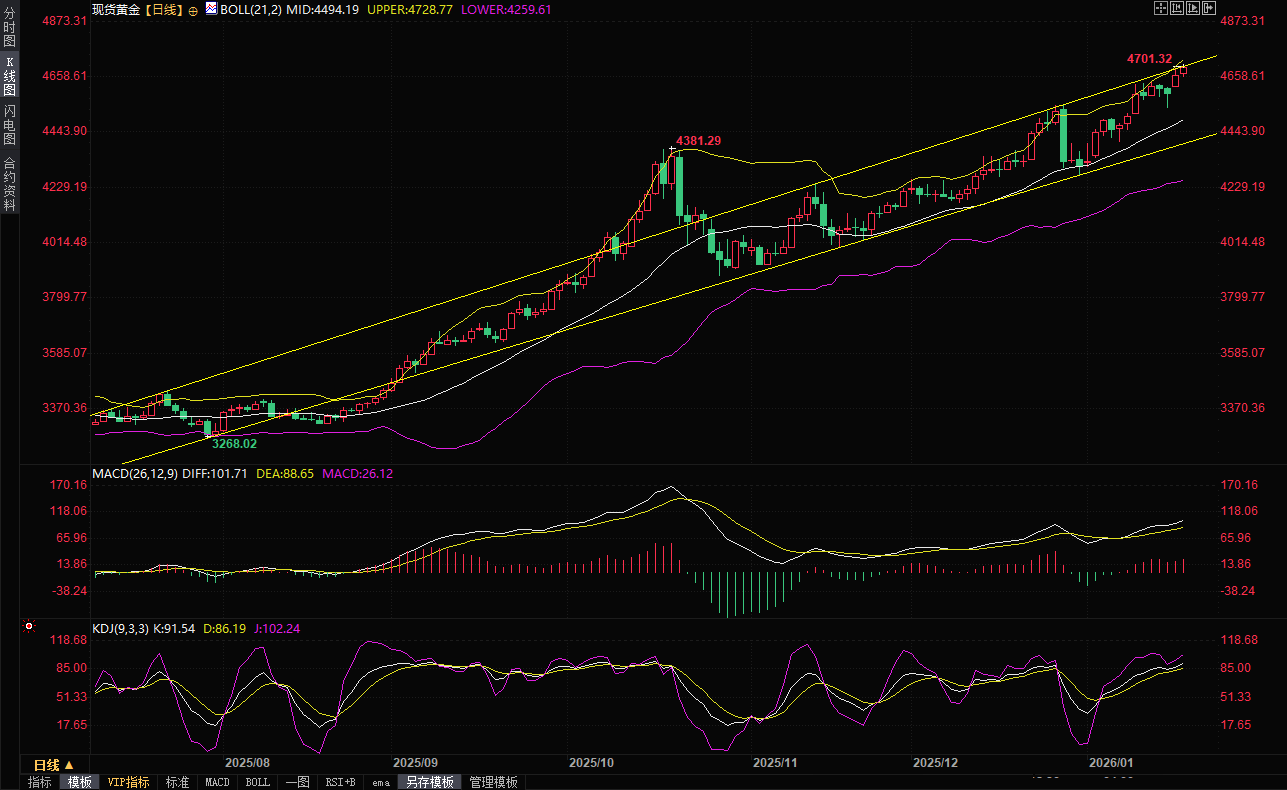
(Spot gold daily chart, source: FX678)
At 13:33 Beijing time, spot gold was trading at $4698.64 per ounce.
The depth and breadth of the US-EU economic ties
The economic ties between the United States and the European Union go far beyond simple trade, forming a deeply intertwined and interdependent relationship. The EU is the United States' largest trading partner and also its largest source of foreign direct investment.
As of 2024, total direct investment from Europe in the United States reached $3.6 trillion, while American companies also reaped huge returns in Europe, particularly in the software, financial products, and energy sectors. In terms of services trade, US service exports to the EU reached $294.7 billion in 2024, with digital services, cloud computing, and financial services dominating.
The Western European market accounts for a significant portion of the revenue of many top U.S. technology companies, such as Microsoft, Amazon, Google, and IBM. This deep integration means that trade barriers imposed by either side could trigger a chain reaction, directly impacting the profits and global competitiveness of companies in both countries.
The trigger for Trump's radical policies
Trump is using the strength of the U.S. economy as a diplomatic lever, attempting to force allies to comply through tariff threats. He publicly stated that a 10% tariff would be imposed on Denmark, Norway, Sweden, France, Germany, the United Kingdom, the Netherlands, and Finland starting February 1, and that if no agreement was reached on the sale of Greenland by June 1, the tariff would rise to 25%.
These measures target high-end goods such as French perfumes, cheeses, and wines, as well as German cars, aiming to exert pressure by impacting European luxury goods and manufactured exports. This unilateral approach has plunged the transatlantic alliance into a serious crisis, forcing European leaders to weigh whether to continue relying on US military support or to take stronger countermeasures.
Possible retaliatory strikes from Europe
Faced with Trump's tariff threats, European countries are not without recourse. EU leaders are considering various retaliatory measures, including imposing tariffs on over $100 billion worth of US goods and restricting US multinational corporations from bidding on European public contracts.
In the past, the EU has targeted iconic products of "red states" in trade disputes, such as American bourbon whiskey, Harley-Davidson motorcycles, and agricultural products, in order to maximize political pressure.
This time, the EU may continue to use a similar strategy, retaliating against high-end consumer goods and exports that are politically sensitive to the United States.
Furthermore, the EU may also postpone ratification of the previously reached trade agreement with the US, further escalating tensions. Some analysts point out that if Europe uses its "bazooka"-like anti-coercion tools to impose regulatory restrictions or tax barriers on US services and investment, the consequences will be even more severe.
Potential drag on US economic growth in the short term
Economists generally believe that even if a full-blown trade war breaks out, it may not immediately trigger a recession in the United States, but a slowdown in growth is almost inevitable. Additional tariffs will push up import costs for American businesses and consumers, and this pressure could further drive up prices, especially before inflation has fully subsided.
The U.S. manufacturing sector is already in a vulnerable state due to high interest rates and supply chain tensions, and the addition of tariffs will exacerbate its contraction.
Research shows that between 2024 and 2025, U.S. companies and consumers will bear 96% of the tariff costs, while foreign exporters will absorb only 4%. Although previous tariffs have not triggered runaway inflation, the tariffs targeting high-end European goods could have a greater impact, especially on U.S. factories that rely on European parts and equipment.
Severe challenges for manufacturing and key regions
The US manufacturing sector is highly intertwined with European supply chains, making the impact of tariff threats particularly pronounced in certain regions. For example, the BMW plant in Spartanburg, South Carolina, employs approximately 12,000 people and indirectly supports tens of thousands of other jobs.
BMW sources a large portion of its engines and components from Europe, and exports more than half of its cars to the EU. If Europe imposes retaliatory tariffs, BMW could be forced to cut production in the US, severely impacting the local economy.
Other U.S. manufacturers that rely on European machinery, turbines, and components will also face soaring costs. Conversely, U.S. automakers, which are less dependent on the European market, may benefit in the short term from the decline in the competitiveness of imported cars, but this "beggar-thy-neighbor" effect is unlikely to offset the overall losses in the manufacturing sector.
Long-term concerns facing the technology and service industries
American tech giants are highly dependent on the European market, and any tariffs or regulatory upgrades will directly impact their global profits.
The CEO of cloud software company Snowflake stated clearly at the Davos Forum that regulatory and tariff measures are "of great importance" to technology companies. If the EU strengthens its scrutiny or raises taxes, US companies' intellectual property portfolios and profit recognition in places like Ireland will be severely impacted.
The pharmaceutical industry also faces risks. Many American companies have placed research and development and production in low-tax areas of Europe. If these channels are blocked, global profits and stock market valuations will both come under pressure. In the long run, Europe may accelerate its reduction of dependence on the United States and instead deepen trade ties with other regions, which will open up greater market opportunities for competitors such as China.
The erosion of financial markets and investor confidence
European investors hold approximately $8 trillion in U.S. stocks and bonds, far exceeding the total holdings of all other regions combined. If the geoeconomic stability between the U.S. and Europe is fundamentally shaken, capital outflows from Europe will lead to a weaker dollar, a stock market decline, and higher U.S. borrowing costs, further dampening business investment and household spending.
While markets have historically become desensitized to Trump's tariff threats, this aggressive move targeting traditional allies could disrupt that balance. Analysts warn that if European investors reduce their allocation to US assets, the US will struggle to maintain a low-interest-rate environment, and the sustainability of its massive budget deficit will be put to the test.
Conclusion: Irreversible Risks and an Uncertain Future
The deterioration of US-EU relations is not merely a trade friction, but a profound challenge to the global economic order. In the short term, the US may gain some concessions through a hardline stance, but the long-term costs will far exceed expectations: damaged corporate profits, lost market share, a deteriorating investment environment, and even a loss of competitive advantage in cutting-edge fields such as artificial intelligence. While Europe is militarily dependent on the US, its determination for economic retaliation is growing, and neither side is willing to back down easily. This potential trade war will test the resilience of the US economy and reshape the future of the transatlantic partnership. Regardless of the outcome, the US will find it difficult to remain unscathed.
Latest market data shows that gold prices continued their strong upward trend during Tuesday's Asian trading session, climbing as much as 0.65% to $4,701.32 per ounce, a new record high. This increase was mainly driven by escalating trade tensions between the US and Europe, heightened geopolitical uncertainty, and a surge in investor demand for safe-haven assets. Continued concerns about a potential trade war, inflationary pressures, and a weakening dollar have fueled a flow of funds into gold as a traditional safe-haven asset.
Analysts point out that if the US-EU tariff confrontation continues or escalates further, gold prices still have room to rise further; conversely, if there are signs of easing tensions, profit-taking may trigger a pullback, but the long-term bullish trend for gold remains unchanged.
(Spot gold daily chart, source: FX678)
At 13:33 Beijing time, spot gold was trading at $4698.64 per ounce.
- Risk Warning and Disclaimer
- The market involves risk, and trading may not be suitable for all investors. This article is for reference only and does not constitute personal investment advice, nor does it take into account certain users’ specific investment objectives, financial situation, or other needs. Any investment decisions made based on this information are at your own risk.