Escalating trade concerns between the US and Europe led to increased risk aversion, causing the US dollar index to fall below 99 and continue its decline.
2026-01-20 14:52:43
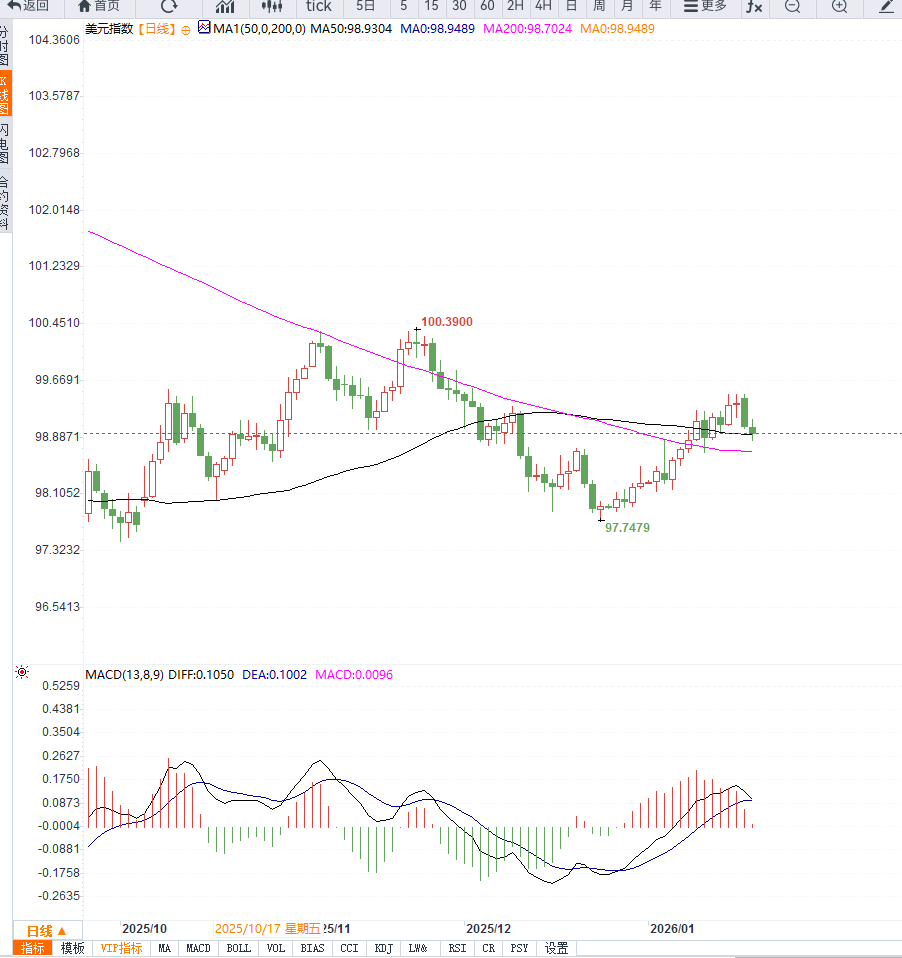
The US dollar index (DXY) continued to be under pressure during Asian trading hours on Tuesday, falling for the second consecutive session and trading around 98.90.
As tensions escalate between the United States and the European Union, risk aversion in global markets is rising, and the US dollar is facing new downward pressure.
US President Trump said last Saturday that if the US is not allowed to purchase Greenland, it will impose a 10% tariff on goods from Denmark, Sweden, France, Germany, the Netherlands, Finland, the United Kingdom and Norway starting February 1.

This statement quickly triggered a strong reaction from Europe, exacerbating market concerns about transatlantic trade friction. The EU reached a consensus on Sunday to intensify diplomatic efforts to prevent the tariffs from being implemented, while preparing countermeasures for the worst-case scenario.
French President Emmanuel Macron called on the European Union to use its so-called "trade bazooka," a mechanism that could restrict US companies' access to the EU market or impose controls on some exports, further complicating the situation.
In terms of monetary policy, the downside potential of the US dollar remains somewhat limited. Previously released robust US labor market data has pushed back market expectations for further interest rate cuts by the Federal Reserve to June.
Several Federal Reserve officials have also emphasized that they are in no hurry to further ease policy until inflation has clearly and sustainably fallen back to the 2% target. Morgan Stanley analysts say the Fed may only cut rates once in June and once in September 2026, significantly fewer than previously expected.
From a daily chart perspective, the US dollar index continues to trade below its 50-day and 20-day moving averages, indicating a weak short-term trend. Recent rebound highs have been gradually declining, suggesting insufficient bullish momentum. The Relative Strength Index (RSI) is below 50, remaining in bearish territory, indicating that market sentiment has not yet shown a significant reversal.
If the index breaks below 98.50, it may open up further downside potential to around 98.00; conversely, if it regains its footing above 99.30, it may alleviate the current downward pressure and allow the exchange rate to enter a consolidation phase.
Editor's Note:
In summary, the core factor currently putting pressure on the US dollar index is not solely monetary policy expectations, but rather the combined effect of rising US-EU trade concerns and changes in global risk appetite.
Although the possibility of the Federal Reserve making significant easing in the short term is limited, the US dollar is unlikely to escape its weak and volatile pattern in the short term, given the continued escalation of geopolitical and trade uncertainties.
As tensions escalate between the United States and the European Union, risk aversion in global markets is rising, and the US dollar is facing new downward pressure.
US President Trump said last Saturday that if the US is not allowed to purchase Greenland, it will impose a 10% tariff on goods from Denmark, Sweden, France, Germany, the Netherlands, Finland, the United Kingdom and Norway starting February 1.
This statement quickly triggered a strong reaction from Europe, exacerbating market concerns about transatlantic trade friction. The EU reached a consensus on Sunday to intensify diplomatic efforts to prevent the tariffs from being implemented, while preparing countermeasures for the worst-case scenario.
French President Emmanuel Macron called on the European Union to use its so-called "trade bazooka," a mechanism that could restrict US companies' access to the EU market or impose controls on some exports, further complicating the situation.
In terms of monetary policy, the downside potential of the US dollar remains somewhat limited. Previously released robust US labor market data has pushed back market expectations for further interest rate cuts by the Federal Reserve to June.
Several Federal Reserve officials have also emphasized that they are in no hurry to further ease policy until inflation has clearly and sustainably fallen back to the 2% target. Morgan Stanley analysts say the Fed may only cut rates once in June and once in September 2026, significantly fewer than previously expected.
From a daily chart perspective, the US dollar index continues to trade below its 50-day and 20-day moving averages, indicating a weak short-term trend. Recent rebound highs have been gradually declining, suggesting insufficient bullish momentum. The Relative Strength Index (RSI) is below 50, remaining in bearish territory, indicating that market sentiment has not yet shown a significant reversal.
If the index breaks below 98.50, it may open up further downside potential to around 98.00; conversely, if it regains its footing above 99.30, it may alleviate the current downward pressure and allow the exchange rate to enter a consolidation phase.
Editor's Note:
In summary, the core factor currently putting pressure on the US dollar index is not solely monetary policy expectations, but rather the combined effect of rising US-EU trade concerns and changes in global risk appetite.
Although the possibility of the Federal Reserve making significant easing in the short term is limited, the US dollar is unlikely to escape its weak and volatile pattern in the short term, given the continued escalation of geopolitical and trade uncertainties.
- Risk Warning and Disclaimer
- The market involves risk, and trading may not be suitable for all investors. This article is for reference only and does not constitute personal investment advice, nor does it take into account certain users’ specific investment objectives, financial situation, or other needs. Any investment decisions made based on this information are at your own risk.