"All options are open!" Japan's Finance Minister makes a bold statement. Will yen bears be afraid?
2026-01-20 15:26:40
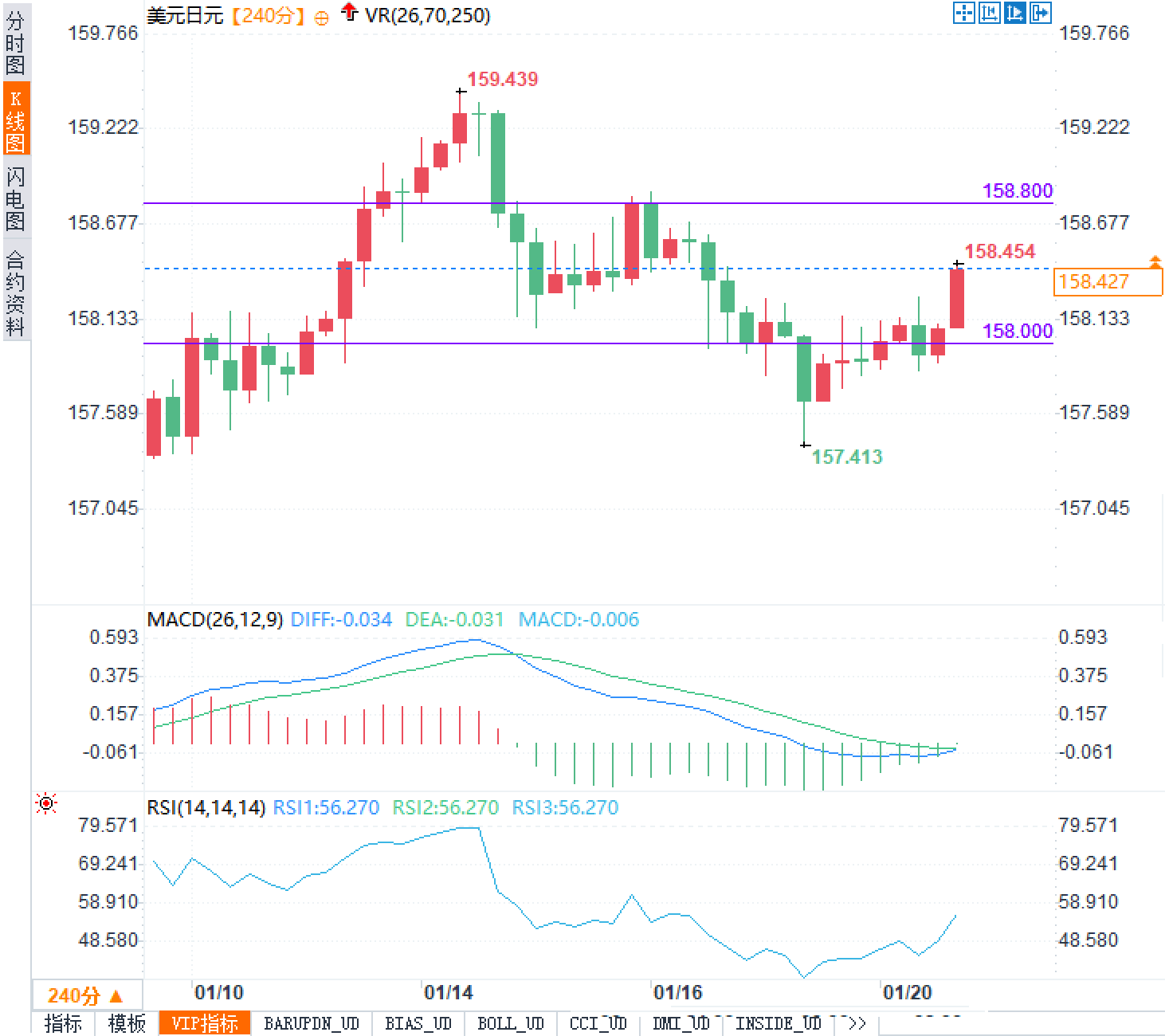
On Tuesday (January 20), the USD/JPY pair traded around 158.50 in early European trading, entering a technical correction phase. The price had previously surged to 159.439, a new 18-month high, before retreating to 157.413, forming a clear consolidation pattern. Currently, the price is in the upper part of this range, with initial resistance at 158.800 and key psychological support at 158.000.

If the price breaks through the former, it may retest the high near 159.4; if it falls below the latter, the low of 157.4 may be retested. From a technical perspective, although the MACD is still below the zero line, the negative values of DIFF (-0.034) and DEA (-0.031) continue to converge, indicating weakening downward momentum; the RSI reading is 56.270, in the neutral zone, reflecting that the market is in a consolidation phase after a rebound and has not yet formed a one-sided trend.
Behind this round of volatility lies a deep interplay of macroeconomic logic. The main trading themes focus on two core issues: first, whether the Bank of Japan will adjust its policy pace due to sharp exchange rate fluctuations; and second, how changes in expectations regarding Federal Reserve rate cuts will affect the US-Japan interest rate differential, thereby driving capital flows. Although the Bank of Japan is highly likely to maintain its interest rate at 0.75% this week, the market's focus has shifted from its actions to its statements. Once the central bank releases warning signals about inflation risks and hints at possible further rate hikes, the yen often receives support from expectations as it weakens further. Conversely, if the wording is vague or dovish, the exchange rate may accelerate its decline again.
It is worth noting that since Sanae Takashi took office in October, the yen has depreciated by about 8% against the dollar, and the imported inflationary pressure from rising import costs has become a recurring risk point mentioned by policymakers. Although the exchange rate has recently stabilized, cost transmission has a lag, and end-price pressures have not disappeared. Against this backdrop, the Bank of Japan faces a dilemma: it must curb inflation caused by excessive yen depreciation, while also preventing a rapid rise in government bond yields from impacting financial market stability. More hawkish rhetoric, while helping to boost the yen, could push up the bond yield curve and suppress the valuation of risky assets; while allowing the exchange rate to decline could force policy tightening more quickly, disrupting the original pace.
Political developments in Japan are subtly influencing the foreign exchange market. Sanae Takaichi announced a snap election on February 8th and pledged a fiscal stimulus package including tax cuts and increased spending. This expansionary policy mix has triggered two interpretations in the market: on the one hand, fiscal stimulus may boost economic momentum and support further interest rate hikes to combat potential inflation; on the other hand, some worry that the "growth-first" narrative will overshadow monetary policy independence, creating expectations of "low interest rates for a longer period," thus weakening the yen's attractiveness.
More concerning is that this policy inclination could alter market perceptions of Japan's fiscal sustainability. The recent rise in 10-year government bond yields to near multi-decade highs reflects investor concerns about increasing debt burdens. Rising yields not only increase government financing costs but also strengthen the correlation between Japanese government bonds and the yen—when the bond market is under pressure, the exchange rate tends to weaken in tandem. This strained "fiscal-interest-exchange rate" triangle forces the Bank of Japan to be more cautious in its policy-making, and any statements regarding inflation sustainability are likely to be interpreted with greater care and precision.
Meanwhile, the possibility of foreign exchange intervention is also rising. Japanese Finance Minister Katayama explicitly stated that "all options are under consideration," including directly buying yen in the market, and even not ruling out coordinated action with the US. While such statements do not equate to immediate intervention, they are highly intimidating in terms of market sentiment. Once traders realize that "shorting the yen unilaterally may encounter strong resistance," their willingness to leverage up the USD/JPY pair will decrease, and volatility may suddenly amplify at key levels. Historical experience shows that Japanese authorities typically intervene when the yen depreciates rapidly and approaches key psychological levels (such as 160), therefore the current level around 158.50 is in a sensitive range.
Globally, the Federal Reserve's actions remain a significant variable. While market bets on interest rate cuts in 2026 have somewhat subsided, the interest rate differential still provides some support for the US dollar. However, a strong dollar does not advance linearly. When geopolitical conflicts or trade frictions escalate, traditional safe-haven demand often pushes up the yen. This means that the USD/JPY exchange rate essentially fluctuates between "interest rate differential support" and "safe-haven buying," and without a single dominant force, the price action tends to be range-bound.
True directional breakthroughs often require catalysts. For example, if the Bank of Japan significantly strengthens its hawkish stance at its next meeting, emphasizing that exchange rate fluctuations will be taken into policy considerations, it would effectively include the yen's trajectory in its forward guidance, potentially triggering short covering. Conversely, if the Federal Reserve signals an early rate cut due to weak economic data, the expected reversal of the US-Japan interest rate differential would quickly depress the exchange rate. Currently, there is disagreement in the market regarding the timing of the Bank of Japan's next rate hike: some believe that if the yen continues to fall below 159, a rate hike in April is not impossible; more predictions point to July, provided that wage and inflation data continue to improve.
It is worth emphasizing that while past interest rate hikes were primarily driven by endogenous economic drivers, foreign exchange fluctuations are now becoming a significant factor influencing policy pace. If the central bank explicitly states that "excessive exchange rate volatility will affect policy decisions," it means that yen depreciation is no longer simply a market-driven phenomenon but could trigger expectations of policy intervention. Once this "expectation anchoring" mechanism is established, it can, to some extent, curb the development of one-sided market trends, even without actual interest rate hikes or intervention. However, from another perspective, this also means that the bond market will face greater pressure—to stabilize the exchange rate, yields may be forced to remain high, further squeezing policy maneuvering space.
If the price breaks through the former, it may retest the high near 159.4; if it falls below the latter, the low of 157.4 may be retested. From a technical perspective, although the MACD is still below the zero line, the negative values of DIFF (-0.034) and DEA (-0.031) continue to converge, indicating weakening downward momentum; the RSI reading is 56.270, in the neutral zone, reflecting that the market is in a consolidation phase after a rebound and has not yet formed a one-sided trend.
Behind this round of volatility lies a deep interplay of macroeconomic logic. The main trading themes focus on two core issues: first, whether the Bank of Japan will adjust its policy pace due to sharp exchange rate fluctuations; and second, how changes in expectations regarding Federal Reserve rate cuts will affect the US-Japan interest rate differential, thereby driving capital flows. Although the Bank of Japan is highly likely to maintain its interest rate at 0.75% this week, the market's focus has shifted from its actions to its statements. Once the central bank releases warning signals about inflation risks and hints at possible further rate hikes, the yen often receives support from expectations as it weakens further. Conversely, if the wording is vague or dovish, the exchange rate may accelerate its decline again.
It is worth noting that since Sanae Takashi took office in October, the yen has depreciated by about 8% against the dollar, and the imported inflationary pressure from rising import costs has become a recurring risk point mentioned by policymakers. Although the exchange rate has recently stabilized, cost transmission has a lag, and end-price pressures have not disappeared. Against this backdrop, the Bank of Japan faces a dilemma: it must curb inflation caused by excessive yen depreciation, while also preventing a rapid rise in government bond yields from impacting financial market stability. More hawkish rhetoric, while helping to boost the yen, could push up the bond yield curve and suppress the valuation of risky assets; while allowing the exchange rate to decline could force policy tightening more quickly, disrupting the original pace.
Fiscal expansion and political upheaval exacerbate policy uncertainty.
Political developments in Japan are subtly influencing the foreign exchange market. Sanae Takaichi announced a snap election on February 8th and pledged a fiscal stimulus package including tax cuts and increased spending. This expansionary policy mix has triggered two interpretations in the market: on the one hand, fiscal stimulus may boost economic momentum and support further interest rate hikes to combat potential inflation; on the other hand, some worry that the "growth-first" narrative will overshadow monetary policy independence, creating expectations of "low interest rates for a longer period," thus weakening the yen's attractiveness.
More concerning is that this policy inclination could alter market perceptions of Japan's fiscal sustainability. The recent rise in 10-year government bond yields to near multi-decade highs reflects investor concerns about increasing debt burdens. Rising yields not only increase government financing costs but also strengthen the correlation between Japanese government bonds and the yen—when the bond market is under pressure, the exchange rate tends to weaken in tandem. This strained "fiscal-interest-exchange rate" triangle forces the Bank of Japan to be more cautious in its policy-making, and any statements regarding inflation sustainability are likely to be interpreted with greater care and precision.
Meanwhile, the possibility of foreign exchange intervention is also rising. Japanese Finance Minister Katayama explicitly stated that "all options are under consideration," including directly buying yen in the market, and even not ruling out coordinated action with the US. While such statements do not equate to immediate intervention, they are highly intimidating in terms of market sentiment. Once traders realize that "shorting the yen unilaterally may encounter strong resistance," their willingness to leverage up the USD/JPY pair will decrease, and volatility may suddenly amplify at key levels. Historical experience shows that Japanese authorities typically intervene when the yen depreciates rapidly and approaches key psychological levels (such as 160), therefore the current level around 158.50 is in a sensitive range.
With US and Japanese policies diverging and locked in a tug-of-war, exchange rate trends will depend on "who blinks first."
Globally, the Federal Reserve's actions remain a significant variable. While market bets on interest rate cuts in 2026 have somewhat subsided, the interest rate differential still provides some support for the US dollar. However, a strong dollar does not advance linearly. When geopolitical conflicts or trade frictions escalate, traditional safe-haven demand often pushes up the yen. This means that the USD/JPY exchange rate essentially fluctuates between "interest rate differential support" and "safe-haven buying," and without a single dominant force, the price action tends to be range-bound.
True directional breakthroughs often require catalysts. For example, if the Bank of Japan significantly strengthens its hawkish stance at its next meeting, emphasizing that exchange rate fluctuations will be taken into policy considerations, it would effectively include the yen's trajectory in its forward guidance, potentially triggering short covering. Conversely, if the Federal Reserve signals an early rate cut due to weak economic data, the expected reversal of the US-Japan interest rate differential would quickly depress the exchange rate. Currently, there is disagreement in the market regarding the timing of the Bank of Japan's next rate hike: some believe that if the yen continues to fall below 159, a rate hike in April is not impossible; more predictions point to July, provided that wage and inflation data continue to improve.
It is worth emphasizing that while past interest rate hikes were primarily driven by endogenous economic drivers, foreign exchange fluctuations are now becoming a significant factor influencing policy pace. If the central bank explicitly states that "excessive exchange rate volatility will affect policy decisions," it means that yen depreciation is no longer simply a market-driven phenomenon but could trigger expectations of policy intervention. Once this "expectation anchoring" mechanism is established, it can, to some extent, curb the development of one-sided market trends, even without actual interest rate hikes or intervention. However, from another perspective, this also means that the bond market will face greater pressure—to stabilize the exchange rate, yields may be forced to remain high, further squeezing policy maneuvering space.
- Risk Warning and Disclaimer
- The market involves risk, and trading may not be suitable for all investors. This article is for reference only and does not constitute personal investment advice, nor does it take into account certain users’ specific investment objectives, financial situation, or other needs. Any investment decisions made based on this information are at your own risk.