The geopolitical crisis has barely subsided when oversupply strikes again! Oil prices are caught in a tug-of-war between two narratives.
2026-01-20 15:42:11
On Tuesday (January 20), during the European session, US crude oil prices fluctuated downwards, with a daily decline of about 0.3%, currently trading around $59.15 per barrel. As the situation in Iran stabilized, safe-haven buying partially subsided, and market focus shifted from short-term geopolitical risks to long-term structural supply and demand pressures, putting downward pressure on oil prices.
Investors remain focused on the repercussions of US President Trump's attempt to control Greenland. This event has roiled financial markets and reignited concerns about a potential trade conflict between the US and Europe. Despite heightened risk awareness, market pricing suggests that expectations remain anchored to a negotiated resolution rather than full-blown retaliation.
XAnalysts analyst Mukesh Sahdev points out that current pricing does not reflect the worst-case scenario. His assessment suggests that expectations of a compromise are easing risk premiums, even as political headlines continue to create uncertainty. The relative size of the U.S. economy and its energy self-sufficiency are seen as factors influencing any escalation, which in turn affects how traders assess downside risks rather than immediately triggering a price revaluation.
Besides geopolitical factors, the crude oil market continues to face pressure from evidence of supply exceeding demand. As OPEC+ oil-producing countries increase production, spot crude oil prices in some parts of the Middle East have declined. The International Energy Agency has repeatedly warned of a significant supply glut in 2026, reinforcing expectations that rising inventories could drag down prices in the long term.
These supply-side dynamics are closely linked to the sluggish price performance. Even with short-term disruptions or political events, expectations of oversupply limit upside potential. Therefore, geopolitical developments tend to exacerbate price volatility rather than act as a catalyst for sustained price increases.
Despite strong risk aversion in the overall market, several factors helped limit downward pressure. A firm spread structure suggests that near-term supply is tighter than longer-term supply. ING's Warren Patterson noted that these factors offset some of the negative sentiment, indicating that the market structure still reflects demand for spot crude oil.
This relationship reflects a divergence between short-term tightness and long-term surplus expectations. While near-term contracts have shown resilience, the forward curve continues to signal caution regarding supply and demand balance later in the year.
Parallel to concerns about oversupply, specific disruptions have led to localized supply tightness. Issues at Union ports along the Black Sea-Caspian Pipeline, coupled with a malfunction at Kazakhstan's Tengiz oil field, have resulted in a short-term reduction in crude oil flows from the Mediterranean region. While the overall outlook remains dominated by oversupply risks, these constraints have provided some support for prices.
The current crude oil market is being influenced by conflicting narratives. Geopolitical uncertainty and localized supply disruptions are providing intermittent support, while expectations of a significant global oversupply continue to limit price recovery. Until clearer signals emerge regarding sustained strong demand or substantial supply constraints, prices are likely to remain range-bound, sensitive to news, but anchored by structural fundamentals.
From a weekly perspective, crude oil prices continue to trade within a downward channel, with the Relative Strength Index (RSI) below the 50 neutral threshold, reflecting neutral to bearish momentum.
The key resistance level remains the high of $62.20 reached during the previous escalation of US-Iran tensions, which also coincides with the midline of the downward channel. If the price can clearly hold above this level, the upside target could be $64.70.
The primary trend remains bearish, consistent with the risk of structural oversupply, unless prices sustain a firm hold above the aforementioned key resistance levels, thereby altering the dominant market narrative. On the downside, 58 and 55 remain key support levels.
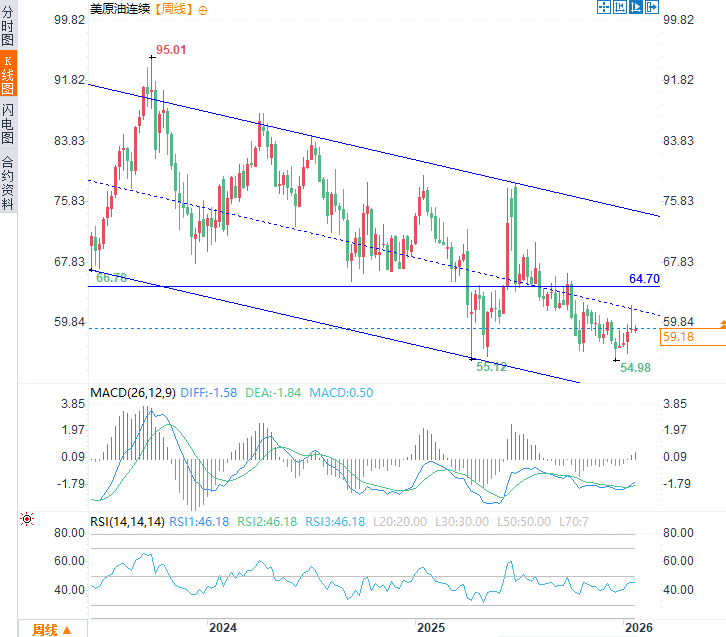
(US crude oil weekly chart, source: FX678)
At 15:38 Beijing time, US crude oil futures were trading at $59.12 per barrel.
Investors remain focused on the repercussions of US President Trump's attempt to control Greenland. This event has roiled financial markets and reignited concerns about a potential trade conflict between the US and Europe. Despite heightened risk awareness, market pricing suggests that expectations remain anchored to a negotiated resolution rather than full-blown retaliation.
XAnalysts analyst Mukesh Sahdev points out that current pricing does not reflect the worst-case scenario. His assessment suggests that expectations of a compromise are easing risk premiums, even as political headlines continue to create uncertainty. The relative size of the U.S. economy and its energy self-sufficiency are seen as factors influencing any escalation, which in turn affects how traders assess downside risks rather than immediately triggering a price revaluation.
Oversupply signals dominate medium-term outlook
Besides geopolitical factors, the crude oil market continues to face pressure from evidence of supply exceeding demand. As OPEC+ oil-producing countries increase production, spot crude oil prices in some parts of the Middle East have declined. The International Energy Agency has repeatedly warned of a significant supply glut in 2026, reinforcing expectations that rising inventories could drag down prices in the long term.
These supply-side dynamics are closely linked to the sluggish price performance. Even with short-term disruptions or political events, expectations of oversupply limit upside potential. Therefore, geopolitical developments tend to exacerbate price volatility rather than act as a catalyst for sustained price increases.
Currency trends and structure limit downside potential
Despite strong risk aversion in the overall market, several factors helped limit downward pressure. A firm spread structure suggests that near-term supply is tighter than longer-term supply. ING's Warren Patterson noted that these factors offset some of the negative sentiment, indicating that the market structure still reflects demand for spot crude oil.
This relationship reflects a divergence between short-term tightness and long-term surplus expectations. While near-term contracts have shown resilience, the forward curve continues to signal caution regarding supply and demand balance later in the year.
The risk of localized tensions remains.
Parallel to concerns about oversupply, specific disruptions have led to localized supply tightness. Issues at Union ports along the Black Sea-Caspian Pipeline, coupled with a malfunction at Kazakhstan's Tengiz oil field, have resulted in a short-term reduction in crude oil flows from the Mediterranean region. While the overall outlook remains dominated by oversupply risks, these constraints have provided some support for prices.
The current crude oil market is being influenced by conflicting narratives. Geopolitical uncertainty and localized supply disruptions are providing intermittent support, while expectations of a significant global oversupply continue to limit price recovery. Until clearer signals emerge regarding sustained strong demand or substantial supply constraints, prices are likely to remain range-bound, sensitive to news, but anchored by structural fundamentals.
Technical Analysis
From a weekly perspective, crude oil prices continue to trade within a downward channel, with the Relative Strength Index (RSI) below the 50 neutral threshold, reflecting neutral to bearish momentum.
The key resistance level remains the high of $62.20 reached during the previous escalation of US-Iran tensions, which also coincides with the midline of the downward channel. If the price can clearly hold above this level, the upside target could be $64.70.
The primary trend remains bearish, consistent with the risk of structural oversupply, unless prices sustain a firm hold above the aforementioned key resistance levels, thereby altering the dominant market narrative. On the downside, 58 and 55 remain key support levels.
(US crude oil weekly chart, source: FX678)
At 15:38 Beijing time, US crude oil futures were trading at $59.12 per barrel.
- Risk Warning and Disclaimer
- The market involves risk, and trading may not be suitable for all investors. This article is for reference only and does not constitute personal investment advice, nor does it take into account certain users’ specific investment objectives, financial situation, or other needs. Any investment decisions made based on this information are at your own risk.