Trump reaches a "framework agreement" with NATO, temporarily easing tariff threats against Europe, causing gold bulls to retreat.
2026-01-22 09:19:46
US President Donald Trump said on Wednesday (January 21) that he and NATO Secretary General Jens Stoltenberg had "built a framework for future deals with Greenland," therefore the US will not impose punitive tariffs on several European countries. These tariffs were originally scheduled to take effect on February 1.
Rising market risk appetite has diminished gold's appeal as a safe-haven asset. Spot gold traded lower in Asian trading on Thursday, currently hovering around $4,790 per ounce, down approximately 0.85% on the day.
In a subsequent interview, Trump stated that the framework agreement with Greenland was merely "a preliminary idea for a deal." He also indicated that the framework involved U.S. mining rights and the Trump administration's "Gold Top" missile defense system plan.
When asked for more details about the proposal, Trump said, "It's a bit complicated, but we'll explain it step by step."
Trump said, "They will participate in the Gold Top program and have mining rights, and so will we." When asked if he was sure that no further tariffs would be imposed next month, Trump said, "Yes, we canceled that decision because we had reached the basic framework of a deal."
Based on my productive meeting with NATO Secretary General Mark Rutte, we have established a framework agreement on future cooperation in Greenland and the entire Arctic region. If finalized, this will be a significant achievement for the United States of America and all NATO members. Based on this consensus, the tariffs originally scheduled to take effect on February 1 will not be implemented. In-depth consultations are underway regarding the "Gold Dome" defense system in Greenland. We will continue to release more details as negotiations progress. Vice President JD Vance, Secretary of State Marco Rubio, Special Envoy Steve Vitkov, and other relevant personnel will jointly lead these negotiations—reporting directly to me. Thank you for your attention!
According to The New York Times, citing three senior officials familiar with the talks, the announcement came after some NATO members discussed a proposal to cede sovereignty over a small piece of Greenland to the United States at the World Economic Forum in Davos, Switzerland. Other details of the framework agreement remain unclear. When asked for more information, White House spokeswoman Anna Kelly reiterated Trump's assurances that more details would be released "gradually as negotiations continue."
While the specifics remain unclear, this statement marks a dramatic shift in the dispute surrounding Trump's continued push for the U.S. acquisition of Greenland. Despite Greenland being territory of NATO ally Denmark, the Trump administration has tentatively proposed purchasing the island in recent weeks, even considering using U.S. military force to control it.
Officials in Denmark and Greenland have explicitly rejected the US offer, reiterating that Greenland is not for sale. As tensions escalate, several European NATO countries have increased their military presence in the region. Last weekend, Trump responded by threatening to impose a new 10% tariff on these countries starting next month, raising it to 25% in June.
In a speech in Davos earlier Wednesday, Trump outlined the U.S. claim to Greenland on national security grounds. His remarks, including a call for “immediate negotiations” with Denmark, unsettled some attendees.
However, Trump also stated that he would not use force to acquire the territory, which is clearly a shift from his previous stance.
Late Wednesday, Trump, who had previously declared that "anything less than full ownership of Greenland is unacceptable," declined to say whether the new framework involved the U.S. acquiring ownership of the island. Trump stated, "This is a long-term deal, the ultimate long-term deal. I think this will put all parties in a very favorable position."
Danish Foreign Minister Rasmus Løvno posted on social media: "Today ended on a more positive note than this morning." He urged all parties to "sit down and discuss how to address U.S. security concerns in the Arctic while respecting Denmark's red lines."
However, some European leaders cautioned against premature optimism. German Finance Minister Lars Klinger said after Trump's meeting with Rutte, "It's good that they've started dialogue, but we need to be patient and not place too high expectations too early."
In the short term, this has eased tensions arising from the escalating trade conflict between the US and Europe. The rebound in market risk appetite may diminish gold's appeal as a safe-haven asset.
In the medium to long term, the Arctic resource competition, the uncertainty of the relationship between Europe and the United States, and the potential inflation risk may still provide support for gold.
We need to pay close attention to the substantive progress of the Greenland negotiations, changes in US tariff policy, and internal developments within NATO, as these factors may determine the trajectory of gold's safe-haven demand.
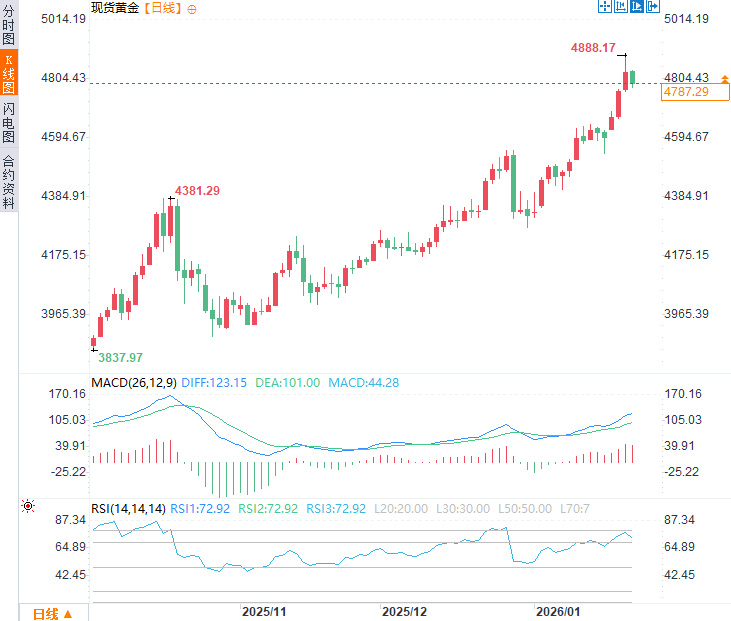
(Spot gold daily chart, source: FX678)
At 9:19 Beijing time, spot gold is trading at $4,796.02 per ounce.
Rising market risk appetite has diminished gold's appeal as a safe-haven asset. Spot gold traded lower in Asian trading on Thursday, currently hovering around $4,790 per ounce, down approximately 0.85% on the day.
The framework agreement has taken initial shape.
In a subsequent interview, Trump stated that the framework agreement with Greenland was merely "a preliminary idea for a deal." He also indicated that the framework involved U.S. mining rights and the Trump administration's "Gold Top" missile defense system plan.
When asked for more details about the proposal, Trump said, "It's a bit complicated, but we'll explain it step by step."
Trump said, "They will participate in the Gold Top program and have mining rights, and so will we." When asked if he was sure that no further tariffs would be imposed next month, Trump said, "Yes, we canceled that decision because we had reached the basic framework of a deal."
Trump's full statement on the platform:
Based on my productive meeting with NATO Secretary General Mark Rutte, we have established a framework agreement on future cooperation in Greenland and the entire Arctic region. If finalized, this will be a significant achievement for the United States of America and all NATO members. Based on this consensus, the tariffs originally scheduled to take effect on February 1 will not be implemented. In-depth consultations are underway regarding the "Gold Dome" defense system in Greenland. We will continue to release more details as negotiations progress. Vice President JD Vance, Secretary of State Marco Rubio, Special Envoy Steve Vitkov, and other relevant personnel will jointly lead these negotiations—reporting directly to me. Thank you for your attention!
Sovereignty Proposal and Historical Disputes
According to The New York Times, citing three senior officials familiar with the talks, the announcement came after some NATO members discussed a proposal to cede sovereignty over a small piece of Greenland to the United States at the World Economic Forum in Davos, Switzerland. Other details of the framework agreement remain unclear. When asked for more information, White House spokeswoman Anna Kelly reiterated Trump's assurances that more details would be released "gradually as negotiations continue."
While the specifics remain unclear, this statement marks a dramatic shift in the dispute surrounding Trump's continued push for the U.S. acquisition of Greenland. Despite Greenland being territory of NATO ally Denmark, the Trump administration has tentatively proposed purchasing the island in recent weeks, even considering using U.S. military force to control it.
Officials in Denmark and Greenland have explicitly rejected the US offer, reiterating that Greenland is not for sale. As tensions escalate, several European NATO countries have increased their military presence in the region. Last weekend, Trump responded by threatening to impose a new 10% tariff on these countries starting next month, raising it to 25% in June.
From threats of force to a shift in dialogue
In a speech in Davos earlier Wednesday, Trump outlined the U.S. claim to Greenland on national security grounds. His remarks, including a call for “immediate negotiations” with Denmark, unsettled some attendees.
However, Trump also stated that he would not use force to acquire the territory, which is clearly a shift from his previous stance.
Late Wednesday, Trump, who had previously declared that "anything less than full ownership of Greenland is unacceptable," declined to say whether the new framework involved the U.S. acquiring ownership of the island. Trump stated, "This is a long-term deal, the ultimate long-term deal. I think this will put all parties in a very favorable position."
A desire for dialogue coupled with vigilance
Danish Foreign Minister Rasmus Løvno posted on social media: "Today ended on a more positive note than this morning." He urged all parties to "sit down and discuss how to address U.S. security concerns in the Arctic while respecting Denmark's red lines."
However, some European leaders cautioned against premature optimism. German Finance Minister Lars Klinger said after Trump's meeting with Rutte, "It's good that they've started dialogue, but we need to be patient and not place too high expectations too early."
Gold prices may face downward pressure in the short term, but medium- to long-term geopolitical uncertainties will continue to provide support.
In the short term, this has eased tensions arising from the escalating trade conflict between the US and Europe. The rebound in market risk appetite may diminish gold's appeal as a safe-haven asset.
In the medium to long term, the Arctic resource competition, the uncertainty of the relationship between Europe and the United States, and the potential inflation risk may still provide support for gold.
We need to pay close attention to the substantive progress of the Greenland negotiations, changes in US tariff policy, and internal developments within NATO, as these factors may determine the trajectory of gold's safe-haven demand.
(Spot gold daily chart, source: FX678)
At 9:19 Beijing time, spot gold is trading at $4,796.02 per ounce.
- Risk Warning and Disclaimer
- The market involves risk, and trading may not be suitable for all investors. This article is for reference only and does not constitute personal investment advice, nor does it take into account certain users’ specific investment objectives, financial situation, or other needs. Any investment decisions made based on this information are at your own risk.