As geopolitical risks ease, crude oil futures fell by more than 2%.
2026-01-23 01:44:21
On Thursday (January 22), during the US trading session, international oil prices fell by about 2% due to factors such as increased US crude oil inventories and a decline in geopolitical risk premiums. WTI crude oil futures closed at $59.33 per barrel, the lowest closing price since January 15, and the market is caught in a pattern of short-term bullishness but medium-term pressure.

Easing geopolitical risks weaken premium support
One of the key factors putting downward pressure on oil prices that day was the decline in geopolitical risk premiums. Former US President Trump's softened stance on Greenland and Iran significantly alleviated market concerns about supply disruptions. Trump stated that he had secured full and permanent US access to Greenland through an agreement with NATO, while explicitly abandoning tariff threats against Europe and ruling out the possibility of seizing Greenland by force. This shift in position eased previously tense transatlantic relations.
Supply risks from Iran have also decreased. Trump indicated his hope that the US would refrain from further military action against Iran, but emphasized that the US would take decisive action if Tehran resumes its nuclear program. As the third-largest crude oil producer in OPEC, Iran's supply stability has a significant impact on global oil prices, and the easing of tensions has further weakened the risk support for oil prices.
Ole Hansen, chief commodities analyst at Saxo Bank, said the easing of tensions in Greenland and Iranian supply risks directly led to a decline in the risk premium in oil prices. Tony Secomo, an analyst at online brokerage IG, believes that against this backdrop, oil prices are likely to remain around $60 per barrel.
Furthermore, potential developments in the situation in Ukraine have become an uncertain factor affecting oil prices. Trump called for an end to the Russia-Ukraine conflict, stating that he had "good" talks with Ukrainian President Zelensky in Davos and that the US and Ukraine have been engaged in shuttle diplomacy for several weeks.
If an agreement is reached in the future aimed at promoting peace in Ukraine and lifting sanctions against Russia, Russia, as the world's third-largest crude oil producer, may increase its oil exports, thus putting downward pressure on oil prices. However, there are currently no clear signs that Moscow intends to end the war. Meanwhile, the French Navy intercepted an oil tanker in the Mediterranean suspected of participating in Russia's "shadow fleet," which is considered an important channel for Russia to circumvent sanctions and export oil. Data shows that Russia's oil production fell by 0.8% last year to 10.28 million barrels per day, accounting for about one-tenth of global production.
The interplay between supply and demand, and changes in inventory and production capacity are drawing attention.
On the supply side, besides geopolitical factors, inventory data and the dynamics of domestic production capacity under sanctions have become the focus of the market. Due to Martin Luther King Jr. Day in the United States on Monday, the inventory reports from the U.S. Energy Information Administration (EIA) and the American Petroleum Institute (API) were both delayed by one day. Data released by the API on Wednesday evening showed that for the week ending January 16, U.S. crude oil inventories increased by 3.04 million barrels, gasoline inventories increased by 6.21 million barrels, and distillate fuel inventories decreased by 33,000 barrels; the EIA report released today showed that crude oil inventories increased by approximately 1.119 million barrels. Haitong Futures analyst Yang An stated that under market expectations of oversupply, high crude oil inventories will continue to limit further increases in oil prices.
The production dynamics of Venezuela, an OPEC member subject to sanctions, have also drawn market attention. Three sources close to the decision-making process revealed that trading company Vitol is preparing to export Venezuelan fuel oil following President Maduro's arrest, under a US-backed agreement. Increased Venezuelan oil exports could further alleviate global supply shortages and put downward pressure on oil prices.
It's worth noting that the International Energy Agency (IEA), in its monthly oil market report released Wednesday, raised its 2026 global oil demand growth forecast. This news provided slight bullish support for oil prices, suggesting that the global oil supply glut this year may have narrowed slightly. Saudi Aramco CEO Amin Nasser also stated that forecasts of a global oil supply glut have been significantly exaggerated, with demand growth remaining strong and global oil inventories already depleted, providing some support for oil prices.
Furthermore, the anticipated deterioration in the health of European businesses is also weighing on oil prices. According to data from LSEG I/B/E/S, European companies expect average profits to decline by 4.2% in the fourth quarter of 2025, slightly lower than the 4.1% forecast by analysts a week earlier, reflecting growing market concerns about European energy demand.
Technical Analysis: Short-term bullish bias with medium-term pressure; clear trading range.
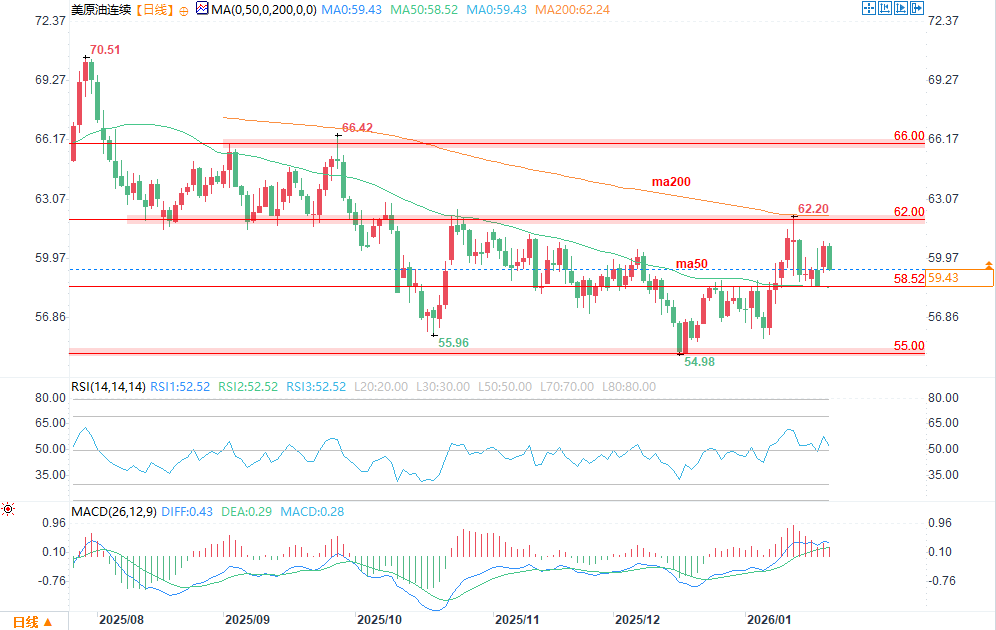
(WTI crude oil daily chart source: FX678)
From a technical perspective, the current price of US crude oil is trading above the 50-day moving average (MA50, $58.52), but is facing resistance at the 200-day moving average (MA200, $62.24). The 50-day moving average is relatively stable, while the 200-day moving average continues its downward trend, indicating that the medium-term trend has not yet clearly reversed, and the market is in a low-level consolidation phase, with prices recently fluctuating around $59.43.
Regarding resistance levels, the first resistance zone is $62.00-$62.20. This area, coinciding with previous highs, a consolidation pattern, and the 200-day moving average, is a key area of contention between bulls and bears. Further resistance lies at the previous high consolidation platform of $66.00, a level that will be difficult to break through. As for support levels, the first support is the 50-day moving average at $58.52, a crucial defensive line for short-term bulls. The key support zone below is $55.00-$55.96, a densely traded area at the lows of this decline; a break below this level could trigger a new round of downward movement.
In terms of indicators, the RSI indicator is currently at 52.52, which is above the 50 neutral line, indicating that the bulls have a slight advantage in the short term, but it has not yet entered the overbought zone (>70), and there is still some room for upward movement. In the MACD indicator, the DIFF line (0.43) has crossed above the DEA line (0.29), and the histogram is in the positive zone and continues to increase in volume, indicating that the short-term momentum is bullish. However, the difference between the DIFF line and the DEA line is small, and the upward momentum still needs further confirmation.
Overall Outlook
Overall, the current crude oil market is in a tug-of-war pattern of "short-term bullishness and medium-term downward pressure." Easing geopolitical risks and rising inventories are creating downward pressure, while upward revisions in demand growth expectations and a shift towards a bullish short-term technical outlook are providing support. In the short term, oil prices are expected to fluctuate between $58.52 and $62.20, with close attention focused on today's EIA inventory report and whether prices break through key moving averages. If prices can hold above the 50-day moving average and effectively break through the $62.20 resistance level, they are likely to open up upward potential, moving towards the $66.00 target. Conversely, if prices fall below the $58.52 support level, they may retrace to the $55.00 support area, and investors should wait for a clearer direction before making any moves.
Easing geopolitical risks weaken premium support
One of the key factors putting downward pressure on oil prices that day was the decline in geopolitical risk premiums. Former US President Trump's softened stance on Greenland and Iran significantly alleviated market concerns about supply disruptions. Trump stated that he had secured full and permanent US access to Greenland through an agreement with NATO, while explicitly abandoning tariff threats against Europe and ruling out the possibility of seizing Greenland by force. This shift in position eased previously tense transatlantic relations.
Supply risks from Iran have also decreased. Trump indicated his hope that the US would refrain from further military action against Iran, but emphasized that the US would take decisive action if Tehran resumes its nuclear program. As the third-largest crude oil producer in OPEC, Iran's supply stability has a significant impact on global oil prices, and the easing of tensions has further weakened the risk support for oil prices.
Ole Hansen, chief commodities analyst at Saxo Bank, said the easing of tensions in Greenland and Iranian supply risks directly led to a decline in the risk premium in oil prices. Tony Secomo, an analyst at online brokerage IG, believes that against this backdrop, oil prices are likely to remain around $60 per barrel.
Furthermore, potential developments in the situation in Ukraine have become an uncertain factor affecting oil prices. Trump called for an end to the Russia-Ukraine conflict, stating that he had "good" talks with Ukrainian President Zelensky in Davos and that the US and Ukraine have been engaged in shuttle diplomacy for several weeks.
If an agreement is reached in the future aimed at promoting peace in Ukraine and lifting sanctions against Russia, Russia, as the world's third-largest crude oil producer, may increase its oil exports, thus putting downward pressure on oil prices. However, there are currently no clear signs that Moscow intends to end the war. Meanwhile, the French Navy intercepted an oil tanker in the Mediterranean suspected of participating in Russia's "shadow fleet," which is considered an important channel for Russia to circumvent sanctions and export oil. Data shows that Russia's oil production fell by 0.8% last year to 10.28 million barrels per day, accounting for about one-tenth of global production.
The interplay between supply and demand, and changes in inventory and production capacity are drawing attention.
On the supply side, besides geopolitical factors, inventory data and the dynamics of domestic production capacity under sanctions have become the focus of the market. Due to Martin Luther King Jr. Day in the United States on Monday, the inventory reports from the U.S. Energy Information Administration (EIA) and the American Petroleum Institute (API) were both delayed by one day. Data released by the API on Wednesday evening showed that for the week ending January 16, U.S. crude oil inventories increased by 3.04 million barrels, gasoline inventories increased by 6.21 million barrels, and distillate fuel inventories decreased by 33,000 barrels; the EIA report released today showed that crude oil inventories increased by approximately 1.119 million barrels. Haitong Futures analyst Yang An stated that under market expectations of oversupply, high crude oil inventories will continue to limit further increases in oil prices.
The production dynamics of Venezuela, an OPEC member subject to sanctions, have also drawn market attention. Three sources close to the decision-making process revealed that trading company Vitol is preparing to export Venezuelan fuel oil following President Maduro's arrest, under a US-backed agreement. Increased Venezuelan oil exports could further alleviate global supply shortages and put downward pressure on oil prices.
It's worth noting that the International Energy Agency (IEA), in its monthly oil market report released Wednesday, raised its 2026 global oil demand growth forecast. This news provided slight bullish support for oil prices, suggesting that the global oil supply glut this year may have narrowed slightly. Saudi Aramco CEO Amin Nasser also stated that forecasts of a global oil supply glut have been significantly exaggerated, with demand growth remaining strong and global oil inventories already depleted, providing some support for oil prices.
Furthermore, the anticipated deterioration in the health of European businesses is also weighing on oil prices. According to data from LSEG I/B/E/S, European companies expect average profits to decline by 4.2% in the fourth quarter of 2025, slightly lower than the 4.1% forecast by analysts a week earlier, reflecting growing market concerns about European energy demand.
Technical Analysis: Short-term bullish bias with medium-term pressure; clear trading range.
(WTI crude oil daily chart source: FX678)
From a technical perspective, the current price of US crude oil is trading above the 50-day moving average (MA50, $58.52), but is facing resistance at the 200-day moving average (MA200, $62.24). The 50-day moving average is relatively stable, while the 200-day moving average continues its downward trend, indicating that the medium-term trend has not yet clearly reversed, and the market is in a low-level consolidation phase, with prices recently fluctuating around $59.43.
Regarding resistance levels, the first resistance zone is $62.00-$62.20. This area, coinciding with previous highs, a consolidation pattern, and the 200-day moving average, is a key area of contention between bulls and bears. Further resistance lies at the previous high consolidation platform of $66.00, a level that will be difficult to break through. As for support levels, the first support is the 50-day moving average at $58.52, a crucial defensive line for short-term bulls. The key support zone below is $55.00-$55.96, a densely traded area at the lows of this decline; a break below this level could trigger a new round of downward movement.
In terms of indicators, the RSI indicator is currently at 52.52, which is above the 50 neutral line, indicating that the bulls have a slight advantage in the short term, but it has not yet entered the overbought zone (>70), and there is still some room for upward movement. In the MACD indicator, the DIFF line (0.43) has crossed above the DEA line (0.29), and the histogram is in the positive zone and continues to increase in volume, indicating that the short-term momentum is bullish. However, the difference between the DIFF line and the DEA line is small, and the upward momentum still needs further confirmation.
Overall Outlook
Overall, the current crude oil market is in a tug-of-war pattern of "short-term bullishness and medium-term downward pressure." Easing geopolitical risks and rising inventories are creating downward pressure, while upward revisions in demand growth expectations and a shift towards a bullish short-term technical outlook are providing support. In the short term, oil prices are expected to fluctuate between $58.52 and $62.20, with close attention focused on today's EIA inventory report and whether prices break through key moving averages. If prices can hold above the 50-day moving average and effectively break through the $62.20 resistance level, they are likely to open up upward potential, moving towards the $66.00 target. Conversely, if prices fall below the $58.52 support level, they may retrace to the $55.00 support area, and investors should wait for a clearer direction before making any moves.
- Risk Warning and Disclaimer
- The market involves risk, and trading may not be suitable for all investors. This article is for reference only and does not constitute personal investment advice, nor does it take into account certain users’ specific investment objectives, financial situation, or other needs. Any investment decisions made based on this information are at your own risk.