The US dollar index continued its correction, with the market focusing on US PMI data and geopolitical uncertainties.
2026-01-23 14:13:29
On Friday during Asian trading hours, the US dollar index remained around 98.30, continuing its correction after a decline of approximately 0.5% in the previous trading day. Despite recent robust US macroeconomic data, the main reason for the dollar's downward pressure lies in persistent geopolitical and trade uncertainties.
On the economic data front, the annualized GDP growth rate for the third quarter in the United States was revised upward to 4.4%, slightly higher than the market expectation of 4.3%, indicating a robust economic expansion. Meanwhile, initial jobless claims last week totaled 200,000, lower than the market consensus of 212,000, reflecting a tight labor market.
On the inflation front, the U.S. Personal Consumption Expenditures (PCE) price index rose 2.8% year-on-year in November, continuing the 2.7% level in October. Core PCE also rose 2.8% year-on-year, in line with market expectations, indicating that inflation is moderate and under control.
 Despite positive economic data, the US dollar faces significant external pressure. Trade tensions and geopolitical anxieties between the US and Europe have recently intensified. US President Trump had threatened tariffs on European countries opposing his Greenland plan, but subsequently postponed this action due to a potential framework agreement reached with NATO.
There is much speculation in the market regarding the details of the agreement, including uncertainties surrounding mineral rights and missile deployment. Furthermore, Europe may use its substantial holdings of US assets as leverage in negotiations, exacerbating market concerns about the safety of dollar-denominated assets.
Regarding policy expectations, the market widely anticipates that the Federal Reserve will keep interest rates unchanged next week. According to the CME FedWatch tool, investors have priced in a 95% probability of a rate cut in December, indicating that market expectations for future monetary easing are forming.
Overall, despite the strong fundamentals of the US economy, the US dollar remains under pressure from external uncertainties, and the index may continue to fluctuate within a narrow range in the short term, awaiting further guidance from economic data or policy signals.
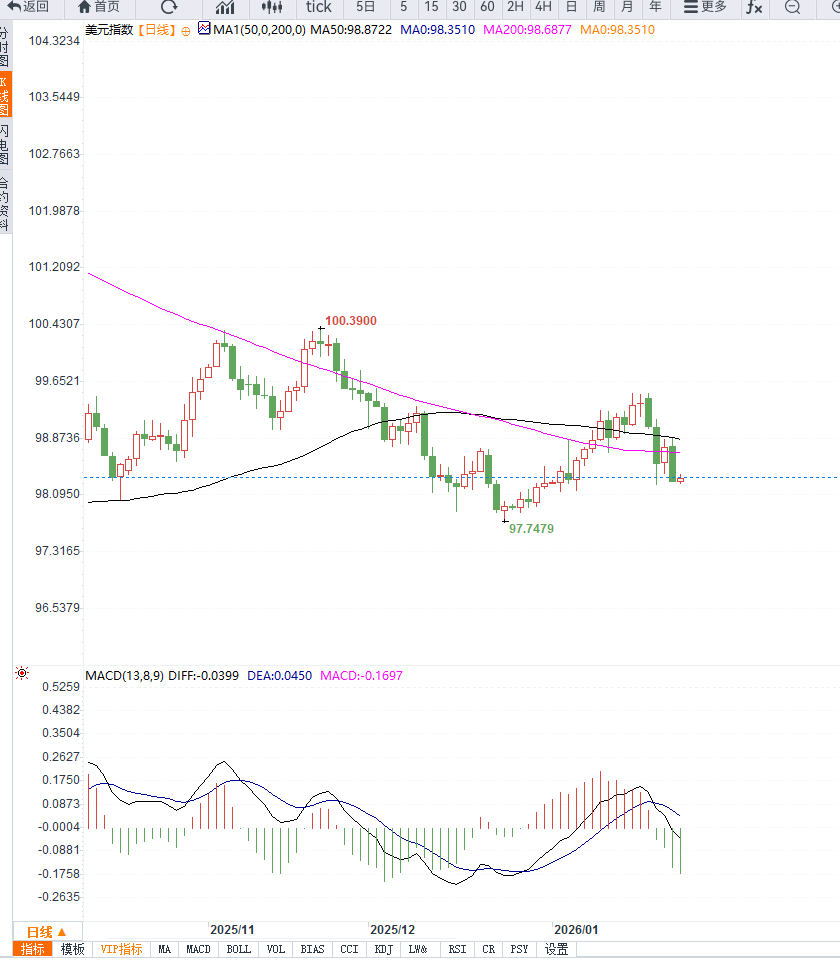
From a technical perspective, the US dollar index is finding support around 98.30, showing clear signs of short-term consolidation. The daily chart indicates that the index has retreated from recent highs but has not broken below key moving average support levels, suggesting limited downward momentum in the short term.
In terms of indicators, the Relative Strength Index (RSI) is hovering in the neutral zone, with no clear momentum bias. The short-term direction still awaits confirmation from economic and policy signals. The moving average system shows that the index remains above the 50-day moving average, indicating effective support.
If the index falls below 98.00, it may retrace to the 97.70 area in the short term; if it stabilizes and breaks through 98.50, it may challenge the recent high of 99.00.
Editor's Note:
The short-term pressure on the US dollar index stems primarily from geopolitical and trade uncertainties, rather than weak US economic data. The market remains cautious, balancing macroeconomic stability with external risks, resulting in a relatively even balance between bullish and bearish forces in the short term.
We need to pay attention to today's preliminary US S&P Global PMI reading and future policy statements from the Federal Reserve, as these will determine whether the US dollar can break through its current consolidation range and guide its short- to medium-term trend.
On the economic data front, the annualized GDP growth rate for the third quarter in the United States was revised upward to 4.4%, slightly higher than the market expectation of 4.3%, indicating a robust economic expansion. Meanwhile, initial jobless claims last week totaled 200,000, lower than the market consensus of 212,000, reflecting a tight labor market.
On the inflation front, the U.S. Personal Consumption Expenditures (PCE) price index rose 2.8% year-on-year in November, continuing the 2.7% level in October. Core PCE also rose 2.8% year-on-year, in line with market expectations, indicating that inflation is moderate and under control.
Despite positive economic data, the US dollar faces significant external pressure. Trade tensions and geopolitical anxieties between the US and Europe have recently intensified. US President Trump had threatened tariffs on European countries opposing his Greenland plan, but subsequently postponed this action due to a potential framework agreement reached with NATO.There is much speculation in the market regarding the details of the agreement, including uncertainties surrounding mineral rights and missile deployment. Furthermore, Europe may use its substantial holdings of US assets as leverage in negotiations, exacerbating market concerns about the safety of dollar-denominated assets.
Regarding policy expectations, the market widely anticipates that the Federal Reserve will keep interest rates unchanged next week. According to the CME FedWatch tool, investors have priced in a 95% probability of a rate cut in December, indicating that market expectations for future monetary easing are forming.
Overall, despite the strong fundamentals of the US economy, the US dollar remains under pressure from external uncertainties, and the index may continue to fluctuate within a narrow range in the short term, awaiting further guidance from economic data or policy signals.
From a technical perspective, the US dollar index is finding support around 98.30, showing clear signs of short-term consolidation. The daily chart indicates that the index has retreated from recent highs but has not broken below key moving average support levels, suggesting limited downward momentum in the short term.
In terms of indicators, the Relative Strength Index (RSI) is hovering in the neutral zone, with no clear momentum bias. The short-term direction still awaits confirmation from economic and policy signals. The moving average system shows that the index remains above the 50-day moving average, indicating effective support.
If the index falls below 98.00, it may retrace to the 97.70 area in the short term; if it stabilizes and breaks through 98.50, it may challenge the recent high of 99.00.
Editor's Note:
The short-term pressure on the US dollar index stems primarily from geopolitical and trade uncertainties, rather than weak US economic data. The market remains cautious, balancing macroeconomic stability with external risks, resulting in a relatively even balance between bullish and bearish forces in the short term.
We need to pay attention to today's preliminary US S&P Global PMI reading and future policy statements from the Federal Reserve, as these will determine whether the US dollar can break through its current consolidation range and guide its short- to medium-term trend.
- Risk Warning and Disclaimer
- The market involves risk, and trading may not be suitable for all investors. This article is for reference only and does not constitute personal investment advice, nor does it take into account certain users’ specific investment objectives, financial situation, or other needs. Any investment decisions made based on this information are at your own risk.