Geopolitical and Climate Synergy: A Technical Outlook for Soaring Oil Prices
2026-01-29 15:53:33
Extreme weather events have had a significant impact on US oil production and global markets, revealing the vulnerability of energy infrastructure and the ripple effects on global supply chains. A winter storm caused a temporary 15% drop in US oil production, triggering volatility in crude oil prices. Brent crude futures are currently trading at $68.29 per barrel, while WTI crude is trading around $64.20. Market sensitivity to supply disruptions has resulted in a risk premium of $3-8 per barrel, while production recovery times vary from 24 hours to 10 days across different regions.
For crude oil traders, understanding the logic behind the impact of weather on energy infrastructure is key to grasping short-term fluctuations and long-term trends. In other words, besides geopolitical issues, extreme weather is also a key reason for the recent upward movement in oil prices.

Crude oil production facilities are extremely sensitive to temperature. Low temperatures can easily lead to a decrease in the efficiency of wellhead equipment and freezing of production fluids. Small-diameter gathering and transmission pipelines and compression stations are particularly vulnerable. Especially when the temperature drops below 20 degrees Fahrenheit (-6.7 degrees Celsius), the risk of equipment failure increases sharply. When the temperature approaches 10 degrees Fahrenheit (-12.2 degrees Celsius), hydrate crystals can easily form inside the pipeline, completely blocking transportation.
More importantly, U.S. crude oil production is highly dependent on the power grid, and storm-induced power outages can paralyze production facilities. Even after power is restored, procedures such as safety checks and system pressurization take 24-72 hours, and the recovery cycle for complex facilities is even longer. For example, the "Fern Winter Storm" caused a temporary disruption of 15% of U.S. crude oil production, directly triggering market concerns about a supply gap.
It will take 5-10 days for the oil field to return to full capacity: production and transportation will return to normal, and the risk premium will gradually subside.
During periods of heightened storm activity, the market typically adds a risk premium of $3-8 per barrel to supply uncertainty. If recovery proceeds as expected, the premium will gradually correct within 48-72 hours; however, if disturbances escalate (such as those compounded by geopolitical conflicts), the premium may continue to widen.
Limited inventory buffer: Global crude oil inventories of 60-90 days may seem sufficient, but issues such as uneven geographical distribution, quality mismatch, and transportation constraints make it difficult for them to play a quick role in the event of sudden disturbances and effectively smooth out short-term price fluctuations.
Cross-commodity linkage effect: The storm also affects natural gas production. The surge in heating demand and the supply shortage will drive power producers to turn to oil-based fuels, further increasing the pressure on crude oil demand and amplifying oil price volatility.
Stock price correlation: The stock prices of upstream crude oil companies are sensitive to supply disruptions. For example, after the storm, the stock price of Indian Oil Corporation rose by 10%, ONGC rose by 8%, and the Nifty oil and gas index rose by far more than the broader market. These stocks can be used as indirect trading targets for crude oil price fluctuations.
Regional price arbitrage opportunities: The US Gulf Coast, as an export hub, is most directly affected by disturbances; Asian refineries, due to their long transportation cycles, are more significantly affected by supply chain disruptions, which may lead to regional oil price divergences, providing opportunities for cross-regional arbitrage.
Different companies face different risks: Upstream companies in weather-sensitive areas such as the Permian Basin experience higher production fluctuations and operating costs, resulting in greater risk exposure; while companies with comprehensive weather protection facilities and redundant power systems have stronger risk resistance and more resilient valuations.
While the market is focused on supply concerns caused by geopolitics, extreme weather and storm warnings are a common leading indicator for oil prices. If these warnings, combined with other factors, have a significant upward effect on crude oil prices, they can serve as a window for bullish reactions. During periods of disruption, positions should be adjusted based on actual production reduction data, and profits should be taken in a timely manner during the recovery phase.
Technical Analysis: The March WTI crude oil futures contract has been strictly following the pattern of testing the bottom of a trading range recently, breaking through the middle band, retracing to the middle band, and then breaking through the upper band. Current resistance levels are at 66.70 and 63.84. If oil prices can hold above 63.84, the red middle band will become the current support level. Currently, oil prices are far from the 5-day moving average, and the long-term oversupply has not been eliminated, suggesting a need for adjustment.
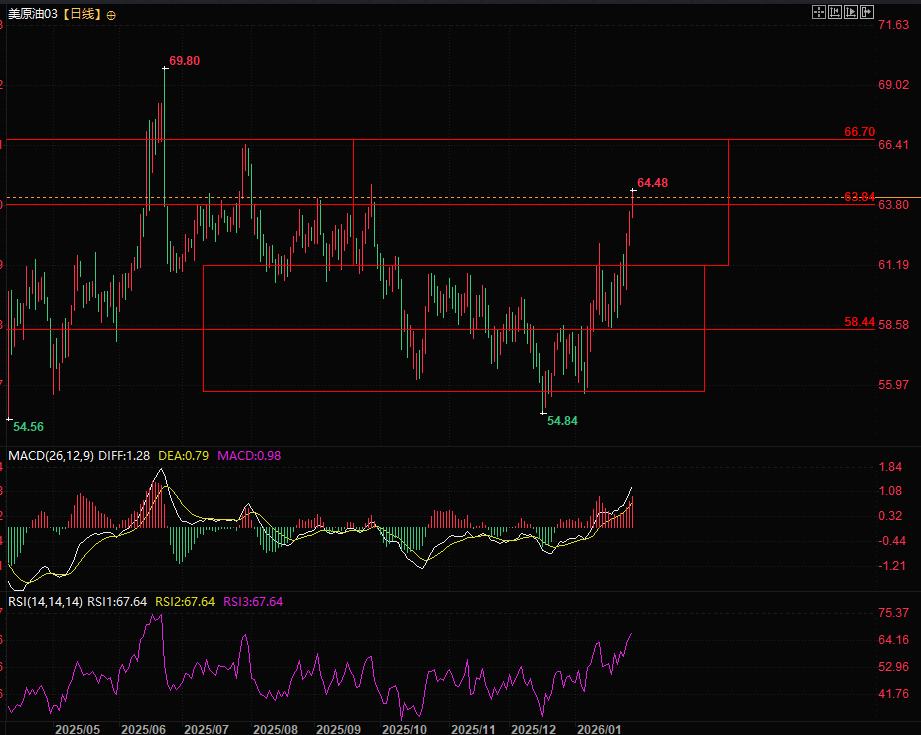
(Daily chart of US crude oil March futures contract, source: FX678)
At 15:51 Beijing time, the March crude oil futures contract was trading at $64.22 per barrel.
For crude oil traders, understanding the logic behind the impact of weather on energy infrastructure is key to grasping short-term fluctuations and long-term trends. In other words, besides geopolitical issues, extreme weather is also a key reason for the recent upward movement in oil prices.
How do storms impact crude oil supplies?
Crude oil production facilities are extremely sensitive to temperature. Low temperatures can easily lead to a decrease in the efficiency of wellhead equipment and freezing of production fluids. Small-diameter gathering and transmission pipelines and compression stations are particularly vulnerable. Especially when the temperature drops below 20 degrees Fahrenheit (-6.7 degrees Celsius), the risk of equipment failure increases sharply. When the temperature approaches 10 degrees Fahrenheit (-12.2 degrees Celsius), hydrate crystals can easily form inside the pipeline, completely blocking transportation.
More importantly, U.S. crude oil production is highly dependent on the power grid, and storm-induced power outages can paralyze production facilities. Even after power is restored, procedures such as safety checks and system pressurization take 24-72 hours, and the recovery cycle for complex facilities is even longer. For example, the "Fern Winter Storm" caused a temporary disruption of 15% of U.S. crude oil production, directly triggering market concerns about a supply gap.
Production recovery pace and trading window
It will take 5-10 days for the oil field to return to full capacity: production and transportation will return to normal, and the risk premium will gradually subside.
During periods of heightened storm activity, the market typically adds a risk premium of $3-8 per barrel to supply uncertainty. If recovery proceeds as expected, the premium will gradually correct within 48-72 hours; however, if disturbances escalate (such as those compounded by geopolitical conflicts), the premium may continue to widen.
Limited inventory buffer: Global crude oil inventories of 60-90 days may seem sufficient, but issues such as uneven geographical distribution, quality mismatch, and transportation constraints make it difficult for them to play a quick role in the event of sudden disturbances and effectively smooth out short-term price fluctuations.
Cross-commodity linkage effect: The storm also affects natural gas production. The surge in heating demand and the supply shortage will drive power producers to turn to oil-based fuels, further increasing the pressure on crude oil demand and amplifying oil price volatility.
The linkage effect of oil prices
Stock price correlation: The stock prices of upstream crude oil companies are sensitive to supply disruptions. For example, after the storm, the stock price of Indian Oil Corporation rose by 10%, ONGC rose by 8%, and the Nifty oil and gas index rose by far more than the broader market. These stocks can be used as indirect trading targets for crude oil price fluctuations.
Regional price arbitrage opportunities: The US Gulf Coast, as an export hub, is most directly affected by disturbances; Asian refineries, due to their long transportation cycles, are more significantly affected by supply chain disruptions, which may lead to regional oil price divergences, providing opportunities for cross-regional arbitrage.
Different companies face different risks: Upstream companies in weather-sensitive areas such as the Permian Basin experience higher production fluctuations and operating costs, resulting in greater risk exposure; while companies with comprehensive weather protection facilities and redundant power systems have stronger risk resistance and more resilient valuations.
Summary and Technical Analysis:
While the market is focused on supply concerns caused by geopolitics, extreme weather and storm warnings are a common leading indicator for oil prices. If these warnings, combined with other factors, have a significant upward effect on crude oil prices, they can serve as a window for bullish reactions. During periods of disruption, positions should be adjusted based on actual production reduction data, and profits should be taken in a timely manner during the recovery phase.
Technical Analysis: The March WTI crude oil futures contract has been strictly following the pattern of testing the bottom of a trading range recently, breaking through the middle band, retracing to the middle band, and then breaking through the upper band. Current resistance levels are at 66.70 and 63.84. If oil prices can hold above 63.84, the red middle band will become the current support level. Currently, oil prices are far from the 5-day moving average, and the long-term oversupply has not been eliminated, suggesting a need for adjustment.
(Daily chart of US crude oil March futures contract, source: FX678)
At 15:51 Beijing time, the March crude oil futures contract was trading at $64.22 per barrel.
- Risk Warning and Disclaimer
- The market involves risk, and trading may not be suitable for all investors. This article is for reference only and does not constitute personal investment advice, nor does it take into account certain users’ specific investment objectives, financial situation, or other needs. Any investment decisions made based on this information are at your own risk.