February 3rd Financial Breakfast: The risk of a US government shutdown resurfaces; gold prices rebound above $4700; "serious talks" between the US and Iran cause oil prices to plummet by over 5%.
2026-02-03 07:27:55
On Tuesday (February 3rd, Beijing time) in early Asian trading, spot gold was trading around $4734.70 per ounce. Gold prices fell more than 4% on Monday, pressured by the possibility that the new Federal Reserve chairman might favor interest rate cuts and a stricter balance sheet policy. The Chicago Mercantile Exchange's increase in margin requirements exacerbated the market sell-off. However, gold prices rebounded somewhat due to the renewed US government shutdown and potential delays in employment data. US crude oil was trading around $62.23 per barrel, after falling more than 5% on Monday. US President Trump stated that Iran was having "serious talks" with Washington, suggesting a de-escalation of tensions between the two countries and easing supply concerns.


Reserve Bank of Australia Governor Bullock held a monetary policy press conference, Federal Reserve Governor Bowman delivered a speech, and Richmond Fed President Barkin, a 2027 FOMC voting member, also spoke.
U.S. stocks closed higher on Monday, with the S&P 500 nearing a record high, driven primarily by gains in chip and artificial intelligence-related stocks, while small-cap stocks also rallied significantly. The Russell 2000 jumped about 1%, significantly outperforming major indices year-to-date.
The S&P 500 rose 0.54% to 6976.44; the Nasdaq gained 0.56%; and the Dow Jones Industrial Average climbed 1.05%. Market volatility index declined slightly, while trading volume was slightly above recent averages.
Among tech stocks, Alphabet and Amazon rose 1.9% and 1.5% respectively, with both companies about to release their earnings reports and the market focusing on their progress in artificial intelligence. Chip stocks performed strongly, with SanDisk surging 15.4%, and AMD and Micron rising 4% and 5.5% respectively. Artificial intelligence data company Palantir closed slightly higher ahead of its after-hours earnings report.
Despite better-than-expected quarterly earnings, Disney's stock price plunged 7.4% after warning of declining international visitor numbers at its theme parks and shrinking profits in its film and television division. The energy sector fell 2% following oil price declines, while airline stocks generally rose 4%-8% due to easing cost pressures.
On the economic data front, the US manufacturing PMI rose for the first time in a year in January, indicating a recovery in economic activity. On the policy front, the House of Representatives is considering a bill to end the government shutdown, and the January jobs report will be delayed due to the shutdown.
Gold and silver prices continued their decline on Monday as the Chicago Mercantile Exchange raised margin requirements, exacerbating the sell-off. Spot gold fell 4.8% to $4,630.59 an ounce, down about $900 from its record high last week; spot silver plunged 9.2% to $76.81 an ounce, a cumulative drop of about 37% from its record high last week.
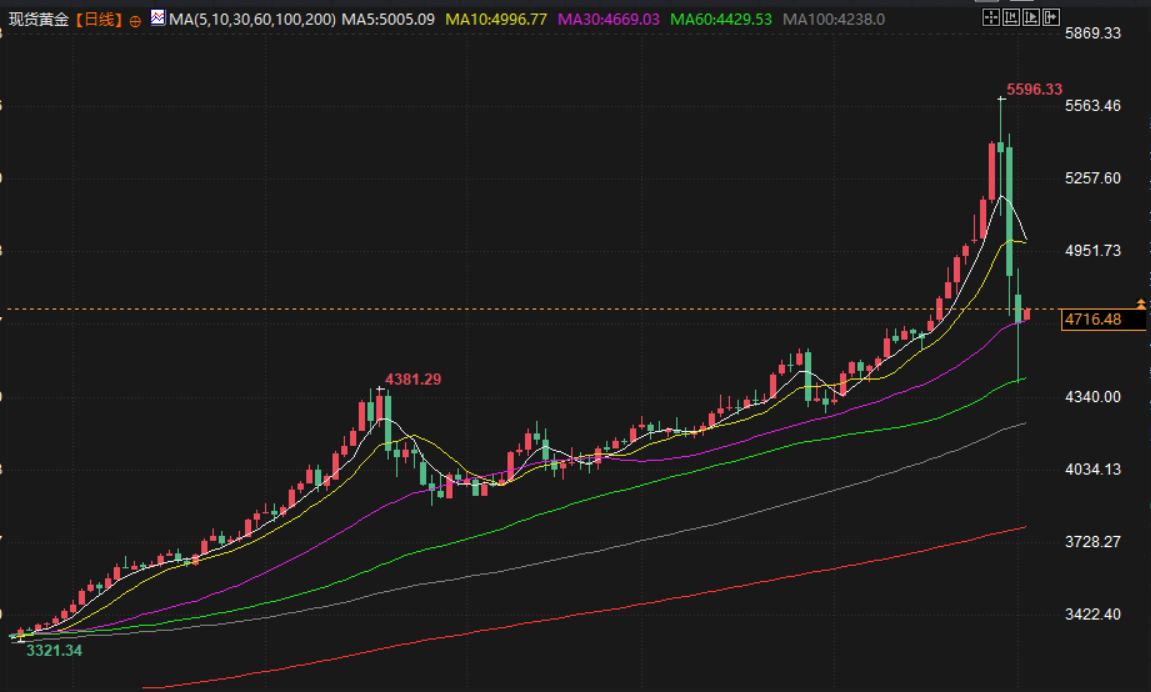
This sharp pullback occurred after President Trump nominated former Federal Reserve Governor Warsh as the next Fed chair, with markets anticipating that the new chair might favor interest rate cuts and a more stringent balance sheet policy. Meanwhile, the strengthening of the US dollar index to a more than one-week high also put pressure on gold prices. Analysts pointed out that the price plunge squeezed out some speculative trading, helping to cool the market, but a Deutsche Bank report believes that the current environment does not create conditions for a sustained reversal in gold prices, and investors generally remain optimistic about upside potential.
Other precious metals also fell, with spot platinum and palladium prices declining by 3.3% and 1.4%, respectively.
Oil prices fell more than 5% on Monday, retreating from multi-month highs. US President Trump stated that Iran was engaged in "serious dialogue" with Washington, suggesting a de-escalation of tensions between the two countries and easing supply concerns. Additionally, a stronger dollar and forecasts of warmer weather in the US also weighed on oil prices.
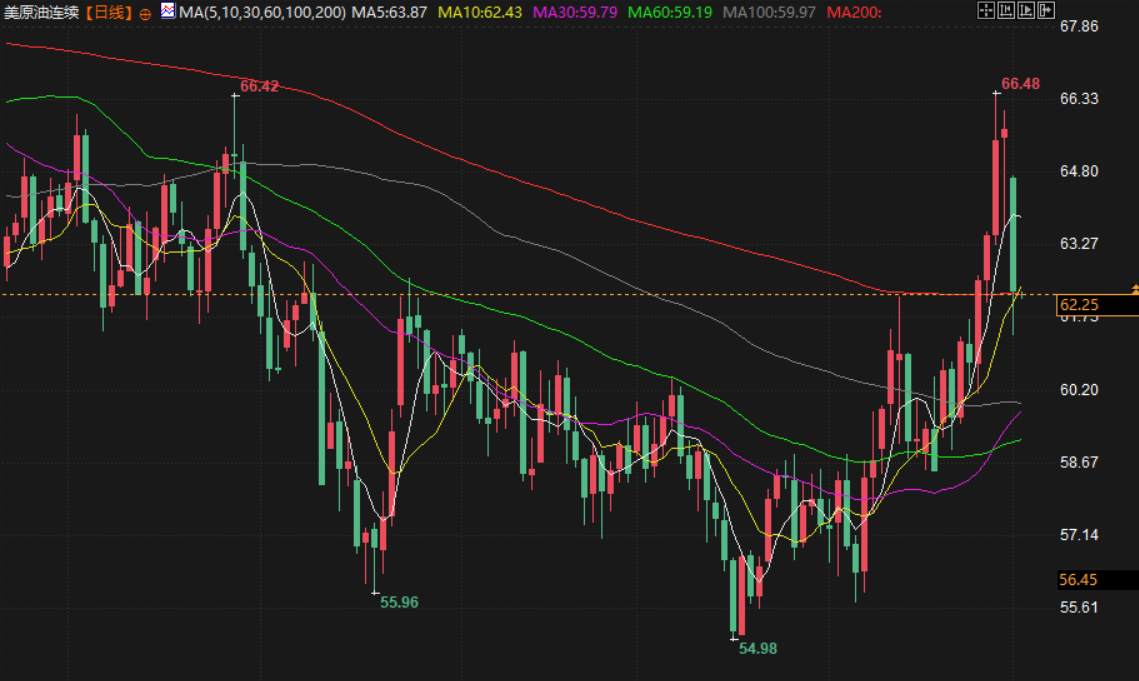
Brent crude futures fell 4.4% to settle at $66.30 a barrel; WTI crude futures fell 4.7% to settle at $62.14 a barrel. Officials from both countries said Iran and the United States would resume nuclear negotiations on Friday.
Trump's recent repeated threats of U.S. intervention if Iran rejects the nuclear deal or continues its crackdown on protesters supported oil prices in January. A stronger dollar also made dollar-denominated crude oil more expensive for holders of other currencies. Meanwhile, forecasts of warmer weather in the U.S. led to a sharp drop in diesel futures prices, further dragging down oil prices.
Previously, tensions in the Middle East, coupled with the polar vortex in the United States, drove U.S. crude oil futures up 14% and Brent crude up 16% in January. As the impact of these short-term factors diminishes, market focus has shifted back to the fundamentals of an expected increase in global crude oil inventories this year.
OPEC+ decided at its Sunday meeting to keep crude oil production unchanged in March. The alliance had already frozen its planned production increases for the period from January to March 2026 last November due to weak seasonal demand.
The dollar rose against all major currencies on Monday, primarily supported by safe-haven inflows and strong U.S. manufacturing data. Meanwhile, markets were also assessing the potential policy impact of the Federal Reserve's nominee for the new chairman.
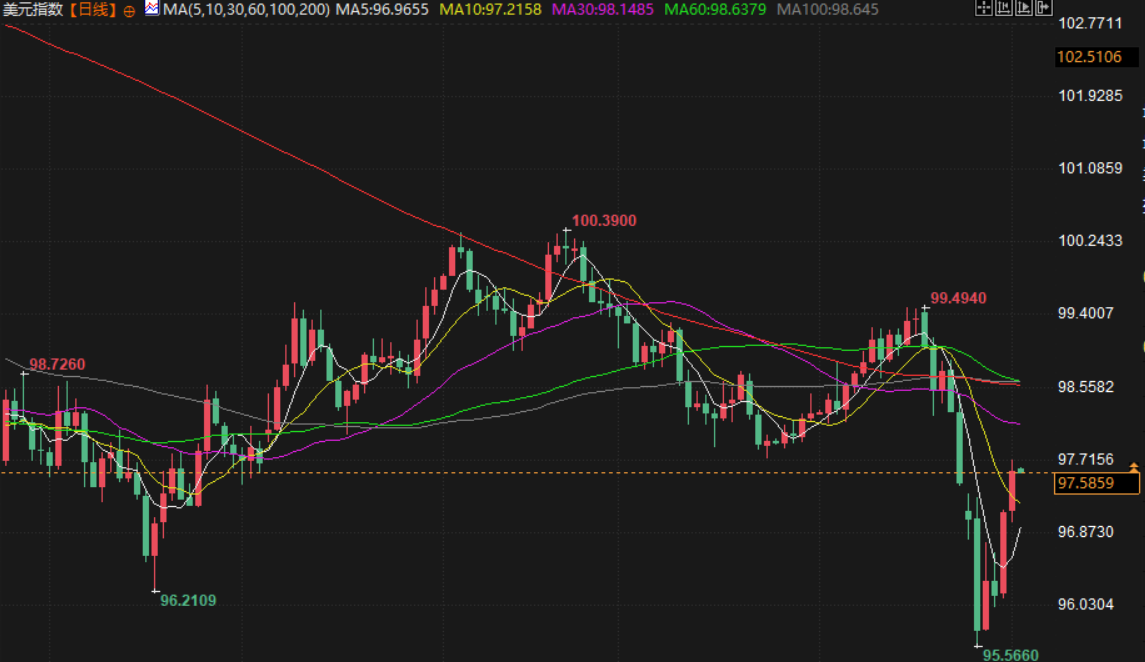
Data shows that despite cost pressures and supply chain challenges, US manufacturing resumed growth in January, which solidified the dollar's gains. Furthermore, the sell-off in the precious metals market triggered broader risk aversion, further boosting the dollar.
The dollar index rose 0.44% to 97.64. The euro fell 0.53% against the dollar to $1.1788, moving further away from the $1.20 level. Markets expect the European Central Bank and the Bank of England to keep interest rates unchanged at their meetings later this week.
Currencies heavily influenced by commodity prices and global risk sentiment weakened. The Australian and New Zealand dollars both fell against the US dollar, with markets focused on the Reserve Bank of Australia's interest rate decision.
In the yen, the dollar rose 0.57% against the yen to 155.64 yen. Markets anticipate a landslide victory for Prime Minister Sanae Takaichi's Liberal Democratic Party in the upcoming general election, which could pave the way for more expansionary fiscal policies. However, traders remain wary of the possibility of coordinated US-Japan intervention in the currency market.
The partisan divide on immigration enforcement in the US remains unresolved, and the shutdown of multiple government departments may be extended.
The U.S. House of Representatives is embroiled in political turmoil over President Donald Trump's immigration raids, potentially extending the partial government shutdown that began last Saturday. House Speaker Mike Johnson faces a difficult path in pushing through a bill that has already passed the Senate. This bill, a product of negotiations between Trump and Democratic Leader Chuck Schumer, would fund most federal agencies until September 30 and the Department of Homeland Security until February 13. This arrangement preserves funding for the immigration raids while bipartisan negotiations continue on enforcement policy adjustments. However, the bill is facing challenges within both parties and could extend what was initially expected to be a short-lived shutdown over the weekend. Johnson anticipates a preliminary vote by the rules committee on Monday and has expressed hope for final passage on Tuesday. If the shutdown continues this week, it could delay the release of the closely watched Labor Department jobs report on Friday. The tax season, which began last week, could also be affected. As time goes on, delays in government contractor pay and services will likely spread further, and non-essential government employees may be forced to take unpaid leave.
Zelensky: Bilateral talks between Ukraine and the United States will also be held in Abu Dhabi.
Ukrainian President Volodymyr Zelenskyy posted on social media on October 2 that the Ukrainian negotiating delegation is scheduled to hold bilateral talks with the US on several agreements during the second round of trilateral talks between Ukraine, the US, and Russia in Abu Dhabi, the capital of the United Arab Emirates, on October 4. Zelenskyy said he met with members of the Ukrainian negotiating delegation who will travel to Abu Dhabi that day, including National Security and Defense Council Secretary Umerov, Chief of Staff of the Presidential Office Budanov, First Deputy Chief of Staff of the Presidential Office Kislitsa, Chief of the General Staff of the Ukrainian Armed Forces Genatov, and Presidential Office Advisor Alexander Bevz. The leader of the parliamentary group of the ruling Servant of the People party, Alakhamia, will also participate in the trilateral talks. Zelenskyy said that during the second round of trilateral talks between Russia, the US, and Ukraine, the Ukrainian delegation will also hold bilateral talks with the US. He stated that Ukraine is prepared to take real steps and believes that a "dignified and lasting peace" can be achieved. (Xinhua)
Trump has raised $483 million to bolster his chances of winning the midterm elections.
US President Donald Trump has stated that his only concern is losing Republican control of Congress in the November elections. Newly filed campaign finance documents reveal he has raised an unprecedented amount of money to prevent this. According to documents submitted to the Federal Election Commission, as of the end of December, Trump's political committees and the Republican National Committee had raised a total of $483 million. This amount is almost three times the total amount raised by the Democrats ($167 million). Trump recently stated, "It seems like both the Republican and Democratic presidents are going to lose in the midterm elections. So, that's my only concern."
Israel makes three demands in US-Iran negotiations
According to a report by Israel's Channel 12 on the evening of February 2nd, Israel will present its "three no's" demands regarding Iran during its meeting with visiting US Presidential Envoy Witkov on February 3rd. These demands stipulate that in any potential agreement between the US and Iran, Iran must agree to the following three "red lines": no nuclear program, no ballistic missile program, and no support for armed "proxies," including so-called "terrorist organizations" that threaten Israel. The report also states that in addition to Israeli Prime Minister Netanyahu, Mossad chief Barnea and Chief of the General Staff Zamir will also attend the meeting with Witkov. The report further states that Israel still believes that "overthrowing the Iranian regime through military action is 'possible.'" (CCTV International News)
The U.S. Bureau of Labor Statistics delayed the release of its employment report due to the partial government shutdown.
On February 2, local time, the U.S. Bureau of Labor Statistics announced that the January employment report, originally scheduled for release on February 6, would not be published as planned due to the partial shutdown of the federal government. Emily Liddell, the Bureau of Labor Statistics official in charge, stated in a statement, "The report will be rescheduled once government funding is restored." (CCTV News)
The French National Assembly formally passed the 2026 budget.
On the evening of February 2nd local time, the French National Assembly rejected two motions of no confidence proposed by the left-wing camp and the far-right National Rally party. With both motions failing to pass, the French Parliament formally approved the 2026 national budget. Previously, the no-confidence motion proposed by the left-wing camp only received 260 votes, failing to reach the 289 votes required for passage. Subsequently, the motion proposed by the National Rally was also rejected. Thus, the French government avoided the risk of being overthrown, and the budget was ultimately passed. Prime Minister Le Corny had earlier stated that the budget would be submitted to the Constitutional Council for review. (CCTV News)
Trump announces tariff reductions on India
Trump announced a phone call with Indian Prime Minister Modi, during which they discussed a trade agreement and ending the Russia-Ukraine conflict. Trump stated that Modi agreed to halt purchases of Russian oil and significantly increase oil purchases from the United States, as well as potentially from Venezuela; the two sides immediately reached a US-India trade agreement. Under this agreement, the US will reduce reciprocal tariffs from 25% to 18%. India will also begin work to reduce its tariffs and non-tariff barriers to the US to zero. Trump stated that Modi also pledged to significantly increase "Buy American" efforts and committed to providing India with over $500 billion worth of US energy, technology, agricultural products, coal, and numerous other products.
Kuwait's crude oil exports fell sharply in January.
Kuwait's monitored crude oil exports declined in January, influenced by factors such as OPEC+'s suspension of its crude oil market supply restoration plan and the resumption of full-capacity production at Kuwait's large Zour refinery after equipment failure. Tanker tracking data showed that Kuwait's total crude oil exports in January (including its 50% share of exports from the Neutral Zone, which it shares with Saudi Arabia) fell to approximately 1.52 million barrels per day from 1.78 million barrels per day in December, the lowest level since August of last year.
Britain imposes new sanctions on Iran
British Foreign Secretary Yvette Cooper announced on February 2nd that Britain was imposing a new round of sanctions on Iran, targeting Iranian law enforcement and 10 individuals, including Home Minister Eskander Mhomeini. According to a statement released by the British Foreign Office that day, the British government's sanctions stemmed from the recent unrest in Iran. Besides Mhomeini, those sanctioned include Lorestan Provincial Police Chief Mohammad Reza Hashimifar, Iranian Public Security Police Chief Saeed Majid Faiz Jafari, and Yadullah Bouari, commander of the Iranian Islamic Revolutionary Guard Corps in Fars Province. The British Foreign Office stated that Britain has to date imposed more than 550 sanctions on individuals and organizations related to Iran, including sanctions against the entire Iranian Islamic Revolutionary Guard Corps. (Xinhua)
The UK Treasury is offering up to £100,000 in compensation to officials who voluntarily resign.
The UK Treasury is offering up to £100,000 in compensation to officials who voluntarily resign as part of a redundancy plan. Multiple sources familiar with the matter have reportedly revealed that Chancellor of the Exchequer Rachel Reeves plans to reduce her department's workforce of approximately 300 from around 2,100 by 2030. The Treasury has also frozen external hiring for many non-essential positions. Officials could still face redundancy if the number of voluntary departures in the London, Darlington, Norwich, and Edinburgh offices falls short. The Treasury told the Financial Times, "The Treasury is currently the largest in its history." (CCTV)
Notice from the Ministry of Commerce and eight other departments on Issuing the "2026 'Happy Shopping Spring Festival' Special Activity Plan"
Strengthen trade-in programs. Local governments are encouraged to increase subsidies for trade-in consumer goods during the Spring Festival, strengthen support for offline retail, mobilize businesses to continue exhibitions and sales of automobiles, home appliances, digital products, and smart products during the Spring Festival, guide businesses to create product experience zones for smart terminals, offer more discounts to consumers who experience products in-store, and increase efforts to explain policies and promote offline experiential consumption to create a strong atmosphere for trade-in programs. (Ministry of Commerce)
Officials from the Ministry of Finance, the Ministry of Commerce, and the State Taxation Administration answered reporters' questions regarding the "Notice on Carrying Out Pilot Work on Prize-Winning Invoices".
Q: What are the main contents of the pilot program for prize-winning invoices? A: The main contents of the pilot program for prize-winning invoices are to organize a lottery for invoices obtained by consumers for purchasing goods and services, specifically covering retail, catering, accommodation, culture and arts, entertainment, tourism, sports, and residential services. The program will be implemented for six months in approximately 50 pilot cities. Pilot cities, in accordance with the requirements of the "Notice on Carrying Out Pilot Work on Prize-Winning Invoices" issued by the Ministry of Finance, the Ministry of Commerce, and the State Taxation Administration, and in light of local conditions, have formulated implementation plans for the pilot program, clarifying the scope of prize-winning invoices, participation methods, winning rules, prize settings, prize redemption methods, and requirements for reporting illegal activities, and have made these plans public. Consumers can pay attention to the announcements of the pilot cities and actively participate according to the specific requirements of the published prize-winning invoice activities. (Xinhua News Agency)
China Unicom: Adjustment of the Scope of Application for Value-Added Tax on Telecommunication Services
China Unicom announced that, effective January 1, 2026, the Ministry of Finance and the State Taxation Administration stipulate that the applicable tax category for business activities providing mobile data services within China will be changed from value-added telecommunications services to basic telecommunications services, with the corresponding VAT rate increasing from 6% to 9%. This adjustment in the scope of tax application will impact the company's revenue and profits. The company will focus on its core business, improve operational efficiency, and promote high-quality development.
Key Focus Today
Reserve Bank of Australia Governor Bullock held a monetary policy press conference, Federal Reserve Governor Bowman delivered a speech, and Richmond Fed President Barkin, a 2027 FOMC voting member, also spoke.
stock market
U.S. stocks closed higher on Monday, with the S&P 500 nearing a record high, driven primarily by gains in chip and artificial intelligence-related stocks, while small-cap stocks also rallied significantly. The Russell 2000 jumped about 1%, significantly outperforming major indices year-to-date.
The S&P 500 rose 0.54% to 6976.44; the Nasdaq gained 0.56%; and the Dow Jones Industrial Average climbed 1.05%. Market volatility index declined slightly, while trading volume was slightly above recent averages.
Among tech stocks, Alphabet and Amazon rose 1.9% and 1.5% respectively, with both companies about to release their earnings reports and the market focusing on their progress in artificial intelligence. Chip stocks performed strongly, with SanDisk surging 15.4%, and AMD and Micron rising 4% and 5.5% respectively. Artificial intelligence data company Palantir closed slightly higher ahead of its after-hours earnings report.
Despite better-than-expected quarterly earnings, Disney's stock price plunged 7.4% after warning of declining international visitor numbers at its theme parks and shrinking profits in its film and television division. The energy sector fell 2% following oil price declines, while airline stocks generally rose 4%-8% due to easing cost pressures.
On the economic data front, the US manufacturing PMI rose for the first time in a year in January, indicating a recovery in economic activity. On the policy front, the House of Representatives is considering a bill to end the government shutdown, and the January jobs report will be delayed due to the shutdown.
Gold Market
Gold and silver prices continued their decline on Monday as the Chicago Mercantile Exchange raised margin requirements, exacerbating the sell-off. Spot gold fell 4.8% to $4,630.59 an ounce, down about $900 from its record high last week; spot silver plunged 9.2% to $76.81 an ounce, a cumulative drop of about 37% from its record high last week.
This sharp pullback occurred after President Trump nominated former Federal Reserve Governor Warsh as the next Fed chair, with markets anticipating that the new chair might favor interest rate cuts and a more stringent balance sheet policy. Meanwhile, the strengthening of the US dollar index to a more than one-week high also put pressure on gold prices. Analysts pointed out that the price plunge squeezed out some speculative trading, helping to cool the market, but a Deutsche Bank report believes that the current environment does not create conditions for a sustained reversal in gold prices, and investors generally remain optimistic about upside potential.
Other precious metals also fell, with spot platinum and palladium prices declining by 3.3% and 1.4%, respectively.
oil market
Oil prices fell more than 5% on Monday, retreating from multi-month highs. US President Trump stated that Iran was engaged in "serious dialogue" with Washington, suggesting a de-escalation of tensions between the two countries and easing supply concerns. Additionally, a stronger dollar and forecasts of warmer weather in the US also weighed on oil prices.
Brent crude futures fell 4.4% to settle at $66.30 a barrel; WTI crude futures fell 4.7% to settle at $62.14 a barrel. Officials from both countries said Iran and the United States would resume nuclear negotiations on Friday.
Trump's recent repeated threats of U.S. intervention if Iran rejects the nuclear deal or continues its crackdown on protesters supported oil prices in January. A stronger dollar also made dollar-denominated crude oil more expensive for holders of other currencies. Meanwhile, forecasts of warmer weather in the U.S. led to a sharp drop in diesel futures prices, further dragging down oil prices.
Previously, tensions in the Middle East, coupled with the polar vortex in the United States, drove U.S. crude oil futures up 14% and Brent crude up 16% in January. As the impact of these short-term factors diminishes, market focus has shifted back to the fundamentals of an expected increase in global crude oil inventories this year.
OPEC+ decided at its Sunday meeting to keep crude oil production unchanged in March. The alliance had already frozen its planned production increases for the period from January to March 2026 last November due to weak seasonal demand.
Foreign exchange market
The dollar rose against all major currencies on Monday, primarily supported by safe-haven inflows and strong U.S. manufacturing data. Meanwhile, markets were also assessing the potential policy impact of the Federal Reserve's nominee for the new chairman.
Data shows that despite cost pressures and supply chain challenges, US manufacturing resumed growth in January, which solidified the dollar's gains. Furthermore, the sell-off in the precious metals market triggered broader risk aversion, further boosting the dollar.
The dollar index rose 0.44% to 97.64. The euro fell 0.53% against the dollar to $1.1788, moving further away from the $1.20 level. Markets expect the European Central Bank and the Bank of England to keep interest rates unchanged at their meetings later this week.
Currencies heavily influenced by commodity prices and global risk sentiment weakened. The Australian and New Zealand dollars both fell against the US dollar, with markets focused on the Reserve Bank of Australia's interest rate decision.
In the yen, the dollar rose 0.57% against the yen to 155.64 yen. Markets anticipate a landslide victory for Prime Minister Sanae Takaichi's Liberal Democratic Party in the upcoming general election, which could pave the way for more expansionary fiscal policies. However, traders remain wary of the possibility of coordinated US-Japan intervention in the currency market.
International News
The partisan divide on immigration enforcement in the US remains unresolved, and the shutdown of multiple government departments may be extended.
The U.S. House of Representatives is embroiled in political turmoil over President Donald Trump's immigration raids, potentially extending the partial government shutdown that began last Saturday. House Speaker Mike Johnson faces a difficult path in pushing through a bill that has already passed the Senate. This bill, a product of negotiations between Trump and Democratic Leader Chuck Schumer, would fund most federal agencies until September 30 and the Department of Homeland Security until February 13. This arrangement preserves funding for the immigration raids while bipartisan negotiations continue on enforcement policy adjustments. However, the bill is facing challenges within both parties and could extend what was initially expected to be a short-lived shutdown over the weekend. Johnson anticipates a preliminary vote by the rules committee on Monday and has expressed hope for final passage on Tuesday. If the shutdown continues this week, it could delay the release of the closely watched Labor Department jobs report on Friday. The tax season, which began last week, could also be affected. As time goes on, delays in government contractor pay and services will likely spread further, and non-essential government employees may be forced to take unpaid leave.
Zelensky: Bilateral talks between Ukraine and the United States will also be held in Abu Dhabi.
Ukrainian President Volodymyr Zelenskyy posted on social media on October 2 that the Ukrainian negotiating delegation is scheduled to hold bilateral talks with the US on several agreements during the second round of trilateral talks between Ukraine, the US, and Russia in Abu Dhabi, the capital of the United Arab Emirates, on October 4. Zelenskyy said he met with members of the Ukrainian negotiating delegation who will travel to Abu Dhabi that day, including National Security and Defense Council Secretary Umerov, Chief of Staff of the Presidential Office Budanov, First Deputy Chief of Staff of the Presidential Office Kislitsa, Chief of the General Staff of the Ukrainian Armed Forces Genatov, and Presidential Office Advisor Alexander Bevz. The leader of the parliamentary group of the ruling Servant of the People party, Alakhamia, will also participate in the trilateral talks. Zelenskyy said that during the second round of trilateral talks between Russia, the US, and Ukraine, the Ukrainian delegation will also hold bilateral talks with the US. He stated that Ukraine is prepared to take real steps and believes that a "dignified and lasting peace" can be achieved. (Xinhua)
Trump has raised $483 million to bolster his chances of winning the midterm elections.
US President Donald Trump has stated that his only concern is losing Republican control of Congress in the November elections. Newly filed campaign finance documents reveal he has raised an unprecedented amount of money to prevent this. According to documents submitted to the Federal Election Commission, as of the end of December, Trump's political committees and the Republican National Committee had raised a total of $483 million. This amount is almost three times the total amount raised by the Democrats ($167 million). Trump recently stated, "It seems like both the Republican and Democratic presidents are going to lose in the midterm elections. So, that's my only concern."
Israel makes three demands in US-Iran negotiations
According to a report by Israel's Channel 12 on the evening of February 2nd, Israel will present its "three no's" demands regarding Iran during its meeting with visiting US Presidential Envoy Witkov on February 3rd. These demands stipulate that in any potential agreement between the US and Iran, Iran must agree to the following three "red lines": no nuclear program, no ballistic missile program, and no support for armed "proxies," including so-called "terrorist organizations" that threaten Israel. The report also states that in addition to Israeli Prime Minister Netanyahu, Mossad chief Barnea and Chief of the General Staff Zamir will also attend the meeting with Witkov. The report further states that Israel still believes that "overthrowing the Iranian regime through military action is 'possible.'" (CCTV International News)
The U.S. Bureau of Labor Statistics delayed the release of its employment report due to the partial government shutdown.
On February 2, local time, the U.S. Bureau of Labor Statistics announced that the January employment report, originally scheduled for release on February 6, would not be published as planned due to the partial shutdown of the federal government. Emily Liddell, the Bureau of Labor Statistics official in charge, stated in a statement, "The report will be rescheduled once government funding is restored." (CCTV News)
The French National Assembly formally passed the 2026 budget.
On the evening of February 2nd local time, the French National Assembly rejected two motions of no confidence proposed by the left-wing camp and the far-right National Rally party. With both motions failing to pass, the French Parliament formally approved the 2026 national budget. Previously, the no-confidence motion proposed by the left-wing camp only received 260 votes, failing to reach the 289 votes required for passage. Subsequently, the motion proposed by the National Rally was also rejected. Thus, the French government avoided the risk of being overthrown, and the budget was ultimately passed. Prime Minister Le Corny had earlier stated that the budget would be submitted to the Constitutional Council for review. (CCTV News)
Trump announces tariff reductions on India
Trump announced a phone call with Indian Prime Minister Modi, during which they discussed a trade agreement and ending the Russia-Ukraine conflict. Trump stated that Modi agreed to halt purchases of Russian oil and significantly increase oil purchases from the United States, as well as potentially from Venezuela; the two sides immediately reached a US-India trade agreement. Under this agreement, the US will reduce reciprocal tariffs from 25% to 18%. India will also begin work to reduce its tariffs and non-tariff barriers to the US to zero. Trump stated that Modi also pledged to significantly increase "Buy American" efforts and committed to providing India with over $500 billion worth of US energy, technology, agricultural products, coal, and numerous other products.
Kuwait's crude oil exports fell sharply in January.
Kuwait's monitored crude oil exports declined in January, influenced by factors such as OPEC+'s suspension of its crude oil market supply restoration plan and the resumption of full-capacity production at Kuwait's large Zour refinery after equipment failure. Tanker tracking data showed that Kuwait's total crude oil exports in January (including its 50% share of exports from the Neutral Zone, which it shares with Saudi Arabia) fell to approximately 1.52 million barrels per day from 1.78 million barrels per day in December, the lowest level since August of last year.
Britain imposes new sanctions on Iran
British Foreign Secretary Yvette Cooper announced on February 2nd that Britain was imposing a new round of sanctions on Iran, targeting Iranian law enforcement and 10 individuals, including Home Minister Eskander Mhomeini. According to a statement released by the British Foreign Office that day, the British government's sanctions stemmed from the recent unrest in Iran. Besides Mhomeini, those sanctioned include Lorestan Provincial Police Chief Mohammad Reza Hashimifar, Iranian Public Security Police Chief Saeed Majid Faiz Jafari, and Yadullah Bouari, commander of the Iranian Islamic Revolutionary Guard Corps in Fars Province. The British Foreign Office stated that Britain has to date imposed more than 550 sanctions on individuals and organizations related to Iran, including sanctions against the entire Iranian Islamic Revolutionary Guard Corps. (Xinhua)
The UK Treasury is offering up to £100,000 in compensation to officials who voluntarily resign.
The UK Treasury is offering up to £100,000 in compensation to officials who voluntarily resign as part of a redundancy plan. Multiple sources familiar with the matter have reportedly revealed that Chancellor of the Exchequer Rachel Reeves plans to reduce her department's workforce of approximately 300 from around 2,100 by 2030. The Treasury has also frozen external hiring for many non-essential positions. Officials could still face redundancy if the number of voluntary departures in the London, Darlington, Norwich, and Edinburgh offices falls short. The Treasury told the Financial Times, "The Treasury is currently the largest in its history." (CCTV)
Domestic News
Notice from the Ministry of Commerce and eight other departments on Issuing the "2026 'Happy Shopping Spring Festival' Special Activity Plan"
Strengthen trade-in programs. Local governments are encouraged to increase subsidies for trade-in consumer goods during the Spring Festival, strengthen support for offline retail, mobilize businesses to continue exhibitions and sales of automobiles, home appliances, digital products, and smart products during the Spring Festival, guide businesses to create product experience zones for smart terminals, offer more discounts to consumers who experience products in-store, and increase efforts to explain policies and promote offline experiential consumption to create a strong atmosphere for trade-in programs. (Ministry of Commerce)
Officials from the Ministry of Finance, the Ministry of Commerce, and the State Taxation Administration answered reporters' questions regarding the "Notice on Carrying Out Pilot Work on Prize-Winning Invoices".
Q: What are the main contents of the pilot program for prize-winning invoices? A: The main contents of the pilot program for prize-winning invoices are to organize a lottery for invoices obtained by consumers for purchasing goods and services, specifically covering retail, catering, accommodation, culture and arts, entertainment, tourism, sports, and residential services. The program will be implemented for six months in approximately 50 pilot cities. Pilot cities, in accordance with the requirements of the "Notice on Carrying Out Pilot Work on Prize-Winning Invoices" issued by the Ministry of Finance, the Ministry of Commerce, and the State Taxation Administration, and in light of local conditions, have formulated implementation plans for the pilot program, clarifying the scope of prize-winning invoices, participation methods, winning rules, prize settings, prize redemption methods, and requirements for reporting illegal activities, and have made these plans public. Consumers can pay attention to the announcements of the pilot cities and actively participate according to the specific requirements of the published prize-winning invoice activities. (Xinhua News Agency)
China Unicom: Adjustment of the Scope of Application for Value-Added Tax on Telecommunication Services
China Unicom announced that, effective January 1, 2026, the Ministry of Finance and the State Taxation Administration stipulate that the applicable tax category for business activities providing mobile data services within China will be changed from value-added telecommunications services to basic telecommunications services, with the corresponding VAT rate increasing from 6% to 9%. This adjustment in the scope of tax application will impact the company's revenue and profits. The company will focus on its core business, improve operational efficiency, and promote high-quality development.
- Risk Warning and Disclaimer
- The market involves risk, and trading may not be suitable for all investors. This article is for reference only and does not constitute personal investment advice, nor does it take into account certain users’ specific investment objectives, financial situation, or other needs. Any investment decisions made based on this information are at your own risk.