Crude oil trading alert: Easing geopolitical risks coupled with rising supply pressures lead to continued price consolidation and pullback in oil prices.
2026-02-03 09:44:35
WTI crude oil has entered a clear correction phase after reaching a temporary high. During Tuesday's Asian trading session, it traded around $62.30 per barrel. Although prices found brief support near $61, the rebound lacked sustainability, reflecting continued weak market confidence in future price movements, with funds primarily adopting a strategy of reducing positions on rallies.
First, the rapid easing of geopolitical risk premiums was one of the core drivers of the weakening oil prices. Tensions surrounding the Iranian nuclear issue showed signs of easing, with both the US and Iran releasing positive signals of resuming negotiations, significantly reducing market concerns about potential military conflict and disruptions to oil supply.

Against this backdrop, crude oil prices gapped down at the beginning of the week, indicating that the previously accumulated risk premium was being systematically digested. Secondly, the macroeconomic environment continued to constrain oil prices. A shift towards milder weather expectations in the United States diminished the potential for increased demand for heating fuels.
Meanwhile, the dollar's corrective rebound from multi-year lows has also suppressed the performance of dollar-denominated commodity prices to some extent. As market expectations for the Federal Reserve's future policy path become more cautious, the dollar's temporary strengthening has indirectly put pressure on crude oil.
Furthermore, expectations of easing supply have exacerbated market concerns. Venezuelan crude oil exports have rebounded significantly recently, and with the lack of clear signs of improvement on the demand side, this increased supply is more likely to amplify market anxieties about a supply-demand imbalance.
This change has led investors to adopt a more conservative outlook on the short-to-medium-term trend of crude oil. Overall, the current environment for WTI crude oil is more like a phase of "gradual realization of negative factors," and the downward shift in the price center is not an isolated fluctuation, but a natural result of multiple factors.
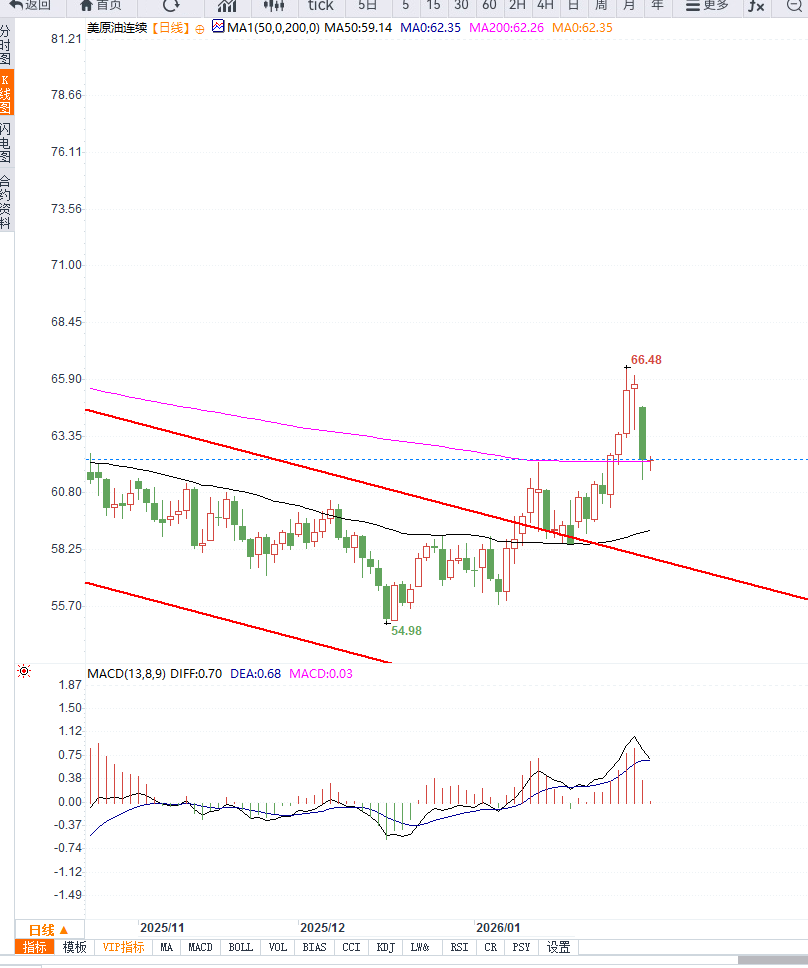
From a daily chart perspective, WTI crude oil had previously rebounded from its lows, even reaching above $66, a new high since last year. However, as prices entered a previously densely traded area, upward momentum weakened significantly, and the problem of insufficient buying support at higher levels gradually became apparent.
The daily candlestick chart shows that oil prices have experienced a surge followed by a pullback at high levels, with the body of the candlestick gradually shortening, reflecting increased divergence between bulls and bears, and the trend is shifting from a one-sided upward movement to a correction. Prices are currently trading below short-term moving averages, and the short-term trend has shifted from slightly bullish to slightly bearish, indicating a significant decline in bullish momentum.
Structurally, the current market movement is more in line with the characteristics of a technical pullback after an upward trend. The previously formed upward channel has been effectively broken, and the price center of gravity has begun to shift downwards, indicating that the market is reassessing its medium-term valuation range.
The $61 level has become a key area for short-term bullish and bearish battles. This level is both the starting point of the previous rebound and an important support zone on the daily chart. If this support zone fails to hold, a further downward correction on the daily chart may occur, potentially opening up more room for retracement.
Conversely, if prices stabilize in this area and consolidate effectively, a technical rebound cannot be ruled out, but the rebound's extent will still be limited by the moving average system above. On the upside, the $62.80 to $63.50 range constitutes significant technical resistance; this area is not only a previous consolidation platform but also a densely distributed area of short-term moving averages.
Until it can regain a foothold in this range, oil prices will remain in a phase where rebounds are easily blocked and the risk of a pullback is relatively high. Overall, the daily trend of WTI crude oil has shifted from trend-driven to structural correction, and it still needs time to digest the previous gains in the short term, with the market trend leaning towards a downward oscillation.
Editor's Note:
The current correction in WTI crude oil is more like a systemic cooling down after a trending market. The decline in geopolitical risk premiums, the temporary strengthening of the US dollar, and marginal easing on the supply side have combined to create a lack of catalysts for further upward movement in oil prices.
From an operational perspective, the short-term market should focus more on risk control than chasing rebounds. The effectiveness of the support level around $61 will be key to judging the subsequent trend; once it breaks down, market sentiment may further shift to a defensive stance.
In the medium term, for crude oil to regain strength, it needs to see a substantial improvement in demand or new supply disruptions; otherwise, the rebound is more likely to be seen as a correction within a period of adjustment.
First, the rapid easing of geopolitical risk premiums was one of the core drivers of the weakening oil prices. Tensions surrounding the Iranian nuclear issue showed signs of easing, with both the US and Iran releasing positive signals of resuming negotiations, significantly reducing market concerns about potential military conflict and disruptions to oil supply.
Against this backdrop, crude oil prices gapped down at the beginning of the week, indicating that the previously accumulated risk premium was being systematically digested. Secondly, the macroeconomic environment continued to constrain oil prices. A shift towards milder weather expectations in the United States diminished the potential for increased demand for heating fuels.
Meanwhile, the dollar's corrective rebound from multi-year lows has also suppressed the performance of dollar-denominated commodity prices to some extent. As market expectations for the Federal Reserve's future policy path become more cautious, the dollar's temporary strengthening has indirectly put pressure on crude oil.
Furthermore, expectations of easing supply have exacerbated market concerns. Venezuelan crude oil exports have rebounded significantly recently, and with the lack of clear signs of improvement on the demand side, this increased supply is more likely to amplify market anxieties about a supply-demand imbalance.
This change has led investors to adopt a more conservative outlook on the short-to-medium-term trend of crude oil. Overall, the current environment for WTI crude oil is more like a phase of "gradual realization of negative factors," and the downward shift in the price center is not an isolated fluctuation, but a natural result of multiple factors.
From a daily chart perspective, WTI crude oil had previously rebounded from its lows, even reaching above $66, a new high since last year. However, as prices entered a previously densely traded area, upward momentum weakened significantly, and the problem of insufficient buying support at higher levels gradually became apparent.
The daily candlestick chart shows that oil prices have experienced a surge followed by a pullback at high levels, with the body of the candlestick gradually shortening, reflecting increased divergence between bulls and bears, and the trend is shifting from a one-sided upward movement to a correction. Prices are currently trading below short-term moving averages, and the short-term trend has shifted from slightly bullish to slightly bearish, indicating a significant decline in bullish momentum.
Structurally, the current market movement is more in line with the characteristics of a technical pullback after an upward trend. The previously formed upward channel has been effectively broken, and the price center of gravity has begun to shift downwards, indicating that the market is reassessing its medium-term valuation range.
The $61 level has become a key area for short-term bullish and bearish battles. This level is both the starting point of the previous rebound and an important support zone on the daily chart. If this support zone fails to hold, a further downward correction on the daily chart may occur, potentially opening up more room for retracement.
Conversely, if prices stabilize in this area and consolidate effectively, a technical rebound cannot be ruled out, but the rebound's extent will still be limited by the moving average system above. On the upside, the $62.80 to $63.50 range constitutes significant technical resistance; this area is not only a previous consolidation platform but also a densely distributed area of short-term moving averages.
Until it can regain a foothold in this range, oil prices will remain in a phase where rebounds are easily blocked and the risk of a pullback is relatively high. Overall, the daily trend of WTI crude oil has shifted from trend-driven to structural correction, and it still needs time to digest the previous gains in the short term, with the market trend leaning towards a downward oscillation.
Editor's Note:
The current correction in WTI crude oil is more like a systemic cooling down after a trending market. The decline in geopolitical risk premiums, the temporary strengthening of the US dollar, and marginal easing on the supply side have combined to create a lack of catalysts for further upward movement in oil prices.
From an operational perspective, the short-term market should focus more on risk control than chasing rebounds. The effectiveness of the support level around $61 will be key to judging the subsequent trend; once it breaks down, market sentiment may further shift to a defensive stance.
In the medium term, for crude oil to regain strength, it needs to see a substantial improvement in demand or new supply disruptions; otherwise, the rebound is more likely to be seen as a correction within a period of adjustment.
- Risk Warning and Disclaimer
- The market involves risk, and trading may not be suitable for all investors. This article is for reference only and does not constitute personal investment advice, nor does it take into account certain users’ specific investment objectives, financial situation, or other needs. Any investment decisions made based on this information are at your own risk.