Is the Federal Reserve's independence being tested? Will Trump's chosen candidate usher in a major shift in the dollar's direction?
2026-02-03 10:03:55
US President Trump nominated Kevin Warsh, known for his hawkish stance, as the next Federal Reserve Chairman. This nomination has sparked deep concerns in the market about the Fed's independence.
Warsh's nomination is not simply a matter of being bullish or bearish for the US dollar; rather, it introduces greater uncertainty and volatility. On Tuesday (February 3rd) during the Asian session, the US dollar index fluctuated narrowly around 97.45.
Kevin Warsh's nomination is yet another test of the Federal Reserve's independence. If the stock market's reaction to Warsh's nomination tells you anything, it's that the coming months will be quite turbulent for investors.
Warsh is President Trump's nominee to succeed Jerome Powell and will head the Federal Reserve after Powell's term ends in May. Known as an "inflation hawk" and an opponent of quantitative easing, Warsh's nomination can be seen as another test of the Fed's independence.
Typically, the views that Warsh has repeatedly articulated in numerous articles over the decades have prompted bond investors to sell off U.S. Treasuries, which clearly runs counter to the president's expectations—Trump has consistently demanded lower interest rates to reduce borrowing costs for households and businesses.
Given the president's statement that "anyone who disagrees with me on the path of interest rates is not fit to be the chairman of the Federal Reserve," investors' reactions suggest that the market is uncertain whether Warsh will stand up to the pressure from the president's "affordability agenda" and stick to his own views.
Therefore, market volatility may once again dominate the trading arena in the coming months.
Overvalued, hot stocks will be the most risky area—these assets are most vulnerable to collapse before the market re-establishes its direction. Take the Russell 2000 index as an example: about 40% of the small-cap companies in this index are losing money, yet it outperforms the S&P SmallCap 600 index, which is primarily composed of profitable companies.
Some investors may turn to defensive sectors for refuge, including consumer staples, utilities, and healthcare. The investment logic for these sectors is that, regardless of economic fluctuations, consumers will always need to buy necessities, pay electricity bills, and access healthcare services .
Technology blue-chip stocks are also likely to benefit, as investors are betting heavily on artificial intelligence and its potential to drive overall stock market returns. The technology sector will receive even stronger support if Warsh maintains his view that "AI investment will become an engine of economic productivity growth."
Warsh's nomination means that Powell will likely remain on the Federal Reserve Board of Governors until the end of his term in 2028, thus ensuring that any major reforms to the Fed's goals will be voted off by the "veteran" governors.
Some investors believe Trump chose Warsh because he could influence other Federal Reserve officials to support the president's stance on interest rate cuts. Others believe Warsh might turn against the president—a possibility that clearly worries Trump, who remarked at the World Economic Forum in Davos, Switzerland in early 2026: "It's amazing how people change their stance once they take office."
Regardless of the scenario, concerns about the Federal Reserve's independence will remain a focal point. The report states that Trump joked last Saturday that he would sue Warsh if he didn't cut interest rates. This remark is the latest in a series of actions by the Trump administration to interfere with the Fed's independence: the Justice Department has launched a criminal investigation into Powell, and the president has also attempted to remove Fed Governor Lisa Cook from her post.
Investors need time to adjust to the new Federal Reserve Chairman, and must remember that he only has one vote in interest rate decisions. Power and influence have their limits. But until then, investors are best advised to buckle up and wait for the market to fully digest Warsh's policy stance.
Kevin Warsh's nomination has a multi-dimensional and contradictory impact on the US dollar. At its core lies the struggle between "hawkish policy proposals" and "the risk of political interference," leading to a "two-way volatility" characteristic in the dollar's outlook. This is not simply a matter of being bullish or bearish, but rather introduces greater uncertainty and volatility.
The tug-of-war between political pressure and the Fed's independence has resulted in confusing policy signals. The dollar is more likely to fluctuate, with its movements driven more by risk sentiment and daily assessments of the Fed's credibility than by economic fundamentals alone.
This "test of the Fed's independence" may damage the dollar more than any specific policy outcome itself. Investors need to prepare for a period of uncertainty and increased volatility in the dollar due to internal policy conflicts. In the long run, the dollar's trajectory will depend on whether the Fed's "institutional character" can survive this contest.
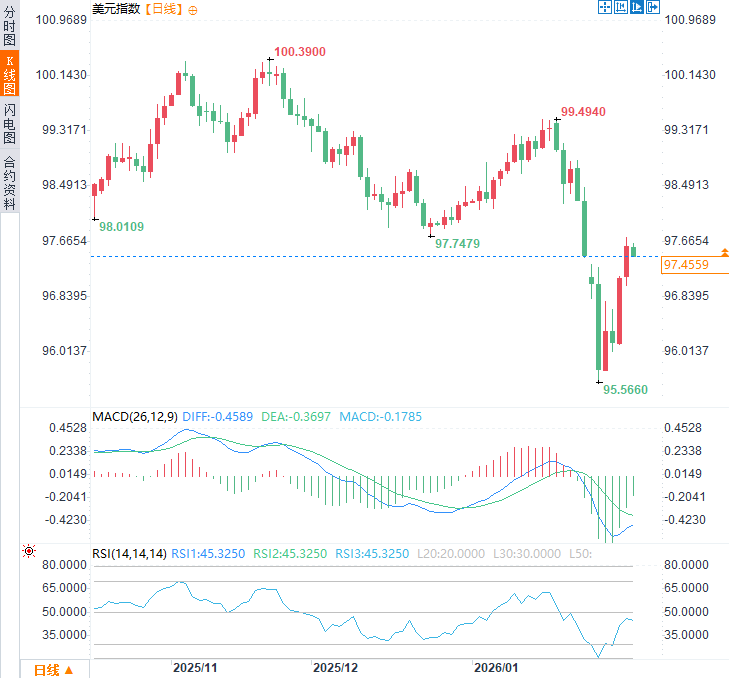
(US Dollar Index Daily Chart, Source: FX678)
At 10:03 Beijing time, the US dollar index is currently at 97.44.
Warsh's nomination is not simply a matter of being bullish or bearish for the US dollar; rather, it introduces greater uncertainty and volatility. On Tuesday (February 3rd) during the Asian session, the US dollar index fluctuated narrowly around 97.45.
Eye of the Nomination Storm: A Hawk Takes the Head of the Federal Reserve
Kevin Warsh's nomination is yet another test of the Federal Reserve's independence. If the stock market's reaction to Warsh's nomination tells you anything, it's that the coming months will be quite turbulent for investors.
Warsh is President Trump's nominee to succeed Jerome Powell and will head the Federal Reserve after Powell's term ends in May. Known as an "inflation hawk" and an opponent of quantitative easing, Warsh's nomination can be seen as another test of the Fed's independence.
Market Myth: Will he stick to his own opinion, or will he succumb to the White House?
Typically, the views that Warsh has repeatedly articulated in numerous articles over the decades have prompted bond investors to sell off U.S. Treasuries, which clearly runs counter to the president's expectations—Trump has consistently demanded lower interest rates to reduce borrowing costs for households and businesses.
Given the president's statement that "anyone who disagrees with me on the path of interest rates is not fit to be the chairman of the Federal Reserve," investors' reactions suggest that the market is uncertain whether Warsh will stand up to the pressure from the president's "affordability agenda" and stick to his own views.
Therefore, market volatility may once again dominate the trading arena in the coming months.
A bumpy journey: Which sectors can become safe havens?
Overvalued, hot stocks will be the most risky area—these assets are most vulnerable to collapse before the market re-establishes its direction. Take the Russell 2000 index as an example: about 40% of the small-cap companies in this index are losing money, yet it outperforms the S&P SmallCap 600 index, which is primarily composed of profitable companies.
Some investors may turn to defensive sectors for refuge, including consumer staples, utilities, and healthcare. The investment logic for these sectors is that, regardless of economic fluctuations, consumers will always need to buy necessities, pay electricity bills, and access healthcare services .
Technology blue-chip stocks are also likely to benefit, as investors are betting heavily on artificial intelligence and its potential to drive overall stock market returns. The technology sector will receive even stronger support if Warsh maintains his view that "AI investment will become an engine of economic productivity growth."
Interest Rates and Brakes
Warsh's nomination means that Powell will likely remain on the Federal Reserve Board of Governors until the end of his term in 2028, thus ensuring that any major reforms to the Fed's goals will be voted off by the "veteran" governors.
Some investors believe Trump chose Warsh because he could influence other Federal Reserve officials to support the president's stance on interest rate cuts. Others believe Warsh might turn against the president—a possibility that clearly worries Trump, who remarked at the World Economic Forum in Davos, Switzerland in early 2026: "It's amazing how people change their stance once they take office."
Regardless of the scenario, concerns about the Federal Reserve's independence will remain a focal point. The report states that Trump joked last Saturday that he would sue Warsh if he didn't cut interest rates. This remark is the latest in a series of actions by the Trump administration to interfere with the Fed's independence: the Justice Department has launched a criminal investigation into Powell, and the president has also attempted to remove Fed Governor Lisa Cook from her post.
Investors need time to adjust to the new Federal Reserve Chairman, and must remember that he only has one vote in interest rate decisions. Power and influence have their limits. But until then, investors are best advised to buckle up and wait for the market to fully digest Warsh's policy stance.
Two-way fluctuations in the US dollar and long-term credit challenges
Kevin Warsh's nomination has a multi-dimensional and contradictory impact on the US dollar. At its core lies the struggle between "hawkish policy proposals" and "the risk of political interference," leading to a "two-way volatility" characteristic in the dollar's outlook. This is not simply a matter of being bullish or bearish, but rather introduces greater uncertainty and volatility.
The tug-of-war between political pressure and the Fed's independence has resulted in confusing policy signals. The dollar is more likely to fluctuate, with its movements driven more by risk sentiment and daily assessments of the Fed's credibility than by economic fundamentals alone.
This "test of the Fed's independence" may damage the dollar more than any specific policy outcome itself. Investors need to prepare for a period of uncertainty and increased volatility in the dollar due to internal policy conflicts. In the long run, the dollar's trajectory will depend on whether the Fed's "institutional character" can survive this contest.
(US Dollar Index Daily Chart, Source: FX678)
At 10:03 Beijing time, the US dollar index is currently at 97.44.
- Risk Warning and Disclaimer
- The market involves risk, and trading may not be suitable for all investors. This article is for reference only and does not constitute personal investment advice, nor does it take into account certain users’ specific investment objectives, financial situation, or other needs. Any investment decisions made based on this information are at your own risk.