Crude Oil Trading Alert: Uncertainty surrounding US-Iran negotiations coupled with supply pressures keep WTI crude oil prices fluctuating at high levels.
2026-02-05 10:10:03
During Thursday's Asian trading session, West Texas Intermediate (WTI) crude oil prices consolidated after significant two-way fluctuations in the previous session, trading in a narrow range around the $64 mark.
Although overall price levels remain at a relatively high level, compared to the more than five-month high reached last week, oil prices have shown signs of weakening upward momentum, and market sentiment has gradually shifted from chasing the rally to a wait-and-see approach.
The main variable in the current crude oil market stems from geopolitical factors. The United States and Iran have confirmed that they will hold talks on the nuclear issue in Oman on Friday, which has alleviated concerns about a rapid deterioration of the situation in the short term.

However, the US insistence on including non-nuclear issues in the negotiation framework has left the outcome uncertain and potential military risks not yet fully eliminated from oil price pricing. Against this backdrop, the geopolitical risk premium continues to support oil prices.
However, fundamental pressures are gradually emerging. The recent rebound in Venezuelan crude oil exports has brought additional supply to the global crude oil market, while milder weather expectations in the United States have also reduced the potential for short-term energy demand.
These factors, to some extent, offset the support from geopolitical risks, making it difficult for oil prices to continue their previous one-sided upward trend. Furthermore, the US dollar's performance exerted a significant external constraint on crude oil prices.
The dollar index rebounded after hitting multi-year lows and is trading near two-week highs. The market widely believes that Kevin Warsh, President Trump's nominee for the next Federal Reserve Chair, may have a more hawkish policy stance than previously expected.
This assessment reinforced the dollar's short-term support, thus putting downward pressure on dollar-denominated crude oil prices. Amidst increasing supply, a stabilizing dollar, and ongoing macroeconomic uncertainties, traders are generally more cautious about risk, opting to wait for key events to unfold.
In the short term, the US JOLTS job openings data and initial jobless claims will be important indicators to watch during the North American trading session, potentially providing clues for periodic fluctuations in oil prices.
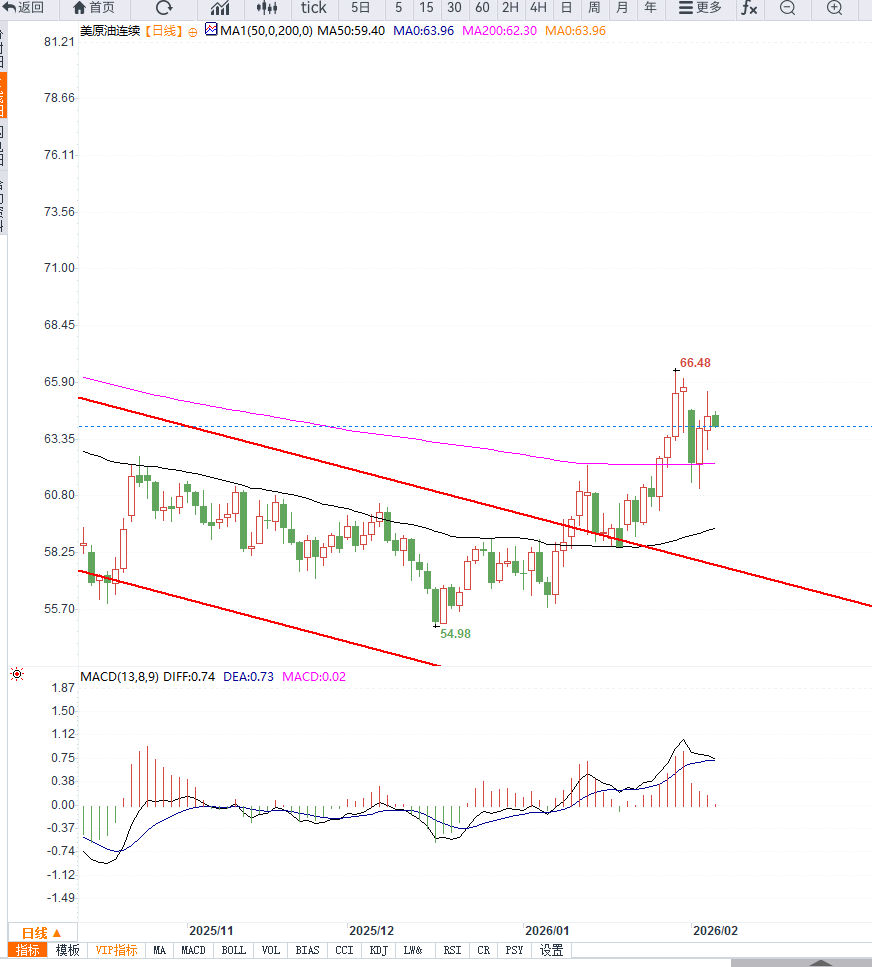
From a daily chart perspective, WTI crude oil is still operating within a medium-term upward channel, but the price action has shifted from a trend-driven phase to a consolidation phase at higher levels. After approaching a recent high, the price failed to sustain its upward momentum with increased volume, and the daily candlestick bodies are gradually narrowing, reflecting a significantly intensified struggle between bulls and bears in the high-level area.
Regarding the moving average system, the short-term moving average remains above the medium-term moving average, and the overall bullish alignment has not been broken, indicating that the foundation of the medium-term trend still exists. However, it should be noted that the upward slope of the short-term moving average has slowed significantly, and the deviation between the price and the moving average is gradually converging, indicating that the market's momentum for chasing higher prices is cooling down, and funds are more inclined to repeatedly change hands at higher levels.
In terms of momentum indicators, the Relative Strength Index (RSI) has fallen from its previous high range to the neutral-to-strong zone, without releasing a clear trend reversal signal. This change is more in line with the characteristics of technical consolidation after an upward move, indicating that the current adjustment is mainly due to time digestion rather than a rapid decline driven by panic.
As long as the RSI doesn't break below the midline, the overall structure still leans towards a bullish bias within a range. Looking at the price structure, a key short-term support area has gradually formed around $64, with multiple pullbacks finding support near this area, indicating that buying interest remains somewhat defensive.
If this support level holds, oil prices will likely continue to consolidate within a range; conversely, a decisive break below this level on the daily chart could open up further downside potential. Resistance is concentrated around the previous high of $66, and without new fundamental catalysts, a breakout will remain difficult.
In summary, the current daily chart pattern for WTI crude oil is more consistent with high-level consolidation, indicating a trend reversal rather than a clear trend reversal. The subsequent direction will heavily depend on any new developments in geopolitical tensions and macroeconomic factors.
Editor's Note:
Overall, WTI crude oil is currently in a typical tug-of-war phase, supported by geopolitical risks on the downside and suppressed by supply and the US dollar on the upside. The uncertain outcome of the US-Iran negotiations makes it difficult for the market to completely eliminate pricing risks; however, improvements on the supply side and a stronger dollar are continuously reducing the upside potential of oil prices.
Against this backdrop, a range-bound approach is more suitable for short-term crude oil trading than chasing one-sided trends. Only a substantial escalation in geopolitical tensions or an unexpected tightening of supply will likely trigger a renewed directional trend in oil prices. Until then, volatility will remain the dominant theme.
Although overall price levels remain at a relatively high level, compared to the more than five-month high reached last week, oil prices have shown signs of weakening upward momentum, and market sentiment has gradually shifted from chasing the rally to a wait-and-see approach.
The main variable in the current crude oil market stems from geopolitical factors. The United States and Iran have confirmed that they will hold talks on the nuclear issue in Oman on Friday, which has alleviated concerns about a rapid deterioration of the situation in the short term.
However, the US insistence on including non-nuclear issues in the negotiation framework has left the outcome uncertain and potential military risks not yet fully eliminated from oil price pricing. Against this backdrop, the geopolitical risk premium continues to support oil prices.
However, fundamental pressures are gradually emerging. The recent rebound in Venezuelan crude oil exports has brought additional supply to the global crude oil market, while milder weather expectations in the United States have also reduced the potential for short-term energy demand.
These factors, to some extent, offset the support from geopolitical risks, making it difficult for oil prices to continue their previous one-sided upward trend. Furthermore, the US dollar's performance exerted a significant external constraint on crude oil prices.
The dollar index rebounded after hitting multi-year lows and is trading near two-week highs. The market widely believes that Kevin Warsh, President Trump's nominee for the next Federal Reserve Chair, may have a more hawkish policy stance than previously expected.
This assessment reinforced the dollar's short-term support, thus putting downward pressure on dollar-denominated crude oil prices. Amidst increasing supply, a stabilizing dollar, and ongoing macroeconomic uncertainties, traders are generally more cautious about risk, opting to wait for key events to unfold.
In the short term, the US JOLTS job openings data and initial jobless claims will be important indicators to watch during the North American trading session, potentially providing clues for periodic fluctuations in oil prices.
From a daily chart perspective, WTI crude oil is still operating within a medium-term upward channel, but the price action has shifted from a trend-driven phase to a consolidation phase at higher levels. After approaching a recent high, the price failed to sustain its upward momentum with increased volume, and the daily candlestick bodies are gradually narrowing, reflecting a significantly intensified struggle between bulls and bears in the high-level area.
Regarding the moving average system, the short-term moving average remains above the medium-term moving average, and the overall bullish alignment has not been broken, indicating that the foundation of the medium-term trend still exists. However, it should be noted that the upward slope of the short-term moving average has slowed significantly, and the deviation between the price and the moving average is gradually converging, indicating that the market's momentum for chasing higher prices is cooling down, and funds are more inclined to repeatedly change hands at higher levels.
In terms of momentum indicators, the Relative Strength Index (RSI) has fallen from its previous high range to the neutral-to-strong zone, without releasing a clear trend reversal signal. This change is more in line with the characteristics of technical consolidation after an upward move, indicating that the current adjustment is mainly due to time digestion rather than a rapid decline driven by panic.
As long as the RSI doesn't break below the midline, the overall structure still leans towards a bullish bias within a range. Looking at the price structure, a key short-term support area has gradually formed around $64, with multiple pullbacks finding support near this area, indicating that buying interest remains somewhat defensive.
If this support level holds, oil prices will likely continue to consolidate within a range; conversely, a decisive break below this level on the daily chart could open up further downside potential. Resistance is concentrated around the previous high of $66, and without new fundamental catalysts, a breakout will remain difficult.
In summary, the current daily chart pattern for WTI crude oil is more consistent with high-level consolidation, indicating a trend reversal rather than a clear trend reversal. The subsequent direction will heavily depend on any new developments in geopolitical tensions and macroeconomic factors.
Editor's Note:
Overall, WTI crude oil is currently in a typical tug-of-war phase, supported by geopolitical risks on the downside and suppressed by supply and the US dollar on the upside. The uncertain outcome of the US-Iran negotiations makes it difficult for the market to completely eliminate pricing risks; however, improvements on the supply side and a stronger dollar are continuously reducing the upside potential of oil prices.
Against this backdrop, a range-bound approach is more suitable for short-term crude oil trading than chasing one-sided trends. Only a substantial escalation in geopolitical tensions or an unexpected tightening of supply will likely trigger a renewed directional trend in oil prices. Until then, volatility will remain the dominant theme.
- Risk Warning and Disclaimer
- The market involves risk, and trading may not be suitable for all investors. This article is for reference only and does not constitute personal investment advice, nor does it take into account certain users’ specific investment objectives, financial situation, or other needs. Any investment decisions made based on this information are at your own risk.