The US and Israel are plotting a new strategy against Iran, raising concerns that Iran may retaliate against US military bases, and sending safe-haven gold prices testing $5,000 again.
2026-02-09 10:39:18
Israeli Prime Minister Benjamin Netanyahu will meet with US President Donald Trump in Washington on Wednesday (February 11) to discuss US-Iran negotiations. His office issued a statement on Saturday as the Iranian Foreign Minister threatened to strike US military bases in the region the day after the talks.
In a brief statement, Netanyahu's office said, "The Prime Minister believes all negotiations must include limiting ballistic missile programs and ending support for the Iranian axis," referring to Tehran's support for armed groups including Hezbollah in Lebanon and Hamas in the Palestinian territories. Trump and Netanyahu last met in December 2025.
The White House did not immediately comment. The escalating confrontation between the US and Iran is expected to provide upward momentum for gold in the short term. Spot gold traded around $5,000 per ounce in Asian trading on Monday, up about 0.8% on the day, after previously rising above $5,045.

The United States and the Islamic Republic of Iran held indirect talks in Oman last Friday, seemingly returning to square one on how to handle negotiations regarding Iran's nuclear program.
Trump described the talks as "very successful" and indicated that more consultations would be held earlier this week. The U.S. side was represented by Special Envoy for the Middle East Steve Vitkov and Jared Kushner, Trump's son-in-law.
As the crackdown on nationwide protests in Tehran leaves thousands dead, the Trump administration has deployed the aircraft carrier USS Abraham Lincoln and other warships to the region and has repeatedly threatened to use force to compel Iran to reach an agreement on its nuclear program.
Gulf Arab states are concerned that the attack could trigger a regional war, with the 12-day conflict between Israel and Iran in June still fresh in their minds.
Last Friday, the United States sent its top military commander in the Middle East to participate in talks with Iran for the first time. Admiral Brad Cooper, commander of U.S. Central Command, subsequently boarded the USS Lincoln aircraft carrier on Saturday with Vitkov and Kushner, the command said in a statement.
Iranian Foreign Minister Abbas Araqchi said last Friday, "Nuclear negotiations and the resolution of major issues must be conducted in a calm atmosphere free from tension and threats." He added that diplomats would return to their respective capitals, marking the end of this round of talks.
Last Saturday, Araghchi stated that if the United States attacks Iran, Iran would lack the capability to strike the U.S. mainland and would therefore be forced to attack or retaliate against U.S. military bases in the region. He indicated that "extremely deep distrust" exists between the two sides following the events of the previous round of negotiations, when the U.S. bombed Iranian nuclear facilities during the 2025 Israel-Iran war.
Araghchi also emphasized that there is absolutely no room for negotiation on "missile issues and other defense matters," now and at no time in the future . Tehran insists that such talks will be limited to its nuclear program.
However, it has been reported that diplomats from Egypt, Turkey, and Qatar have presented Iran with a proposal demanding that Tehran suspend its uranium enrichment activities for three years, export highly enriched uranium, and pledge a "no first use of ballistic missiles." US Secretary of State Marco Rubio stated that the relevant negotiations must cover all of these issues.
Israel, a close ally of the United States, believes Iran is pursuing the development of nuclear weapons and has demanded that it halt the program, while Iran insists its atomic energy program is for peaceful purposes only. Israel has also demanded that Iran cease ballistic missile development and end its support for armed groups in the region.
Speaking at a forum in Qatar last Saturday, Araghshi accused Israel of undermining regional stability, saying it "violates national sovereignty, assassinates government officials, carries out terrorist acts, and expands its influence on multiple fronts." He condemned Israel's treatment of Palestinians and called for "comprehensive and targeted sanctions against Israel, including an immediate arms embargo."
Last Sunday, Araghzi briefed Omani on the recent negotiations with the United States in Muscat, the capital of Oman. He stated that the talks focused on the nuclear issue and that the results are currently being assessed. Both sides generally agreed to continue negotiations, but the specific arrangements will be finalized by their respective leaders. The time and location of the next round of talks will be discussed with Oman's Foreign Minister.
From Iran's perspective, the negotiations will continue in the form of indirect contact. Araghchi pointed out that this round of negotiations continued the indirect dialogue approach, with no direct talks held. Previous rounds of negotiations also adopted an indirect format, with representatives only meeting briefly upon entering and leaving the meeting room. He emphasized that the key to reaching an agreement lies in moving towards mutual respect, mutual understanding, and based on common interests. Araghchi also stated that if Iran assesses that the other side's attitude is serious, the negotiations will continue.
He further added that the continued existence of some sanctions and certain military actions have cast doubt on Iran's sincerity and preparedness for substantive negotiations. When asked about this, Araghchi stated unequivocally that Iran would never accept a "zero enrichment" plan. Uranium enrichment is one of the core issues in the negotiations. Iran does not oppose confidence-building measures, but only on the premise that the principle of Iran's right to enrich uranium must be recognized.
Iranian President Peshichiyan said on social media last Sunday that Iran's position on the nuclear issue is based on the rights clearly stipulated in the Treaty on the Non-Proliferation of Nuclear Weapons, and emphasized that "the Iranian people have always responded to respect with respect, but will never accept the language of power."
He also pointed out that dialogue has always been Iran's established strategy for peacefully resolving issues. This dialogue between Iran and the United States, facilitated by friendly countries in the region, represents a step forward.
The deadlock in US-Iran negotiations, Israel's hardline stance, and the Iranian foreign minister's threat to strike US military bases have all significantly increased geopolitical risks. Gold, as a traditional safe-haven asset, is expected to attract substantial capital inflows.
The confrontational stance and "power rhetoric" of the United States in negotiations may exacerbate market concerns about the stability of the US-led global political and economic system. This macroeconomic uncertainty provides support for the long-term investment value of gold.
For traders, it is essential to closely monitor the outcome of the subsequent meeting between the US and Israeli leaders, any military developments, and whether the negotiations have completely broken down.
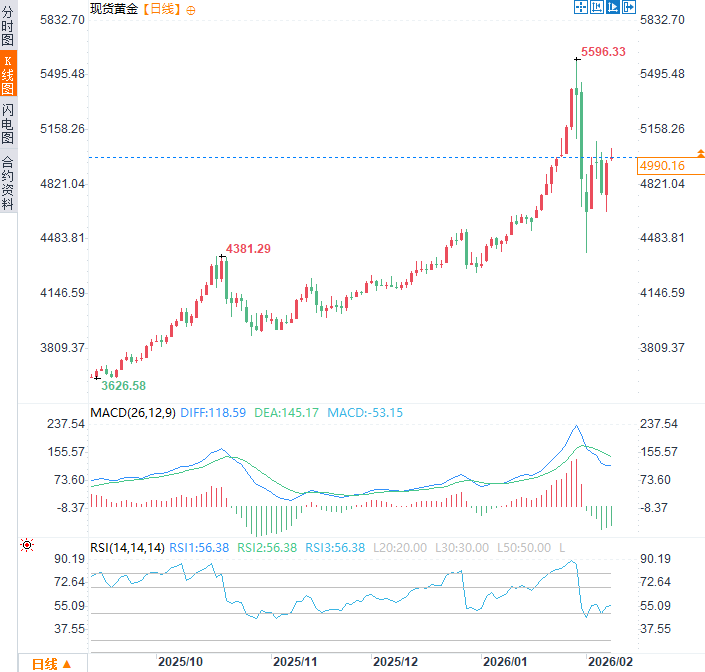
(Spot gold daily chart, source: FX678)
At 10:38 Beijing time, spot gold was trading at $4,997.44 per ounce.
In a brief statement, Netanyahu's office said, "The Prime Minister believes all negotiations must include limiting ballistic missile programs and ending support for the Iranian axis," referring to Tehran's support for armed groups including Hezbollah in Lebanon and Hamas in the Palestinian territories. Trump and Netanyahu last met in December 2025.
The White House did not immediately comment. The escalating confrontation between the US and Iran is expected to provide upward momentum for gold in the short term. Spot gold traded around $5,000 per ounce in Asian trading on Monday, up about 0.8% on the day, after previously rising above $5,045.
Negotiations have stalled, with both the US and Iran returning to their original positions.
The United States and the Islamic Republic of Iran held indirect talks in Oman last Friday, seemingly returning to square one on how to handle negotiations regarding Iran's nuclear program.
Trump described the talks as "very successful" and indicated that more consultations would be held earlier this week. The U.S. side was represented by Special Envoy for the Middle East Steve Vitkov and Jared Kushner, Trump's son-in-law.
Military deterrence intensifies, casting a shadow over regional security.
As the crackdown on nationwide protests in Tehran leaves thousands dead, the Trump administration has deployed the aircraft carrier USS Abraham Lincoln and other warships to the region and has repeatedly threatened to use force to compel Iran to reach an agreement on its nuclear program.
Gulf Arab states are concerned that the attack could trigger a regional war, with the 12-day conflict between Israel and Iran in June still fresh in their minds.
Last Friday, the United States sent its top military commander in the Middle East to participate in talks with Iran for the first time. Admiral Brad Cooper, commander of U.S. Central Command, subsequently boarded the USS Lincoln aircraft carrier on Saturday with Vitkov and Kushner, the command said in a statement.
Iran criticizes US and Israeli pressure, draws red lines on missile issue.
Iranian Foreign Minister Abbas Araqchi said last Friday, "Nuclear negotiations and the resolution of major issues must be conducted in a calm atmosphere free from tension and threats." He added that diplomats would return to their respective capitals, marking the end of this round of talks.
Last Saturday, Araghchi stated that if the United States attacks Iran, Iran would lack the capability to strike the U.S. mainland and would therefore be forced to attack or retaliate against U.S. military bases in the region. He indicated that "extremely deep distrust" exists between the two sides following the events of the previous round of negotiations, when the U.S. bombed Iranian nuclear facilities during the 2025 Israel-Iran war.
Araghchi also emphasized that there is absolutely no room for negotiation on "missile issues and other defense matters," now and at no time in the future . Tehran insists that such talks will be limited to its nuclear program.
However, it has been reported that diplomats from Egypt, Turkey, and Qatar have presented Iran with a proposal demanding that Tehran suspend its uranium enrichment activities for three years, export highly enriched uranium, and pledge a "no first use of ballistic missiles." US Secretary of State Marco Rubio stated that the relevant negotiations must cover all of these issues.
Israel, a close ally of the United States, believes Iran is pursuing the development of nuclear weapons and has demanded that it halt the program, while Iran insists its atomic energy program is for peaceful purposes only. Israel has also demanded that Iran cease ballistic missile development and end its support for armed groups in the region.
Speaking at a forum in Qatar last Saturday, Araghshi accused Israel of undermining regional stability, saying it "violates national sovereignty, assassinates government officials, carries out terrorist acts, and expands its influence on multiple fronts." He condemned Israel's treatment of Palestinians and called for "comprehensive and targeted sanctions against Israel, including an immediate arms embargo."
Iranian Foreign Minister reiterates nuclear red line: Zero enrichment will never be accepted.
Last Sunday, Araghzi briefed Omani on the recent negotiations with the United States in Muscat, the capital of Oman. He stated that the talks focused on the nuclear issue and that the results are currently being assessed. Both sides generally agreed to continue negotiations, but the specific arrangements will be finalized by their respective leaders. The time and location of the next round of talks will be discussed with Oman's Foreign Minister.
From Iran's perspective, the negotiations will continue in the form of indirect contact. Araghchi pointed out that this round of negotiations continued the indirect dialogue approach, with no direct talks held. Previous rounds of negotiations also adopted an indirect format, with representatives only meeting briefly upon entering and leaving the meeting room. He emphasized that the key to reaching an agreement lies in moving towards mutual respect, mutual understanding, and based on common interests. Araghchi also stated that if Iran assesses that the other side's attitude is serious, the negotiations will continue.
He further added that the continued existence of some sanctions and certain military actions have cast doubt on Iran's sincerity and preparedness for substantive negotiations. When asked about this, Araghchi stated unequivocally that Iran would never accept a "zero enrichment" plan. Uranium enrichment is one of the core issues in the negotiations. Iran does not oppose confidence-building measures, but only on the premise that the principle of Iran's right to enrich uranium must be recognized.
Iranian President Stance: Respond to respect with respect, reject hegemony.
Iranian President Peshichiyan said on social media last Sunday that Iran's position on the nuclear issue is based on the rights clearly stipulated in the Treaty on the Non-Proliferation of Nuclear Weapons, and emphasized that "the Iranian people have always responded to respect with respect, but will never accept the language of power."
He also pointed out that dialogue has always been Iran's established strategy for peacefully resolving issues. This dialogue between Iran and the United States, facilitated by friendly countries in the region, represents a step forward.
Impact on the gold market
The deadlock in US-Iran negotiations, Israel's hardline stance, and the Iranian foreign minister's threat to strike US military bases have all significantly increased geopolitical risks. Gold, as a traditional safe-haven asset, is expected to attract substantial capital inflows.
The confrontational stance and "power rhetoric" of the United States in negotiations may exacerbate market concerns about the stability of the US-led global political and economic system. This macroeconomic uncertainty provides support for the long-term investment value of gold.
For traders, it is essential to closely monitor the outcome of the subsequent meeting between the US and Israeli leaders, any military developments, and whether the negotiations have completely broken down.
(Spot gold daily chart, source: FX678)
At 10:38 Beijing time, spot gold was trading at $4,997.44 per ounce.
- Risk Warning and Disclaimer
- The market involves risk, and trading may not be suitable for all investors. This article is for reference only and does not constitute personal investment advice, nor does it take into account certain users’ specific investment objectives, financial situation, or other needs. Any investment decisions made based on this information are at your own risk.