The Russia-Ukraine conflict has entered a phase of "balance of terror," with energy infrastructure becoming the focus, driving up safe-haven gold prices.
2026-02-09 10:43:48
Faced with escalating long-range strikes in the Russia-Ukraine conflict, Ukrainian President Volodymyr Zelensky is vying for international support to prevent the devastation caused by the war from becoming "habitualized" by the international community. After being attacked by more than 3,300 rounds of various types of ammunition in a week, he warned: "The world cannot turn a blind eye to Russian attacks. Without a global response, the attacks will become more frequent and brutal."
The Russia-Ukraine conflict has entered a new phase of long-range offensives and infrastructure strikes, which will provide significant and sustained upward support for gold prices primarily through three channels: enhanced safe-haven demand, creation of energy supply uncertainty, and the triggering of geopolitical risk premiums. On Monday (February 9th) during the Asian session, spot gold fluctuated upwards, currently trading around $5,000 per ounce, with a daily increase of approximately 0.7%, having previously touched around $5,046 per ounce.

Zelensky said on Sunday that in the past week, the Russian military launched more than 2,000 attack drones, 1,200 guided air-to-ground bombs, and 116 missiles at Ukraine, targeting energy, logistics infrastructure, and residential buildings.
Between Saturday night and early Sunday morning, Ukrainian forces intercepted 69 of the 101 drones targeted, but 32 still managed to hit 13 targets. The ongoing attacks have plunged many parts of Ukraine into widespread power outages following Friday's large-scale airstrikes, and civilian and industrial facilities have suffered severe damage.
Faced with immense pressure on the battlefield, Zelenskyy announced a more aggressive strategic shift. He explicitly designated Russia's energy sector as a "legitimate target of attacks on Ukraine," his logic pointing directly to the economic foundation of the conflict: "He (Russia) sells oil, gets the money, invests in weapons, and then uses those weapons to kill Ukrainians."
This means that, in addition to traditional military targets, attacking Russia's "source of funding"—energy infrastructure—will become a strategic option for Ukraine in the future. Zelenskyy also announced a new round of sanctions against foreign companies supplying key components for the production of Russian drones and missiles.
The fierce fighting on the battlefield is rapidly spilling over into other areas. Ukraine is not only enduring attacks but also continuing to launch long-range drone strikes against Russia. The Russian Ministry of Defense stated that its forces shot down 22 Ukrainian drones overnight.
Meanwhile, a failed assassination attempt in Moscow further escalated tensions. The Russian Federal Security Service (FSB) announced the arrest and extradition in Dubai of a Russian citizen suspected of shooting a senior Russian military intelligence officer, accusing him of working for Ukrainian security services. Ukrainian authorities denied the allegations, but Russian Foreign Minister Lavrov directly pointed the finger at Kyiv.
The current situation indicates that the conflict has entered a new phase of "balance of terror" characterized by long-range strikes and infrastructure destruction. Ukraine's attempt to turn the tide of the war by targeting Russia's energy and economic lifelines could impact the stability of global energy markets. Furthermore, the escalation of cross-border attacks and accusations suggests that the boundaries of the war's risks are becoming increasingly blurred.
Zelensky's calls for "tangible support for Ukraine" and "continued pressure on Russia" will be at the heart of future international diplomatic maneuvering, and the outcome will not only concern Ukraine's fate but also profoundly impact the security and economic landscape of Europe and the world.
The current Russia-Ukraine conflict exhibits new characteristics—systematic long-range strikes, targeting the energy economy, and the spread of cross-border attacks—significantly reinforcing its status as a core source of risk in global markets. This is not merely a regional military conflict, but a macroeconomic event impacting global energy security, inflationary paths, and growth expectations. Therefore, gold, as an ideal tool for hedging such complex risks, is supported by multiple factors, and its upward trend is expected to be consolidated .
Investors need to closely monitor subsequent attacks on energy facilities, developments in Western military aid, and any events that could escalate the conflict.
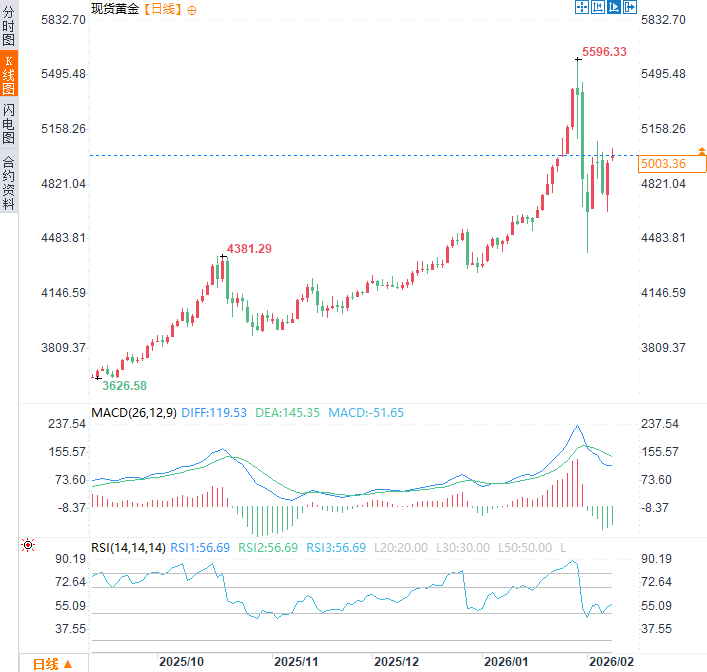
(Spot gold daily chart, source: FX678)
At 10:42 Beijing time, spot gold was trading at $4,996.76 per ounce.
The Russia-Ukraine conflict has entered a new phase of long-range offensives and infrastructure strikes, which will provide significant and sustained upward support for gold prices primarily through three channels: enhanced safe-haven demand, creation of energy supply uncertainty, and the triggering of geopolitical risk premiums. On Monday (February 9th) during the Asian session, spot gold fluctuated upwards, currently trading around $5,000 per ounce, with a daily increase of approximately 0.7%, having previously touched around $5,046 per ounce.
Intense fighting: Over 3,300 ranged attacks in a week
Zelensky said on Sunday that in the past week, the Russian military launched more than 2,000 attack drones, 1,200 guided air-to-ground bombs, and 116 missiles at Ukraine, targeting energy, logistics infrastructure, and residential buildings.
Between Saturday night and early Sunday morning, Ukrainian forces intercepted 69 of the 101 drones targeted, but 32 still managed to hit 13 targets. The ongoing attacks have plunged many parts of Ukraine into widespread power outages following Friday's large-scale airstrikes, and civilian and industrial facilities have suffered severe damage.
Strategic Upgrade: Zelensky Designates Russian Energy Sector as a Legitimate Target
Faced with immense pressure on the battlefield, Zelenskyy announced a more aggressive strategic shift. He explicitly designated Russia's energy sector as a "legitimate target of attacks on Ukraine," his logic pointing directly to the economic foundation of the conflict: "He (Russia) sells oil, gets the money, invests in weapons, and then uses those weapons to kill Ukrainians."
This means that, in addition to traditional military targets, attacking Russia's "source of funding"—energy infrastructure—will become a strategic option for Ukraine in the future. Zelenskyy also announced a new round of sanctions against foreign companies supplying key components for the production of Russian drones and missiles.
Beyond the battlefield: Cross-border attacks and assassinations unfold simultaneously.
The fierce fighting on the battlefield is rapidly spilling over into other areas. Ukraine is not only enduring attacks but also continuing to launch long-range drone strikes against Russia. The Russian Ministry of Defense stated that its forces shot down 22 Ukrainian drones overnight.
Meanwhile, a failed assassination attempt in Moscow further escalated tensions. The Russian Federal Security Service (FSB) announced the arrest and extradition in Dubai of a Russian citizen suspected of shooting a senior Russian military intelligence officer, accusing him of working for Ukrainian security services. Ukrainian authorities denied the allegations, but Russian Foreign Minister Lavrov directly pointed the finger at Kyiv.
Geopolitical implications: Prolonged conflict exacerbates global energy and security risks
The current situation indicates that the conflict has entered a new phase of "balance of terror" characterized by long-range strikes and infrastructure destruction. Ukraine's attempt to turn the tide of the war by targeting Russia's energy and economic lifelines could impact the stability of global energy markets. Furthermore, the escalation of cross-border attacks and accusations suggests that the boundaries of the war's risks are becoming increasingly blurred.
Zelensky's calls for "tangible support for Ukraine" and "continued pressure on Russia" will be at the heart of future international diplomatic maneuvering, and the outcome will not only concern Ukraine's fate but also profoundly impact the security and economic landscape of Europe and the world.
Comprehensive assessment of gold price trends
The current Russia-Ukraine conflict exhibits new characteristics—systematic long-range strikes, targeting the energy economy, and the spread of cross-border attacks—significantly reinforcing its status as a core source of risk in global markets. This is not merely a regional military conflict, but a macroeconomic event impacting global energy security, inflationary paths, and growth expectations. Therefore, gold, as an ideal tool for hedging such complex risks, is supported by multiple factors, and its upward trend is expected to be consolidated .
Investors need to closely monitor subsequent attacks on energy facilities, developments in Western military aid, and any events that could escalate the conflict.
(Spot gold daily chart, source: FX678)
At 10:42 Beijing time, spot gold was trading at $4,996.76 per ounce.
- Risk Warning and Disclaimer
- The market involves risk, and trading may not be suitable for all investors. This article is for reference only and does not constitute personal investment advice, nor does it take into account certain users’ specific investment objectives, financial situation, or other needs. Any investment decisions made based on this information are at your own risk.