Geopolitical conflicts and the unemployment curse: a tug-of-war between bulls and bears in gold.
2026-02-10 17:59:08
On Tuesday (February 10), during the Asian and European sessions, spot gold entered a tug-of-war between bulls and bears after a recent rapid rebound. The market showed a bottoming-out and rebound trend, with the lowest point during the session reaching 4986. It is currently back above 5000 points and trading at $5046 per ounce.
The key factors affecting gold prices recently include the escalating geopolitical risks between the US and Iran, the policy expectations brought to the market by the incoming Federal Reserve Chairman, and the upcoming release of several important data sets.

Although both sides claimed to have made "positive progress" after the resumption of US-Iran nuclear negotiations, the standoff has not been substantially eased.
The United States continues to increase its troop presence in the Middle East and intensifies sanctions on Iranian oil. While pushing forward with talks, Trump has issued a strong warning that a breakdown in negotiations would come at a “very high price” for Iran.
Israeli Prime Minister Benjamin Netanyahu will meet with Donald Trump on Wednesday, and is expected to further pressure the U.S. to maintain a hardline stance on Iran.
As a crucial passage for nearly one-third of global seaborne crude oil trade, the Strait of Hormuz is experiencing rapidly escalating shipping risks, directly creating a core positive factor for safe-haven assets such as crude oil and gold.
The U.S. Maritime Safety Administration officially issued a navigation warning on Monday, requiring all U.S.-flagged vessels to stay away from Iranian waters, and for eastbound vessels to sail as close as possible to the Omani side. The warning also explicitly rejected Iranian requests to board the vessels, providing evidence that the U.S.-Iran situation remains deadlocked.
The US disclosed that on February 3, Iran used small boats and helicopters to try to stop a merchant ship. The warning document explicitly requires crew members not to use force to resist when they are forcibly boarded, but emphasizes that passive cooperation does not mean endorsement of the legitimacy of such behavior. This escalation of geopolitical conflict became the strongest driving force for the demand for gold as a safe haven during the day.
Data Window: Non-Farm Payrolls Revision and Unemployment Rate Become Key Observation Points <br/>This week, a flurry of US economic data will be released. December retail sales data will be released on Tuesday evening, with the market expecting a continued steady trend. The US Department of Agriculture's monthly supply and demand report will also be released at noon on the same day. On Thursday, the National Association of Realtors will release January existing home sales data, which is likely to show a decline.
The delayed non-farm payroll report has become a key variable in gold trading. This report will simultaneously release revised figures for the full year of 2025 non-farm payrolls. The U.S. Bureau of Labor Statistics (BLS) had already disclosed this in advance last September, suggesting a possible downward revision of 900,000 jobs.
From a trading perspective, if the downward revision exceeds expectations, it will directly lead to a weaker dollar, which in turn will drive gold higher; if the downward revision meets expectations and causes a short-term downward impact on the dollar, it may become a good opportunity to short gold at higher prices.
The unemployment rate is a key indicator to watch in this non-farm payroll data release. According to the SAM rule, when the three-month moving average of the US unemployment rate is 0.5 percentage points higher than the lowest point in the past 12 months, the economy officially enters a recession. This threshold is exactly 4.4%.
Meanwhile, economists generally believe that the inflection point of the Beveridge curve is at 4.4%. Once the unemployment rate breaks through this inflection point, it means that the labor market is not simply cooling down, but entering a recession.
Historical evidence shows that the US unemployment rate once hit 4.3% in July 2024, which directly triggered the "Black Monday" volatility in global markets, demonstrating the critical impact of this threshold on the market.
The market itself is influenced by Warsh's background, which has led to concerns about the Federal Reserve's balance sheet reduction. Warsh is considered a hawk. However, considering the long-term yield of US Treasury bonds, the current yield of 4.83% already imposes a high cost of debt issuance on the government. Balance sheet reduction would further push up Treasury yields and increase the government's debt issuance costs. On this basis, balance sheet reduction is very unrealistic. Balance sheet reduction would make the US government constrained by debt pressure and unable to take action.
Meanwhile, market expectations for the Federal Reserve's easing policies continued to grow. At a private dinner in early February 2026, Trump joked that if his nominee for the new Federal Reserve chairman, Kevin Warsh, did not lower interest rates after taking office, he might sue Warsh.
Although Trump later told reporters it was just a "roast," the incident has raised concerns in political circles. Currently, at least two interest rate cuts are widely expected this year, providing underlying support for gold prices.
The market's attitude toward Warsh has shifted from a hawkish advocate of balance sheet reduction to a dovish advocate of interest rates.
The nomination process for the Federal Reserve Chair also introduces additional variables to gold trading, which is generally positive as it further reduces obstacles to Warsh's appointment.
U.S. Treasury Secretary Scott Bessant said on Sunday that he called on the Senate to proceed with hearings for President Trump’s nomination of Kevin Warsh as Federal Reserve chairman, despite threats from key Republican senators to block all Fed nominations until the criminal investigation into current chairman Jerome Powell is completed.
North Carolina Republican Senator Thom Tillis, a member of the Senate Banking Committee responsible for hearing Federal Reserve nominees, has made it clear that he will reject all of Trump's Federal Reserve nominees until the Department of Justice completes its investigation into Jerome Powell's testimony to Congress last year regarding the renovation of the Federal Reserve headquarters.
The turning point came when Bessant pointed out on Fox News' "Sunday Morning Futures" that Senator Tillis had publicly endorsed Kevin Walsh's candidacy and suggested initiating hearings while awaiting the results of U.S. Attorney Jeanine Piro's investigation into Powell.
Piro has now taken the lead in the investigation and issued subpoenas. This personnel struggle will affect market expectations for the continuity of the Federal Reserve's policies, thereby indirectly boosting gold prices.
In summary, the current gold trading market is caught in a triple game of geopolitical risks, economic data, and policy expectations.
In the short term, attention should be paid to the further development of the situation in the Strait of Hormuz; in the medium term, the focus should be on the revision of non-farm payroll data and the performance of the unemployment rate; and in the long term, it is necessary to track the direction of the Federal Reserve's policies and the sustainability of official gold purchase demand.
Investors should be wary of increased volatility before and after data releases, and rationally manage the balance between long and short positions, focusing on key points such as the 4.4% unemployment rate threshold and the downward revision of the non-farm payrolls forecast of 900,000.
Technically, gold has rebounded rapidly recently, but despite numerous positive factors, the price has not risen further. Going forward, we should observe whether gold prices will fail to rise despite positive news, indicating that gold needs time to consolidate and digest the recent rapid rebound. We should pay attention to any new marginal changes in the market that may occur in the future.
Support is around 4940, which is close to 5000, while resistance is at 5125. Until the price of gold rises above 5125, the price will continue to fluctuate with a downward bias.
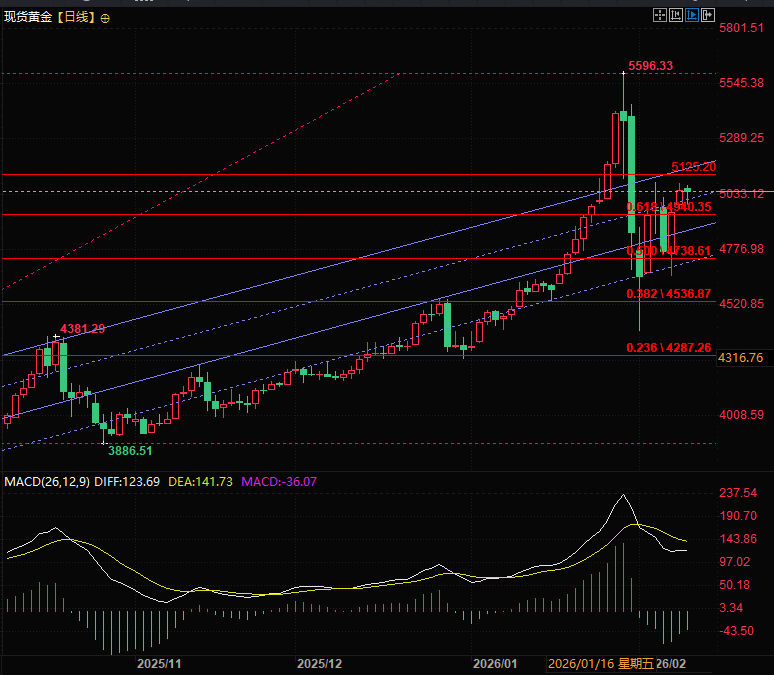
(Spot gold daily chart, source: FX678)
At 17:55 Beijing time, spot gold was trading at $5042.2 per ounce.
The key factors affecting gold prices recently include the escalating geopolitical risks between the US and Iran, the policy expectations brought to the market by the incoming Federal Reserve Chairman, and the upcoming release of several important data sets.
Escalating Geopolitical Risks: Strait of Hormuz Becomes a Key Driver of Risk Aversion
Although both sides claimed to have made "positive progress" after the resumption of US-Iran nuclear negotiations, the standoff has not been substantially eased.
The United States continues to increase its troop presence in the Middle East and intensifies sanctions on Iranian oil. While pushing forward with talks, Trump has issued a strong warning that a breakdown in negotiations would come at a “very high price” for Iran.
Israeli Prime Minister Benjamin Netanyahu will meet with Donald Trump on Wednesday, and is expected to further pressure the U.S. to maintain a hardline stance on Iran.
As a crucial passage for nearly one-third of global seaborne crude oil trade, the Strait of Hormuz is experiencing rapidly escalating shipping risks, directly creating a core positive factor for safe-haven assets such as crude oil and gold.
The U.S. Maritime Safety Administration officially issued a navigation warning on Monday, requiring all U.S.-flagged vessels to stay away from Iranian waters, and for eastbound vessels to sail as close as possible to the Omani side. The warning also explicitly rejected Iranian requests to board the vessels, providing evidence that the U.S.-Iran situation remains deadlocked.
The US disclosed that on February 3, Iran used small boats and helicopters to try to stop a merchant ship. The warning document explicitly requires crew members not to use force to resist when they are forcibly boarded, but emphasizes that passive cooperation does not mean endorsement of the legitimacy of such behavior. This escalation of geopolitical conflict became the strongest driving force for the demand for gold as a safe haven during the day.
Data Window: Non-Farm Payrolls Revision and Unemployment Rate Become Key Observation Points <br/>This week, a flurry of US economic data will be released. December retail sales data will be released on Tuesday evening, with the market expecting a continued steady trend. The US Department of Agriculture's monthly supply and demand report will also be released at noon on the same day. On Thursday, the National Association of Realtors will release January existing home sales data, which is likely to show a decline.
The delayed non-farm payroll report has become a key variable in gold trading. This report will simultaneously release revised figures for the full year of 2025 non-farm payrolls. The U.S. Bureau of Labor Statistics (BLS) had already disclosed this in advance last September, suggesting a possible downward revision of 900,000 jobs.
From a trading perspective, if the downward revision exceeds expectations, it will directly lead to a weaker dollar, which in turn will drive gold higher; if the downward revision meets expectations and causes a short-term downward impact on the dollar, it may become a good opportunity to short gold at higher prices.
The unemployment rate is a key indicator to watch in this non-farm payroll data release. According to the SAM rule, when the three-month moving average of the US unemployment rate is 0.5 percentage points higher than the lowest point in the past 12 months, the economy officially enters a recession. This threshold is exactly 4.4%.
Meanwhile, economists generally believe that the inflection point of the Beveridge curve is at 4.4%. Once the unemployment rate breaks through this inflection point, it means that the labor market is not simply cooling down, but entering a recession.
Historical evidence shows that the US unemployment rate once hit 4.3% in July 2024, which directly triggered the "Black Monday" volatility in global markets, demonstrating the critical impact of this threshold on the market.
The market continues to adjust its expectations for the new Federal Reserve Chairman's policies.
The market itself is influenced by Warsh's background, which has led to concerns about the Federal Reserve's balance sheet reduction. Warsh is considered a hawk. However, considering the long-term yield of US Treasury bonds, the current yield of 4.83% already imposes a high cost of debt issuance on the government. Balance sheet reduction would further push up Treasury yields and increase the government's debt issuance costs. On this basis, balance sheet reduction is very unrealistic. Balance sheet reduction would make the US government constrained by debt pressure and unable to take action.
Meanwhile, market expectations for the Federal Reserve's easing policies continued to grow. At a private dinner in early February 2026, Trump joked that if his nominee for the new Federal Reserve chairman, Kevin Warsh, did not lower interest rates after taking office, he might sue Warsh.
Although Trump later told reporters it was just a "roast," the incident has raised concerns in political circles. Currently, at least two interest rate cuts are widely expected this year, providing underlying support for gold prices.
The market's attitude toward Warsh has shifted from a hawkish advocate of balance sheet reduction to a dovish advocate of interest rates.
The Fed personnel saga adds to market uncertainty.
The nomination process for the Federal Reserve Chair also introduces additional variables to gold trading, which is generally positive as it further reduces obstacles to Warsh's appointment.
U.S. Treasury Secretary Scott Bessant said on Sunday that he called on the Senate to proceed with hearings for President Trump’s nomination of Kevin Warsh as Federal Reserve chairman, despite threats from key Republican senators to block all Fed nominations until the criminal investigation into current chairman Jerome Powell is completed.
North Carolina Republican Senator Thom Tillis, a member of the Senate Banking Committee responsible for hearing Federal Reserve nominees, has made it clear that he will reject all of Trump's Federal Reserve nominees until the Department of Justice completes its investigation into Jerome Powell's testimony to Congress last year regarding the renovation of the Federal Reserve headquarters.
The turning point came when Bessant pointed out on Fox News' "Sunday Morning Futures" that Senator Tillis had publicly endorsed Kevin Walsh's candidacy and suggested initiating hearings while awaiting the results of U.S. Attorney Jeanine Piro's investigation into Powell.
Piro has now taken the lead in the investigation and issued subpoenas. This personnel struggle will affect market expectations for the continuity of the Federal Reserve's policies, thereby indirectly boosting gold prices.
Summary and Technical Analysis:
In summary, the current gold trading market is caught in a triple game of geopolitical risks, economic data, and policy expectations.
In the short term, attention should be paid to the further development of the situation in the Strait of Hormuz; in the medium term, the focus should be on the revision of non-farm payroll data and the performance of the unemployment rate; and in the long term, it is necessary to track the direction of the Federal Reserve's policies and the sustainability of official gold purchase demand.
Investors should be wary of increased volatility before and after data releases, and rationally manage the balance between long and short positions, focusing on key points such as the 4.4% unemployment rate threshold and the downward revision of the non-farm payrolls forecast of 900,000.
Technically, gold has rebounded rapidly recently, but despite numerous positive factors, the price has not risen further. Going forward, we should observe whether gold prices will fail to rise despite positive news, indicating that gold needs time to consolidate and digest the recent rapid rebound. We should pay attention to any new marginal changes in the market that may occur in the future.
Support is around 4940, which is close to 5000, while resistance is at 5125. Until the price of gold rises above 5125, the price will continue to fluctuate with a downward bias.
(Spot gold daily chart, source: FX678)
At 17:55 Beijing time, spot gold was trading at $5042.2 per ounce.
- Risk Warning and Disclaimer
- The market involves risk, and trading may not be suitable for all investors. This article is for reference only and does not constitute personal investment advice, nor does it take into account certain users’ specific investment objectives, financial situation, or other needs. Any investment decisions made based on this information are at your own risk.