Index rebound: Is it time for the Swiss franc?
2026-02-10 17:56:43
On Tuesday, February 10th, the USD/CHF pair traded in a narrow range around 0.7650 during the European session. After a cumulative decline of 1.6% over the previous two trading days, the pair showed signs of fatigue following a period of concentrated selling pressure. The market is currently in no hurry to choose a direction, instead consolidating sideways while awaiting key economic data releases to guide its next move. The US retail sales report, to be released later today, will be the focus of the day. Traders are closely watching whether consumer spending remains resilient to assess whether the overall economy can withstand the pressure from the recent weakening job market.
Over the past few days, a series of US data has reignited market concerns about economic growth. January's ADP employment data showed a significant slowdown in new job creation, while JOLTS job openings fell to their lowest level in nine years. Both indicators point to a common reality: the labor market is cooling. This shift has not only weakened market expectations of a "single-handed" US economic performance but has also shaken the foundation upon which the dollar's strength previously rested—the interest rate differential advantage in a high-interest-rate environment. As the growth outlook becomes increasingly uncertain, funds are beginning to withdraw from previously accumulated long dollar positions, resulting in a weak dollar rebound.
More alarmingly, market pricing in the Federal Reserve's future policy path is undergoing a subtle shift. White House economic advisor Kevin Hassett stated publicly on Monday that job growth is likely to remain sluggish in the coming months due to a slowdown in labor force growth coupled with productivity gains. Such official statements have undoubtedly amplified market caution regarding this week's non-farm payroll report and prompted traders to reassess the Fed's pace of rate cuts. Previously, the market widely expected only a 25 basis point rate cut in 2026, but now a growing number of voices suggest that if employment and demand weaken simultaneously, the Fed may have to bring forward or increase its easing measures.
If interest rate expectations shift to a more dovish stance, the dollar's appeal will be further diminished. This is because exchange rates essentially reflect the interest rate differential and growth prospects between two countries. If the US not only faces a lower central interest rate but also a slowdown in growth momentum, the likelihood of capital flowing to other relatively stable regions will increase. The Swiss franc, as a traditional safe-haven currency, often finds support during periods of heightened uncertainty. Although Switzerland's own economy is not without its challenges, its safe-haven characteristics may actually be amplified in such environments.
In Switzerland, the latest SECO Consumer Sentiment Index shows that it rebounded to -30 in the three months ending in January, better than the previous reading of -37, indicating a recovery in consumer confidence in their finances and willingness to make large purchases. However, confidence in the overall economic outlook continues to decline, suggesting that the recovery is not on a solid foundation. This structural divergence means the Swiss franc lacks a clear driver in the short term; there is neither strong domestic demand to push for appreciation nor a severe recession to trigger a sharp depreciation. A true directional breakthrough will depend on the January Consumer Price Index (CPI) to be released next Friday, to determine whether the Swiss National Bank will adjust its current policy stance.
Currently, the data releases from the two major economies of Europe and the United States are highly synchronized, making this week a "super data week." Tuesday's retail sales, Wednesday's non-farm payrolls, and Friday's CPI are all interconnected, and each step could trigger a market repricing. If US consumer data is unexpectedly strong and the employment sub-indices do not deteriorate significantly, market bets on interest rate cuts may diminish, and the dollar may see a brief recovery. Conversely, if the data remains weak, the dollar's rebound will be severely limited, and it may even trigger a new round of decline.
From a technical chart perspective, the USD/CHF pair has broken through several key levels since its high of 0.8039, eventually accelerating to 0.7601, and is currently trading not far above its previous low. This suggests the market is testing the effectiveness of a key support zone. The MACD indicator shows the DIFF at -0.0065 and the DEA at -0.0058, both still in negative territory, indicating that medium-term momentum has not yet reversed. The RSI is 36.4894, close to the weak zone but not yet oversold, consistent with the technical characteristics of consolidation after a decline.
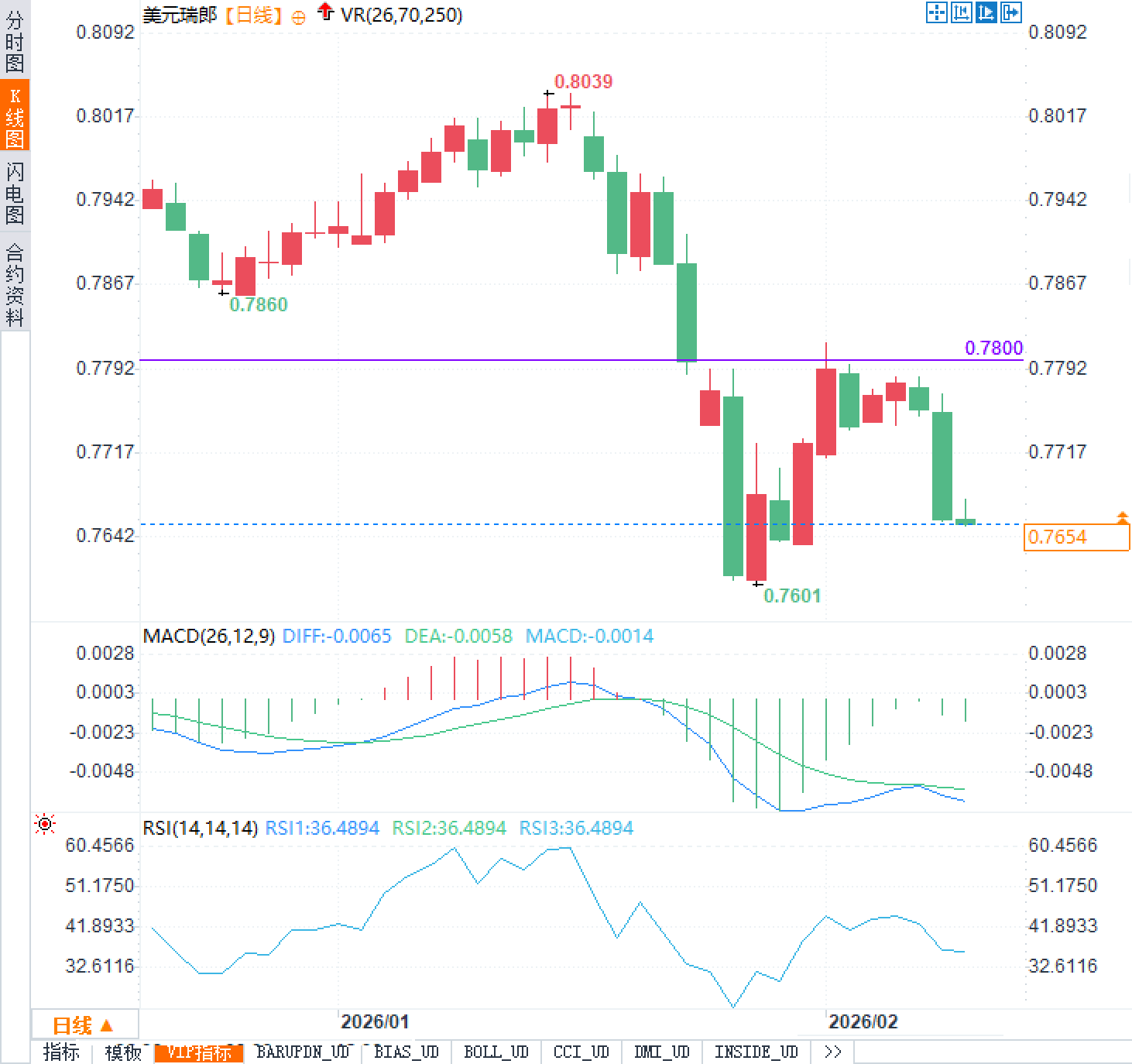
The next move will depend on whether the data provides a breakout opportunity. If the exchange rate can hold above 0.7650 and gradually rise, it may challenge the important resistance level of 0.7800; however, if it falls below the psychological level of 0.7600 again, it may trigger a surge of stop-loss orders, exacerbating the downside risk.
Over the past few days, a series of US data has reignited market concerns about economic growth. January's ADP employment data showed a significant slowdown in new job creation, while JOLTS job openings fell to their lowest level in nine years. Both indicators point to a common reality: the labor market is cooling. This shift has not only weakened market expectations of a "single-handed" US economic performance but has also shaken the foundation upon which the dollar's strength previously rested—the interest rate differential advantage in a high-interest-rate environment. As the growth outlook becomes increasingly uncertain, funds are beginning to withdraw from previously accumulated long dollar positions, resulting in a weak dollar rebound.
Rising expectations of interest rate cuts put deep pressure on the US dollar.
More alarmingly, market pricing in the Federal Reserve's future policy path is undergoing a subtle shift. White House economic advisor Kevin Hassett stated publicly on Monday that job growth is likely to remain sluggish in the coming months due to a slowdown in labor force growth coupled with productivity gains. Such official statements have undoubtedly amplified market caution regarding this week's non-farm payroll report and prompted traders to reassess the Fed's pace of rate cuts. Previously, the market widely expected only a 25 basis point rate cut in 2026, but now a growing number of voices suggest that if employment and demand weaken simultaneously, the Fed may have to bring forward or increase its easing measures.
If interest rate expectations shift to a more dovish stance, the dollar's appeal will be further diminished. This is because exchange rates essentially reflect the interest rate differential and growth prospects between two countries. If the US not only faces a lower central interest rate but also a slowdown in growth momentum, the likelihood of capital flowing to other relatively stable regions will increase. The Swiss franc, as a traditional safe-haven currency, often finds support during periods of heightened uncertainty. Although Switzerland's own economy is not without its challenges, its safe-haven characteristics may actually be amplified in such environments.
The Swiss franc awaits its opportunity, amid a complex interplay of internal and external factors.
In Switzerland, the latest SECO Consumer Sentiment Index shows that it rebounded to -30 in the three months ending in January, better than the previous reading of -37, indicating a recovery in consumer confidence in their finances and willingness to make large purchases. However, confidence in the overall economic outlook continues to decline, suggesting that the recovery is not on a solid foundation. This structural divergence means the Swiss franc lacks a clear driver in the short term; there is neither strong domestic demand to push for appreciation nor a severe recession to trigger a sharp depreciation. A true directional breakthrough will depend on the January Consumer Price Index (CPI) to be released next Friday, to determine whether the Swiss National Bank will adjust its current policy stance.
Currently, the data releases from the two major economies of Europe and the United States are highly synchronized, making this week a "super data week." Tuesday's retail sales, Wednesday's non-farm payrolls, and Friday's CPI are all interconnected, and each step could trigger a market repricing. If US consumer data is unexpectedly strong and the employment sub-indices do not deteriorate significantly, market bets on interest rate cuts may diminish, and the dollar may see a brief recovery. Conversely, if the data remains weak, the dollar's rebound will be severely limited, and it may even trigger a new round of decline.
Technically, a breakout is imminent; key support levels will become the decisive battleground.
From a technical chart perspective, the USD/CHF pair has broken through several key levels since its high of 0.8039, eventually accelerating to 0.7601, and is currently trading not far above its previous low. This suggests the market is testing the effectiveness of a key support zone. The MACD indicator shows the DIFF at -0.0065 and the DEA at -0.0058, both still in negative territory, indicating that medium-term momentum has not yet reversed. The RSI is 36.4894, close to the weak zone but not yet oversold, consistent with the technical characteristics of consolidation after a decline.
The next move will depend on whether the data provides a breakout opportunity. If the exchange rate can hold above 0.7650 and gradually rise, it may challenge the important resistance level of 0.7800; however, if it falls below the psychological level of 0.7600 again, it may trigger a surge of stop-loss orders, exacerbating the downside risk.
- Risk Warning and Disclaimer
- The market involves risk, and trading may not be suitable for all investors. This article is for reference only and does not constitute personal investment advice, nor does it take into account certain users’ specific investment objectives, financial situation, or other needs. Any investment decisions made based on this information are at your own risk.