Has the myth of safe-haven assets been shattered? The US dollar and Japanese yen have fallen, while the Swiss franc's strength has become a "sweet poison."
2026-02-13 08:59:05
If you ask investors which currencies are safe havens, most will mention the US dollar, the Swiss franc, and the Japanese yen. Historically, these currencies have tended to remain stable during periods of geopolitical or economic turmoil.
However, these currencies themselves have recently experienced significant volatility. The US dollar and Japanese yen are expected to depreciate sharply between 2025 and 2026. While the Swiss franc continues to strengthen, this poses a serious challenge for Switzerland, which has an extremely low inflation rate and relies heavily on exports.

In 2025, US President Donald Trump will reshape the global trade order with tariff policies, triggering a wave of "selling America"—global investors are accelerating the sale of US assets, including the US dollar, shaking the foundation of the safe-haven dollar.
The constant changes in other tariff measures continue to put pressure on the market.
In a December 2025 report, the Swiss private bank Julius Baer noted that " erratic trade policies" are only one of the causes of the dollar's predicament, adding that Trump's Big and Beautiful Act is pushing the US onto an "unsustainable debt trajectory ." The report also emphasized that Trump's pressure on Federal Reserve Chairman Jerome Powell has further eroded investor confidence in the dollar .
On January 27, 2026, the very day Trump declared the dollar was "performing well," the dollar index plummeted 1.33%, marking its largest single-day drop since the tariffs were first announced in April 2025, pushing the dollar to its lowest level in nearly four years (95.57). The index suffered a nearly 10% decline throughout 2025, and the downward trend continues into 2026.
In a report dated February 11, George Saravilos, head of foreign exchange research at Deutsche Bank, said that the safe-haven status of the US dollar is a "myth".
He refuted the idea that the dollar "strengthens when market risk aversion rises," adding, "A simple chart showing the correlation between the dollar and the stock market is enough to disprove it. Historically, the average correlation between the dollar and US stocks is close to zero, and in the past year, the dollar has once again decoupled from the S&P 500."
Cole Smead, CEO and portfolio manager at Smead Capital Management, said in late January that he expected the dollar to weaken further.
He said, "In the long run, we are in a dollar bear market. If you look back at the telecom bubble and tech bubble of the late 1990s, you'll see that American frenzy (in the market) – the dollar peaked in 2002 and then fell to extremely low levels over the next six years." During the period from 2002 to 2008 when it bottomed out, the dollar index plummeted by about 41%.
On Friday (February 13) in early Asian trading, the US dollar index lacked momentum and fluctuated narrowly around 96.95.
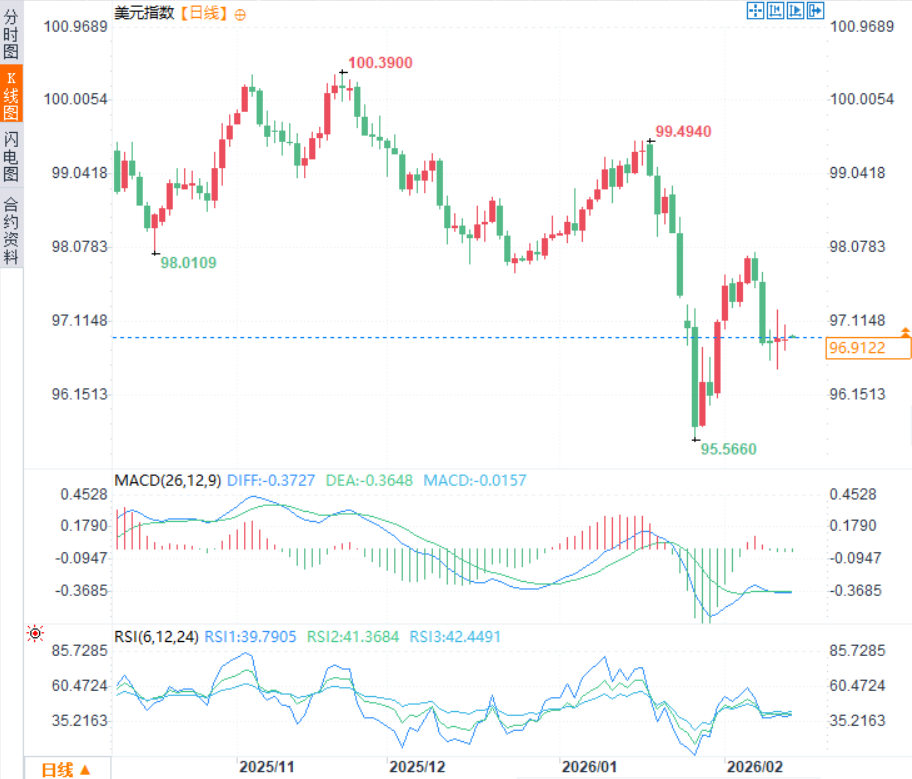
(US Dollar Index Daily Chart, Source: FX678)
The yen's exchange rate is expected to remain volatile in 2025, and rumors of intervention are now circulating about this Asian safe-haven currency.
In early 2025, the yen was trading at approximately 156 against the dollar. As the Bank of Japan began signaling further interest rate hikes, the yen strengthened, but remained around 150 for most of the second and third quarters.
After Sanae Takaichi becomes prime minister in October 2025, the yen begins to depreciate sharply. Her expansionary fiscal policy stance triggers a sell-off of the yen, pushing up long-term yields on Japanese government bonds.
From the time Sanae Takashi took office until January 23, 2026, the yen depreciated by 5.9%. Subsequently, on January 23, the New York Federal Reserve reportedly conducted a "currency check" on the USD/JPY exchange rate, causing the yen to appreciate sharply and the USD/JPY exchange rate to fall to around 152.
However, in the following days, the yen weakened again, and the USD/JPY pair fluctuated upwards, approaching the 157 level, until the yen strengthened again after the Liberal Democratic Party won an overwhelming victory in the House of Representatives election last Sunday.
Citigroup analysts say the USD/JPY pair is unlikely to break significantly above 160, as this could trigger intervention from Japanese or U.S. authorities .
ING stated in a report on February 9th: "The yen will once again approach the 160 level, but the market and authorities may engage in a tug-of-war around 159." US Treasury Secretary Scott Bessant has denied that the US intervened before the January currency check.
The USD/JPY pair traded in a narrow range around 152.85 during Friday's early Asian trading session, after declining for four consecutive trading days.
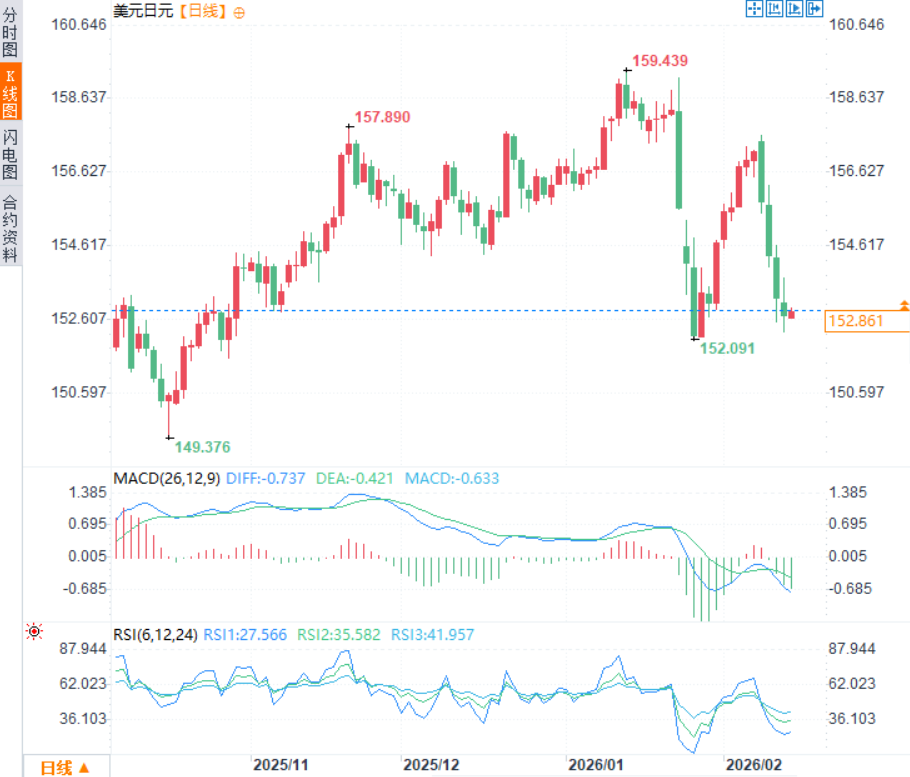
(USD/JPY daily chart, source: FX678)
Unlike the US dollar and the Japanese yen, the Swiss franc, though not issued by a large country, benefits from Switzerland's political stability, low debt, and diversified economy, making it a safe-haven asset. It has benefited from the past year's pursuit of stable assets, with the Swiss franc demonstrating significantly stronger value preservation capabilities than the US dollar and the Japanese yen .
Throughout 2025, the Swiss franc appreciated by nearly 13% against the US dollar. The upward trend continued into 2026, reaching an 11-year high against the dollar. In early February 2026, the Swiss franc also hit an 11-year high against the euro.
On January 30, as gold and silver experienced a historic sell-off, with the latter losing nearly 30% of its market value, investors also withdrew from the Swiss franc, causing the franc to fall by about 1.2% against the US dollar that day.
This was just one of ten trading days in the past year in which the Swiss franc weakened against the dollar. However, the strong Swiss franc is causing problems for Switzerland – continued appreciation could force authorities to intervene to curb the overheated currency and its impact on the overall economy.
Among developed economies, Switzerland is struggling with sluggish price growth, and the appreciation of the Swiss franc will add further deflationary pressures to this export-oriented economy. The country's inflation rate is only 0.1%, and the Swiss National Bank's key interest rate remains at 0%. As authorities try to avoid repeating the negative interest rate policy of 2015-2022, the strengthening franc further complicates the Swiss National Bank's monetary policy landscape.
Swiss officials have previously intervened in the foreign exchange market to cool their currency by selling Swiss francs and buying foreign currency. However, this move now carries hidden risks— both Trump administrations have objected to the Swiss National Bank's intervention .
Martin Schlegel, president of the Swiss National Bank, said last month at the World Economic Forum in Davos, Switzerland, that the central bank is "prepared to intervene in the foreign exchange market if necessary."
On February 11, economists at UBS, the Swiss investment bank, said that the Swiss National Bank is unlikely to "react strongly" to the appreciation of the Swiss franc, and the bank predicts that the Swiss franc will depreciate by about 2% against the US dollar by the end of 2026.
Economists stated, "Sporadic foreign exchange interventions may occur, but given the limited risk of deflation, optimistic global growth prospects, and a moderately high valuation of the Swiss franc, we believe a full-scale action is unnecessary." However, in another report, the bank also noted that the Swiss franc has limited room for further appreciation. Economists expect the US dollar to recover 2.2% of its losses against the Swiss franc by the end of April.
Matthew Ryan, head of market strategy at global financial services firm Ebury, said on February 11 that the US dollar and Japanese yen "have undoubtedly lost some of their luster recently," while the Swiss franc has "solidified its position as the preferred safe-haven currency."
Lee Hardman, a currency analyst at Mitsubishi UFJ Financial Group in the UK, also believes that the safe-haven appeal of the yen and the dollar has been "weakened" due to political turmoil. He said, "In the long run, the Swiss franc, including the yen and the dollar, has proven to be the best store of value among the G10 currencies." The dollar strengthened slightly against the Swiss franc in early Asian trading on Friday, currently trading around 0.7695, up about 0.16% on the day.
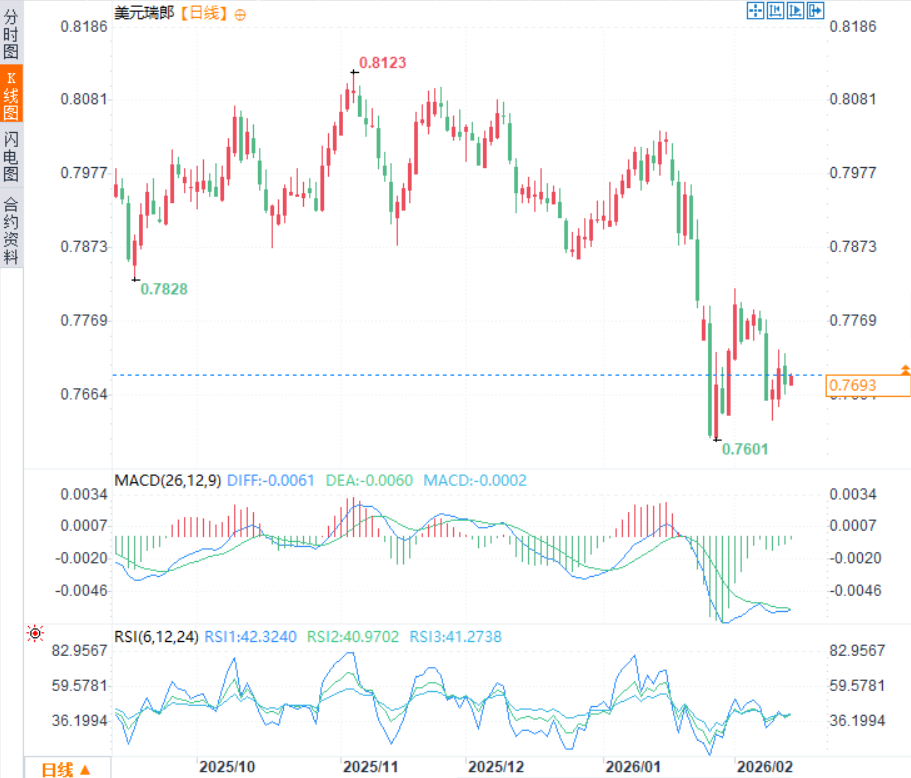
(USD/CHF daily chart, source: FX678)
At 8:57 AM Beijing time, the US dollar index is currently at 96.90.
However, these currencies themselves have recently experienced significant volatility. The US dollar and Japanese yen are expected to depreciate sharply between 2025 and 2026. While the Swiss franc continues to strengthen, this poses a serious challenge for Switzerland, which has an extremely low inflation rate and relies heavily on exports.
The dollar depreciated.
In 2025, US President Donald Trump will reshape the global trade order with tariff policies, triggering a wave of "selling America"—global investors are accelerating the sale of US assets, including the US dollar, shaking the foundation of the safe-haven dollar.
The constant changes in other tariff measures continue to put pressure on the market.
In a December 2025 report, the Swiss private bank Julius Baer noted that " erratic trade policies" are only one of the causes of the dollar's predicament, adding that Trump's Big and Beautiful Act is pushing the US onto an "unsustainable debt trajectory ." The report also emphasized that Trump's pressure on Federal Reserve Chairman Jerome Powell has further eroded investor confidence in the dollar .
On January 27, 2026, the very day Trump declared the dollar was "performing well," the dollar index plummeted 1.33%, marking its largest single-day drop since the tariffs were first announced in April 2025, pushing the dollar to its lowest level in nearly four years (95.57). The index suffered a nearly 10% decline throughout 2025, and the downward trend continues into 2026.
In a report dated February 11, George Saravilos, head of foreign exchange research at Deutsche Bank, said that the safe-haven status of the US dollar is a "myth".
He refuted the idea that the dollar "strengthens when market risk aversion rises," adding, "A simple chart showing the correlation between the dollar and the stock market is enough to disprove it. Historically, the average correlation between the dollar and US stocks is close to zero, and in the past year, the dollar has once again decoupled from the S&P 500."
Cole Smead, CEO and portfolio manager at Smead Capital Management, said in late January that he expected the dollar to weaken further.
He said, "In the long run, we are in a dollar bear market. If you look back at the telecom bubble and tech bubble of the late 1990s, you'll see that American frenzy (in the market) – the dollar peaked in 2002 and then fell to extremely low levels over the next six years." During the period from 2002 to 2008 when it bottomed out, the dollar index plummeted by about 41%.
On Friday (February 13) in early Asian trading, the US dollar index lacked momentum and fluctuated narrowly around 96.95.
(US Dollar Index Daily Chart, Source: FX678)
Interest-free yen
The yen's exchange rate is expected to remain volatile in 2025, and rumors of intervention are now circulating about this Asian safe-haven currency.
In early 2025, the yen was trading at approximately 156 against the dollar. As the Bank of Japan began signaling further interest rate hikes, the yen strengthened, but remained around 150 for most of the second and third quarters.
After Sanae Takaichi becomes prime minister in October 2025, the yen begins to depreciate sharply. Her expansionary fiscal policy stance triggers a sell-off of the yen, pushing up long-term yields on Japanese government bonds.
From the time Sanae Takashi took office until January 23, 2026, the yen depreciated by 5.9%. Subsequently, on January 23, the New York Federal Reserve reportedly conducted a "currency check" on the USD/JPY exchange rate, causing the yen to appreciate sharply and the USD/JPY exchange rate to fall to around 152.
However, in the following days, the yen weakened again, and the USD/JPY pair fluctuated upwards, approaching the 157 level, until the yen strengthened again after the Liberal Democratic Party won an overwhelming victory in the House of Representatives election last Sunday.
Citigroup analysts say the USD/JPY pair is unlikely to break significantly above 160, as this could trigger intervention from Japanese or U.S. authorities .
ING stated in a report on February 9th: "The yen will once again approach the 160 level, but the market and authorities may engage in a tug-of-war around 159." US Treasury Secretary Scott Bessant has denied that the US intervened before the January currency check.
The USD/JPY pair traded in a narrow range around 152.85 during Friday's early Asian trading session, after declining for four consecutive trading days.
(USD/JPY daily chart, source: FX678)
Swiss franc remains strong
Unlike the US dollar and the Japanese yen, the Swiss franc, though not issued by a large country, benefits from Switzerland's political stability, low debt, and diversified economy, making it a safe-haven asset. It has benefited from the past year's pursuit of stable assets, with the Swiss franc demonstrating significantly stronger value preservation capabilities than the US dollar and the Japanese yen .
Throughout 2025, the Swiss franc appreciated by nearly 13% against the US dollar. The upward trend continued into 2026, reaching an 11-year high against the dollar. In early February 2026, the Swiss franc also hit an 11-year high against the euro.
On January 30, as gold and silver experienced a historic sell-off, with the latter losing nearly 30% of its market value, investors also withdrew from the Swiss franc, causing the franc to fall by about 1.2% against the US dollar that day.
This was just one of ten trading days in the past year in which the Swiss franc weakened against the dollar. However, the strong Swiss franc is causing problems for Switzerland – continued appreciation could force authorities to intervene to curb the overheated currency and its impact on the overall economy.
Among developed economies, Switzerland is struggling with sluggish price growth, and the appreciation of the Swiss franc will add further deflationary pressures to this export-oriented economy. The country's inflation rate is only 0.1%, and the Swiss National Bank's key interest rate remains at 0%. As authorities try to avoid repeating the negative interest rate policy of 2015-2022, the strengthening franc further complicates the Swiss National Bank's monetary policy landscape.
Swiss officials have previously intervened in the foreign exchange market to cool their currency by selling Swiss francs and buying foreign currency. However, this move now carries hidden risks— both Trump administrations have objected to the Swiss National Bank's intervention .
Martin Schlegel, president of the Swiss National Bank, said last month at the World Economic Forum in Davos, Switzerland, that the central bank is "prepared to intervene in the foreign exchange market if necessary."
On February 11, economists at UBS, the Swiss investment bank, said that the Swiss National Bank is unlikely to "react strongly" to the appreciation of the Swiss franc, and the bank predicts that the Swiss franc will depreciate by about 2% against the US dollar by the end of 2026.
Economists stated, "Sporadic foreign exchange interventions may occur, but given the limited risk of deflation, optimistic global growth prospects, and a moderately high valuation of the Swiss franc, we believe a full-scale action is unnecessary." However, in another report, the bank also noted that the Swiss franc has limited room for further appreciation. Economists expect the US dollar to recover 2.2% of its losses against the Swiss franc by the end of April.
Matthew Ryan, head of market strategy at global financial services firm Ebury, said on February 11 that the US dollar and Japanese yen "have undoubtedly lost some of their luster recently," while the Swiss franc has "solidified its position as the preferred safe-haven currency."
Lee Hardman, a currency analyst at Mitsubishi UFJ Financial Group in the UK, also believes that the safe-haven appeal of the yen and the dollar has been "weakened" due to political turmoil. He said, "In the long run, the Swiss franc, including the yen and the dollar, has proven to be the best store of value among the G10 currencies." The dollar strengthened slightly against the Swiss franc in early Asian trading on Friday, currently trading around 0.7695, up about 0.16% on the day.
(USD/CHF daily chart, source: FX678)
At 8:57 AM Beijing time, the US dollar index is currently at 96.90.
- Risk Warning and Disclaimer
- The market involves risk, and trading may not be suitable for all investors. This article is for reference only and does not constitute personal investment advice, nor does it take into account certain users’ specific investment objectives, financial situation, or other needs. Any investment decisions made based on this information are at your own risk.