Crude oil trading alert: Concerns about oversupply coupled with weakness in commodities have pushed oil prices back into range-bound trading.
2026-02-13 09:24:35
On Friday during Asian trading hours, US crude oil rebounded slightly, trading around $63 per barrel, returning to the lower end of its trading range. On the fundamental front, the International Energy Agency (IEA) released its monthly report, indicating that the global crude oil market's supply and demand structure has deteriorated significantly as supply expansion and demand slowdown occur simultaneously.
Global crude oil inventories are projected to increase by 477 million barrels in 2025, the fastest pace of accumulation since 2020. OECD country inventories are expected to rise above their five-year average for the first time in four years, signaling a re-entry into a surplus cycle.
On the demand side, the IEA lowered its 2025 global oil demand growth forecast to 769,000 barrels per day, reflecting economic uncertainty and the suppression of consumption by high oil prices. Demand is projected to grow by 849,000 barrels per day in 2026, reaching a total of 104.87 million barrels per day, but this will still be insufficient to absorb the supply expansion.
 On the supply side, OPEC+ has resumed some production, while the United States, Brazil, Canada, and Guyana continue to expand production, creating supply pressure from multiple points. The IEA predicts that the global daily supply surplus will exceed 3.7 million barrels in 2026, potentially setting a new record high.
Despite weakening fundamentals, oil prices have remained resilient, driven by geopolitical risks. The IEA noted that relatively tight inventories in pricing centers are providing short-term support for prices. On the geopolitical front, US President Trump stated that negotiations with Iran could last a month, and that failure to reach an agreement would have serious consequences.
Market concerns about Middle East supply stability have led to a temporary rise in risk premiums. The founder of Vanda Insights stated, "More confrontational rhetoric could push up risk premiums, but if the situation doesn't escalate to a stage of imminent conflict, the upside potential for oil prices may be limited." Overall, inventory realities and risk premiums are creating a tug-of-war, resulting in increased price volatility.
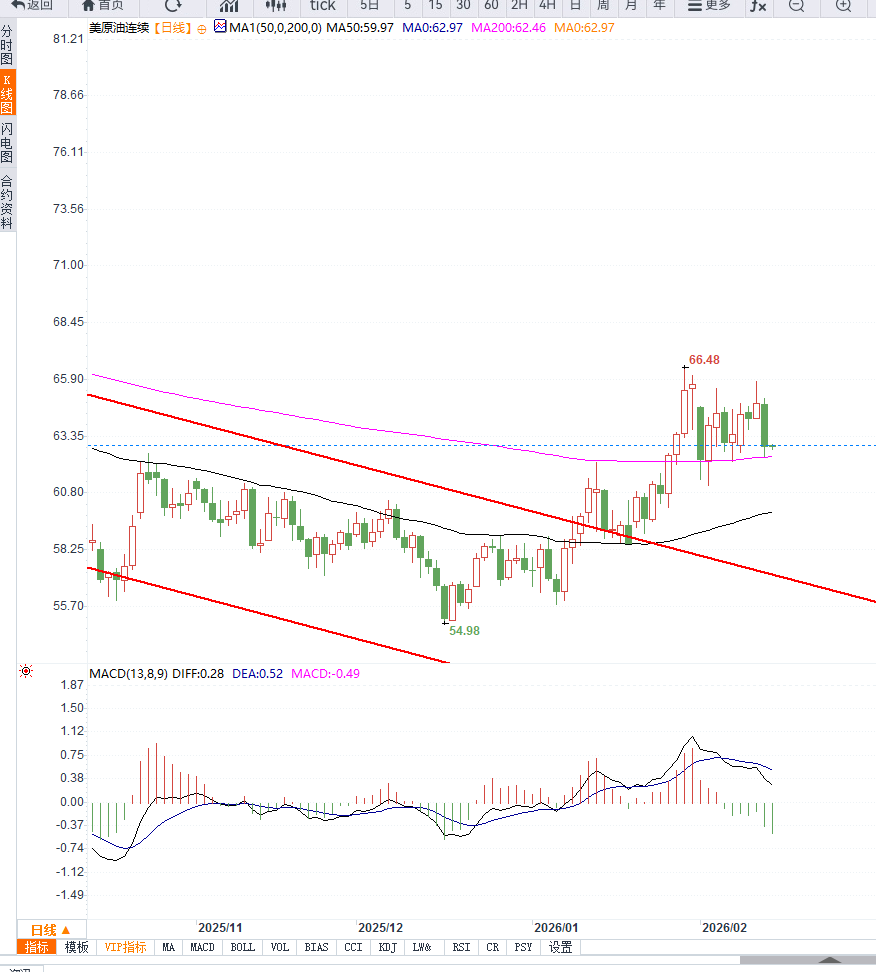
From a daily chart perspective, WTI crude oil futures have been trading below $63 recently, indicating a weakening short-term trend. The previous upward consolidation has been broken, with prices falling below the lower edge of the previous upward channel, shifting the market from a trending market to range-bound trading.
The first technical support level is currently around $62, which corresponds to a previous area of dense trading and a recent low. A break below this level could see the price further test the psychological level of $60. If $60 is decisively broken, the medium-term structure will turn bearish.
Resistance is concentrated in the $64.50 to $65 range. This area is both a previous breakout platform and a convergence point of short-term moving averages. If the rebound fails to hold above $65, bullish momentum will be difficult to recover. In terms of momentum indicators, the RSI has fallen below 50, indicating a significant weakening of upward momentum.
The MACD histogram is contracting, posing a risk of a death cross. This suggests that short-term downward pressure has not yet fully dissipated. Overall, the WTI technical structure has shifted from a slightly bullish to a slightly bearish bias. If inventories continue to accumulate and geopolitical risks do not escalate significantly, the price center may gradually shift downwards.
Editor's Note:
The core issue in current oil prices has shifted from "expectations of supply disruptions" to "the reality of rapid inventory accumulation." Risk premiums can provide short-term support, but they are unlikely to counteract persistent oversupply in the long run. From a cyclical perspective, when inventories enter a phase of rapid increase, prices often eventually revert to the reality of supply and demand.
The key to future price trends lies in OPEC+ production decisions and whether the surplus crude oil truly translates into demand in core consumption regions. Before the supply-demand structure improves, oil prices are more likely to maintain a weak and volatile pattern rather than resume a sustained upward trend.
Global crude oil inventories are projected to increase by 477 million barrels in 2025, the fastest pace of accumulation since 2020. OECD country inventories are expected to rise above their five-year average for the first time in four years, signaling a re-entry into a surplus cycle.
On the demand side, the IEA lowered its 2025 global oil demand growth forecast to 769,000 barrels per day, reflecting economic uncertainty and the suppression of consumption by high oil prices. Demand is projected to grow by 849,000 barrels per day in 2026, reaching a total of 104.87 million barrels per day, but this will still be insufficient to absorb the supply expansion.
On the supply side, OPEC+ has resumed some production, while the United States, Brazil, Canada, and Guyana continue to expand production, creating supply pressure from multiple points. The IEA predicts that the global daily supply surplus will exceed 3.7 million barrels in 2026, potentially setting a new record high.Despite weakening fundamentals, oil prices have remained resilient, driven by geopolitical risks. The IEA noted that relatively tight inventories in pricing centers are providing short-term support for prices. On the geopolitical front, US President Trump stated that negotiations with Iran could last a month, and that failure to reach an agreement would have serious consequences.
Market concerns about Middle East supply stability have led to a temporary rise in risk premiums. The founder of Vanda Insights stated, "More confrontational rhetoric could push up risk premiums, but if the situation doesn't escalate to a stage of imminent conflict, the upside potential for oil prices may be limited." Overall, inventory realities and risk premiums are creating a tug-of-war, resulting in increased price volatility.
From a daily chart perspective, WTI crude oil futures have been trading below $63 recently, indicating a weakening short-term trend. The previous upward consolidation has been broken, with prices falling below the lower edge of the previous upward channel, shifting the market from a trending market to range-bound trading.
The first technical support level is currently around $62, which corresponds to a previous area of dense trading and a recent low. A break below this level could see the price further test the psychological level of $60. If $60 is decisively broken, the medium-term structure will turn bearish.
Resistance is concentrated in the $64.50 to $65 range. This area is both a previous breakout platform and a convergence point of short-term moving averages. If the rebound fails to hold above $65, bullish momentum will be difficult to recover. In terms of momentum indicators, the RSI has fallen below 50, indicating a significant weakening of upward momentum.
The MACD histogram is contracting, posing a risk of a death cross. This suggests that short-term downward pressure has not yet fully dissipated. Overall, the WTI technical structure has shifted from a slightly bullish to a slightly bearish bias. If inventories continue to accumulate and geopolitical risks do not escalate significantly, the price center may gradually shift downwards.
Editor's Note:
The core issue in current oil prices has shifted from "expectations of supply disruptions" to "the reality of rapid inventory accumulation." Risk premiums can provide short-term support, but they are unlikely to counteract persistent oversupply in the long run. From a cyclical perspective, when inventories enter a phase of rapid increase, prices often eventually revert to the reality of supply and demand.
The key to future price trends lies in OPEC+ production decisions and whether the surplus crude oil truly translates into demand in core consumption regions. Before the supply-demand structure improves, oil prices are more likely to maintain a weak and volatile pattern rather than resume a sustained upward trend.
- Risk Warning and Disclaimer
- The market involves risk, and trading may not be suitable for all investors. This article is for reference only and does not constitute personal investment advice, nor does it take into account certain users’ specific investment objectives, financial situation, or other needs. Any investment decisions made based on this information are at your own risk.