Diverging policy expectations in Japan, coupled with uncertainty surrounding the Federal Reserve's interest rate cut path, kept the USD/JPY pair trading range at low levels.
2026-02-13 09:58:07
During Friday's Asian session, the US dollar/Japanese yen pair (USD/JPY) rebounded slightly from a two-week low near 152.30, but remained largely capped around the 153 level, with the rebound lacking sustained momentum.
Market sentiment is mixed, with bulls and bears currently locked in a stalemate. In Japan, the market anticipates that new Prime Minister Sanae Takaichi will adopt a more prudent fiscal policy and stimulate economic growth through structural measures.
A more conservative fiscal path could provide the Bank of Japan (BoJ) with room to continue normalizing its policy. Amid declining risk appetite, the yen, as a safe-haven currency, is supported, limiting its upside potential.
Regarding the US dollar, despite strong US non-farm payroll data in January, which reduced market bets on a March rate cut, the dollar's overall performance remained weak. Current market pricing indicates that investors still expect at least two 25-basis-point rate cuts in 2026.
Meanwhile, discussions about the Federal Reserve's (Fed) policy independence have also dampened the confidence of dollar bulls to some extent. Market participants generally chose to remain on the sidelines until the latest US inflation data was released.
The upcoming Consumer Price Index (CPI) will provide key clues about the path of interest rates. If inflation cools, expectations for interest rate cuts may rise again, potentially putting further pressure on the US dollar.
If inflation remains stubborn, the US dollar may find some support in the short term. Looking at weekly performance, the USD/JPY pair is close to recording a significant weekly decline. Diverging policy expectations—Japan gradually tightening while the US may shift to easing in the medium term—constitute a bearish medium-term logic for the exchange rate.
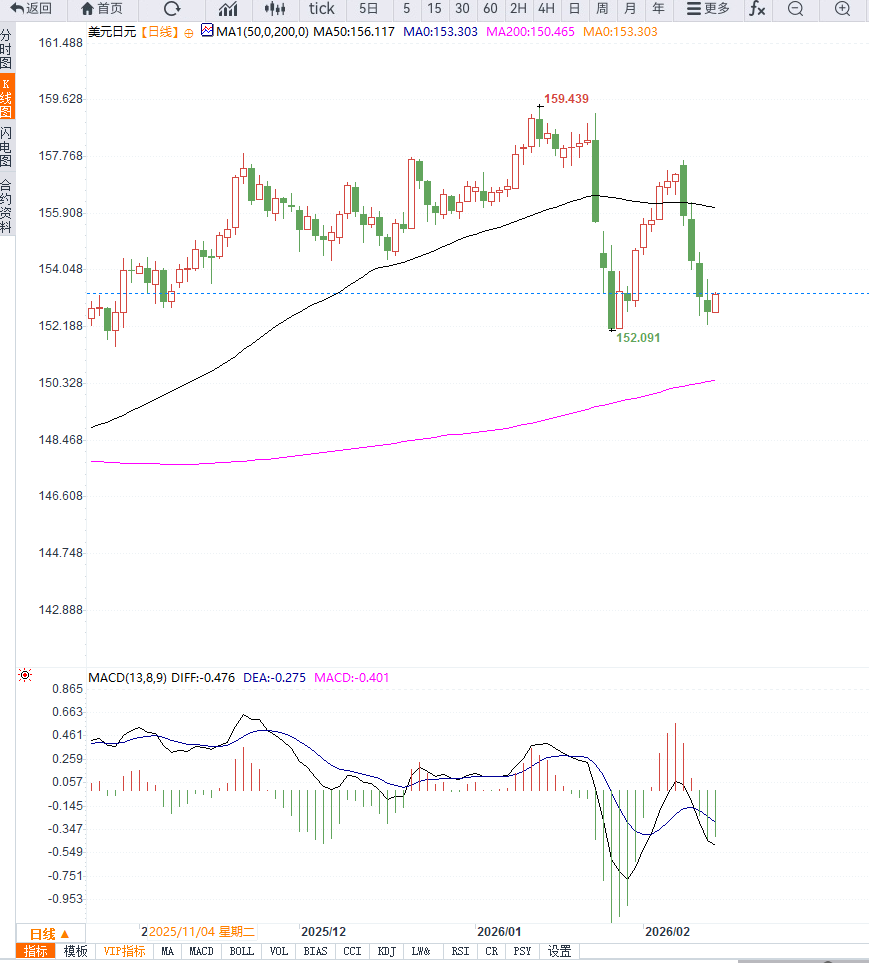
From a daily chart perspective, the USD/JPY pair previously retreated from its highs, breaking below the short-term uptrend line support and forming a temporary low around 152.30. The current rebound is a technical correction, not a trend reversal. Key support lies in the 152.00 area; a decisive break below this level could lead to a further test of the 151.20 level, which corresponds to the lower edge of the previous consolidation range.
If the bearish momentum continues, a pullback to the 150 level is possible. The first resistance level is around 153.50, followed by the 154.20 area. Only a firm hold above 154 could reverse the current weak trend. Momentum indicators show the RSI below 50, indicating bearish dominance.
The MACD histogram remains in negative territory, indicating that the medium-term downtrend has not yet ended. While there may be room for a technical rebound in the short term, the overall structure is biased towards a downward trend with fluctuations.
Editor's Note:
The core driver of the USD/JPY exchange rate has shifted from single data points to policy dynamics. If Japan continues its policy normalization while the US enters an easing cycle around 2026, the interest rate advantage will gradually narrow, putting structural pressure on the USD/JPY exchange rate.
In the short term, inflation data will determine the direction of the US dollar; in the medium term, policy divergence will be the trend variable. With interest rate expectations gradually reversing, the exchange rate faces the risk of further decline.
Market sentiment is mixed, with bulls and bears currently locked in a stalemate. In Japan, the market anticipates that new Prime Minister Sanae Takaichi will adopt a more prudent fiscal policy and stimulate economic growth through structural measures.
A more conservative fiscal path could provide the Bank of Japan (BoJ) with room to continue normalizing its policy. Amid declining risk appetite, the yen, as a safe-haven currency, is supported, limiting its upside potential.
Regarding the US dollar, despite strong US non-farm payroll data in January, which reduced market bets on a March rate cut, the dollar's overall performance remained weak. Current market pricing indicates that investors still expect at least two 25-basis-point rate cuts in 2026.
Meanwhile, discussions about the Federal Reserve's (Fed) policy independence have also dampened the confidence of dollar bulls to some extent. Market participants generally chose to remain on the sidelines until the latest US inflation data was released.
The upcoming Consumer Price Index (CPI) will provide key clues about the path of interest rates. If inflation cools, expectations for interest rate cuts may rise again, potentially putting further pressure on the US dollar.
If inflation remains stubborn, the US dollar may find some support in the short term. Looking at weekly performance, the USD/JPY pair is close to recording a significant weekly decline. Diverging policy expectations—Japan gradually tightening while the US may shift to easing in the medium term—constitute a bearish medium-term logic for the exchange rate.
From a daily chart perspective, the USD/JPY pair previously retreated from its highs, breaking below the short-term uptrend line support and forming a temporary low around 152.30. The current rebound is a technical correction, not a trend reversal. Key support lies in the 152.00 area; a decisive break below this level could lead to a further test of the 151.20 level, which corresponds to the lower edge of the previous consolidation range.
If the bearish momentum continues, a pullback to the 150 level is possible. The first resistance level is around 153.50, followed by the 154.20 area. Only a firm hold above 154 could reverse the current weak trend. Momentum indicators show the RSI below 50, indicating bearish dominance.
The MACD histogram remains in negative territory, indicating that the medium-term downtrend has not yet ended. While there may be room for a technical rebound in the short term, the overall structure is biased towards a downward trend with fluctuations.
Editor's Note:
The core driver of the USD/JPY exchange rate has shifted from single data points to policy dynamics. If Japan continues its policy normalization while the US enters an easing cycle around 2026, the interest rate advantage will gradually narrow, putting structural pressure on the USD/JPY exchange rate.
In the short term, inflation data will determine the direction of the US dollar; in the medium term, policy divergence will be the trend variable. With interest rate expectations gradually reversing, the exchange rate faces the risk of further decline.
- Risk Warning and Disclaimer
- The market involves risk, and trading may not be suitable for all investors. This article is for reference only and does not constitute personal investment advice, nor does it take into account certain users’ specific investment objectives, financial situation, or other needs. Any investment decisions made based on this information are at your own risk.