Gold and silver prices are under downward pressure, and bulls urgently need new positive support.
2026-02-17 22:22:20
On Tuesday (February 17), gold and silver prices fell sharply during the European session, primarily driven by short-term futures traders liquidating their weak long positions. There's an old saying in the trading world: a sustained bull market requires a continuous injection of new fundamental positive factors. Currently, the bullish camp in the gold and silver markets has failed to receive any new fundamental stimulus for some time. The latest price for April gold futures fell $135.30 to $4911.00; March silver futures fell $5.33 to $73.810.
The Geneva nuclear negotiations between the US and Iran have failed to make a breakthrough.
Following the US military strike against Iran last year, to avoid a further escalation of conflict in the Middle East, Iran and the US began a second round of nuclear talks today in Geneva, Switzerland. Oman served as the mediator in these talks, which concluded this morning (lasting only 3-4 hours). Bloomberg reported that Iranian officials have expressed a willingness to discuss uranium enrichment activities, but all concessions are tied to the easing of US sanctions. Meanwhile, both sides have increased their military deployments in the Middle East. The US has warned that if the talks, which could last for weeks, fail to reach a compromise, the US military may strike Iran, and is currently deploying a second aircraft carrier to the region. Iran's Islamic Revolutionary Guard Corps conducted military exercises on Monday around the strategically important Strait of Hormuz, with the core objective of responding "decisively" to various security threats. The US negotiating team is led by Special Envoy for the Middle East Steve Witkov and President Trump's son-in-law Jared Kushner. Trump stated on Monday that Iran is willing to reach an agreement, and that he himself will indirectly participate in the negotiations.
Iranian state media and The Guardian reported that the US exchanged views but made no substantial concessions, and while it increased troop deployments in the Middle East, no new military actions were observed. Iranian Supreme Leader Khamenei's tough stance and Trump's "indirect involvement" in the US have weakened overall expectations of de-escalation, leading to safe-haven buying. This has become another immediate factor contributing to the loss of support for precious metals in the past few hours.
Iranian Foreign Minister Araqchi stated that the latest round of Iran-US Geneva talks involved serious discussions in a more constructive atmosphere. Both sides reached a general consensus on a set of guiding principles and will continue to work on the text of a potential agreement based on this. Some issues still require further negotiation, which could potentially lead to an agreement. Araqchi said this round of talks was more in-depth than the previous one. Both sides put forward various ideas and reached a general consensus on a series of guiding principles, on which a possible agreement text will be drafted. However, Araqchi also stated that this does not mean an agreement will be reached quickly, but the path has been opened. "When it comes to drafting the agreement text, the work will be more difficult," Araqchi said. He added that the negotiations are progressing well and the situation is optimistic. The specific time for the next round of talks has not yet been determined; both sides agreed to first consult on some texts before setting a time for the third round of talks.
The liquidity vacuum during the Chinese holiday amplified selling pressure.
With major Asian markets closed, and China being the world's largest consumer of gold and silver, physical demand and investment buying virtually ceased during the holiday period. This resulted in a lack of buying support in international markets such as Comex, and any sell-off under thin liquidity could easily trigger a chain reaction. Multiple institutions reported today that this is the core immediate driver of the current correction, and the holiday effect is expected to continue until mid-week. A retaliatory rebound may occur after Asian markets reopen, but the correction may also continue.
The Munich meeting between Chinese and American officials paves the way for Trump's visit to China.
Late last week, Chinese Foreign Minister Wang Yi met with U.S. Secretary of State Marco Rubio in Munich to prepare for the summit between the two leaders, President Trump, scheduled for his visit to China in April. Foreign Minister Wang Yi expressed his hope that 2026 would be a year of mutual respect and cooperation between China and the United States, and both sides reached a consensus to strengthen dialogue and cooperation in various fields. This meeting is seen as an important step in continuing the momentum of cooperation for the China-U.S. summit in April.
The key performance of overseas markets today is as follows: the US dollar index rose, crude oil prices remained flat, trading around $62.85 per barrel; the benchmark 10-year US Treasury yield is currently at 4.03%, a new low in 2.5 months.
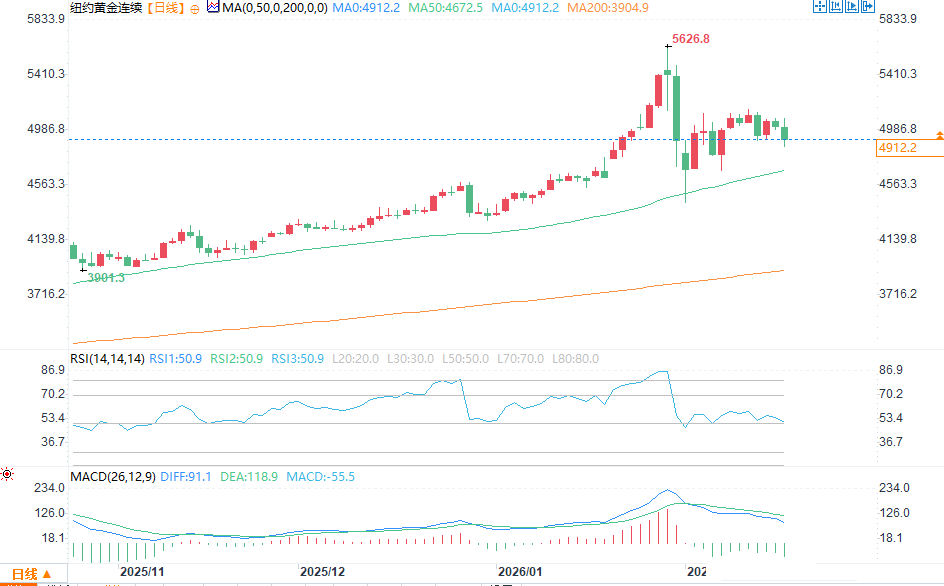
(COMEX Gold Daily Chart Source: FX678)
From a technical perspective, the next upside target for April gold futures bulls is a close above the key resistance level of $5250.00; the short-term downside target for bears is to push futures prices below the important technical support level of last week's low of $4670.00. The first resistance level for gold futures is $4960.00, followed by last week's high of $5144.50; the first support level is the overnight low of $4875.20, followed by $4800.00.
For March silver futures, the upside target for bulls is a close above the key technical resistance level of $90.00; the downside target for bears is a close below the important support level of $63.90, the low of February. The first resistance level for silver futures is the overnight high of $78.42, followed by $80.00; the next support level is the overnight low of $72.505, followed by $71.20.
Note: The gold market operates primarily through two pricing mechanisms: the spot market, which quotes prices for immediate buying, selling, and settlement; and the futures market, which determines the price for gold to be settled on a future date. Due to year-end position adjustments and market liquidity, the most actively traded gold futures contract on the Chicago Mercantile Exchange is currently the December contract.
The Geneva nuclear negotiations between the US and Iran have failed to make a breakthrough.
Following the US military strike against Iran last year, to avoid a further escalation of conflict in the Middle East, Iran and the US began a second round of nuclear talks today in Geneva, Switzerland. Oman served as the mediator in these talks, which concluded this morning (lasting only 3-4 hours). Bloomberg reported that Iranian officials have expressed a willingness to discuss uranium enrichment activities, but all concessions are tied to the easing of US sanctions. Meanwhile, both sides have increased their military deployments in the Middle East. The US has warned that if the talks, which could last for weeks, fail to reach a compromise, the US military may strike Iran, and is currently deploying a second aircraft carrier to the region. Iran's Islamic Revolutionary Guard Corps conducted military exercises on Monday around the strategically important Strait of Hormuz, with the core objective of responding "decisively" to various security threats. The US negotiating team is led by Special Envoy for the Middle East Steve Witkov and President Trump's son-in-law Jared Kushner. Trump stated on Monday that Iran is willing to reach an agreement, and that he himself will indirectly participate in the negotiations.
Iranian state media and The Guardian reported that the US exchanged views but made no substantial concessions, and while it increased troop deployments in the Middle East, no new military actions were observed. Iranian Supreme Leader Khamenei's tough stance and Trump's "indirect involvement" in the US have weakened overall expectations of de-escalation, leading to safe-haven buying. This has become another immediate factor contributing to the loss of support for precious metals in the past few hours.
Iranian Foreign Minister Araqchi stated that the latest round of Iran-US Geneva talks involved serious discussions in a more constructive atmosphere. Both sides reached a general consensus on a set of guiding principles and will continue to work on the text of a potential agreement based on this. Some issues still require further negotiation, which could potentially lead to an agreement. Araqchi said this round of talks was more in-depth than the previous one. Both sides put forward various ideas and reached a general consensus on a series of guiding principles, on which a possible agreement text will be drafted. However, Araqchi also stated that this does not mean an agreement will be reached quickly, but the path has been opened. "When it comes to drafting the agreement text, the work will be more difficult," Araqchi said. He added that the negotiations are progressing well and the situation is optimistic. The specific time for the next round of talks has not yet been determined; both sides agreed to first consult on some texts before setting a time for the third round of talks.
The liquidity vacuum during the Chinese holiday amplified selling pressure.
With major Asian markets closed, and China being the world's largest consumer of gold and silver, physical demand and investment buying virtually ceased during the holiday period. This resulted in a lack of buying support in international markets such as Comex, and any sell-off under thin liquidity could easily trigger a chain reaction. Multiple institutions reported today that this is the core immediate driver of the current correction, and the holiday effect is expected to continue until mid-week. A retaliatory rebound may occur after Asian markets reopen, but the correction may also continue.
The Munich meeting between Chinese and American officials paves the way for Trump's visit to China.
Late last week, Chinese Foreign Minister Wang Yi met with U.S. Secretary of State Marco Rubio in Munich to prepare for the summit between the two leaders, President Trump, scheduled for his visit to China in April. Foreign Minister Wang Yi expressed his hope that 2026 would be a year of mutual respect and cooperation between China and the United States, and both sides reached a consensus to strengthen dialogue and cooperation in various fields. This meeting is seen as an important step in continuing the momentum of cooperation for the China-U.S. summit in April.
The key performance of overseas markets today is as follows: the US dollar index rose, crude oil prices remained flat, trading around $62.85 per barrel; the benchmark 10-year US Treasury yield is currently at 4.03%, a new low in 2.5 months.
(COMEX Gold Daily Chart Source: FX678)
From a technical perspective, the next upside target for April gold futures bulls is a close above the key resistance level of $5250.00; the short-term downside target for bears is to push futures prices below the important technical support level of last week's low of $4670.00. The first resistance level for gold futures is $4960.00, followed by last week's high of $5144.50; the first support level is the overnight low of $4875.20, followed by $4800.00.
For March silver futures, the upside target for bulls is a close above the key technical resistance level of $90.00; the downside target for bears is a close below the important support level of $63.90, the low of February. The first resistance level for silver futures is the overnight high of $78.42, followed by $80.00; the next support level is the overnight low of $72.505, followed by $71.20.
Note: The gold market operates primarily through two pricing mechanisms: the spot market, which quotes prices for immediate buying, selling, and settlement; and the futures market, which determines the price for gold to be settled on a future date. Due to year-end position adjustments and market liquidity, the most actively traded gold futures contract on the Chicago Mercantile Exchange is currently the December contract.
- Risk Warning and Disclaimer
- The market involves risk, and trading may not be suitable for all investors. This article is for reference only and does not constitute personal investment advice, nor does it take into account certain users’ specific investment objectives, financial situation, or other needs. Any investment decisions made based on this information are at your own risk.