Behind the market's indifference: The "Sword of Damocles" of the US-Japan interest rate differential has yet to fall.
2026-02-18 21:52:34
On Wednesday, February 18th, the USD/JPY pair traded around 153.80 during the North American session, its recent movement resembling a thrilling rollercoaster. Looking at the daily chart, the price initially surged to a temporary peak of 159.439, followed by a sharp drop, finding support around 152.091 before rebounding to 157.652. However, the upward momentum faltered, causing it to fall back to a low of 152.264. Currently, although the exchange rate is holding above the previous low, the underlying bearish sentiment remains, exhibiting a complex structure of "sharp drop followed by recovery, then further consolidation."

Provisional trade data for January 2026 shows that Japan's exports reached 9.19 trillion yen, a surge of 16.8% year-on-year, far exceeding the 7.87 trillion yen in the same period of the previous year. This is the strongest year-on-year increase since November 2022, when the growth rate was 20%. However, in this impressive report card, exports to the United States bucked the trend and declined by 5% year-on-year.
This raises a perplexing phenomenon for many traders: why didn't such strong export data fuel a strong rebound in the yen? Analysts believe the underlying logic lies in the data's strength in total volume and regional distribution, but weakness in a single direction. First, external demand isn't weakening across the board; the expansion of orders stems more from regional redistribution and optimization of product categories than from a general surge in global demand. Second, the power to determine exchange rates remains firmly in the hands of interest rate expectations, capital flows, and monetary policy; single-month trade fluctuations are unlikely to shake the overall picture. The market's lukewarm response to the positive data precisely illustrates that, under the current macroeconomic narrative, funds are more focused on the policy differences between the Federal Reserve and the Bank of Japan, rather than simply the trade surplus.
More intriguing than the trade data itself are the underlying capital flows. Plans indicate that Japan intends to invest up to $36 billion in US oil and gas and key mineral projects, described as the first tranche of its $550 billion commitment under a trade arrangement. Such large-scale long-term foreign capital expenditures often generate complex exchange rate effects. During the preparation and hedging phases before the funds are implemented, there may be temporary foreign exchange demand management, meaning the yen may not immediately strengthen. However, once the investment continues, the pace of cross-border capital flows and profit repatriation will become the market focus, with traders pricing this in conjunction with changes in risk appetite and interest rate differentials. In other words, a surge in exports with a lackluster yen response is not contradictory, because the narrative of capital flows and expectations of monetary policy often have a stronger "stickiness."
Meanwhile, a structural policy development is unfolding. A Japanese accounting group has proposed relaxing the rules for life insurance companies to account for book losses on government bonds, allowing some bonds held to match long-term insurance policies to be treated as "held to maturity" under certain conditions, thus avoiding impairment at the accounting level. If this direction is pursued, it will effectively alleviate the financial statement pressure on life insurance institutions under interest rate fluctuations, reduce their incentive to passively sell bonds, and consequently affect bond market volatility and capital allocation. Regarding exchange rates, while such changes are not immediate catalysts, they profoundly influence market assessments of financial system stability and domestic capital retention intentions, indirectly affecting the yen's pricing logic.
Technically, the battleground is clearly defined. The area around 154.500 forms a near-term resistance zone. If the bulls can recover and hold this level, a short-term push towards 156.50 is possible, opening up upward potential. Conversely, if the rebound is again capped here, it indicates that the previous correction was merely a temporary pause in the downtrend. On the downside, the support level formed by the lows of 152.264 and 152.091 needs close monitoring. A decisive break below this level could trigger stop-loss orders and trend-following moves, opening up further downside potential. Momentum indicators also lean cautious: the MACD is below the zero line with weak histogram bars, indicating that the medium-term downward momentum has not completely subsided; the RSI is hovering around 43.130, a weak but not extreme range, suggesting the market is more likely undergoing a "weak consolidation" rather than a unilateral acceleration.
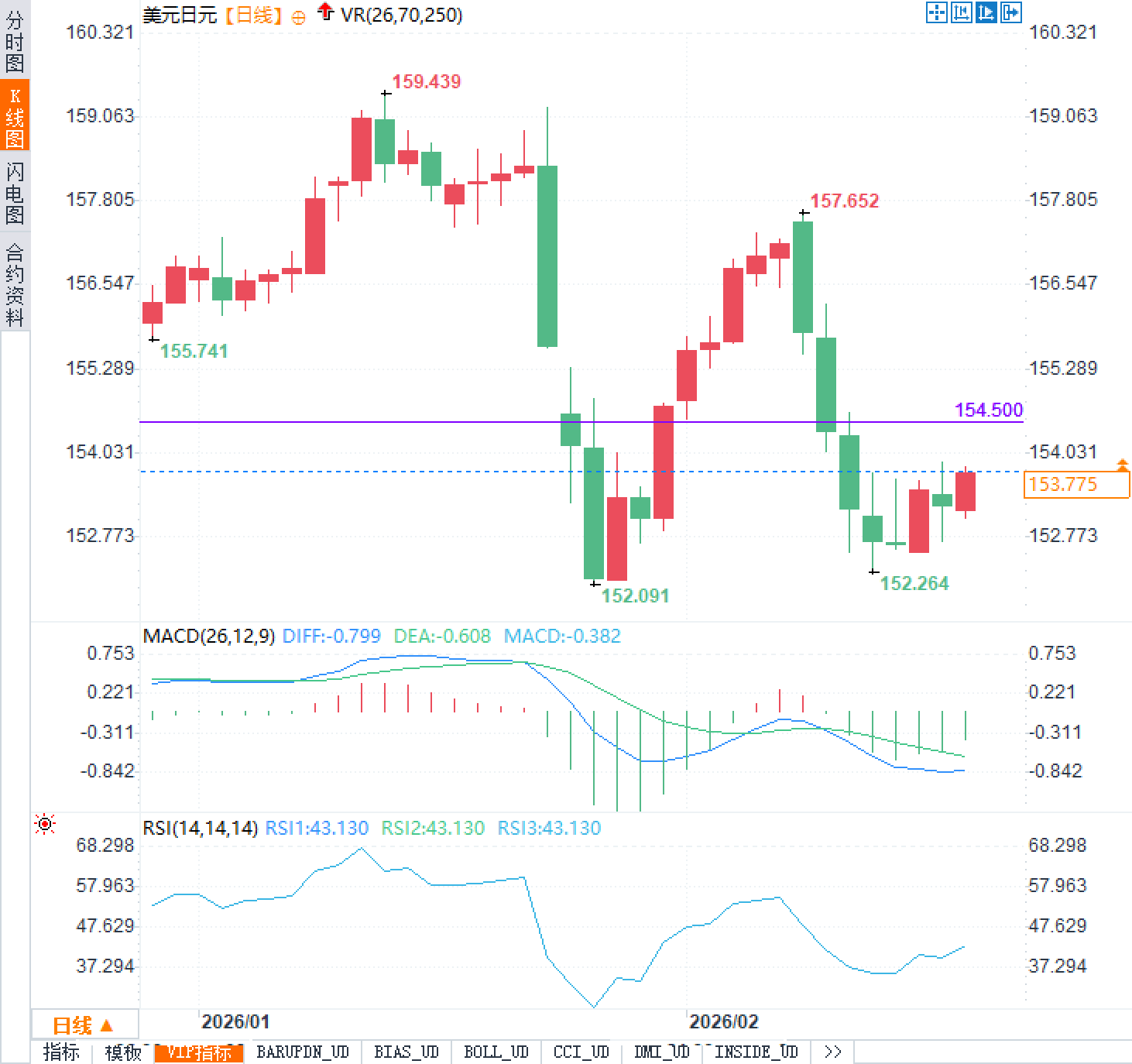
In summary, the key to the short-term USD/JPY exchange rate game lies not in whether the export data is strong, but in the combined effect of three main factors: first, whether the policy expectation gap between the central banks of the US and Japan will continue to support the dollar's interest rate advantage; second, whether the capital flows related to foreign investment and trade can create a sustained buying and selling tendency in the exchange rate; and third, whether the price can effectively stand above 154.500 and raise the consolidation range upward.
Why is soaring exports failing to save the yen?
Provisional trade data for January 2026 shows that Japan's exports reached 9.19 trillion yen, a surge of 16.8% year-on-year, far exceeding the 7.87 trillion yen in the same period of the previous year. This is the strongest year-on-year increase since November 2022, when the growth rate was 20%. However, in this impressive report card, exports to the United States bucked the trend and declined by 5% year-on-year.
This raises a perplexing phenomenon for many traders: why didn't such strong export data fuel a strong rebound in the yen? Analysts believe the underlying logic lies in the data's strength in total volume and regional distribution, but weakness in a single direction. First, external demand isn't weakening across the board; the expansion of orders stems more from regional redistribution and optimization of product categories than from a general surge in global demand. Second, the power to determine exchange rates remains firmly in the hands of interest rate expectations, capital flows, and monetary policy; single-month trade fluctuations are unlikely to shake the overall picture. The market's lukewarm response to the positive data precisely illustrates that, under the current macroeconomic narrative, funds are more focused on the policy differences between the Federal Reserve and the Bank of Japan, rather than simply the trade surplus.
The Great Migration of Capital and the Secrets in the Ledgers
More intriguing than the trade data itself are the underlying capital flows. Plans indicate that Japan intends to invest up to $36 billion in US oil and gas and key mineral projects, described as the first tranche of its $550 billion commitment under a trade arrangement. Such large-scale long-term foreign capital expenditures often generate complex exchange rate effects. During the preparation and hedging phases before the funds are implemented, there may be temporary foreign exchange demand management, meaning the yen may not immediately strengthen. However, once the investment continues, the pace of cross-border capital flows and profit repatriation will become the market focus, with traders pricing this in conjunction with changes in risk appetite and interest rate differentials. In other words, a surge in exports with a lackluster yen response is not contradictory, because the narrative of capital flows and expectations of monetary policy often have a stronger "stickiness."
Meanwhile, a structural policy development is unfolding. A Japanese accounting group has proposed relaxing the rules for life insurance companies to account for book losses on government bonds, allowing some bonds held to match long-term insurance policies to be treated as "held to maturity" under certain conditions, thus avoiding impairment at the accounting level. If this direction is pursued, it will effectively alleviate the financial statement pressure on life insurance institutions under interest rate fluctuations, reduce their incentive to passively sell bonds, and consequently affect bond market volatility and capital allocation. Regarding exchange rates, while such changes are not immediate catalysts, they profoundly influence market assessments of financial system stability and domestic capital retention intentions, indirectly affecting the yen's pricing logic.
Decisive Battle at Key Position: Awaiting the Signal to Break the Stalemate
Technically, the battleground is clearly defined. The area around 154.500 forms a near-term resistance zone. If the bulls can recover and hold this level, a short-term push towards 156.50 is possible, opening up upward potential. Conversely, if the rebound is again capped here, it indicates that the previous correction was merely a temporary pause in the downtrend. On the downside, the support level formed by the lows of 152.264 and 152.091 needs close monitoring. A decisive break below this level could trigger stop-loss orders and trend-following moves, opening up further downside potential. Momentum indicators also lean cautious: the MACD is below the zero line with weak histogram bars, indicating that the medium-term downward momentum has not completely subsided; the RSI is hovering around 43.130, a weak but not extreme range, suggesting the market is more likely undergoing a "weak consolidation" rather than a unilateral acceleration.
In summary, the key to the short-term USD/JPY exchange rate game lies not in whether the export data is strong, but in the combined effect of three main factors: first, whether the policy expectation gap between the central banks of the US and Japan will continue to support the dollar's interest rate advantage; second, whether the capital flows related to foreign investment and trade can create a sustained buying and selling tendency in the exchange rate; and third, whether the price can effectively stand above 154.500 and raise the consolidation range upward.
- Risk Warning and Disclaimer
- The market involves risk, and trading may not be suitable for all investors. This article is for reference only and does not constitute personal investment advice, nor does it take into account certain users’ specific investment objectives, financial situation, or other needs. Any investment decisions made based on this information are at your own risk.