Durable goods data stabilizes the dollar, but AI is "ambushing" the Federal Reserve.
2026-02-18 21:47:23
On Wednesday (February 18) in early New York trading, the US dollar index (DXY), which measures the dollar against six major currencies, steadily climbed to the 97.20 level, influenced by better-than-expected US durable goods orders data. The global foreign exchange market entered a cautious wait-and-see state ahead of the release of the minutes of the Federal Open Market Committee (FOMC) meeting.
This summary serves as a core basis for understanding the Federal Reserve's interest rate policy path, and its details will directly influence the short-term trend of the US dollar and have a ripple effect on core financial areas such as global trade and emerging market assets.

The current stability of the US dollar index above 97.20 is inseparable from the dual support of fundamentals and policy expectations.
The market generally believes that, compared to major central banks such as the European Central Bank and the Bank of Japan, the Federal Reserve is more likely to maintain a long-term high interest rate stance. Coupled with strong performance in core economic data such as US employment and consumption, the market's bets on aggressive short-term interest rate cuts have cooled significantly.
The divergence in economic fundamentals and monetary policies between the US and Europe, and between the US and Japan, has become the core logic behind the strengthening of the US dollar.
From a technical perspective, 97.20 is a key watershed between bullish and bearish sentiment in the near term. If it holds above this level, the US dollar is expected to test the 97.50-97.80 range; if it falls back under pressure, it will retest the 96.80 support level. Technical factors and policy uncertainties are working together.
U.S. durable goods orders for December, released Wednesday evening, showed a decline of 1.4%, better than the market expectation of a 2% decline, continuing the recent resilience of U.S. economic data.
The upcoming release of the minutes from the FOMC meeting at the end of January will be a key focus for the market, with particular attention paid to crucial details such as inflation stickiness, the labor market, and the pace of quantitative tightening (QT). Historical data shows that dollar volatility increases significantly within 4-6 hours of the minutes' release.
However, TD Securities points out that the guidance provided by this meeting minutes may be limited. On the one hand, more timely inflation and employment data have been released recently; on the other hand, the yield curve of US Treasury bonds flattened on Tuesday, mainly due to profit-taking after the interest rate rebound, and Fed officials collectively released a cautious wait-and-see policy signal. Furthermore, artificial intelligence factors have not yet affected the Fed's judgment on the neutral interest rate.
In addition to traditional economic data and monetary policy, the impact of artificial intelligence on the Federal Reserve's policies has become a new variable affecting the medium-term logic of the US dollar.
Rabobank stated bluntly that recent statements by Federal Reserve officials regarding AI and interest rates severely underestimate the disruptive nature of AI and its dual effects of inflation and deflation, indicating a clear cognitive bias in the Fed's current policy framework.
The bank's analysts emphasized that the core constraint on the AI industry is not capital, but physical resources such as electricity, copper, and memory chips, which is completely contrary to the Fed's traditional analytical framework that focuses on capital and wages.
AI will both drive up demand for physical resources and cause localized inflation, as well as produce deflationary effects in many sectors. The view of Federal Reserve officials that AI will drive wage growth is out of touch with reality.
This contradiction has also put the Federal Reserve in a policy dilemma: maintaining high interest rates will exacerbate the collective shock, while cutting interest rates too quickly will intensify local inflation. This policy uncertainty may exacerbate the volatility of the US dollar.
Overall, the US dollar index is currently at a convergence point of multiple factors, including policy, data, and technical aspects.
Durable goods orders data exceeded expectations, and safe-haven buying driven by geopolitical risks and the relative attractiveness of US Treasury yields jointly supported the US dollar. Meanwhile, policy signals from the FOMC minutes and expectations of a revision in the Fed's policy logic triggered by the AI controversy will be key catalysts for a new round of dollar rally.
The market's "calm before the storm," characterized by position tightening and narrow-range trading ahead of the minutes, will likely be broken after the data and minutes are released, and a directional shift in the US dollar index is imminent.
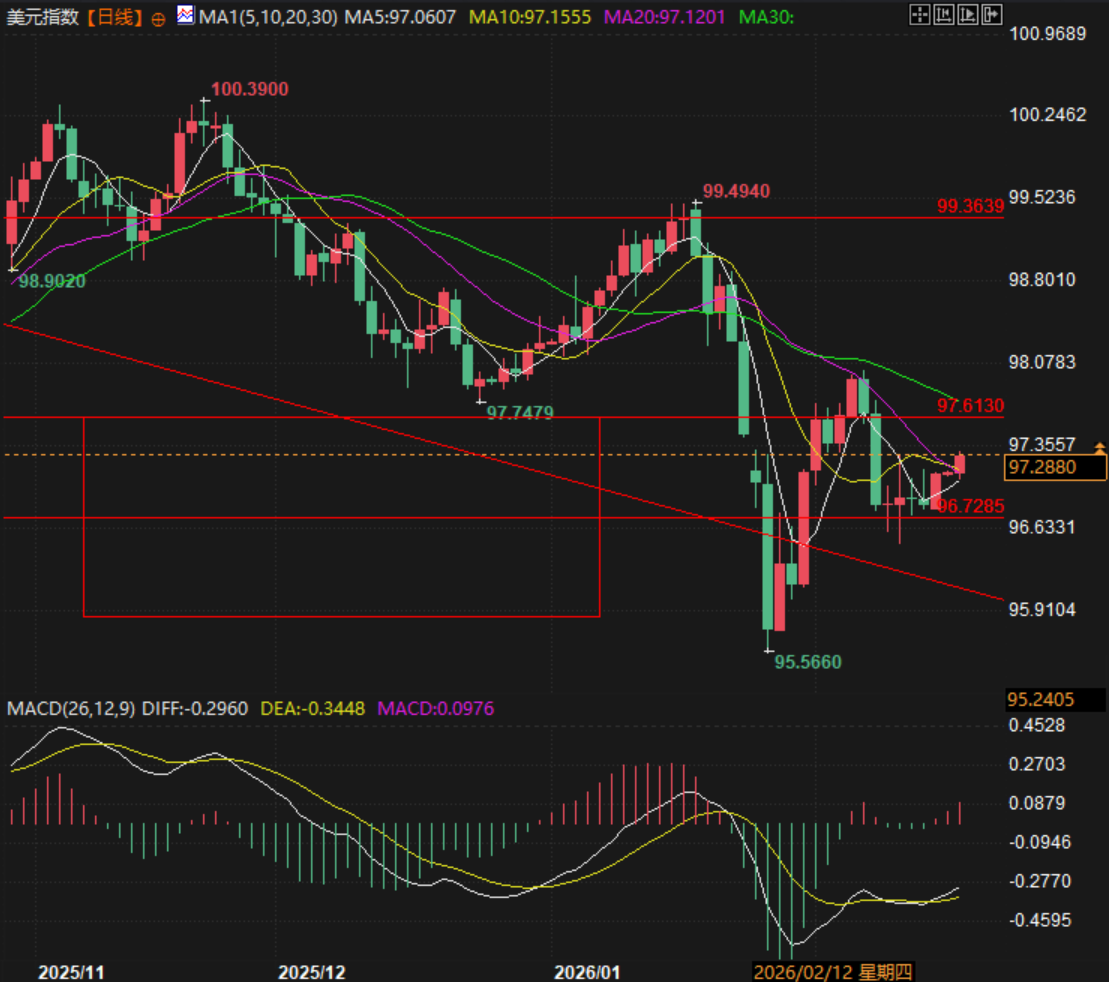
(US Dollar Index Daily Chart, Source: FX678)
At 21:45 Beijing time, the US dollar index is currently at 97.30.
This summary serves as a core basis for understanding the Federal Reserve's interest rate policy path, and its details will directly influence the short-term trend of the US dollar and have a ripple effect on core financial areas such as global trade and emerging market assets.
The core logic behind the strengthening of the US dollar: a combination of policy divergence and fundamental support.
The current stability of the US dollar index above 97.20 is inseparable from the dual support of fundamentals and policy expectations.
The market generally believes that, compared to major central banks such as the European Central Bank and the Bank of Japan, the Federal Reserve is more likely to maintain a long-term high interest rate stance. Coupled with strong performance in core economic data such as US employment and consumption, the market's bets on aggressive short-term interest rate cuts have cooled significantly.
The divergence in economic fundamentals and monetary policies between the US and Europe, and between the US and Japan, has become the core logic behind the strengthening of the US dollar.
From a technical perspective, 97.20 is a key watershed between bullish and bearish sentiment in the near term. If it holds above this level, the US dollar is expected to test the 97.50-97.80 range; if it falls back under pressure, it will retest the 96.80 support level. Technical factors and policy uncertainties are working together.
Market Focus: FOMC Minutes and US Durable Goods Data and Industrial Production
U.S. durable goods orders for December, released Wednesday evening, showed a decline of 1.4%, better than the market expectation of a 2% decline, continuing the recent resilience of U.S. economic data.
The upcoming release of the minutes from the FOMC meeting at the end of January will be a key focus for the market, with particular attention paid to crucial details such as inflation stickiness, the labor market, and the pace of quantitative tightening (QT). Historical data shows that dollar volatility increases significantly within 4-6 hours of the minutes' release.
However, TD Securities points out that the guidance provided by this meeting minutes may be limited. On the one hand, more timely inflation and employment data have been released recently; on the other hand, the yield curve of US Treasury bonds flattened on Tuesday, mainly due to profit-taking after the interest rate rebound, and Fed officials collectively released a cautious wait-and-see policy signal. Furthermore, artificial intelligence factors have not yet affected the Fed's judgment on the neutral interest rate.
New medium-term variable: AI controversy exposes cognitive biases in Fed policy.
In addition to traditional economic data and monetary policy, the impact of artificial intelligence on the Federal Reserve's policies has become a new variable affecting the medium-term logic of the US dollar.
Rabobank stated bluntly that recent statements by Federal Reserve officials regarding AI and interest rates severely underestimate the disruptive nature of AI and its dual effects of inflation and deflation, indicating a clear cognitive bias in the Fed's current policy framework.
The bank's analysts emphasized that the core constraint on the AI industry is not capital, but physical resources such as electricity, copper, and memory chips, which is completely contrary to the Fed's traditional analytical framework that focuses on capital and wages.
AI will both drive up demand for physical resources and cause localized inflation, as well as produce deflationary effects in many sectors. The view of Federal Reserve officials that AI will drive wage growth is out of touch with reality.
This contradiction has also put the Federal Reserve in a policy dilemma: maintaining high interest rates will exacerbate the collective shock, while cutting interest rates too quickly will intensify local inflation. This policy uncertainty may exacerbate the volatility of the US dollar.
Summary: With multiple factors converging, the US dollar awaits a directional breakout.
Overall, the US dollar index is currently at a convergence point of multiple factors, including policy, data, and technical aspects.
Durable goods orders data exceeded expectations, and safe-haven buying driven by geopolitical risks and the relative attractiveness of US Treasury yields jointly supported the US dollar. Meanwhile, policy signals from the FOMC minutes and expectations of a revision in the Fed's policy logic triggered by the AI controversy will be key catalysts for a new round of dollar rally.
The market's "calm before the storm," characterized by position tightening and narrow-range trading ahead of the minutes, will likely be broken after the data and minutes are released, and a directional shift in the US dollar index is imminent.
(US Dollar Index Daily Chart, Source: FX678)
At 21:45 Beijing time, the US dollar index is currently at 97.30.
- Risk Warning and Disclaimer
- The market involves risk, and trading may not be suitable for all investors. This article is for reference only and does not constitute personal investment advice, nor does it take into account certain users’ specific investment objectives, financial situation, or other needs. Any investment decisions made based on this information are at your own risk.