













Vance reveals Trump's bottom line: Force will be used if Iran doesn't recognize the red line! Crude oil rises over 4% in a single day.
2026-02-19 11:10:14
On Thursday (February 19) during Asian trading hours, US crude oil prices fluctuated and strengthened, currently trading around $65.35 per barrel, with a daily increase of about 0.45%. On Wednesday, oil prices surged by more than 4% as US Vice President Vance publicly stated that Iran failed to meet the US's core "red line" demands in this week's nuclear negotiations, and that President Trump reserved the right to use military force, causing a sharp rebound in market geopolitical risk premiums.
The main catalyst driving up oil prices came from US Vice President Vance's comments on the Geneva-Iran nuclear talks on Tuesday evening. Vance said that while the talks were "going well in some respects" and both sides agreed to continue meetings, "it is clear that there are certain red lines set by the president that the Iranians are still unwilling to truly acknowledge and resolve."
He emphasized that President Trump would not allow Iran to acquire nuclear weapons and reserved the option to use force in the event of diplomatic failure. "We have a very strong military—and the president has shown the willingness to use it."
On Tuesday, U.S. Special Envoy Steve Witkoff and Trump's son-in-law Jared Kushner, mediated by Oman, held the second round of indirect nuclear talks with Iranian Foreign Minister Abbas Araghchi in Geneva. Iranian state media reported that the two sides reached a general consensus on the "guiding principles" of a potential agreement, and that the talks were "serious, constructive, and positive." They also planned to return within two weeks to submit a detailed proposal to bridge their differences.
However, the US interpretation was noticeably more cautious. Vance's remarks quickly shattered the brief easing in the market following Iran's "optimistic" statements the previous day. Oil prices had closed lower on Tuesday due to expectations of diplomatic progress, with traders initially believing there was still room for some kind of compromise between the US and Iran.
Geopolitical tensions have escalated further. The United States has deployed the USS Abraham Lincoln carrier strike group to the Middle East, and the USS Gerald R. Ford is en route to the region. Trump publicly stated last Friday that a second aircraft carrier would be needed if negotiations break down. "If there's no deal, we need it."
Iran's Revolutionary Guard conducted military exercises in the Strait of Hormuz this week, a vital waterway for about one-third of the world's seaborne crude oil exports. Iranian state media reported that some shipping lanes were temporarily closed due to the exercises, but energy consultants said no actual traffic disruptions were observed on Tuesday. Nevertheless, markets remain highly concerned that an escalation of the conflict could lead to the strait being blocked or attacked, severely disrupting global supply. Several investment banks estimate that if the Strait of Hormuz were completely closed, oil prices could surge to over $120 per barrel.
The current oil price rebound is primarily driven by geopolitical risks rather than fundamental changes. OPEC+ production policies remain stable, and US inventory data is neutral, but uncertainty surrounding the Iranian nuclear issue has once again dominated trading sentiment. Some analysts point out that the market has already priced in a certain "Iran risk premium," but has not yet priced in a full-blown military conflict scenario .
If subsequent negotiations fail to yield substantial breakthroughs within two weeks, or if Iran continues to reject the US's "red line" demands on core issues such as uranium enrichment and ballistic missiles, upward pressure on oil prices may persist. Conversely, if the Geneva process unexpectedly shows positive signs, the risk premium may quickly subside.
In the short term, with the US military continuing to increase its troop presence, Iran conducting frequent military exercises, and Trump restarting his "maximum pressure" strategy, oil market volatility is expected to rise significantly, with geopolitical events remaining the most important variable driving short-term prices.
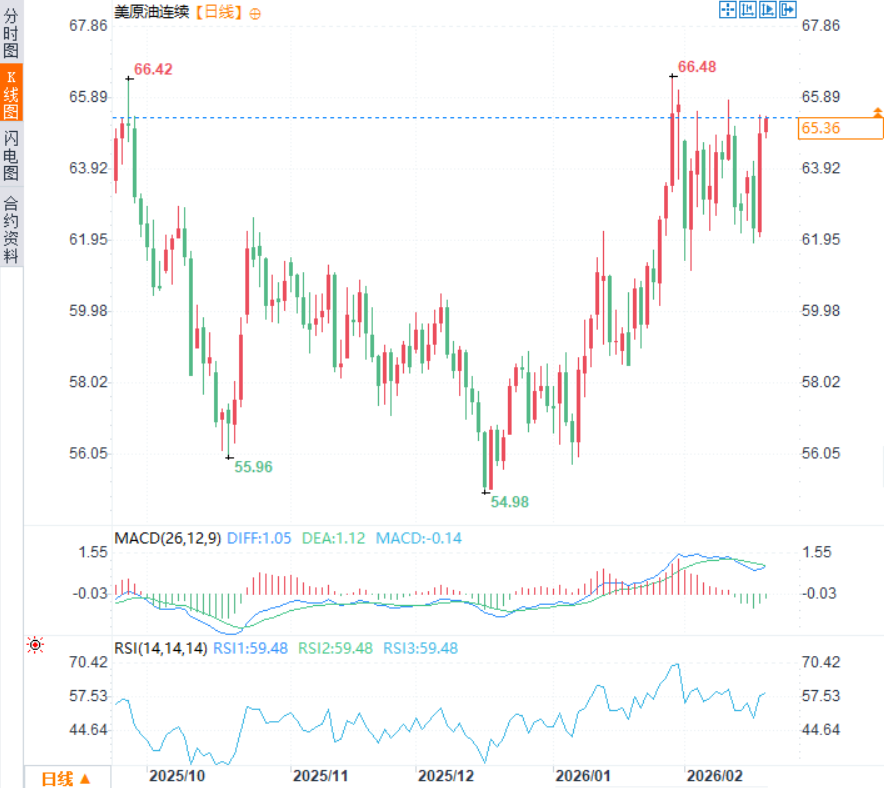
(US crude oil daily chart, source: FX678)
At 11:08 Beijing time, US crude oil futures were trading at $65.36 per barrel.
Oil prices surge more than 4% in a single day as tensions escalate over the stalemate in US-Iran nuclear talks.
The main catalyst driving up oil prices came from US Vice President Vance's comments on the Geneva-Iran nuclear talks on Tuesday evening. Vance said that while the talks were "going well in some respects" and both sides agreed to continue meetings, "it is clear that there are certain red lines set by the president that the Iranians are still unwilling to truly acknowledge and resolve."
He emphasized that President Trump would not allow Iran to acquire nuclear weapons and reserved the option to use force in the event of diplomatic failure. "We have a very strong military—and the president has shown the willingness to use it."
The negotiations revealed significant differences; Iran described them as constructive, while the US stated that its core demands had not been met.
On Tuesday, U.S. Special Envoy Steve Witkoff and Trump's son-in-law Jared Kushner, mediated by Oman, held the second round of indirect nuclear talks with Iranian Foreign Minister Abbas Araghchi in Geneva. Iranian state media reported that the two sides reached a general consensus on the "guiding principles" of a potential agreement, and that the talks were "serious, constructive, and positive." They also planned to return within two weeks to submit a detailed proposal to bridge their differences.
However, the US interpretation was noticeably more cautious. Vance's remarks quickly shattered the brief easing in the market following Iran's "optimistic" statements the previous day. Oil prices had closed lower on Tuesday due to expectations of diplomatic progress, with traders initially believing there was still room for some kind of compromise between the US and Iran.
Military deployment upgrades bring the risks of the Strait of Hormuz back into the spotlight.
Geopolitical tensions have escalated further. The United States has deployed the USS Abraham Lincoln carrier strike group to the Middle East, and the USS Gerald R. Ford is en route to the region. Trump publicly stated last Friday that a second aircraft carrier would be needed if negotiations break down. "If there's no deal, we need it."
Iran's Revolutionary Guard conducted military exercises in the Strait of Hormuz this week, a vital waterway for about one-third of the world's seaborne crude oil exports. Iranian state media reported that some shipping lanes were temporarily closed due to the exercises, but energy consultants said no actual traffic disruptions were observed on Tuesday. Nevertheless, markets remain highly concerned that an escalation of the conflict could lead to the strait being blocked or attacked, severely disrupting global supply. Several investment banks estimate that if the Strait of Hormuz were completely closed, oil prices could surge to over $120 per barrel.
Market pricing shifts to risk premium dominance
The current oil price rebound is primarily driven by geopolitical risks rather than fundamental changes. OPEC+ production policies remain stable, and US inventory data is neutral, but uncertainty surrounding the Iranian nuclear issue has once again dominated trading sentiment. Some analysts point out that the market has already priced in a certain "Iran risk premium," but has not yet priced in a full-blown military conflict scenario .
If subsequent negotiations fail to yield substantial breakthroughs within two weeks, or if Iran continues to reject the US's "red line" demands on core issues such as uranium enrichment and ballistic missiles, upward pressure on oil prices may persist. Conversely, if the Geneva process unexpectedly shows positive signs, the risk premium may quickly subside.
In the short term, with the US military continuing to increase its troop presence, Iran conducting frequent military exercises, and Trump restarting his "maximum pressure" strategy, oil market volatility is expected to rise significantly, with geopolitical events remaining the most important variable driving short-term prices.
(US crude oil daily chart, source: FX678)
At 11:08 Beijing time, US crude oil futures were trading at $65.36 per barrel.
- Risk Warning and Disclaimer
- The market involves risk, and trading may not be suitable for all investors. This article is for reference only and does not constitute personal investment advice, nor does it take into account certain users’ specific investment objectives, financial situation, or other needs. Any investment decisions made based on this information are at your own risk.

