Oil prices rose 2% to a six-month high amid concerns about a potential conflict between the US and Iran.
2026-02-20 01:49:02
On Thursday (February 19), during the US trading session, international oil prices rose by about 2% due to escalating tensions between the US and Iran, with both Brent and WTI crude hitting six-month highs. Oil prices had already surged more than 4% on Wednesday, bringing the two-day cumulative increase to nearly 6%.

At 01:13 Beijing time, Brent crude oil futures rose $1.75 to $71.93 per barrel, a gain of 2.5%; West Texas Intermediate (WTI) crude oil rose $1.66 to $66.71 per barrel, a gain of 1.66%. During the session, Brent crude briefly approached $71.98, and WTI crude neared $66.78, reaching their highest levels since late July to early August last year.
Geopolitical risks dominate the market
Joint naval exercises between Iran and Russia have begun in waters south of Iran, after Iran briefly closed the Strait of Hormuz for several hours to conduct the exercises. The strait carries approximately 20% of global oil shipments, and disruption to it would cause severe supply disruptions.
Andrew Lippo, president of Lippo Petroleum Consulting, said the market is pricing in a significant risk premium for potential events, and oil prices are expected to continue rising. Analysts generally believe that current prices already include a geopolitical risk premium of $7-10 per barrel.
The US-Iran standoff escalates, and the US military deployment intensifies.
At a Washington peace committee meeting, US President Donald Trump stressed the need for a meaningful agreement with Iran, warning of serious consequences if it fails to materialize. He hinted at a crucial decision that could be made within the next 10 days.
White House sources revealed that the United States is prepared to take military action against Iran as early as this weekend. The US has already deployed aircraft carriers, warships, and refueling aircraft on a large scale near Iran, one of the largest deployments since the 2003 Iraq War. US Vice President Vance stated that Washington is weighing diplomatic options. Meanwhile, Iran has notified pilots of a rocket launch in its southern region, and several countries have called on their citizens to evacuate Iran.
Saudi exports decline, OPEC+ production increase expectations emerge
Saudi Arabia, the world's largest oil exporter, has reduced its crude oil exports to approximately 6.988 million barrels per day, the lowest level since September last year (latest data from the Joint Organization Data Initiative).
Earlier this month, Reuters reported that OPEC+ was leaning toward a gradual increase in production starting in April, with the oil-producing alliance, including Russia, discussing the restoration of some output.
Ukraine-Russia negotiations make no progress
Two days of peace talks between Ukraine and Russia in Geneva ended on Wednesday without any breakthrough. Ukrainian President Zelensky accused Moscow of obstructing US-led mediation efforts, bringing the four-year war-ending process to a standstill. This geopolitical event also indirectly supported risk aversion in the energy market.
The unexpected decline in EIA inventories provides fundamental support.
The U.S. Energy Information Administration (EIA) released its weekly oil status report on Thursday (for the week ending February 13), showing that U.S. commercial crude oil inventories (excluding strategic reserves) unexpectedly fell sharply by 9.014 million barrels to 420 million barrels, a decrease of 2.1%, significantly reversing market expectations of an increase of 2.149 million barrels.
Cushing crude oil inventories fell by 1.095 million barrels, gasoline inventories fell by 3.213 million barrels, distillate fuel inventories fell by 4.566 million barrels, and refined product inventories declined across the board during the week.
Despite warnings from the International Energy Agency about slow demand growth and potential oversupply, the unexpected destocking coupled with escalating geopolitical risks has significantly strengthened the upward momentum of oil prices.
Market Outlook and Risk Warning
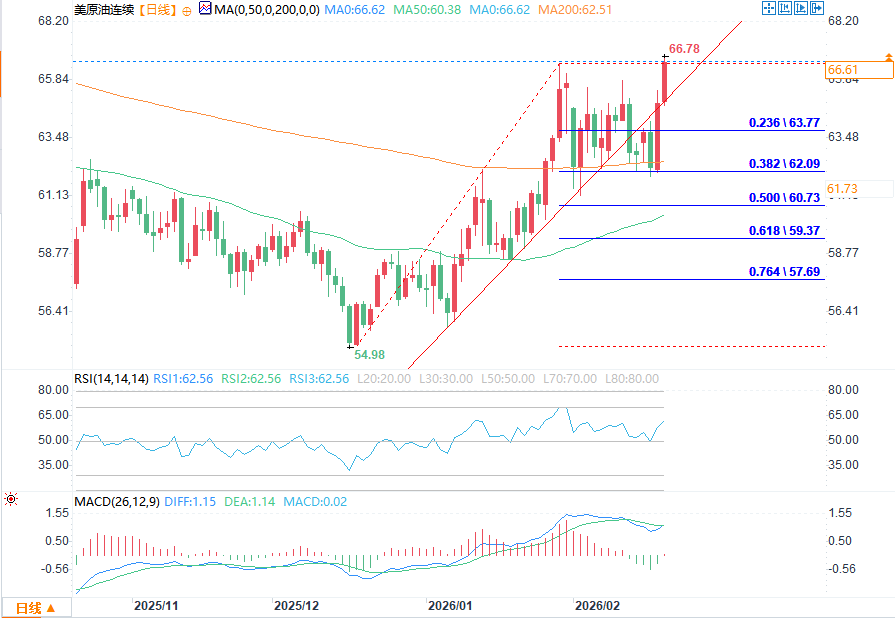
(WTI crude oil daily chart source: FX678)
Oil prices have been fluctuating at high levels primarily driven by geopolitical risks, with a decline in EIA inventories providing unexpected fundamental support. If the US-Iran conflict does not lead to actual supply disruptions, the current gains include a significant risk premium; however, if the Strait of Hormuz is blocked, the conflict escalates, or inventories continue to decline, oil prices may test higher levels further. Analysts caution that the market is in a highly sensitive period, and any new developments will trigger significant volatility.
At 01:13 Beijing time, Brent crude oil futures rose $1.75 to $71.93 per barrel, a gain of 2.5%; West Texas Intermediate (WTI) crude oil rose $1.66 to $66.71 per barrel, a gain of 1.66%. During the session, Brent crude briefly approached $71.98, and WTI crude neared $66.78, reaching their highest levels since late July to early August last year.
Geopolitical risks dominate the market
Joint naval exercises between Iran and Russia have begun in waters south of Iran, after Iran briefly closed the Strait of Hormuz for several hours to conduct the exercises. The strait carries approximately 20% of global oil shipments, and disruption to it would cause severe supply disruptions.
Andrew Lippo, president of Lippo Petroleum Consulting, said the market is pricing in a significant risk premium for potential events, and oil prices are expected to continue rising. Analysts generally believe that current prices already include a geopolitical risk premium of $7-10 per barrel.
The US-Iran standoff escalates, and the US military deployment intensifies.
At a Washington peace committee meeting, US President Donald Trump stressed the need for a meaningful agreement with Iran, warning of serious consequences if it fails to materialize. He hinted at a crucial decision that could be made within the next 10 days.
White House sources revealed that the United States is prepared to take military action against Iran as early as this weekend. The US has already deployed aircraft carriers, warships, and refueling aircraft on a large scale near Iran, one of the largest deployments since the 2003 Iraq War. US Vice President Vance stated that Washington is weighing diplomatic options. Meanwhile, Iran has notified pilots of a rocket launch in its southern region, and several countries have called on their citizens to evacuate Iran.
Saudi exports decline, OPEC+ production increase expectations emerge
Saudi Arabia, the world's largest oil exporter, has reduced its crude oil exports to approximately 6.988 million barrels per day, the lowest level since September last year (latest data from the Joint Organization Data Initiative).
Earlier this month, Reuters reported that OPEC+ was leaning toward a gradual increase in production starting in April, with the oil-producing alliance, including Russia, discussing the restoration of some output.
Ukraine-Russia negotiations make no progress
Two days of peace talks between Ukraine and Russia in Geneva ended on Wednesday without any breakthrough. Ukrainian President Zelensky accused Moscow of obstructing US-led mediation efforts, bringing the four-year war-ending process to a standstill. This geopolitical event also indirectly supported risk aversion in the energy market.
The unexpected decline in EIA inventories provides fundamental support.
The U.S. Energy Information Administration (EIA) released its weekly oil status report on Thursday (for the week ending February 13), showing that U.S. commercial crude oil inventories (excluding strategic reserves) unexpectedly fell sharply by 9.014 million barrels to 420 million barrels, a decrease of 2.1%, significantly reversing market expectations of an increase of 2.149 million barrels.
Cushing crude oil inventories fell by 1.095 million barrels, gasoline inventories fell by 3.213 million barrels, distillate fuel inventories fell by 4.566 million barrels, and refined product inventories declined across the board during the week.
Despite warnings from the International Energy Agency about slow demand growth and potential oversupply, the unexpected destocking coupled with escalating geopolitical risks has significantly strengthened the upward momentum of oil prices.
Market Outlook and Risk Warning
(WTI crude oil daily chart source: FX678)
Oil prices have been fluctuating at high levels primarily driven by geopolitical risks, with a decline in EIA inventories providing unexpected fundamental support. If the US-Iran conflict does not lead to actual supply disruptions, the current gains include a significant risk premium; however, if the Strait of Hormuz is blocked, the conflict escalates, or inventories continue to decline, oil prices may test higher levels further. Analysts caution that the market is in a highly sensitive period, and any new developments will trigger significant volatility.
- Risk Warning and Disclaimer
- The market involves risk, and trading may not be suitable for all investors. This article is for reference only and does not constitute personal investment advice, nor does it take into account certain users’ specific investment objectives, financial situation, or other needs. Any investment decisions made based on this information are at your own risk.