Gold prices remain stagnant as the risk of war with Iran looms and the hawkish minutes of the Federal Reserve's meeting provide some tug-of-war.
2026-02-20 00:00:32
On Thursday (February 19), spot gold rose slightly during the US trading session, reaching $5009.53 per ounce, a gain of 0.67%. Market traders are closely assessing the potential risks of a military conflict between the US and Iran, while digesting the minutes of the Federal Reserve's January meeting released Wednesday evening—the minutes were generally hawkish, further reinforcing market expectations that the Fed will not cut interest rates in the short term. This is a typical battle between bulls and bears: on one side are traditional traders who focus on the fundamentals of gold based on US Treasury yields and the dollar's performance, their core trading logic being the impact of interest rate changes on gold valuations; on the other side are speculative funds betting on gold's safe-haven properties, attempting to use geopolitical tensions to push gold prices out of their trading range.

A month ago, it was all about speculation; now the market is completely different.
Gold prices traded moderately in early trading today, with narrower fluctuations, a stark contrast to a month ago. Back then, while gold prices were at similar levels, they were entirely driven by aggressive speculative sentiment, with a clear herd mentality in the market. Interestingly, a month ago, traders were generally convinced that the Federal Reserve would cut interest rates at least twice in 2026, and this easing expectation supported gold prices, keeping them at high levels. At that time, the US had not deployed naval vessels near Iran, and while US-Iran relations were tense, they had not reached the current state of imminent conflict; geopolitical factors had a negligible impact on gold prices.
As the Federal Reserve's policy stance gradually shifts towards a hawkish stance, coupled with the escalation of geopolitical tensions between the US and Iran, the market's trading logic has undergone a fundamental change: the previous expectation of easing that dominated gold prices has been replaced by the reality of unchanged interest rates. Speculative funds have become more cautious due to losses incurred from the recent sharp drop in gold prices. Although safe-haven funds have entered the market, their strength is insufficient to push gold prices to break through key resistance levels.
Federal Reserve meeting minutes: Near-unanimous support for holding rates steady, but differing views on inflation.
Looking at the minutes of the Federal Reserve's January meeting released yesterday: At the meeting, Fed policymakers almost unanimously agreed to keep the benchmark interest rate unchanged, dispelling market hopes for a short-term rate cut. However, there were significant differences of opinion among the members on how to deal with inflation: some members believed that if inflation remained high and failed to steadily decline towards the 2% target, further rate hikes should be considered to curb inflation; others believed that the current economic recovery was not yet solid, and while cutting rates while inflation remained high would be unwise, policy should not be tightened excessively, and policy flexibility should be maintained.
According to the CME FedWatch Tool, after the release of the meeting minutes, market expectations for a Fed rate cut in March have dropped to zero, with no traders believing that the Fed will take action to cut rates in March; the probability of a rate cut in June has also fallen from 58% before the release of the minutes to about 50.4%, indicating that the market's prediction of the timing of a Fed rate cut has been further delayed, and interest rate uncertainty continues to rise.
Three fleets deployed off the coast of Iran, yet gold prices showed little reaction.
Let's look at gold's safe-haven properties. Typically, escalating geopolitical tensions and rising war risks drive safe-haven funds into the gold market, supporting a significant rise in gold prices. If you were told a month ago that the US had deployed three naval fleets, including its largest warship, to waters near Iran, and that both the US and Iran had completed their military deployments and could launch an attack at any time, you would certainly say that this was a major positive for gold, and that gold prices would likely experience a rapid surge.
However, this situation has now become a reality, yet gold prices have not seen the expected surge. Instead, after rising 2% yesterday, today's trend has been flat, with a significantly narrower range of fluctuation. The core reason behind this phenomenon is that market concerns about the Federal Reserve's interest rate policy have outweighed geopolitical risks. Insufficient safe-haven buying has made it difficult to push gold prices out of the current trading range. This also reflects the market's continued wait-and-see attitude regarding the future development of the US-Iran conflict, with few daring to blindly bet on safe havens.
The market environment has changed, and the types of traders dominating gold trading are different now.
Looking ahead, I'm not saying that if the US attacks Iran and a war actually breaks out, gold prices won't surge—if the conflict escalates, safe-haven demand will likely surge, driving a temporary spike in gold prices. However, I want to emphasize that in just one month, the gold market environment has completely changed, and the types of traders dominating the market have also shifted.
Frankly speaking, the recent sharp drop in gold prices has caused considerable losses for many small speculators, leading them to withdraw from the market and adopt a wait-and-see approach, significantly cooling speculative sentiment. Furthermore, the CME Group's increase in gold futures margin requirements has further raised the cost of speculative trading, suppressing the willingness of speculative funds to enter the market. Meanwhile, the Asian market is currently on holiday, resulting in reduced market liquidity and narrowing the range of gold price fluctuations. However, I believe the most significant factor influencing current gold prices remains the uncertainty surrounding the timing of the Federal Reserve's first interest rate cut in 2026. Until this uncertainty becomes clear, gold prices are likely to remain range-bound, unlikely to form a clear unilateral trend.
At present, interest rate uncertainty outweighs geopolitical risks.
We expect this range-bound trading pattern to continue until the new Federal Reserve Chairman takes office in June, at which time the Fed's policy stance may be adjusted, potentially breaking the current stalemate. At the same time, we do not rule out the possibility of short-term speculative fluctuations due to thin market liquidity—when liquidity is insufficient, even a small amount of capital could drive short-term sharp fluctuations in gold prices.
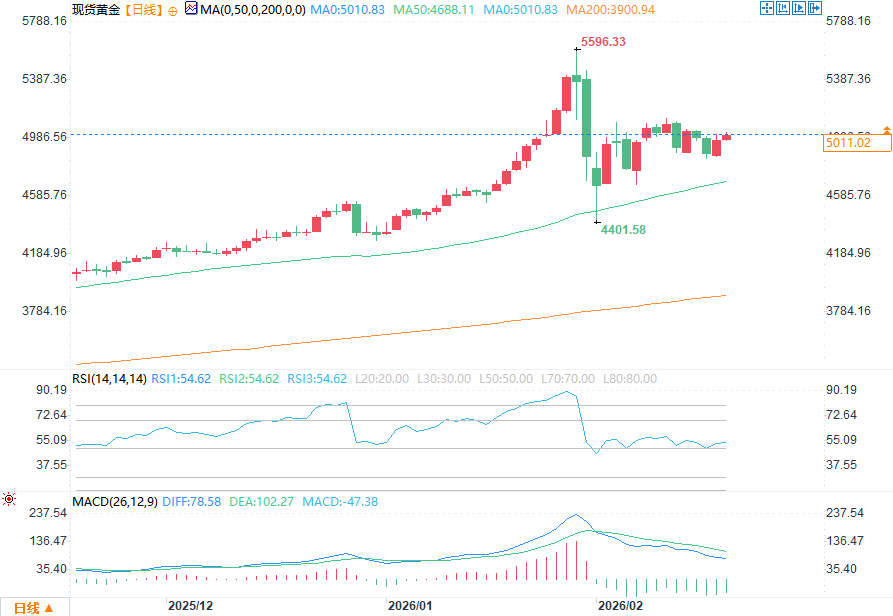
(Spot gold daily chart source: FX678)
However, current price movements clearly indicate that traders are more concerned about interest rate trends than geopolitical situations. Essentially, the current strength of safe-haven buying is insufficient to counteract the reality of the Federal Reserve not cutting rates. The suppressive effect of interest rate uncertainty outweighs the safe-haven support from geopolitical risks. Therefore, gold remains in a consolidation phase and is unlikely to break out of its range in the short term.
A month ago, it was all about speculation; now the market is completely different.
Gold prices traded moderately in early trading today, with narrower fluctuations, a stark contrast to a month ago. Back then, while gold prices were at similar levels, they were entirely driven by aggressive speculative sentiment, with a clear herd mentality in the market. Interestingly, a month ago, traders were generally convinced that the Federal Reserve would cut interest rates at least twice in 2026, and this easing expectation supported gold prices, keeping them at high levels. At that time, the US had not deployed naval vessels near Iran, and while US-Iran relations were tense, they had not reached the current state of imminent conflict; geopolitical factors had a negligible impact on gold prices.
As the Federal Reserve's policy stance gradually shifts towards a hawkish stance, coupled with the escalation of geopolitical tensions between the US and Iran, the market's trading logic has undergone a fundamental change: the previous expectation of easing that dominated gold prices has been replaced by the reality of unchanged interest rates. Speculative funds have become more cautious due to losses incurred from the recent sharp drop in gold prices. Although safe-haven funds have entered the market, their strength is insufficient to push gold prices to break through key resistance levels.
Federal Reserve meeting minutes: Near-unanimous support for holding rates steady, but differing views on inflation.
Looking at the minutes of the Federal Reserve's January meeting released yesterday: At the meeting, Fed policymakers almost unanimously agreed to keep the benchmark interest rate unchanged, dispelling market hopes for a short-term rate cut. However, there were significant differences of opinion among the members on how to deal with inflation: some members believed that if inflation remained high and failed to steadily decline towards the 2% target, further rate hikes should be considered to curb inflation; others believed that the current economic recovery was not yet solid, and while cutting rates while inflation remained high would be unwise, policy should not be tightened excessively, and policy flexibility should be maintained.
According to the CME FedWatch Tool, after the release of the meeting minutes, market expectations for a Fed rate cut in March have dropped to zero, with no traders believing that the Fed will take action to cut rates in March; the probability of a rate cut in June has also fallen from 58% before the release of the minutes to about 50.4%, indicating that the market's prediction of the timing of a Fed rate cut has been further delayed, and interest rate uncertainty continues to rise.
Three fleets deployed off the coast of Iran, yet gold prices showed little reaction.
Let's look at gold's safe-haven properties. Typically, escalating geopolitical tensions and rising war risks drive safe-haven funds into the gold market, supporting a significant rise in gold prices. If you were told a month ago that the US had deployed three naval fleets, including its largest warship, to waters near Iran, and that both the US and Iran had completed their military deployments and could launch an attack at any time, you would certainly say that this was a major positive for gold, and that gold prices would likely experience a rapid surge.
However, this situation has now become a reality, yet gold prices have not seen the expected surge. Instead, after rising 2% yesterday, today's trend has been flat, with a significantly narrower range of fluctuation. The core reason behind this phenomenon is that market concerns about the Federal Reserve's interest rate policy have outweighed geopolitical risks. Insufficient safe-haven buying has made it difficult to push gold prices out of the current trading range. This also reflects the market's continued wait-and-see attitude regarding the future development of the US-Iran conflict, with few daring to blindly bet on safe havens.
The market environment has changed, and the types of traders dominating gold trading are different now.
Looking ahead, I'm not saying that if the US attacks Iran and a war actually breaks out, gold prices won't surge—if the conflict escalates, safe-haven demand will likely surge, driving a temporary spike in gold prices. However, I want to emphasize that in just one month, the gold market environment has completely changed, and the types of traders dominating the market have also shifted.
Frankly speaking, the recent sharp drop in gold prices has caused considerable losses for many small speculators, leading them to withdraw from the market and adopt a wait-and-see approach, significantly cooling speculative sentiment. Furthermore, the CME Group's increase in gold futures margin requirements has further raised the cost of speculative trading, suppressing the willingness of speculative funds to enter the market. Meanwhile, the Asian market is currently on holiday, resulting in reduced market liquidity and narrowing the range of gold price fluctuations. However, I believe the most significant factor influencing current gold prices remains the uncertainty surrounding the timing of the Federal Reserve's first interest rate cut in 2026. Until this uncertainty becomes clear, gold prices are likely to remain range-bound, unlikely to form a clear unilateral trend.
At present, interest rate uncertainty outweighs geopolitical risks.
We expect this range-bound trading pattern to continue until the new Federal Reserve Chairman takes office in June, at which time the Fed's policy stance may be adjusted, potentially breaking the current stalemate. At the same time, we do not rule out the possibility of short-term speculative fluctuations due to thin market liquidity—when liquidity is insufficient, even a small amount of capital could drive short-term sharp fluctuations in gold prices.
(Spot gold daily chart source: FX678)
However, current price movements clearly indicate that traders are more concerned about interest rate trends than geopolitical situations. Essentially, the current strength of safe-haven buying is insufficient to counteract the reality of the Federal Reserve not cutting rates. The suppressive effect of interest rate uncertainty outweighs the safe-haven support from geopolitical risks. Therefore, gold remains in a consolidation phase and is unlikely to break out of its range in the short term.
- Risk Warning and Disclaimer
- The market involves risk, and trading may not be suitable for all investors. This article is for reference only and does not constitute personal investment advice, nor does it take into account certain users’ specific investment objectives, financial situation, or other needs. Any investment decisions made based on this information are at your own risk.