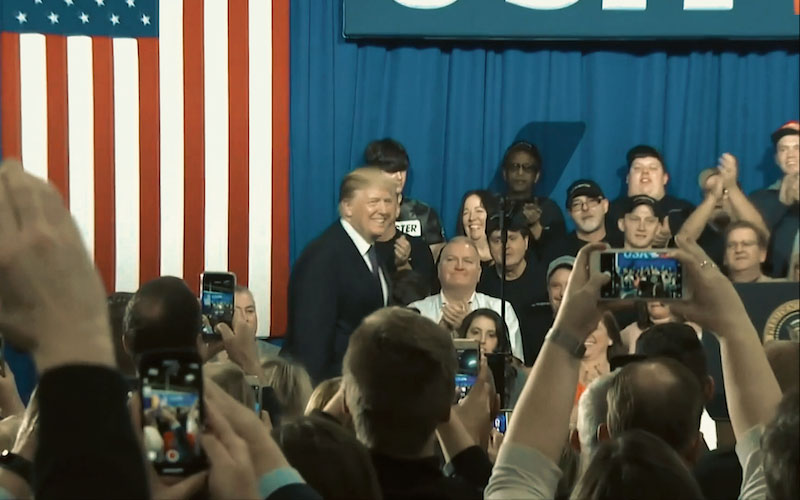
The US Supreme Court halted Trump's tariff policy, causing the pound to rise against the dollar.
2026-02-21 02:11:09
On Friday (February 20), during the US trading session, the pound rose more than 0.23% against the dollar after the US Supreme Court ruled that President Trump's tariff policies implemented under national emergency laws were illegal. This ruling, coupled with weaker-than-expected US GDP data, put downward pressure on the dollar. The pound traded at 1.3489 against the dollar during the session, up 0.20%.
US economic data released on Friday showed signs of stagflation: impacted by the 43-day government shutdown, the year-on-year growth rate of US GDP in the fourth quarter of 2025 slowed sharply to 1.4% from 4.4%. Meanwhile, the Federal Reserve's preferred inflation gauge—the US core personal consumption expenditures (PCE) price index—jumped to 3% year-on-year in December, higher than the market expectation of 2.9% and the previous value of 2.8%.
Following the data release, U.S. stocks dipped slightly, but recovered after the U.S. Supreme Court ruled that tariffs imposed under the International Emergency Economic Powers Act (IEEPA) were illegal without congressional approval. U.S. Treasury Secretary Scott Bessant and other White House officials stated that the U.S. would invoke other legal grounds to preserve as many of the Trump administration's tariff policies as possible.
Following the Supreme Court ruling, the dollar weakened, with the dollar index (DXY) falling 0.04% to 97.78.
On the other hand, data from the UK Office for National Statistics (ONS) showed that UK retail sales rose 4.5% month-on-month in January, far exceeding the expected 2.8%. The preliminary S&P Global Composite Purchasing Managers' Index (PMI) for February indicated that both the UK service and manufacturing sectors expanded, with economic activity continuing to recover.
However, UK employment data fell short of expectations, with the unemployment rate rising in the fourth quarter of 2025, providing a basis for the Bank of England to further ease monetary policy.
The money market had previously priced in an 80% probability of a Bank of England rate cut in March; while traders were pushing back their expectations for the Federal Reserve's first rate cut to June. Therefore, the divergence in monetary policy paths between the US and UK central banks may lead to a pullback in the pound against the dollar before resuming its upward trend.
Technical Analysis
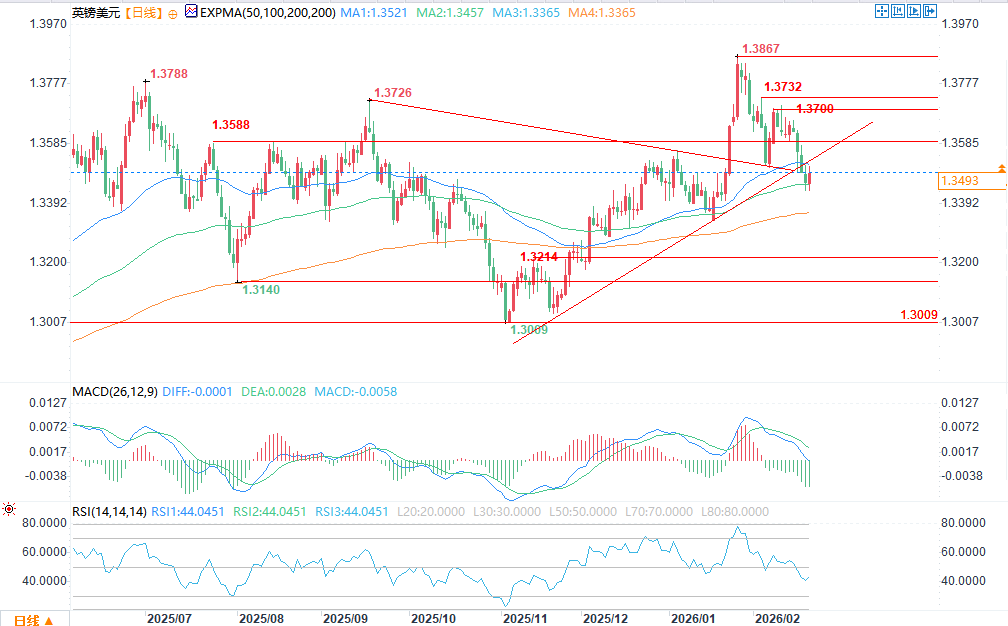
The daily chart shows that the British pound is currently trading around 1.3493 against the US dollar. The EXPMA (50, 100, 200) exponential moving averages are trending upwards, providing support for the exchange rate. The price is currently below the recent exponential moving average around 1.3521, which constitutes short-term upward resistance.
(GBP/USD daily chart source: FX678)
The upward trendline from 1.3009 provides support for the bullish pattern, with the support level around 1.3493. A close above 1.3588 would solidify the uptrend, targeting previous highs of 1.3726 and 1.3867; conversely, failure to recover 1.3588 would likely lead to consolidation. Given the proximity of the trendline support, a break below 1.3392 would increase the downside risk, potentially triggering a correction and testing support at 1.3214 and 1.3009.
From a technical perspective, the MACD shows DIFF at -0.0002, DEA at 0.0028, and the MACD histogram at -0.0059, indicating a weakening of momentum. The RSI is at 43.96, showing a relatively balanced balance between bullish and bearish forces, with no obvious overbought or oversold signals yet.
(GBP/USD monthly chart source: FX678)
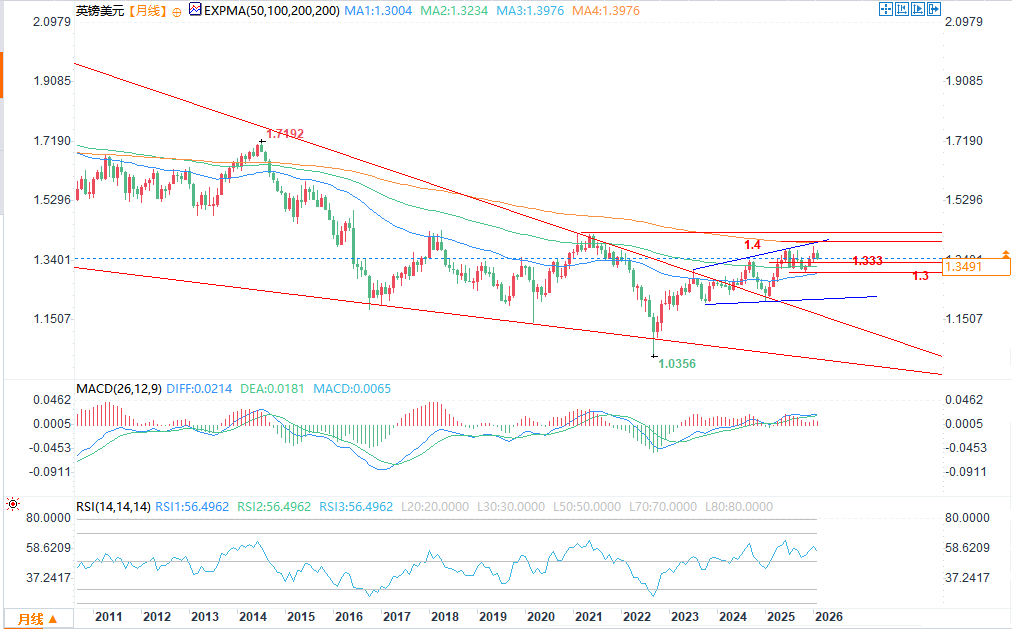
The monthly chart shows that since June 2023, the GBP/USD exchange rate has been challenging a resistance zone connecting multiple highs. Therefore, even after breaking through the downward consolidation range of 2007-2024, there is still a risk of consolidation. The repeated testing of this resistance zone indicates intense competition between bulls and bears. Even if a breakout is achieved, it will be difficult to completely escape the consolidation pattern in the short term, and the downward pressure from profit-taking should be watched closely.
From a downside risk perspective, if the price continues to fall below the 1.3430 support level, then the key level of 1.3330 will be reached. This level coincides with the 0.618 Fibonacci retracement of the November-January upward trend, possessing strong technical support significance. A breach of this level would further strengthen the short-term downtrend. If the price continues to fall below the 1.33 level, the probability of it heading towards the psychological support zone of 1.30 will significantly increase. This downward movement is likely to be accompanied by a strengthening of the overall US dollar index (DXY). Safe-haven buying of the dollar or support from policy expectations will further suppress the GBP/USD exchange rate.
On the positive side, if the price can close above 1.3730 daily or weekly, it will effectively break the current stalemate and reignite bullish momentum in the market. At that point, the price is expected to further challenge the 1.3830 resistance level and gradually approach the important psychological level of 1.40. Once this resistance zone is broken, the price will officially break free from the long-term consolidation range from 2007 to 2024, continuing the previous upward trend and initiating a new round of upward movement.
US economic data released on Friday showed signs of stagflation: impacted by the 43-day government shutdown, the year-on-year growth rate of US GDP in the fourth quarter of 2025 slowed sharply to 1.4% from 4.4%. Meanwhile, the Federal Reserve's preferred inflation gauge—the US core personal consumption expenditures (PCE) price index—jumped to 3% year-on-year in December, higher than the market expectation of 2.9% and the previous value of 2.8%.
Following the data release, U.S. stocks dipped slightly, but recovered after the U.S. Supreme Court ruled that tariffs imposed under the International Emergency Economic Powers Act (IEEPA) were illegal without congressional approval. U.S. Treasury Secretary Scott Bessant and other White House officials stated that the U.S. would invoke other legal grounds to preserve as many of the Trump administration's tariff policies as possible.
Following the Supreme Court ruling, the dollar weakened, with the dollar index (DXY) falling 0.04% to 97.78.
On the other hand, data from the UK Office for National Statistics (ONS) showed that UK retail sales rose 4.5% month-on-month in January, far exceeding the expected 2.8%. The preliminary S&P Global Composite Purchasing Managers' Index (PMI) for February indicated that both the UK service and manufacturing sectors expanded, with economic activity continuing to recover.
However, UK employment data fell short of expectations, with the unemployment rate rising in the fourth quarter of 2025, providing a basis for the Bank of England to further ease monetary policy.
The money market had previously priced in an 80% probability of a Bank of England rate cut in March; while traders were pushing back their expectations for the Federal Reserve's first rate cut to June. Therefore, the divergence in monetary policy paths between the US and UK central banks may lead to a pullback in the pound against the dollar before resuming its upward trend.
Technical Analysis
The daily chart shows that the British pound is currently trading around 1.3493 against the US dollar. The EXPMA (50, 100, 200) exponential moving averages are trending upwards, providing support for the exchange rate. The price is currently below the recent exponential moving average around 1.3521, which constitutes short-term upward resistance.
(GBP/USD daily chart source: FX678)
The upward trendline from 1.3009 provides support for the bullish pattern, with the support level around 1.3493. A close above 1.3588 would solidify the uptrend, targeting previous highs of 1.3726 and 1.3867; conversely, failure to recover 1.3588 would likely lead to consolidation. Given the proximity of the trendline support, a break below 1.3392 would increase the downside risk, potentially triggering a correction and testing support at 1.3214 and 1.3009.
From a technical perspective, the MACD shows DIFF at -0.0002, DEA at 0.0028, and the MACD histogram at -0.0059, indicating a weakening of momentum. The RSI is at 43.96, showing a relatively balanced balance between bullish and bearish forces, with no obvious overbought or oversold signals yet.
(GBP/USD monthly chart source: FX678)
The monthly chart shows that since June 2023, the GBP/USD exchange rate has been challenging a resistance zone connecting multiple highs. Therefore, even after breaking through the downward consolidation range of 2007-2024, there is still a risk of consolidation. The repeated testing of this resistance zone indicates intense competition between bulls and bears. Even if a breakout is achieved, it will be difficult to completely escape the consolidation pattern in the short term, and the downward pressure from profit-taking should be watched closely.
From a downside risk perspective, if the price continues to fall below the 1.3430 support level, then the key level of 1.3330 will be reached. This level coincides with the 0.618 Fibonacci retracement of the November-January upward trend, possessing strong technical support significance. A breach of this level would further strengthen the short-term downtrend. If the price continues to fall below the 1.33 level, the probability of it heading towards the psychological support zone of 1.30 will significantly increase. This downward movement is likely to be accompanied by a strengthening of the overall US dollar index (DXY). Safe-haven buying of the dollar or support from policy expectations will further suppress the GBP/USD exchange rate.
On the positive side, if the price can close above 1.3730 daily or weekly, it will effectively break the current stalemate and reignite bullish momentum in the market. At that point, the price is expected to further challenge the 1.3830 resistance level and gradually approach the important psychological level of 1.40. Once this resistance zone is broken, the price will officially break free from the long-term consolidation range from 2007 to 2024, continuing the previous upward trend and initiating a new round of upward movement.
- Risk Warning and Disclaimer
- The market involves risk, and trading may not be suitable for all investors. This article is for reference only and does not constitute personal investment advice, nor does it take into account certain users’ specific investment objectives, financial situation, or other needs. Any investment decisions made based on this information are at your own risk.