Strong UK retail data offset trade uncertainty, EUR/GBP continued its rebound.
2026-02-23 15:30:26
During Monday's Asian trading session, the EUR/GBP pair rebounded from the previous day's low to around 0.8740, with limited overall volatility.
Previously, the U.S. Supreme Court ruled that the tariffs imposed by President Trump under emergency powers lacked congressional authorization. Subsequently, Trump stated that he would proceed with the new 15% global tariff plan through other trade legal frameworks.
The US Treasury Secretary also hinted at using alternative legal pathways to maintain existing tariff arrangements. This policy uncertainty has kept global markets cautious.
In Europe, EU trade officials indicated that the EU might suspend progress on agreements with the US until clearer trade policy guidance is obtained. This has led to a relatively restrained performance of the euro in the short term.
UK data provided some support for the pound. January retail sales rose 4.5% year-on-year, significantly higher than the market expectation of 2.8%; meanwhile, the preliminary S&P PMI for February showed both the services and manufacturing sectors in expansion territory, indicating improved economic activity.
However, the rise in unemployment in the fourth quarter has strengthened market expectations that the Bank of England will cut interest rates by 25 basis points at its March meeting, with the probability currently priced in by the money market at 75%-80%.
Considering the previous impacts on the UK retail sector, employment costs, and inflationary pressures, the current strong retail sales performance reflects more of a temporary resilience in consumption than a trend of improvement.
If the job market continues to slow, consumer momentum may face the risk of decline in the coming months, which will limit the medium-term upside potential of the pound.
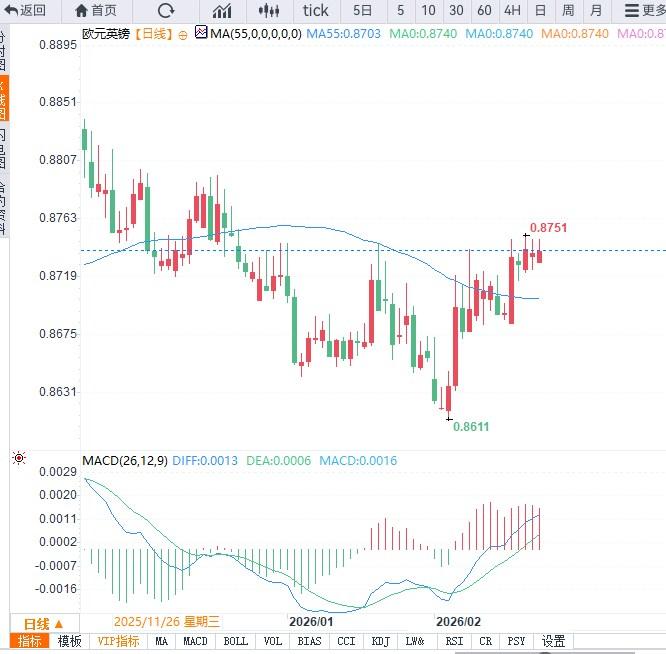
From a daily chart perspective, EUR/GBP recently found support near 0.8700 after falling from the 0.8780 area, and is currently fluctuating within the 0.8700-0.8780 range. The 5-day and 10-day moving averages are flattening, and the price is repeatedly fluctuating around these moving averages, indicating an unclear trend direction.
The MACD is near the zero line, with the histogram shortening and momentum clearly weakening; the RSI is fluctuating around 50, indicating a balance between bullish and bearish forces. Key support levels to watch are 0.8700 and 0.8660; a break below these levels could open up further downside potential.
The upper resistance is located in the 0.8780 and 0.8820 area. Only if it breaks through 0.8780 and holds, can the phase of rebound structure be restarted.
Editor's Note:
The current volatility in EUR/GBP is driven more by external policy uncertainty than by a significant divergence in the fundamentals between Europe and the UK. While UK retail sales and PMI data have provided a short-term boost to the pound, weak employment and rising expectations of interest rate cuts pose medium-term pressures.
Until a clear direction emerges in the tug-of-war between resilient UK consumption and cooling employment, the EUR/GBP exchange rate is likely to remain range-bound. If subsequent UK retail data continues to be strong, the pound may receive further support.
Conversely, if slower employment and income growth impacts consumer confidence, the exchange rate structure may shift back to an upward bias.
Previously, the U.S. Supreme Court ruled that the tariffs imposed by President Trump under emergency powers lacked congressional authorization. Subsequently, Trump stated that he would proceed with the new 15% global tariff plan through other trade legal frameworks.
The US Treasury Secretary also hinted at using alternative legal pathways to maintain existing tariff arrangements. This policy uncertainty has kept global markets cautious.
In Europe, EU trade officials indicated that the EU might suspend progress on agreements with the US until clearer trade policy guidance is obtained. This has led to a relatively restrained performance of the euro in the short term.
UK data provided some support for the pound. January retail sales rose 4.5% year-on-year, significantly higher than the market expectation of 2.8%; meanwhile, the preliminary S&P PMI for February showed both the services and manufacturing sectors in expansion territory, indicating improved economic activity.
However, the rise in unemployment in the fourth quarter has strengthened market expectations that the Bank of England will cut interest rates by 25 basis points at its March meeting, with the probability currently priced in by the money market at 75%-80%.
Considering the previous impacts on the UK retail sector, employment costs, and inflationary pressures, the current strong retail sales performance reflects more of a temporary resilience in consumption than a trend of improvement.
If the job market continues to slow, consumer momentum may face the risk of decline in the coming months, which will limit the medium-term upside potential of the pound.
From a daily chart perspective, EUR/GBP recently found support near 0.8700 after falling from the 0.8780 area, and is currently fluctuating within the 0.8700-0.8780 range. The 5-day and 10-day moving averages are flattening, and the price is repeatedly fluctuating around these moving averages, indicating an unclear trend direction.
The MACD is near the zero line, with the histogram shortening and momentum clearly weakening; the RSI is fluctuating around 50, indicating a balance between bullish and bearish forces. Key support levels to watch are 0.8700 and 0.8660; a break below these levels could open up further downside potential.
The upper resistance is located in the 0.8780 and 0.8820 area. Only if it breaks through 0.8780 and holds, can the phase of rebound structure be restarted.
Editor's Note:
The current volatility in EUR/GBP is driven more by external policy uncertainty than by a significant divergence in the fundamentals between Europe and the UK. While UK retail sales and PMI data have provided a short-term boost to the pound, weak employment and rising expectations of interest rate cuts pose medium-term pressures.
Until a clear direction emerges in the tug-of-war between resilient UK consumption and cooling employment, the EUR/GBP exchange rate is likely to remain range-bound. If subsequent UK retail data continues to be strong, the pound may receive further support.
Conversely, if slower employment and income growth impacts consumer confidence, the exchange rate structure may shift back to an upward bias.
- Risk Warning and Disclaimer
- The market involves risk, and trading may not be suitable for all investors. This article is for reference only and does not constitute personal investment advice, nor does it take into account certain users’ specific investment objectives, financial situation, or other needs. Any investment decisions made based on this information are at your own risk.