Is the "prosperity" of US data versus the raging debt crisis fueling a new gold bull market?
2026-02-23 15:51:57
Behind seemingly robust US retail sales and GDP figures, consumer financial pressure is "slowly escalating." Latest data shows that total US household debt has climbed to $18.8 trillion, and credit card and auto loan delinquency rates continue to worsen.
Experts point out that although consumer spending is still growing, residents are relying on credit cards and "buy now, pay later" lending tools to make ends meet, leading to a significant increase in bankruptcy inquiries. Since the bankruptcy index typically leads actual filings by 2-3 quarters, the wave of bankruptcies in the US may intensify further in the first half of 2026. Against this backdrop, the slow burn of debt beneath the surface of consumer resilience is strengthening market demand for safe-haven assets, providing structural support for assets such as gold.
On Monday (February 23), spot gold fluctuated upwards during the European session, continuing the gains of the previous three trading days, and is currently trading around $5,135 per ounce, with a daily increase of about 0.65%.

Despite seemingly robust overall U.S. retail sales and GDP figures, the financial pressure on American consumers at the grassroots level is quietly intensifying. More and more households are relying on credit cards and alternative credit products like "buy now, pay later" to maintain their daily lives, leading to a continuous rise in credit card delinquency rates and auto loan default rates, as well as a significant increase in bankruptcy inquiries.
The LegalShield Consumer Stress Legal Index (CSLI) – compiled based on data from over 150,000 legal inquiries per month – rose 4.4% quarter-over-quarter in the fourth quarter of 2025, marking its third consecutive quarter of growth. For the full year, it climbed 10.4% compared to 2024, reaching its highest sustained level since the beginning of the pandemic. The index comprises three sub-indices: bankruptcy, foreclosure, and consumer finance. The consumer finance sub-index surged 16.3% since the beginning of 2025, reflecting a sharp increase in legal assistance related to bill disputes, debt collection, and debt negotiations.
Matt Layton, senior vice president of consumer analytics at LegalShield, points out that traditional consumer spending metrics are no longer a comprehensive reflection of the health of the economy. He states, "We've been tracking consumer spending, but is it still a positive sign? I'm increasingly skeptical." Despite continued quarterly spending growth, record high revolving credit balances and monthly increases in credit card and auto loan delinquency rates indicate that Americans are gradually falling into deeper financial distress.
The latest data from the Federal Reserve Bank of New York shows that by the end of the fourth quarter of 2025, total U.S. household debt will rise to $18.8 trillion, an increase of $191 billion from the previous quarter, with a cumulative increase of approximately $740 billion for the year. The increase in non-housing debt is particularly pronounced, with credit card balances surging by $44 billion to $1.28 trillion, and auto loan and student loan balances also rising accordingly.
The overall debt delinquency rate rose to 4.8%, a significant deterioration compared to the same period last year. Average credit card interest rates remained high at 21%-22%, further amplifying repayment pressure. Layton emphasized that unprecedented ease of access to credit, especially products like "buy now, pay later" and payday loans, has led many families to rely on borrowing to "make ends meet," regardless of their income levels.
The LegalShield Bankruptcy Sub-Index surged 19.9% in the second half of 2025, a 15.6% increase year-over-year. The company's data shows that its bankruptcy index has a correlation coefficient of 0.95 with actual bankruptcy filings in U.S. federal courts, leading by 2-3 quarters. Court bankruptcy filings in the fourth quarter of 2025 had already increased by 13% year-over-year, confirming early warning signs.
Legal consultations related to foreclosures have increased by 15% year-on-year. Although there has not yet been a large-scale housing market collapse, high insurance, property taxes and escrow fees are putting pressure on fixed-rate mortgage holders.
Layton anticipates that the pressure will be difficult to alleviate significantly in the next 3-4 months. "This is a slow-burning crisis," they say, adding that while tax refunds during the tax season may offer a short-term respite, they are unlikely to reverse the overall trend. Consumers are trying their best to "hang in there," but pressure continues to accumulate slowly across multiple sectors.
Against the backdrop of global geopolitical uncertainty, geopolitical risks, and monetary policy uncertainty, the "slowly deteriorating" financial situation of US consumers has further strengthened their demand for safe-haven assets. Although US consumption data superficially supports the "no recession" narrative, underlying debt pressures and a potential wave of bankruptcies could translate into a more significant economic drag in the first half of 2026.
As a traditional safe-haven asset, gold's downside potential is limited in this environment. Current gold prices have broken through key resistance levels, and institutions predict that the average price in 2026 could approach the $4700-$5000/ounce range, or even higher. Given the expectation of a Fed rate cut, geopolitical risk premiums, and continued central bank gold purchases, gold still has structural support.
Investors should be wary: a slow-burning debt crisis hidden beneath the surface of resilient consumption may gradually become apparent in the coming quarters, posing a threat to risky assets. In this environment, gold's investment value is highlighted, and the time is not yet ripe for shorting.
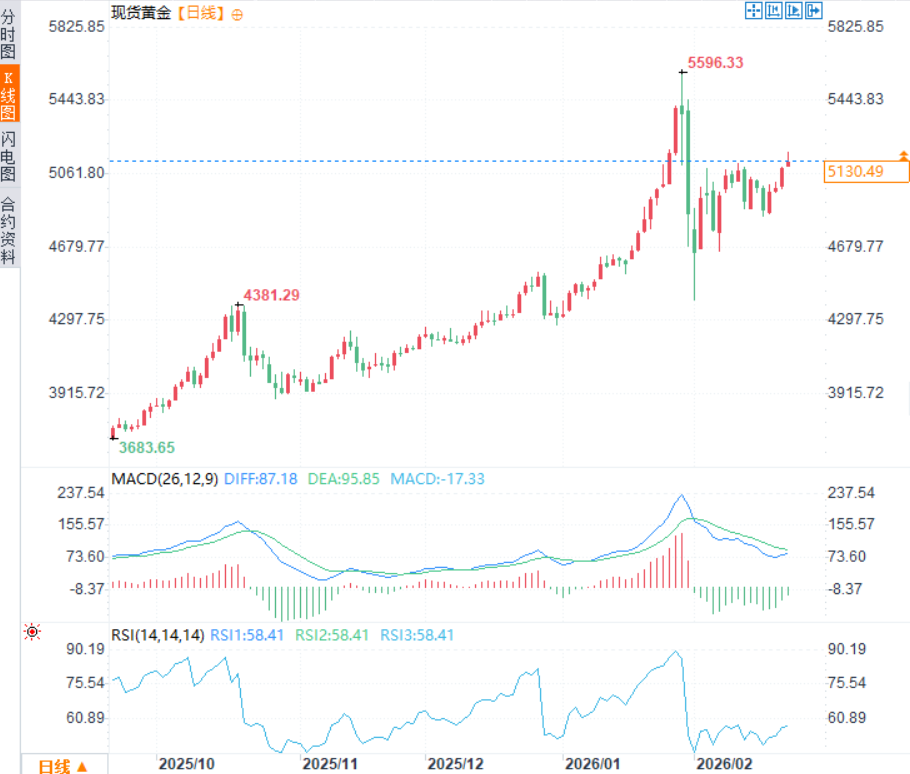
(Spot gold daily chart, source: FX678)
At 15:43 Beijing time, spot gold was trading at $5135.97 per ounce.
Experts point out that although consumer spending is still growing, residents are relying on credit cards and "buy now, pay later" lending tools to make ends meet, leading to a significant increase in bankruptcy inquiries. Since the bankruptcy index typically leads actual filings by 2-3 quarters, the wave of bankruptcies in the US may intensify further in the first half of 2026. Against this backdrop, the slow burn of debt beneath the surface of consumer resilience is strengthening market demand for safe-haven assets, providing structural support for assets such as gold.
On Monday (February 23), spot gold fluctuated upwards during the European session, continuing the gains of the previous three trading days, and is currently trading around $5,135 per ounce, with a daily increase of about 0.65%.
Despite seemingly robust overall U.S. retail sales and GDP figures, the financial pressure on American consumers at the grassroots level is quietly intensifying. More and more households are relying on credit cards and alternative credit products like "buy now, pay later" to maintain their daily lives, leading to a continuous rise in credit card delinquency rates and auto loan default rates, as well as a significant increase in bankruptcy inquiries.
The LegalShield Consumer Stress Legal Index (CSLI) – compiled based on data from over 150,000 legal inquiries per month – rose 4.4% quarter-over-quarter in the fourth quarter of 2025, marking its third consecutive quarter of growth. For the full year, it climbed 10.4% compared to 2024, reaching its highest sustained level since the beginning of the pandemic. The index comprises three sub-indices: bankruptcy, foreclosure, and consumer finance. The consumer finance sub-index surged 16.3% since the beginning of 2025, reflecting a sharp increase in legal assistance related to bill disputes, debt collection, and debt negotiations.
Matt Layton, senior vice president of consumer analytics at LegalShield, points out that traditional consumer spending metrics are no longer a comprehensive reflection of the health of the economy. He states, "We've been tracking consumer spending, but is it still a positive sign? I'm increasingly skeptical." Despite continued quarterly spending growth, record high revolving credit balances and monthly increases in credit card and auto loan delinquency rates indicate that Americans are gradually falling into deeper financial distress.
Household debt and default pressure both rise.
The latest data from the Federal Reserve Bank of New York shows that by the end of the fourth quarter of 2025, total U.S. household debt will rise to $18.8 trillion, an increase of $191 billion from the previous quarter, with a cumulative increase of approximately $740 billion for the year. The increase in non-housing debt is particularly pronounced, with credit card balances surging by $44 billion to $1.28 trillion, and auto loan and student loan balances also rising accordingly.
The overall debt delinquency rate rose to 4.8%, a significant deterioration compared to the same period last year. Average credit card interest rates remained high at 21%-22%, further amplifying repayment pressure. Layton emphasized that unprecedented ease of access to credit, especially products like "buy now, pay later" and payday loans, has led many families to rely on borrowing to "make ends meet," regardless of their income levels.
Bankruptcy warning signs are strong, and leading indicators point to continued pressure in the first half of 2026.
The LegalShield Bankruptcy Sub-Index surged 19.9% in the second half of 2025, a 15.6% increase year-over-year. The company's data shows that its bankruptcy index has a correlation coefficient of 0.95 with actual bankruptcy filings in U.S. federal courts, leading by 2-3 quarters. Court bankruptcy filings in the fourth quarter of 2025 had already increased by 13% year-over-year, confirming early warning signs.
Legal consultations related to foreclosures have increased by 15% year-on-year. Although there has not yet been a large-scale housing market collapse, high insurance, property taxes and escrow fees are putting pressure on fixed-rate mortgage holders.
Layton anticipates that the pressure will be difficult to alleviate significantly in the next 3-4 months. "This is a slow-burning crisis," they say, adding that while tax refunds during the tax season may offer a short-term respite, they are unlikely to reverse the overall trend. Consumers are trying their best to "hang in there," but pressure continues to accumulate slowly across multiple sectors.
Implications for Gold and Major Asset Classes
Against the backdrop of global geopolitical uncertainty, geopolitical risks, and monetary policy uncertainty, the "slowly deteriorating" financial situation of US consumers has further strengthened their demand for safe-haven assets. Although US consumption data superficially supports the "no recession" narrative, underlying debt pressures and a potential wave of bankruptcies could translate into a more significant economic drag in the first half of 2026.
As a traditional safe-haven asset, gold's downside potential is limited in this environment. Current gold prices have broken through key resistance levels, and institutions predict that the average price in 2026 could approach the $4700-$5000/ounce range, or even higher. Given the expectation of a Fed rate cut, geopolitical risk premiums, and continued central bank gold purchases, gold still has structural support.
Investors should be wary: a slow-burning debt crisis hidden beneath the surface of resilient consumption may gradually become apparent in the coming quarters, posing a threat to risky assets. In this environment, gold's investment value is highlighted, and the time is not yet ripe for shorting.
(Spot gold daily chart, source: FX678)
At 15:43 Beijing time, spot gold was trading at $5135.97 per ounce.
- Risk Warning and Disclaimer
- The market involves risk, and trading may not be suitable for all investors. This article is for reference only and does not constitute personal investment advice, nor does it take into account certain users’ specific investment objectives, financial situation, or other needs. Any investment decisions made based on this information are at your own risk.