The dollar plunged, and Trump's swift retaliation triggered a global trade backlash.
2026-02-23 17:25:47
On Monday (February 23), during the Asian and European sessions, the US dollar index continued its downward trend from last Friday, experiencing a slight rebound after hitting a low. It is currently trading at 97.52, down 2.8%.
Financial markets experienced increased volatility at the start of the week, with investors pricing in the latest developments in US trade policy and geopolitics. In the absence of major economic data, Monday's market logic revolved around these two issues, with the US dollar index being one of the most directly affected assets.
Last Friday, the U.S. Supreme Court issued a landmark ruling, deciding 6-3 that the Trump administration's global tariffs imposed under the International Emergency Economic Powers Act (IEEPA) lacked legal authorization. This ruling directly undermined the legitimacy of the Trump administration's tariff policies and cut off the president's core path of bypassing Congress to impose tariffs under the guise of a national emergency.
This ruling puts the more than $100 billion in tariffs previously imposed under IEEPA at risk of invalidation and refunds, and clearly defines the boundaries of the president's emergency powers.
Following the U.S. Supreme Court ruling, U.S. Customs and Border Protection (CBP) stated that goods entering the consumer market or being retrieved from warehouses for consumption starting February 24, Eastern Time, will no longer be subject to this tariff.
Also on the 20th, after the Supreme Court ruling was announced, Trump declared that, in accordance with Section 122 of the U.S. Trade Act of 1974, he would impose a 10% tariff on all goods imported globally for 150 days, in place of the tariffs that the Supreme Court had ruled illegal.
On the 21st, Trump posted on social media that he had announced the previous day that the "global import tariffs" on goods imported into the United States would be increased from 10% to 15%.
Trump immediately retaliated strongly, announcing within hours that he would invoke Section 122 of the new bill to impose a 10% tariff globally, which was raised to 15% just one day later. He also shifted to alternative frameworks such as Section 301 of the Trade Act of 1974 to further strengthen protectionism. This drastic policy shift directly impacted the stability of global foreign exchange and capital markets.
Looking at the deeper implications of the Supreme Court ruling, its direct economic impact is limited. In the short term, it may moderately alleviate inflationary pressures, leave room for the Federal Reserve to adjust its policies, and provide temporary benefits to risk assets. However, the tariff refund process may cause administrative chaos, and the tariff tool has not been phased out, so the subsequent game will continue.
Analysts point out that on the eve of the meeting between the Chinese and US leaders, this ruling has increased China's bargaining power. However, Trump may still use non-tariff barriers such as technology export controls to exacerbate the risks of global supply chain restructuring, supporting risk aversion in the foreign exchange market, but it may not necessarily benefit the US dollar.
The European Commission responded strongly on Sunday, explicitly rejecting any form of tariff increase, emphasizing that "an agreement is an agreement" and hinting at countermeasures; while US Trade Representative Greer released conciliatory signals, saying that he would not amend the existing trade agreement in an attempt to stabilize market expectations.
India has postponed its trade visit to Washington, and uncertainty surrounding trade policies in emerging markets has increased significantly. Some commentators have pointed out that the current situation is "one small step forward, two big steps back." The Supreme Court ruling was intended to ease trade restrictions, but government countermeasures have escalated the risk of further friction.
California Governor Gavin Newsom stated that President Trump's tariff policy was a farce, and that the Trump administration should refund the tariffs already imposed on Americans after the U.S. Supreme Court ruled that the U.S. government's massive tariff policy was illegal.
Newsom said that the U.S. GDP grew by only 1.4% last quarter, inflation rose to 3%, and employment data was the worst since 2013. He added that Trump and Treasury Secretary Bessant are "working together to destroy the U.S. economy."
Geopolitical factors are further impacting the US dollar. According to the Omani Foreign Minister, the US and Iran will hold a new round of nuclear talks in Geneva on Thursday, as the previous round of talks failed to reach an agreement due to core differences between the two sides on sanctions waivers.
The New York Times revealed that Trump is considering a precision strike against Iran in the short term, and if negotiations break down, a larger-scale military operation cannot be ruled out this year. Geopolitical risks and tariff volatility will create dual market disturbances.
The recent sharp drop in US GDP growth compared to expectations, coupled with the US Supreme Court's ruling that Trump's tariffs lacked legal basis, both point to a bleak outlook for the US government's debt repayment ability. This also reflects recent market concerns about a US debt crisis.
Although Trump subsequently imposed additional tariffs, the deadline was only 150 days.
However, the market expects Trump will not give up so easily, and there are many other options for imposing tariffs, so the dollar index rebounded after hitting a low.
In addition, the global market will also focus on Nvidia's earnings report on Wednesday this week. The AI industry is currently in a phase of valuation correction and capital reallocation, and its earnings report and management statements will affect the valuation of the technology sector and the distribution of dollar liquidity, indirectly affecting the trend of the dollar index.
From a technical perspective, the US dollar index attempted to challenge the 97.86 support/resistance level twice this month, but ultimately failed to break through. Currently, the resistance levels are at this price level and the upper boundary of the trading range at 97.61.
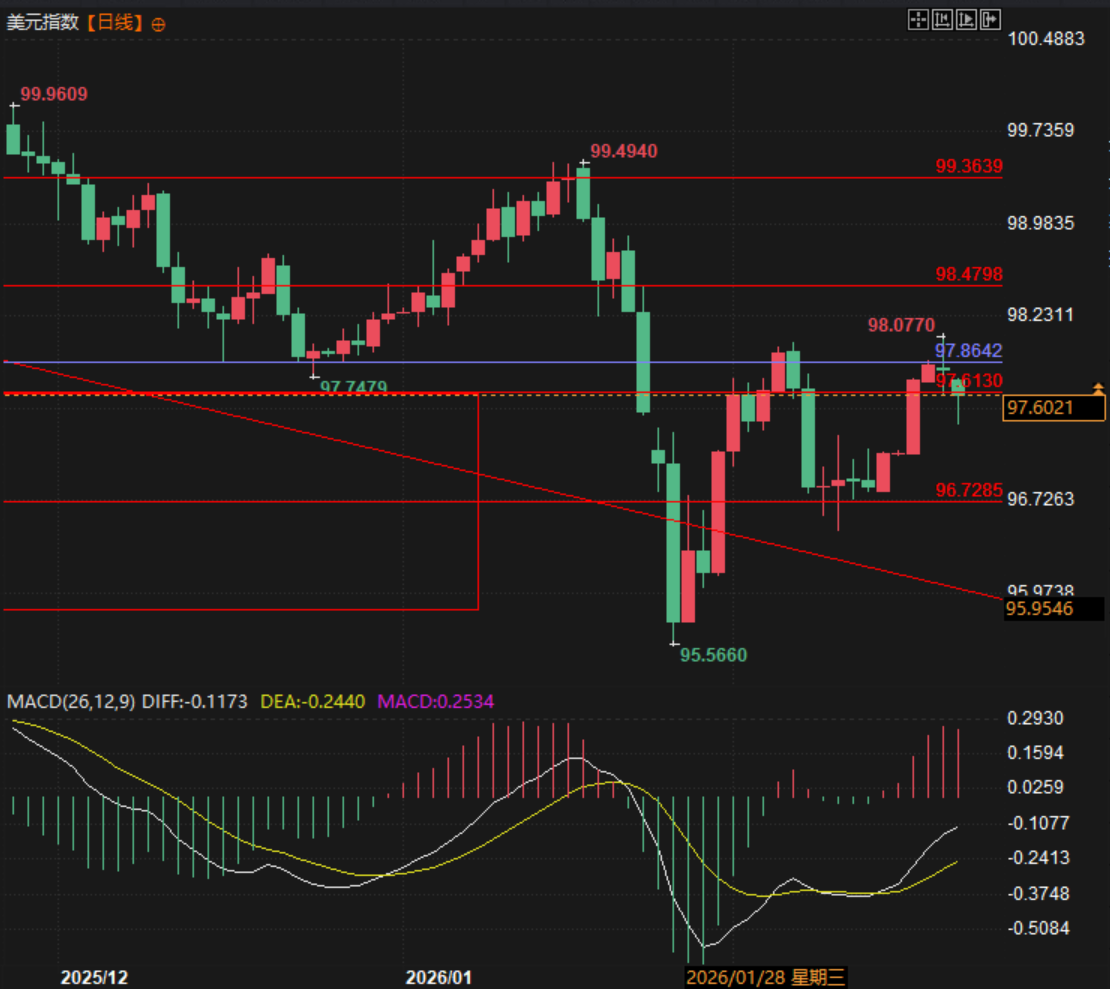
(US Dollar Index Daily Chart, Source: FX678)
At 17:23 Beijing time, the US dollar index is currently at 97.58.
Financial markets experienced increased volatility at the start of the week, with investors pricing in the latest developments in US trade policy and geopolitics. In the absence of major economic data, Monday's market logic revolved around these two issues, with the US dollar index being one of the most directly affected assets.
Supreme Court ruling: Tariff legality severely damaged, policy shifts to more aggressive stance.
Last Friday, the U.S. Supreme Court issued a landmark ruling, deciding 6-3 that the Trump administration's global tariffs imposed under the International Emergency Economic Powers Act (IEEPA) lacked legal authorization. This ruling directly undermined the legitimacy of the Trump administration's tariff policies and cut off the president's core path of bypassing Congress to impose tariffs under the guise of a national emergency.
This ruling puts the more than $100 billion in tariffs previously imposed under IEEPA at risk of invalidation and refunds, and clearly defines the boundaries of the president's emergency powers.
Following the U.S. Supreme Court ruling, U.S. Customs and Border Protection (CBP) stated that goods entering the consumer market or being retrieved from warehouses for consumption starting February 24, Eastern Time, will no longer be subject to this tariff.
Also on the 20th, after the Supreme Court ruling was announced, Trump declared that, in accordance with Section 122 of the U.S. Trade Act of 1974, he would impose a 10% tariff on all goods imported globally for 150 days, in place of the tariffs that the Supreme Court had ruled illegal.
On the 21st, Trump posted on social media that he had announced the previous day that the "global import tariffs" on goods imported into the United States would be increased from 10% to 15%.
Trump immediately retaliated strongly, announcing within hours that he would invoke Section 122 of the new bill to impose a 10% tariff globally, which was raised to 15% just one day later. He also shifted to alternative frameworks such as Section 301 of the Trade Act of 1974 to further strengthen protectionism. This drastic policy shift directly impacted the stability of global foreign exchange and capital markets.
Global responses: Trade friction risks escalate again
Looking at the deeper implications of the Supreme Court ruling, its direct economic impact is limited. In the short term, it may moderately alleviate inflationary pressures, leave room for the Federal Reserve to adjust its policies, and provide temporary benefits to risk assets. However, the tariff refund process may cause administrative chaos, and the tariff tool has not been phased out, so the subsequent game will continue.
Analysts point out that on the eve of the meeting between the Chinese and US leaders, this ruling has increased China's bargaining power. However, Trump may still use non-tariff barriers such as technology export controls to exacerbate the risks of global supply chain restructuring, supporting risk aversion in the foreign exchange market, but it may not necessarily benefit the US dollar.
The European Commission responded strongly on Sunday, explicitly rejecting any form of tariff increase, emphasizing that "an agreement is an agreement" and hinting at countermeasures; while US Trade Representative Greer released conciliatory signals, saying that he would not amend the existing trade agreement in an attempt to stabilize market expectations.
India has postponed its trade visit to Washington, and uncertainty surrounding trade policies in emerging markets has increased significantly. Some commentators have pointed out that the current situation is "one small step forward, two big steps back." The Supreme Court ruling was intended to ease trade restrictions, but government countermeasures have escalated the risk of further friction.
California Governor Gavin Newsom stated that President Trump's tariff policy was a farce, and that the Trump administration should refund the tariffs already imposed on Americans after the U.S. Supreme Court ruled that the U.S. government's massive tariff policy was illegal.
Newsom said that the U.S. GDP grew by only 1.4% last quarter, inflation rose to 3%, and employment data was the worst since 2013. He added that Trump and Treasury Secretary Bessant are "working together to destroy the U.S. economy."
Geopolitical risks compounded: the Iran nuclear negotiations and military expectations create dual disturbances.
Geopolitical factors are further impacting the US dollar. According to the Omani Foreign Minister, the US and Iran will hold a new round of nuclear talks in Geneva on Thursday, as the previous round of talks failed to reach an agreement due to core differences between the two sides on sanctions waivers.
The New York Times revealed that Trump is considering a precision strike against Iran in the short term, and if negotiations break down, a larger-scale military operation cannot be ruled out this year. Geopolitical risks and tariff volatility will create dual market disturbances.
Summary and Technical Analysis:
The recent sharp drop in US GDP growth compared to expectations, coupled with the US Supreme Court's ruling that Trump's tariffs lacked legal basis, both point to a bleak outlook for the US government's debt repayment ability. This also reflects recent market concerns about a US debt crisis.
Although Trump subsequently imposed additional tariffs, the deadline was only 150 days.
However, the market expects Trump will not give up so easily, and there are many other options for imposing tariffs, so the dollar index rebounded after hitting a low.
In addition, the global market will also focus on Nvidia's earnings report on Wednesday this week. The AI industry is currently in a phase of valuation correction and capital reallocation, and its earnings report and management statements will affect the valuation of the technology sector and the distribution of dollar liquidity, indirectly affecting the trend of the dollar index.
From a technical perspective, the US dollar index attempted to challenge the 97.86 support/resistance level twice this month, but ultimately failed to break through. Currently, the resistance levels are at this price level and the upper boundary of the trading range at 97.61.
(US Dollar Index Daily Chart, Source: FX678)
At 17:23 Beijing time, the US dollar index is currently at 97.58.
- Risk Warning and Disclaimer
- The market involves risk, and trading may not be suitable for all investors. This article is for reference only and does not constitute personal investment advice, nor does it take into account certain users’ specific investment objectives, financial situation, or other needs. Any investment decisions made based on this information are at your own risk.