Rising global trade concerns weighed on the euro, with EUR/GBP falling back to 0.8730 pending guidance from Eurozone data.
2026-02-24 15:48:26
The EUR/GBP pair fell in European trading on Tuesday, dropping to around 0.8730. Global trade tensions once again became the focus of market attention, and the euro underperformed against the pound.
After the U.S. Supreme Court ruled some tariff measures invalid, President Trump said he would implement a new 15% uniform tariff policy and warned other countries not to deviate from trade agreements reached with the United States.

As a result, the European Parliament decided to postpone the vote on the EU-US trade agreement. Rising trade concerns have fueled market anxieties about the Eurozone's export prospects. In contrast, the Eurozone's economic structure is more sensitive to external demand, thus the euro faces additional pressure amid rising trade uncertainty.
The market will be closely watching the upcoming German GDP and Eurozone inflation data to determine whether the European Central Bank will adjust its policy stance. Meanwhile, the pound also faces internal easing pressures. Bank of England Monetary Policy Committee member Taylor stated that the UK economic growth outlook faces downside risks, inflation is expected to return to the 2% target, and he supports further interest rate cuts in the near term.
He pointed out that the risks are shifting towards "lower inflation and higher unemployment," suggesting that two or three more interest rate cuts may be needed in the future. Therefore, the current EUR/GBP exchange rate movement exhibits characteristics of a two-way game of easing expectations: the euro is dragged down by trade concerns, while the pound is suppressed by internal expectations of interest rate cuts.
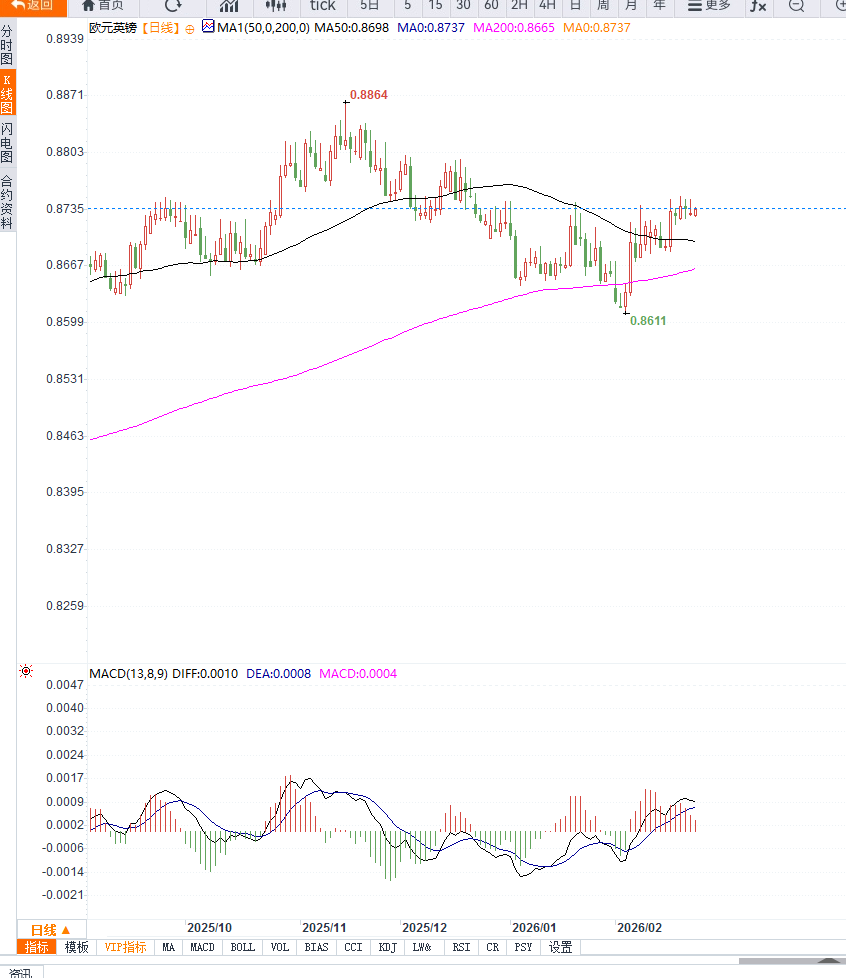
From a daily chart perspective, EUR/GBP is currently in a weak, consolidating pattern. The price has recently retreated from its recent high and is currently trading around the 0.8730 area. The exchange rate is still hovering near short-term moving averages, indicating that the trend is not yet fully established, but downward momentum slightly dominates.
Regarding the moving average system, short-term moving averages are beginning to flatten, while medium- and long-term moving averages have not yet formed a clear bullish or bearish alignment, reflecting a lack of a unidirectional trend in the market. If the price breaks below the recent low, it may further test lower support areas; if it regains its footing above the short-term moving averages, it may enter a consolidation and correction phase.
In terms of momentum indicators, the RSI is running in the neutral to weak zone and has not entered an extremely oversold state; the MACD momentum bars have expanded slightly but have not yet formed a trend divergence, indicating that the bearish force is limited.
The current key price range is between 0.8680 and 0.8800, with 0.8680 forming an important support area below and 0.8800 being a major resistance area above. If it falls below 0.8680, the downward trend may continue, while if it breaks through 0.8800, the short-term structure may turn bullish.
Overall, the technical picture shows a weak, range-bound trading pattern, and a directional breakout will require macroeconomic data to drive it.
Editor's Note:
The current EUR/GBP exchange rate essentially reflects the intertwined effects of external trade concerns and internal expectations of policy easing. The Eurozone is more sensitive to the global trade environment and therefore faces greater pressure when tariff policy uncertainty rises; while the weakening UK economic fundamentals limit the pound's upside potential.
The future trend hinges on Eurozone economic data and the Bank of England's policy communication. Weak Eurozone economic data could put continued downward pressure on the exchange rate; conversely, stronger expectations of a UK interest rate cut could weaken the pound, providing support for EUR/GBP. In the short term, a range-bound trading pattern is more likely.
After the U.S. Supreme Court ruled some tariff measures invalid, President Trump said he would implement a new 15% uniform tariff policy and warned other countries not to deviate from trade agreements reached with the United States.
As a result, the European Parliament decided to postpone the vote on the EU-US trade agreement. Rising trade concerns have fueled market anxieties about the Eurozone's export prospects. In contrast, the Eurozone's economic structure is more sensitive to external demand, thus the euro faces additional pressure amid rising trade uncertainty.
The market will be closely watching the upcoming German GDP and Eurozone inflation data to determine whether the European Central Bank will adjust its policy stance. Meanwhile, the pound also faces internal easing pressures. Bank of England Monetary Policy Committee member Taylor stated that the UK economic growth outlook faces downside risks, inflation is expected to return to the 2% target, and he supports further interest rate cuts in the near term.
He pointed out that the risks are shifting towards "lower inflation and higher unemployment," suggesting that two or three more interest rate cuts may be needed in the future. Therefore, the current EUR/GBP exchange rate movement exhibits characteristics of a two-way game of easing expectations: the euro is dragged down by trade concerns, while the pound is suppressed by internal expectations of interest rate cuts.
From a daily chart perspective, EUR/GBP is currently in a weak, consolidating pattern. The price has recently retreated from its recent high and is currently trading around the 0.8730 area. The exchange rate is still hovering near short-term moving averages, indicating that the trend is not yet fully established, but downward momentum slightly dominates.
Regarding the moving average system, short-term moving averages are beginning to flatten, while medium- and long-term moving averages have not yet formed a clear bullish or bearish alignment, reflecting a lack of a unidirectional trend in the market. If the price breaks below the recent low, it may further test lower support areas; if it regains its footing above the short-term moving averages, it may enter a consolidation and correction phase.
In terms of momentum indicators, the RSI is running in the neutral to weak zone and has not entered an extremely oversold state; the MACD momentum bars have expanded slightly but have not yet formed a trend divergence, indicating that the bearish force is limited.
The current key price range is between 0.8680 and 0.8800, with 0.8680 forming an important support area below and 0.8800 being a major resistance area above. If it falls below 0.8680, the downward trend may continue, while if it breaks through 0.8800, the short-term structure may turn bullish.
Overall, the technical picture shows a weak, range-bound trading pattern, and a directional breakout will require macroeconomic data to drive it.
Editor's Note:
The current EUR/GBP exchange rate essentially reflects the intertwined effects of external trade concerns and internal expectations of policy easing. The Eurozone is more sensitive to the global trade environment and therefore faces greater pressure when tariff policy uncertainty rises; while the weakening UK economic fundamentals limit the pound's upside potential.
The future trend hinges on Eurozone economic data and the Bank of England's policy communication. Weak Eurozone economic data could put continued downward pressure on the exchange rate; conversely, stronger expectations of a UK interest rate cut could weaken the pound, providing support for EUR/GBP. In the short term, a range-bound trading pattern is more likely.
- Risk Warning and Disclaimer
- The market involves risk, and trading may not be suitable for all investors. This article is for reference only and does not constitute personal investment advice, nor does it take into account certain users’ specific investment objectives, financial situation, or other needs. Any investment decisions made based on this information are at your own risk.