A $170 billion tax rebate: Cracks in the US fiscal books – where is gold headed?
2026-02-24 18:15:07
On Tuesday (February 24), during the Asian and European sessions, spot gold opened slightly higher and reached a new recent high. However, Asian funds chose to take profits on their long positions, causing the gold price to pull back. It is currently trading around 5172. As mentioned in yesterday's article, the market is currently in a phase of priced in the positive news.
This article summarizes the recent gold price fluctuations and the specific reasons related to tariffs, and also outlines the further impact of tariff events on US fundamentals and gold fundamentals.

The recent strong rebound in gold prices began with a sharp intraday drop at 11 PM last Friday. At 11 PM last Friday, the US Supreme Court ruled that the tariffs announced by Trump based on IEEPA were illegal. This forced the president to sign an executive order to cancel the tariffs imposed by IEEPA and to provide refunds. The market initially thought that global tariffs might ease, leading to a rapid correction in gold prices. However, this correction became the last drop before the rebound in gold prices.
In the hours that followed, as Trump invoked Section 122 of the 1974 Trade Act to impose a 10% tariff on almost all imported goods, the market realized that the tariff war was not over and that there were even more uncertainties. This led to a rebound in gold prices after a drop on Friday, with prices ultimately rising to near the close. Gold prices experienced a range of events during the day, from the illegality of the US tariffs to the announcement of the new tariff executive order.
Then, last Saturday, Trump raised tariffs to the 15% limit stipulated in Section 122 of the Trade Act. Although such tariffs can only be imposed for 150 days, this series of actions indicates that the Supreme Court's ruling cannot stop Trump's imposition of tariffs on the world, causing gold prices to continue to surge during the New York session on Monday.
The Supreme Court's ruling did not clarify whether previously collected tariffs needed to be refunded, and this legal ambiguity directly created enormous fiscal uncertainty.
According to Wharton Business School's budget model, the potential tax refunds corresponding to the repeal of tariff powers amount to as much as $170 billion to $175 billion.
Even if the final actual tax refund amount is lower than this estimate, the market is never trading on absolute certainty, but rather on expectations under probability distribution—this concern about the loss of fiscal revenue has become the core driving force for funds to flow into gold.
For the U.S. Treasury, tariff revenue has long been included in the established items of long-term fiscal projections.
If this revenue needs to be returned, the fiscal books will face a double squeeze: on the one hand, expected revenue will be revised downwards significantly, and on the other hand, potential expenditures will be passively increased.
Coupled with the weaker-than-expected US GDP figures released last Friday, which depict a further deterioration in the US government's debt repayment capacity, this puts invisible pressure on the US dollar index and is a long-term positive for gold.
As the anchor for market interest rates, the downward trend in US Treasury yields significantly reduces the cost of holding gold. At the same time, the decline in long-term interest rates is significantly slower than that of short-term rates, and the widening futures-spot premium is even more beneficial to gold.
Recently, the market has seen a phenomenon where US Treasury auctions are weak but yields are falling. The bid-to-cover ratio in the primary market for US Treasury auctions is low, but due to strong safe-haven buying triggered by a surge in geopolitical risks, US Treasury bonds in the secondary market are being snapped up, causing yields to fall sharply against the trend. This is a harbinger of impending risk.
Meanwhile, the market suspects that the Federal Reserve may have injected liquidity into the market through covert means or open market operations amid liquidity shortages.
Europe continues to increase fiscal spending, Japan is pushing for yield curve normalization, emerging markets are under pressure from high external financing costs, and the global supply of sovereign debt is already saturated.
Against this backdrop, even the mere market expectation of tax refund liabilities would make the U.S. Treasury’s financing path exceptionally complex: the supply of Treasury bonds would be forced to increase, coupon costs would rise accordingly, and term premiums would continue to widen.
The core of bond market trading has never been political intentions, but rather the matching of supply and market absorption capacity. When yields strengthen due to fiscal risks rather than economic growth, their rise itself implies irrationality, and this is precisely the key moment for gold to explode.
The strength of gold has never relied solely on recession expectations, but rather on its effective hedging against policy uncertainty.
There is a key logical distinction here: if yields rise due to a strong economic recovery, the US dollar will usually strengthen in tandem, while gold will come under pressure.
However, if yields rise due to damage to fiscal credibility and increased supply risks, the dollar's trajectory will become ambiguous. At this point, gold will become the core asset for hedging policy disorder. The key point to watch is whether US Treasury bonds rebound while the dollar does not.
More noteworthy is that Article 122 of the Trade Act sets a 150-day temporary implementation period for the new additional tariffs. This temporary policy tool has precisely created persistent policy uncertainty.
The market today not only prices the level of tariffs themselves, but also anticipates the legal stability of tariffs and the fiscal impact of any policy changes. This multi-layered uncertainty further enhances the investment value of gold.
Legal uncertainty surrounding tariffs directly translates into uncertainty regarding fiscal revenue. This uncertainty in fiscal revenue further triggers fluctuations in government financing. These fluctuations in government financing increase the upside risk of term premiums. The spread of term premium risk undermines market confidence in fiscal policy. Ultimately, this undermining of fiscal confidence directly translates into a rise in gold prices.
While safe-haven inflows and a weakening dollar certainly boosted gold prices, these were not the only key drivers.
In the current global landscape of high debt, the core of gold trading has shifted from conventional concerns about trade growth to deep-seated doubts about the stability of the US fiscal balance sheet.
When the US fiscal balance sheet, which is the core of the global economy, falters, investors will naturally turn to gold, the ultimate safe-haven asset that is not based on the balance sheet of any entity.
The market is playing out amid a global debt crisis and a slowdown in global growth coupled with rising debt pressure. The overall environment is favorable for gold. However, the geopolitical game between the United States and Iran, the US's imposition of tariffs on the world, and the Federal Reserve's decisions are important turning points.
Specifically, there is uncertainty surrounding the Federal Reserve's policies: markets are concerned that it may lose its monetary policy independence under pressure from the White House; geopolitical premium: markets are cautious about the prospect of restarting negotiations between the US and Iran; and scarcity of safe-haven assets: global markets' confidence in the sovereign debt of developed economies continues to decline.
From a technical perspective, spot gold broke through the 5125 bull-bear dividing line, and then encountered resistance at the upper rail of the ascending channel before pulling back. Currently, it can be considered a pullback after the breakout, with support around 5100, which is the 5-day moving average and the middle rail of the ascending channel.
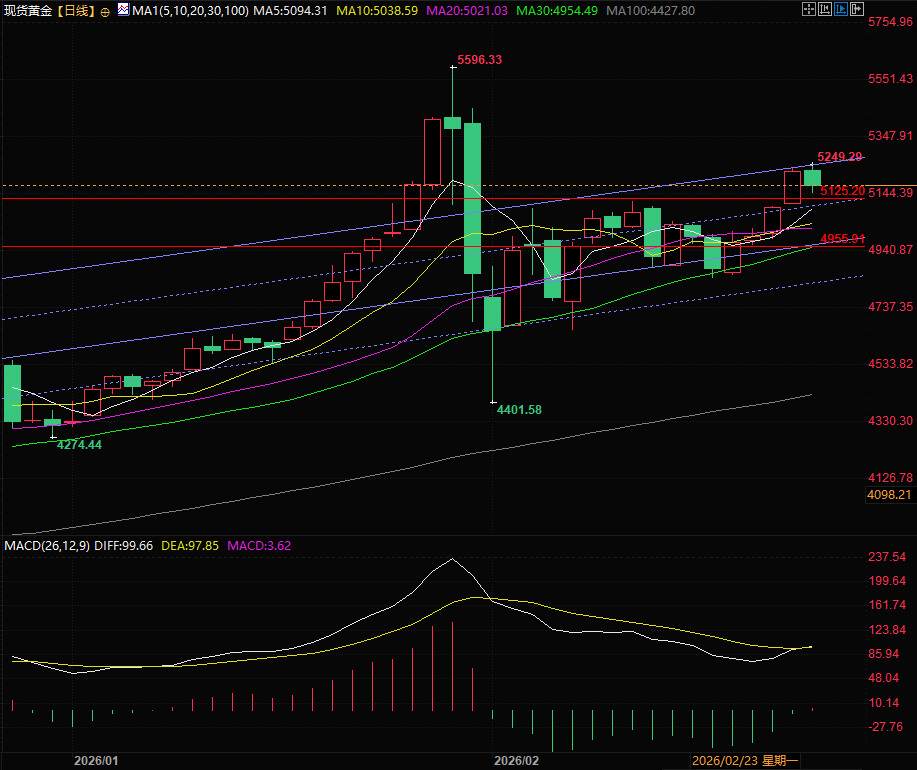
(Spot gold daily chart, source: FX678)
At 18:11 Beijing time, spot gold was trading at $5,173 per ounce.
This article summarizes the recent gold price fluctuations and the specific reasons related to tariffs, and also outlines the further impact of tariff events on US fundamentals and gold fundamentals.
Recent gold price fluctuations:
The recent strong rebound in gold prices began with a sharp intraday drop at 11 PM last Friday. At 11 PM last Friday, the US Supreme Court ruled that the tariffs announced by Trump based on IEEPA were illegal. This forced the president to sign an executive order to cancel the tariffs imposed by IEEPA and to provide refunds. The market initially thought that global tariffs might ease, leading to a rapid correction in gold prices. However, this correction became the last drop before the rebound in gold prices.
In the hours that followed, as Trump invoked Section 122 of the 1974 Trade Act to impose a 10% tariff on almost all imported goods, the market realized that the tariff war was not over and that there were even more uncertainties. This led to a rebound in gold prices after a drop on Friday, with prices ultimately rising to near the close. Gold prices experienced a range of events during the day, from the illegality of the US tariffs to the announcement of the new tariff executive order.
Then, last Saturday, Trump raised tariffs to the 15% limit stipulated in Section 122 of the Trade Act. Although such tariffs can only be imposed for 150 days, this series of actions indicates that the Supreme Court's ruling cannot stop Trump's imposition of tariffs on the world, causing gold prices to continue to surge during the New York session on Monday.
Hidden Concerns Over Tariff Rulings: Billions in Tax Refunds Trigger Shocks to Fiscal Balances
The Supreme Court's ruling did not clarify whether previously collected tariffs needed to be refunded, and this legal ambiguity directly created enormous fiscal uncertainty.
According to Wharton Business School's budget model, the potential tax refunds corresponding to the repeal of tariff powers amount to as much as $170 billion to $175 billion.
Even if the final actual tax refund amount is lower than this estimate, the market is never trading on absolute certainty, but rather on expectations under probability distribution—this concern about the loss of fiscal revenue has become the core driving force for funds to flow into gold.
For the U.S. Treasury, tariff revenue has long been included in the established items of long-term fiscal projections.
If this revenue needs to be returned, the fiscal books will face a double squeeze: on the one hand, expected revenue will be revised downwards significantly, and on the other hand, potential expenditures will be passively increased.
Coupled with the weaker-than-expected US GDP figures released last Friday, which depict a further deterioration in the US government's debt repayment capacity, this puts invisible pressure on the US dollar index and is a long-term positive for gold.
The decline in US Treasury yields, coupled with the widening futures-spot premium, is favorable for gold.
As the anchor for market interest rates, the downward trend in US Treasury yields significantly reduces the cost of holding gold. At the same time, the decline in long-term interest rates is significantly slower than that of short-term rates, and the widening futures-spot premium is even more beneficial to gold.
Recently, the market has seen a phenomenon where US Treasury auctions are weak but yields are falling. The bid-to-cover ratio in the primary market for US Treasury auctions is low, but due to strong safe-haven buying triggered by a surge in geopolitical risks, US Treasury bonds in the secondary market are being snapped up, causing yields to fall sharply against the trend. This is a harbinger of impending risk.
Meanwhile, the market suspects that the Federal Reserve may have injected liquidity into the market through covert means or open market operations amid liquidity shortages.
Europe continues to increase fiscal spending, Japan is pushing for yield curve normalization, emerging markets are under pressure from high external financing costs, and the global supply of sovereign debt is already saturated.
Against this backdrop, even the mere market expectation of tax refund liabilities would make the U.S. Treasury’s financing path exceptionally complex: the supply of Treasury bonds would be forced to increase, coupon costs would rise accordingly, and term premiums would continue to widen.
The core of bond market trading has never been political intentions, but rather the matching of supply and market absorption capacity. When yields strengthen due to fiscal risks rather than economic growth, their rise itself implies irrationality, and this is precisely the key moment for gold to explode.
The key logic behind gold's strength: hedging against fiscal disorder rather than recession expectations.
The strength of gold has never relied solely on recession expectations, but rather on its effective hedging against policy uncertainty.
There is a key logical distinction here: if yields rise due to a strong economic recovery, the US dollar will usually strengthen in tandem, while gold will come under pressure.
However, if yields rise due to damage to fiscal credibility and increased supply risks, the dollar's trajectory will become ambiguous. At this point, gold will become the core asset for hedging policy disorder. The key point to watch is whether US Treasury bonds rebound while the dollar does not.
More noteworthy is that Article 122 of the Trade Act sets a 150-day temporary implementation period for the new additional tariffs. This temporary policy tool has precisely created persistent policy uncertainty.
The market today not only prices the level of tariffs themselves, but also anticipates the legal stability of tariffs and the fiscal impact of any policy changes. This multi-layered uncertainty further enhances the investment value of gold.
A clear transmission chain: the closed loop from policy uncertainty to rising gold prices.
Legal uncertainty surrounding tariffs directly translates into uncertainty regarding fiscal revenue. This uncertainty in fiscal revenue further triggers fluctuations in government financing. These fluctuations in government financing increase the upside risk of term premiums. The spread of term premium risk undermines market confidence in fiscal policy. Ultimately, this undermining of fiscal confidence directly translates into a rise in gold prices.
While safe-haven inflows and a weakening dollar certainly boosted gold prices, these were not the only key drivers.
In the current global landscape of high debt, the core of gold trading has shifted from conventional concerns about trade growth to deep-seated doubts about the stability of the US fiscal balance sheet.
When the US fiscal balance sheet, which is the core of the global economy, falters, investors will naturally turn to gold, the ultimate safe-haven asset that is not based on the balance sheet of any entity.
Summary and Technical Analysis:
The market is playing out amid a global debt crisis and a slowdown in global growth coupled with rising debt pressure. The overall environment is favorable for gold. However, the geopolitical game between the United States and Iran, the US's imposition of tariffs on the world, and the Federal Reserve's decisions are important turning points.
Specifically, there is uncertainty surrounding the Federal Reserve's policies: markets are concerned that it may lose its monetary policy independence under pressure from the White House; geopolitical premium: markets are cautious about the prospect of restarting negotiations between the US and Iran; and scarcity of safe-haven assets: global markets' confidence in the sovereign debt of developed economies continues to decline.
From a technical perspective, spot gold broke through the 5125 bull-bear dividing line, and then encountered resistance at the upper rail of the ascending channel before pulling back. Currently, it can be considered a pullback after the breakout, with support around 5100, which is the 5-day moving average and the middle rail of the ascending channel.
(Spot gold daily chart, source: FX678)
At 18:11 Beijing time, spot gold was trading at $5,173 per ounce.
- Risk Warning and Disclaimer
- The market involves risk, and trading may not be suitable for all investors. This article is for reference only and does not constitute personal investment advice, nor does it take into account certain users’ specific investment objectives, financial situation, or other needs. Any investment decisions made based on this information are at your own risk.